If you ever think English is not a weird language just remember that read and lead rhyme and read and lead rhyme.
But read and lead don't rhyme, and neither do read and lead.
Underrated life advice: Make yourself easy to root for. Be kind. Be reliable. Celebrate other people’s wins. Work hard without complaining. Carry good energy into rooms. You'll be shocked by how many doors open for you by making life better for others.
Time to lock in this week:
1. Go to bed by 9:30pm
2. Read 15 minutes before bed
3. Charge your phone in another room
4. Wake up 5-5:15 am
5. Workout 4x
6. Daily devotion time 30 min
7. Plan you next date with the wife
8. Pray for kids and wife daily
9. Refuse to complain
10. Refuse to talk bad about others
11. Go to church Sunday
12. Invest in $SPY
13. Pay $25 off extra on a debt
14. Look over your budget with spouse
15. Praise God through it all
Bookmark this. Focus daily.
Greatness ahead.
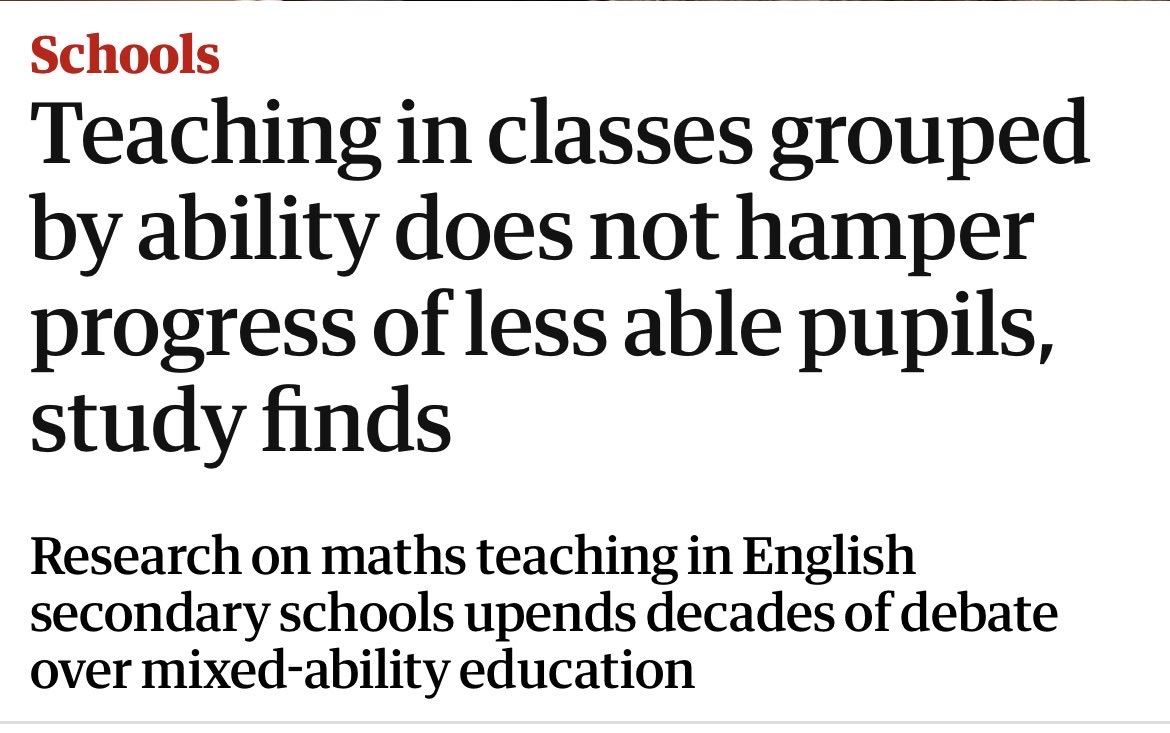
Turns out grouping kids by ability isn’t “symbolic violence”:
“Teaching pupils in classes grouped by ability improves the results of high-flyers but does not affect the progress of less able children”
The best “energy drink” is 3L of water.
The best “focus drug” is 8 hours of sleep.
The best “reset” is a day without screens.
The best “therapy” is time spent with loved ones.
The best “antidepressant” is 45 minutes of exercise.
Dear son, don't let anyone tell you otherwise.
A MIT professor gave a 1-hour lecture in 2019 that has 18 million views.
He died 5 months after recording it.
It was his final gift to the world.
Patrick Winston taught at MIT for 50 years.
The smartest engineers on earth sat in his classroom.
And he spent his last lecture teaching them the one skill their degrees never covered.
How to speak.
15 lessons that will change how you communicate forever:
Never open with a joke. Your audience is not ready to laugh yet. Open with a promise of what they will know by the end.
Your ideas are like your children. You are too close to them. What is obvious to you is invisible to everyone else. Explain the obvious.
The 5-minute rule: the first 5 minutes of any talk determine whether people will listen for the next 55. Spend more time on your opening than anything else.
Repeat your most important idea 3 times in 3 different ways. Once is never enough.
Build a fence around your idea. Tell people what it is NOT before you tell them what it IS.
Verbal punctuation. Pause. Let the idea land before moving to the next one.
Ask questions nobody will answer. Then wait 7 seconds. The silence is not awkward. It is processing.
Never read your slides. Your audience can read. They cannot listen and read simultaneously.
Use the board not the slides. Writing forces you to slow down. Slowing down forces clarity.
Inspire before you inform. Nobody learns from someone they are not inspired by.
End with a contribution not a summary. Tell them what you gave them. Not what you said.
Never say thank you at the end. It is weak. End with something that lands.
Stories make ideas stick. Data makes ideas understood. You need both. In that order.
The quality of your communication determines the quality of your ideas in the eyes of the world. Not the ideas themselves.
Practice is not preparation. Practice IS the skill.
Patrick Winston understood something most people spend their entire careers missing.
Your ideas are only as powerful as your ability to transfer them into someone else's mind.
You can be the smartest person in the room and be completely invisible.
Or you can master communication and make average ideas feel like breakthroughs.
He chose to spend his last lecture teaching this.
Watch it tonight.
Bookmark this first.
Follow @cyrilXBT for more lessons from the people who built the future.
Things to teach your kids from today;
- Chess
- First aid
- Resilience
- Astronomy
- Persuasion
- Adaptability
- Self-respect
- Self-defence
- Cooking skills
- Assertiveness
- Managing time
- A good attitude
- Public speaking
- Problem solving
- Self-awareness
- Gardening skills
- How to volunteer
- How to negotiate
- Living off the land
- Basic home repair
- Starting a business
- Money management
- Good communication
- Don’t watch the news
- Emotional intelligence
- How to manage stress
- Basic car maintenance
- How to make a decision
- How to influence people
- How to be a great mother
- It’s okay to feel your emotions
- Mental frameworks for thinking
- Understanding healthy relationships
- Building others up, not tearing them down
- Problem-solving over memorization
- Exploration over conformity
- Creativity over rote learning
- The value of hard work.
- How to be kind to everyone.
- Why failure is the path to success.
- How to think, not what to think.
- How to adapt, not conform.
- How to lead, not follow.
- How to create, not consume.
- Taking care of animals.
- Good use of language.
- Opposite sex relationships.
- Healhy food choices.
- Music, listening and performing.
- General culture.
- Foreign languages.
- Leadership.
- Stoicism.
- Fasting.
- Sports.
- Video games.
- Spirituality.
- Travelling.
- Copywriting.
- Drawing.
- Self love.
What would you add?
If 90% of your diet is:
• Greek Yogurt
• Avocados
• Potatoes
• Chicken
• Veggies
• Berries
• Water
• Steak
• Eggs
• Fruit
• Fish
You will lose fat, gain muscle & have 10X more energy.
I've been married 15 years. Still married because we treat these like law:
• Bed is for sleep and sex only
• No phones in bedroom
• Kids asleep? We talk. 5 mins or 3 hours. Doesn't matter. We talk
• Pray together before sleep
• We eat every meal together
• No screens when eating
• And we never, and I mean NEVER criticize each other in public
Your marriage is your son's blueprint, and your daughter's standard.
Make sure you lead at the front and everyone will follow.
A friend of mine used to say: “Show up on time, with a good attitude, and do what you said you’d do. That’s it. That’s 90% of winning in life." The older I get, the more I realize just how right he was.
A community college professor taught the same study skills lecture for 30 years, and the video quietly became one of the most watched educational recordings on the internet.
His name is Marty Lobdell. He spent his career as a psychology professor watching students fail not because they were lazy, but because nobody had ever taught them how their brain actually works under the pressure of learning something hard.
The lecture is called "Study Less Study Smart." Over 10 million views. Passed around in Reddit threads, Discord servers, and university study groups for over a decade. And the core insight buried inside it has been sitting in cognitive psychology research for years, waiting for someone to explain it in plain language.
Here is the framework that completely changed how I think about effort.
Your brain does not sustain focus the way you think it does. Studies tracking real students found that the average learner hits a wall somewhere between 25 and 30 minutes.
After that, efficiency doesn't just decline. It collapses. You're still sitting at your desk, still looking at the page, but almost nothing is going in.
Lobdell illustrated this with a student he knew personally. She set a goal of studying 6 hours a night, 5 nights a week, to pull herself out of academic probation. Thirty hours of studying per week. She failed every single class that quarter.
She wasn't failing because she lacked effort. She was failing because she had confused time spent near books with time spent actually learning. The 25-minute crash hit her at 6:30pm every night. She spent the next five and a half hours sitting in the wreckage of her own focus and calling it studying.
The fix sounds almost too simple. The moment you feel the slide, stop. Take five minutes. Do something that actually gives you a small reward. Then go back. That five-minute reset returns you to near full efficiency. Across a six-hour window, the difference is not marginal. It is the difference between thirty minutes of real learning and five and a half hours of it.
The second thing he taught destroyed something I had believed about how memory actually works.
Highlighting feels productive. Going back over your notes and recognizing everything feels like knowing. But recognition and recollection are two completely different cognitive processes, and your brain is very good at making you confuse them.
You can see something you've read before and feel completely certain you understand it, even when you couldn't reconstruct a single sentence from memory if the page were blank.
He proved this live in the room. He read 13 random letters to his audience. Almost nobody could recall them. Then he rearranged the same 13 letters into two words: Happy Thursday. The whole room got all 13 without effort.
Same letters. Same count. The only thing that changed was meaning.
The brain stores meaning. Not repetition. The moment new information connects to something you already understand, the retention changes entirely.
This is what the cognitive psychology literature calls elaborative encoding, and it is the mechanism underneath every effective study technique.
The third principle was the one that hit me hardest, and the one almost nobody applies.
Lobdell cited research showing that 80 percent of your study time should be spent in active recitation, not passive reading. Close the material. Say it back in your own words.
Teach it to someone else, or to an empty chair if no one is around. The struggle of retrieval is where the actual learning happens. Reading your notes again is watching someone else do the work.
His parting line has stayed with me longer than almost anything else I have read about learning.
He told the room that if what he shared didn't change their behavior, they hadn't actually learned it. It would just live in their heads as something they had heard once and felt good about.
He was right. And most people leave every lecture exactly like that.
The students who remember everything aren't putting in more hours.
They stopped confusing the feeling of studying with the fact of it.
If students struggle with fraction arithmetic, algebra is inaccessible. If they struggle with basic number operations (including times tables), fractions are inaccessible. Math is hierarchical & gaps compound. There's no way around it. We have to get math right in primary.