The best cultures don’t happen by accident.
They’re built with intention.
Dan Lanning said they spent 4 months defining the DNA of their program before ever putting it on a wall.
4 traits:
Connection - because players fight harder for people they truly know.
Growth - win or lose, it's “growth week.” The standard is always improving.
Toughness - handling hard without flinching.
Sacrifice - being okay with the team winning even when you don’t get the spotlight.
That’s leadership.
Not just demanding standards…
but building an environment where people want to live them out.
🗣️ Charles Lee: "Anybody that's gonna push you loves you more than anybody that's gonna let you stay the same."
"When we coach you, when we love you up, when I talk to you about, 'Are you tired? You're taking a long time to get to your spots,' that's not me personally attacking you. That's trying to help our team be better. That's trying to help you be better, help us execute better. We have standards. We respect one another. We care about each other, okay? We're all gonna bust our asses and we're gonna be in this thing together if we're really gonna accomplish what we want to accomplish."
Dan Hurley Top Sets In Final Four Runs
- Horns Riffle Grenade Slip
- Down Punch Flip Hammer
- Spread Shuffle Grenade
- Stagger Runner Punch
- Away Get Triple Stagger
- Horns Twist Dive Exit
- Iverson Wedge Down HiLow
- Double Stagger Pop Back
- Box Cross Punch
- Cross Point Zoom
Dan Hurley on the two personas every head coach must master:
The Jockey 🏇, and the Corner Man. 🥊
In practice — you are the jockey. You push. You challenge. You demand more than they think they have. You stretch them past comfort so execution becomes inevitable.
On game night — you become the corner man. You steady. You simplify. You remind them who they are. Confidence replaces correction.
Preparation is where you build them.
Performance is where you believe in them.
I asked Tom Izzo about the viral clip of Charles Barkley defending his coaching style by saying people have gotten too soft.
Izzo: "Now we're supposed to just hug and kiss everybody... Accountability is going to be big until I leave."
Julius Peppers shares what being a Hall of Famer really means.
"It's not about how many touchdowns you scored or how many Super Bowl rings you have - even though those things are nice."
"It really comes down to who you are at your core and what's in your heart."
"Are you resilient? Do you stand tall in the face of adversity when things get tough or do you quit?"
Greatness isn't measured by stats - it's measured by character.
And then he said something everyone needs to hear:
"Everyone can't play in the NFL. And everyone can't have a bust here in Canton. But everyone can be a Hall of Famer in your own life."
"You can be a Hall of Fame dad. Hall of Fame student. Teacher. Spouse. Co-worker. Friend."
Your character is what you do.
"Whatever it is that you do - do it with respect, integrity, passion, resilience, dedication, and gratitude."
"That alone will make you a Hall of Fame person. And you too can have a legacy that lives on forever."
You don't need a gold jacket to be a Hall of Famer.
Be great where you are. That's the legacy that matters.
(🎥NFL Network)
Most freshmen don’t struggle because they’re untalented.
They struggle because everything is new.
New environment.
New system.
Away from family.
And the talent level? Just as good, if not better.
Many expect to start right away. Most don’t.
So when the struggle comes, and it will, take a lesson from Tom Brady.
Early in his career, Brady got 2 practice reps. The starter got 20. He asked his coach, “How can I get better with only two?”
The answer: “Make those two perfect.”
So he treated them like the Super Bowl. Full speed. Full focus. No wasted motion.
Two reps became four.
Four became ten.
Ten became a starting job.
What separated him wasn’t talent.
It was how he treated limited opportunities.
Most backups focus on the reps they didn’t get.
Brady treated his 2 reps like an audition.
That lesson goes beyond sports.
Not leading the project? Own your role like it runs the company.
Not in the big meeting? Make your five minutes count.
Not starting? Practice like it’s game day.
Development isn’t about where you start.
It’s about how you respond.
Opportunity doesn’t expand because you deserve it.
It expands because you make it impossible to ignore.
Question:
What are your “2 reps” right now? And are you treating them like they matter?
“That shot was made by the perfect person at the right time. He’s deserving to be remembered forever.”
@UNC_Basketball HC Hubert Davis on Seth Trimble's game winning shot to take down No. 4 Duke.
Steph Curry with a great message here about affecting the game, even when you don’t stat
“If it’s not your night stat wise, whether you play two, 10, 20 minutes, come with the right energy.”
A winner is a winner, no matter how many minutes they play
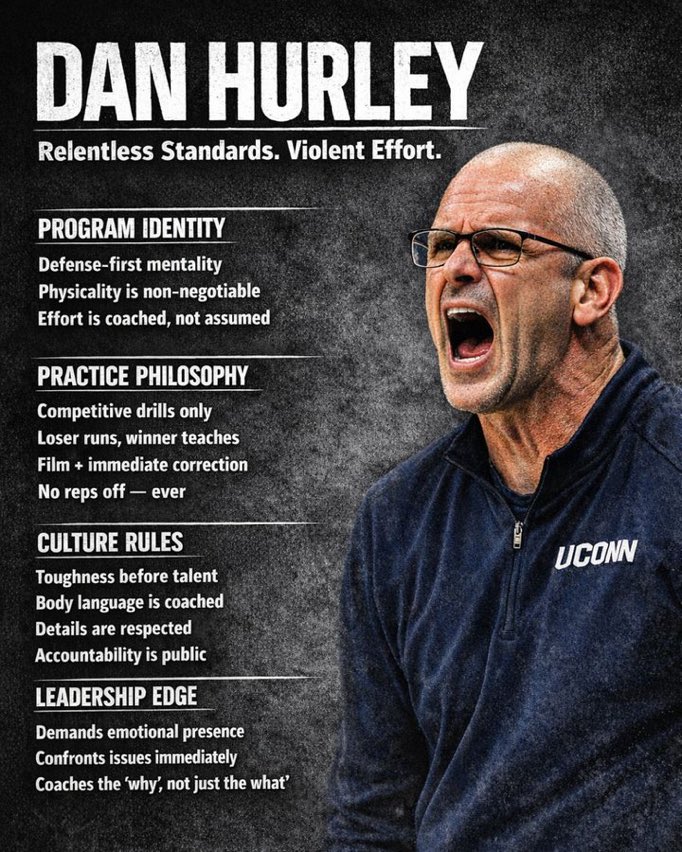
UCONN HC Dan Hurley - Building a System/Identity
- "Our system is how hard we play. How hard we get after people every single possession at both ends of the court & on the backboard."
- "The number one thing you got to understand if you want to have a program that can sustainably be successful and have a chance to win every single night... It's hard to coach that way because it's fu**ing exhausting. To coach every single possession, every single day and when the losing team runs the line because every single drill we do there is a winner & a loser, when they get this close and miss that line, you better be there to call them out and make the whole team now run with them."
"If you want to start the game 6-0, like I start most games just because my team is ready to go because we go so hard every day."