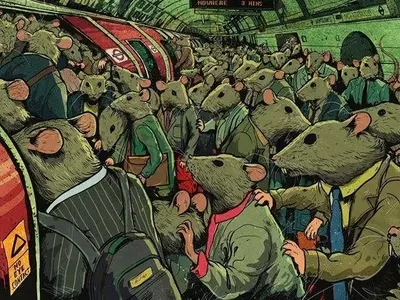
Its very important to "waste time" and be bored when you're young (and even when you're not young). That's when you just follow your instinct and it leads you down fascinating rabbit holes. We need to be less obsessed with productivity overall as a society
@KaiKai2492 And yet no one can explain to me how watching playthroughs is “not experiencing the art” when you’re quite literally experiencing it. You people keep comparing it to “not watching a movie and claiming to be a fan” but you’re literally watching the movie if you watch playthroughs
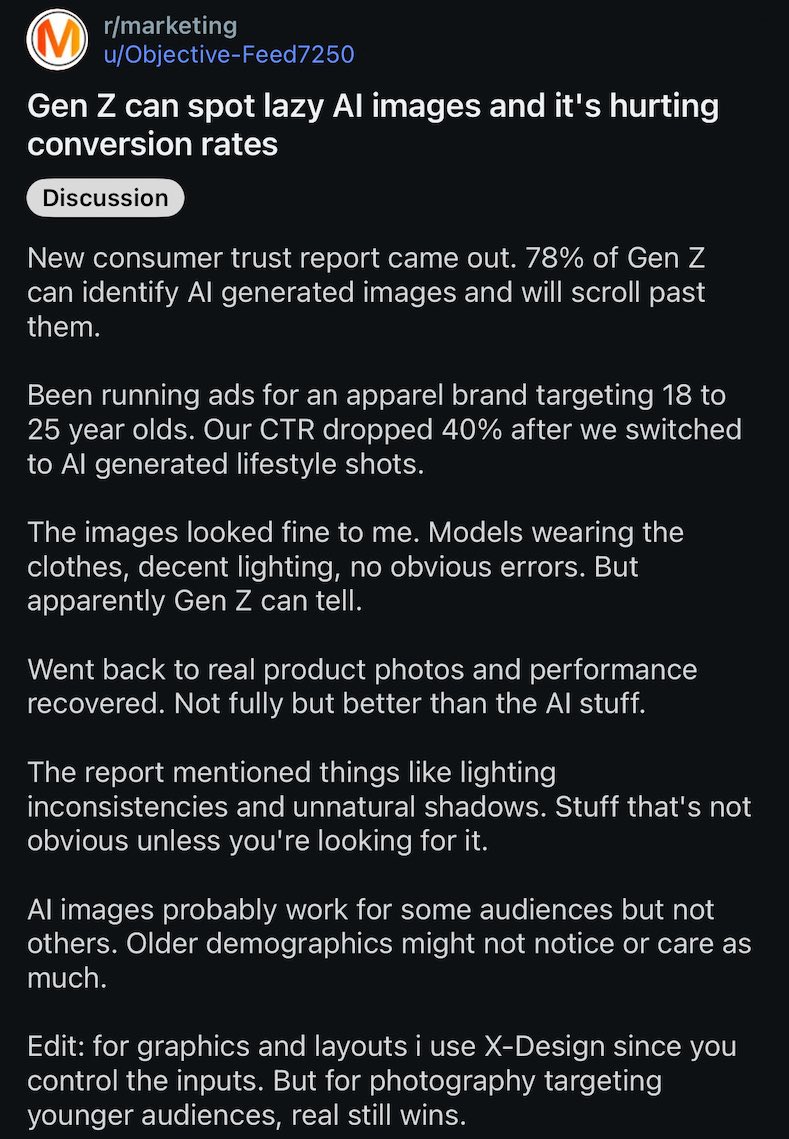
78% Gen-Z can spot AI-generated images and it hurts conversion (one marketer saw click-through-rates fall 40% when it tried AI-generated lifestyle images)
Without question, this is one of the worst things I’ve read online in a while… I wish I could say don’t read it, but you really need to. I’m so tired of watching our labor be used to create horrifying conditions for humanity for the perverse enrichment of a handful of billionaires.
Year 9 of my Easter Egg hunt and basket giveaway and i'm aiming to make this the biggest year ever.
We already have 20k eggs (2x what we usually do), now we need candy to fill them.
This year's goal is 250 baskets.
Baskets are $30 each to sponsor.
https://t.co/jSX55ZEUFC
https://t.co/Gqx2BAgqy5
This weekends goal is 100 baskets sponsored.
@creatrix_ttv I hated having roommates lol. Unless they were really good friends of mine that caused no drama but that was incredibly hard to find. I always found myself liking people less after I lived with them, too.
@Tekeee In 2020, most young adults were living at home the first time since the Depression. It was shocking.
By 2023, media was manufacturing our consent & telling us young adults LIKE it this way.
In 2026, young people can’t live independently at all. This is all for corporations.
Let me get this straight…
OpenAI was founded as a nonprofit. Open source. For everyone. “To benefit humanity.”
Then he raised billions of dollars.
Then he closed the source code.
Then he converted to for-profit.
Then he scraped the entire internet without asking anyone.
Then he used YOUR writing YOUR art YOUR code to train his models.
Now he’s on stage saying you’ll pay HIM to access intelligence. Just like a water meter.
He stole all of your data. He built the product with your work. And now he’s going to bill you to use it…
Corporate greed has reached an all time high, and they’re not even hiding it anymore…
@Rarely_Wrong @trwsenti "Walked 10 miles to work, in the snow, uphill, both ways!"
Yes, us old farts are so much better than everyone else because we accepted hard work, therefore it should always be that way. In fact, Gen Z should be THANKFUL we ALLOW them to experience a taste of our paradise.
/s
@Rarely_Wrong @trwsenti I work 60 hour weeks and can’t afford a home you senile fucking retard
Fuck your story, you lived in a version of this country that wasn’t in constant, sharp decline
@Rarely_Wrong @trwsenti Just because you did it doesn’t mean we want to. You basically lived life in survival mode. We don’t wanna just survive, we wanna live. This shit sucks. Which is why the child population is declining. We can’t even imagine having children on top of what we already deal with.
@trwsenti You get bitched at for leaving 45 minutes early so you can make it to the pharmacy before they close…
& God forbid you step away from your desk to make a couple phone calls related to life…
Miss a day of work to do errands that can only be done Monday - Friday😉👍🏼 good life😒
Gabor Maté on why women bear the greatest burden of illness:
"Women have 70-80% of autoimmune disease."
They're also twice as likely to be diagnosed with PTSD and far more likely to be prescribed anti-anxiety or antidepressant medications.
During COVID, the New York Times ran a headline calling women "society's shock absorbers," describing how women took on the stress of their families and spouses, then felt guilty when they couldn't alleviate it.
Maté argues there's nothing mysterious about these statistics once you understand what culture demands of women:
"If you understand how the culture then imposes its own expectations on certain groups, adding to their stress, then there's absolutely nothing miraculous or nothing mysterious about why women have more autoimmune disease."
He points to the patriarchal assignment of emotional labour as the root cause. Women are expected to absorb the stress of everyone around them and are made to feel guilty if they don't. As Maté puts it:
"Women's guilt is another control mechanism on the part of the culture."
He then raises a striking example: the changing gender ratio in multiple sclerosis.
In the 1930s, the ratio was roughly one to one. Today, it's three and a half women to every man.
Maté systematically rules out the usual explanations: "Can't be the genes, because they don't change in a population over 80 years. Can't be the climate or the diet, that didn't change more for one gender than another."
What did change? The role women were asked to play.
Women were already carrying the emotional weight of their families. But over recent decades, they've also taken on the role of wage earners driven by economic pressure on middle and lower classes and by their own desire to build lives outside the home.
Maté is clear that this shift could have been manageable had one critical thing happened alongside it:
The emotional burden being shared.
"All of which would have been okay had the other role of sharing the emotional burden been shared. But it hasn't. It still falls upon women."
The implication is sobering: the diseases women disproportionately suffer from aren't random biological misfortune. They're the physical cost of a culture that keeps adding to women's load without ever redistributing it.