🦀 Rust is coming to safety-critical software - and #Understand is ready for it.
Memory safety at the language level is great. But you still need to see your codebase: dependencies, call graphs, architecture, metrics.
Understand now speaks Rust, so your comprehension tooling keeps pace with your tech stack.
#Rust #StaticAnalysis #SoftwareEngineering
grep finds text. Entity Locator finds answers. 🎯
"Show me every function over 200 lines, modified this month, in the Payments architecture."
One filter panel. No regex. To open, go to View → Entity Locator.
Learn more at https://t.co/H2MuGnMfKm.
#UnderstandbySciTools #StaticAnalysis
In safety-critical software, "I think it's compliant" doesn't fly. 🛡️ MISRA, AUTOSAR, CERT - auditors want proof, not vibes.
CodeCheck runs the standards checks automatically and gives you a paper trail you can actually hand over.
Stop hoping. Start proving. ✅
Learn more at: https://t.co/91f4fbZUHq
#MISRA #StaticAnalysis #SafetyCritical #EmbeddedSoftware
The files that change the most aren't always the most important ones - but they're almost always the most risky.
Code churn measures how frequently files get modified. High churn + high complexity = where bugs live. Knowing which parts of your codebase are unstable helps you prioritize reviews, testing, and refactoring where it actually matters.
#Understand lets you dig into the complexity side of that equation, so you're not flying blind on your riskiest code. 🔍
Try it today:
https://t.co/P383jmI8Ku
When you're writing FAA safety-critical embedded software, there's no room for "I think that variable is safe."
Jeff has spent 15+ years working in exactly that environment - where understanding your code isn't a nice-to-have, it's a regulatory necessity.
Learn more at https://t.co/H2MuGnMfKm
Have you used Understand to fix a tricky bug, untangle legacy code, speed up onboarding, or catch something your team would’ve missed?
We’d love to hear about it!
Real stories help us shape future features - and we might even highlight yours (with permission, of course).
👉 Send your use case or story to: [email protected]
Tell us what challenge you faced, how you used #Understand, and the impact it made.
Help us show the world how powerful static analysis can be when it’s in the right hands!
Quick tip: hover over any entity in #Understand for an instant summary.
Name, type, parameters, return type - whatever's relevant to that entity, right there without clicking anything.
Bonus tip: if an AI overview has been generated for it, you'll see that too.
Fast context, zero interruption. ⚡
#UnderstandBySciTools #StaticAnalysis
Your codebase. Your rules. 🛠️
Understand 8.0's enhanced #Python API makes it easier than ever to build custom integrations, automate your workflows, and extend #Understand to fit exactly how your team works - not the other way around.
Find the docs here: https://t.co/NMYUuOhjhA
#softwaredevelopment #staticanalysis
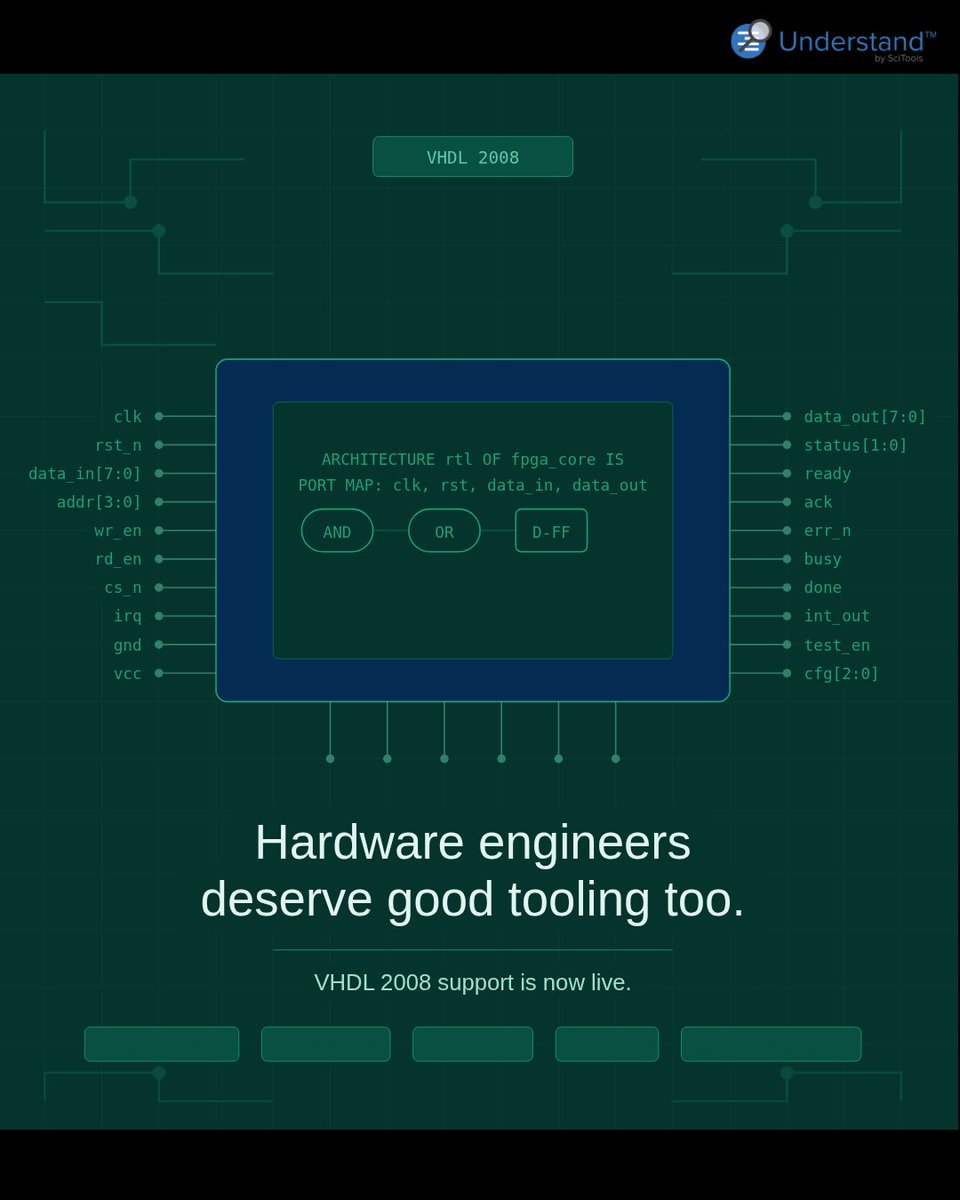
Your VHDL deserves better tooling.
#Understand now supports #VHDL 2008 - explore architectures, trace dependencies, and navigate complex FPGA projects with the same depth you'd expect from any modern #IDE. 🔍
Hardware logic is still logic. Analyze it like it. Try Understand today:
https://t.co/Ax4nJPJLQk
AI explains your code. Understand proves it. 🔍
LLMs are probabilistic - they can hallucinate relationships and miss edge cases. Understand parses your code deterministically, so "who calls this?" and "what breaks if I change this?" always have exact answers.
The best teams use both. That's why we built AI right into Understand - and why adding Understand to your AI's toolkit makes it go from impressive to trustworthy.
🔗 https://t.co/WzoYyTg8Jp
#Understand #staticanalysis #AI #softwaredevelopment
Favorites saved entities. Bookmarks saved locations. Now they live in one widget.
#Understand 8.0 merges both so you can track the functions you care about AND the exact lines you keep coming back to - all in one place.
Check it out under View -> Favorites / Bookmarks.
Read the rest of our 8.0 changes here:
https://t.co/FebTmbDqt3
🔬 Code Smell of the Week: The God Function
We've all inherited one. 350 lines. 14 parameters. Handles validation, discounts, tax, shipping, fraud detection, and loyalty points - all in a single function.
We pulled this one up in #Understand's control flow graph and the branches spoke for themselves. One entry point, five tangled responsibilities, and a recursive call back to itself for good measure.
If your codebase has a function like this hiding in it, Understand's control flow graph will find it. One click on any function and you can see every branch, every decision point, and every path through the logic - laid out visually so the complexity can't hide behind a scroll bar.
Time for a refactor. Your future self will thank you.
#CodeSmells #StaticAnalysis #SciTools #TechDebt
Go beyond #Understand's built-in metrics export 📊
In our latest video, we show you how to use the Python API to export metrics for specific entity kinds - classes, functions, whatever you need.
Watch the full walkthrough from GUI basics to writing an API script:
https://t.co/TAvPQ0WfCZ
Real talk from #Understand user Marty Turner 🗣️
"I would not be able to learn code as quickly without Understand."
Older codebases. Open source. Proprietary. Understand's dependency graphs show you how everything connects - so you spend less time guessing and more time building. 🔍
#StaticAnalysis #CodeComprehension #SciTools #Understand #LegacyCode #SoftwareEngineering
Coupling and cohesion are two fundamental concepts in software design that directly impact how maintainable your codebase is.
🔗 Coupling measures how much modules depend on each other. High coupling means changes ripple unpredictably.
🧱 Cohesion measures how focused a module's responsibilities are. Low cohesion leads to classes that are hard to test and reason about.
Well-designed systems aim for loose coupling and high cohesion - and Understand can help you measure both with features like dependency graphs and code metrics.
#SoftwareEngineering #CodeQuality #StaticAnalysis #SciTools #Understand
What if a "messy" graph could actually reveal hidden structure in your code? 🍝
In our latest video, we break down a plugin that visualizes how functions and objects connect inside a class - and show how it spots cohesion issues, key functions, and utility patterns at a glance.
Check it out 👇
https://t.co/r6LDfM44M8
#staticanalysis #Understand
Ever build the perfect graph in Understand's GUI and wish you could recreate it in a script? You can!
Hit the API command button on any graph, and #Understand hands you the exact code to reproduce it in a custom plugin. No guesswork, no digging through docs - just build what you want visually, then automate it.
That's how you go from "I wonder if I can script this" to running it in seconds.
Watch this short video to see it in action: https://t.co/jsFdaIbCbE
Have you used #Understand to fix a tricky bug, untangle legacy code, speed up onboarding, or catch something your team would’ve missed?
We’d love to hear about it!
Real stories help us shape future features - and we might even highlight yours (with permission, of course).
👉 Send your use case or story to: [email protected]
Tell us what challenge you faced, how you used Understand, and the impact it made.
Help us show the world how powerful static analysis can be when it’s in the right hands!
#staticanalysis #softwaredevelopment
One of our engineers Natasha built an MCP server that lets AI call real #Understand API functions - cyclomatic complexity, dependencies, entity lookups - actual analysis, not hallucinations.
Built with FastMCP + Python in just a few hours. Try it on your own project 👇
https://t.co/mWW0uNhX5R
Ever inherit a codebase and feel like you're navigating a city with no map? 🗺️
#Understand's Dependency Graphs let you see how your code is connected - so you can refactor with confidence instead of crossing your fingers.
Watch this short video on Dependency Graphs to get started:
https://t.co/PStJC3aSHY
#StaticAnalysis #CodeQuality #SoftwareEngineering #SciTools