@Gumsy005 "That's what made Jon different. He didn't inherit Longclaw through birthright, he earned it through courage, loyalty, and sacrifice. A true leader is defined by actions, not titles."
Just finished Episode 6 of Spider-Noir and I'm honestly torn 😩
Dr. Faber went way too far strapping Ben Reilly down in Lab 3 just to harvest his genetic material. But seeing her son ,Ogden, age so rapidly...man, that's just heartbreaking. A mother’s desperation can drive her to do some wild things.
I can’t justify what she did, but I do get why she did it.
What did you guys think?
Can you commit murder in your sleep? Homicidal Somnambulism; the sleepwalking killer
This sounds like a courtroom thriller twist: a person commits a horrific, violent crime, but is found completely innocent because their conscious mind was technically fast asleep the entire time.
As terrifying as it sounds, homicidal somnambulism (homicidal sleepwalking) is a rare, legally recognized neurological phenomenon.
The Science: The Split-Brain Glitch
To understand how someone can navigate, drive, or even attack someone while asleep, you have to look at how the brain handles sleep cycles.
During normal, deep Non-REM (NREM) sleep, your brain is supposed to be in a state of total lockdown. Your conscious mind is offline, and your motor cortex is effectively muted so you don't act out your dreams.
But during a sleepwalking episode, the brain suffers a massive dissociative arousal glitch.
The brain essentially splits in two:
The prefrontal cortex (the part responsible for logic, ethics, decision-making, and conscious awareness) stays completely, deeply asleep.
The primitive brain centers (the amygdala, motor cortex, and brainstem) suddenly violently wake up.
This creates a scary biological paradox: a body capable of complex, high-level motor coordination (like walking downstairs, unlocking doors, or driving a vehicle) guided entirely by a primitive, subconscious autopilot with zero moral compass, fear regulation, or conscious memory formation.
The Forensic Reality
How do neurologists and forensic experts prove someone was actually sleepwalking during a crime versus just lying to escape jail?
They use Polysomnography (sleep studies).
In famous real-world cases — like the 1987 case of Ken Parks, who drove 14 miles and attacked his in-laws while entirely asleep, sleep specialists hook the suspect up to EEG monitors in a controlled hospital ward.
They look for specific, un-fakeable neurological markers:
- Abrupt NREM Arousals:
The patient’s brain waves will show incredibly chaotic, sudden spikes shattering deep sleep, proving their motor system fires up without waking their conscious mind.
- Severe Sleep Architecture Disruption:
True homicidal sleepwalkers usually have a documented history of severe parasomnia, chronic sleep deprivation, or heavy genetic predispositions to sleep disorders.
When these patients "wake up" after an episode, due to the prefrontal cortex being offline, they have retrograde amnesia (they have absolutely no memory of the event) and are often found completely disoriented, crying, and horrified by what their body did while they were "away."
Homicidal somnambulism is a terrifyingly real medical and legal reality. It is a profound glitch where the body executes complex, violent actions while the conscious mind remains totally trapped in deep sleep, leaving the person completely oblivious to the horror they’ve caused until they wake up.
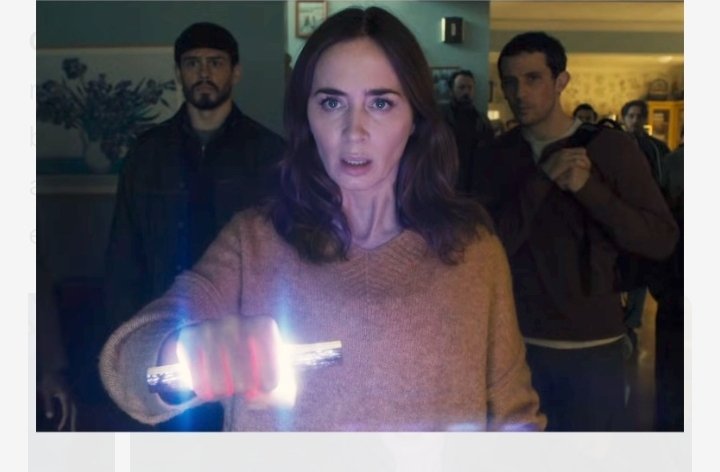
This is a Pivotal First-Look Moments- The Broadcast Interruption, were Emily Blunt’s meteorologist stands in front of a weather map when her voice suddenly shift, delivering eerie, non-human sounds live on air as the studio lights flicker.
One ordinary forecast becomes the moment the world glitches. When the sky speaks back through a familiar face, do we tune in… or turn away in terror?
Spielberg’s signature blends of the everyday and the extraordinary hits differently.
🎬 Disclosure Day. In theatres June 12th
POV: Getting rid of years of congestion, bumps & rough texture in one session 🔥
This deep cleansing facial was HEAVY on the extractions & hydration. Skin went from textured to smooth & glowing.
Who needs this treatment ASAP? 👀
#Blackheadextraction
One of the most chilling turning points in Obsession comes right after Nikki gives Bear her late mother’s necklace. What should be a tender, emotional moment suddenly takes on a sinister meaning when Bear asks, “Do you love me more than anyone else in the entire world?”
Behind the scene, the question isn’t romantic at all. Bear is secretly testing the consequences of the wish he made on the One Wish Willow, where he wished for Nikki to love him more than anyone else. The necklace symbolizes genuine affection and vulnerability, but Bear’s reaction reveals his growing fear that Nikki’s devotion may not be natural.
It’s a brilliantly uncomfortable scene because the audience realizes what Bear is really asking: not whether Nikki loves him, but whether the curse is working. The shift in his expression transforms an intimate moment into psychological horror, quietly setting the stage for the obsession, violence, and tragedy that follow.
The ultimate military paradox: Being sent back in time only to come face-to-face with the father who died saving his men 27 years ago.
🎥: Fantasy Island