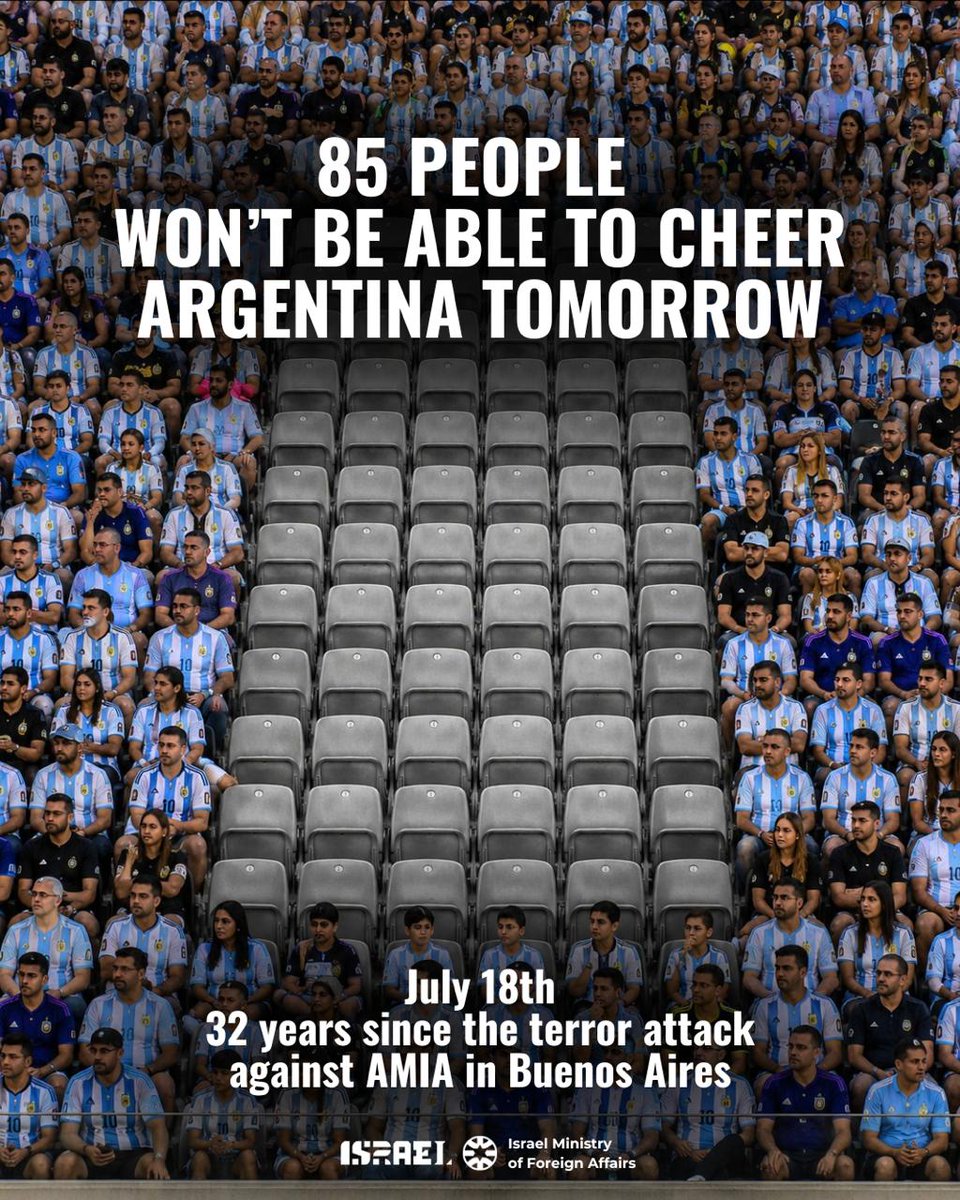
85 empty seats.
This Sunday, millions of fans will gather to cheer for their national teams in the FIFA World Cup Final.
But 85 voices from Argentina will be missing.
They belong to the victims of the 1994 AMIA terrorist bombing in Buenos Aires, an attack planned by the Iranian regime and carried out by Hezbollah.
Behind every terrorist attack are lives stolen and futures cut short.
We remember. We stand against terror. Always.
FIVE-YEAR-OLD GIRL SWEPT AWAY BY FLOOD IN ABA, ABIA STATE
A five-year-old girl, Melody Isaac, was swept away by flood during a heavy rainfall along Akpu road in Ogbor Hill, an area in Aba. The incident has raised fresh concerns about drainage infrastructure and flood safety.
Going through the replies and I can’t help but notice the imported thinking I was just discussing with someone in the comment of my last published thesis.
We need to get that Moniepoint and OPay didn’t build FOR the African informal market. They built WITH it.
Agents in nearly every city. Cash in, Cash Out. No onboarding friction. Smooth and fast transactions.
The truth is that the $1 Trillion opportunity is not new information. The problem is just that founders keep arriving with apps when the market is asking for humans with infrastructure behind them.
Here is what I mean. The market is not struggling or underserved. The humans are already there. Alhaja in Tejuosho market who has been supplying fabrics for 20 years+. She knows exactly who is good for credit and who needs cash first. Onwa the spare parts dealer in Ladipo who sources engine parts across 5 states and settles issues with phone calls. The cold room owner in Mile 2 who has been storing and icing soft drinks for traffic sellers for years before smartphones became a thing.
What these guys don’t have is infrastructure behind them. That’s the real gap. That’s what you should build.
I can already think of 5 infrastructure plays I’d build for myself but I will keep them for now. I casually mentioned 3 in the thesis I tweeted yesterday.
What I’m saying in essence is that the informal economy isn’t waiting for another app. It’s waiting for founders who understand accumulated trust, on-ground distribution, and existing human behavior.
That $1 trillion doesn’t go to the smartest product. It goes to whoever earns the trust first.
My mum owns a primary and secondary school somewhere in Akeja, Ogun Sate. There is this man, Papilo, a supplier who handles FMCG products in that area. He comes Tuesdays, Thursdays, and Fridays. Sundays are for my mum and other school owners stocking up for students during break.
He is not the only one. They are everywhere like that.
One thing I know is that most of these sellers don’t pay him immediately, They pay on the next supply day or after a week. Sometimes it stretches to 3 supplies before payment clears.
I've watched him argue back and forth with customers who say no money yet. He still gives them all or little. I've seen this for over 15 years growing up. This is the practice across every informal market in Nigeria. This is Africa’s informal supply chain.
Papilo knows all his customers. He knows their children’s names. He argues, negotiates, and finds a middle ground. No App or AI can replicate this.
Papilo now runs plenty of small kekes distributed all over Akeja and beyond.
In African businesses, relationships aren’t just nice-to-haves. They are part of the infrastructure. And this is where the majority of our builders get it wrong.
A techie once went to get bread at a store and stumbles on a sole distributor supplying them wines. He thinks “so this is how these get their stocks” he goes home to google the numbers and sees millions of retailers, no central database, orders on phone call, cash payments, manual records. He sees the classic Manufacturer → Distributor → Wholesaler → Retailer chain and he goes “yes! This is a gap. This is untapped. I can build this on an app”.
Actually, he is right. But here is what he missed;
The supplier extends credit
The wholesaler knows who always pays at each time.
The sales rep knows whose child just got admitted into university.
The delivery driver knows which shop opens late or earlier
None of this can fit in an app database because they are the everyday circumstantial reality of Nigerian business owners. Your app can’t document this.
A retailer doesn’t always buy from who is cheaper. She buys from who’s delivered consistently for years. The one who lets her pay next week. The one who picks up the phone immediately there is a problem.
See your app can calculate credit just fine. But the distributor knows Mama Olomi missed payment because her shop flooded last week. That context is the business in this part of the world.
You will think funding fixes this but marketForce had $42M and still died. Sendy had $27M, Medsaf had $7M.
Your investors will push you to the usual playbook; free delivery, discounts, cashback, promotions, etc and growth will look incredible at first but the moment the subsidies disappear, you will start to compete with relationships using economics alone.
Then you’d realize your capital didn't buy survival, it brought speed to a broken model. Somebody say Reality!
Now let’s look at the ones who didn’t die. They simply mutated.
Sabi moved into traceability/export infra. OmniRetail leaned into embedded finance.
Sendy’s co-founder built TABB on trade credit data.
Rather than say we’re replacing distributors, they became the operating system behind the distributors helping them;
📍 Manage inventory
📍 Collect payment
📍 Access financing
📍 Discover retailers
📍 Forecast demand
📍 Coordinate logistics
This is the lesson for anyone building in African informal market.
Don’t ask How do i remove the middleman
Ask, what valuable job is the middleman doing that technology can make easier?
Don’t compete with the market woman, equip her. Build the layer she can’t build herself (credit history, verified supply chains, payment infrastructure, etc).
This is because Africa’s distribution problem was never about apps vs humans. It’s about who controls the trust layer. Build that, not the marketplace.
@blocstreets
Today, Pastor Matthew Ashimolowo stood on the same Mountain of Mercy altar where God used Apostle Joseph Ayo Babalola to birth a revival that is still speaking to generations.
The covenant is still speaking. The God of answers is still changing lives.
🔥 #ERIO26
Politics or vibes? The team reacts to Rufai’s interview with Obi, questioning whether promises like 10,000–20,000MW of power are backed by substance or just popularity.
With Nigerians still waiting for clear economic plans, the conversation highlights the struggle to find leaders offering sound, practical solutions beyond tribal, religious, or partisan lines.
Watch the world cup edition on YouTube @nairametrics.tv
https://t.co/H0mEJr3Jeo
Drinks and Mics is proudly sponsored by @ledropnigeria , @mandilasgroup , @uacfoodsng .
5 prayers when people call it luck:
1. Lord, thank You for every open door.
2. Father, remind me Your favor surrounds me like a shield.
3. Help me trust Your timing.
4. Keep me humble in every blessing.
5. Let my life point people to You.
It’s not luck. It’s God.
The key to saving the environment is not looking backward, it’s moving forward.
I realized this the first time I visited Italy twenty years ago. Everything was clean and green. The rivers sparkled. The lesson for me was obvious: the answer is not underdevelopment. The answer is progress.
When China was poor, the air was so polluted that people could barely see the blue sky. Today, blue skies have returned to their cities. Development does not only create wealth, it also provides the resources needed to restore and protect the environment.
Some environmentalists want us to preserve every aspect of our biodiversity, including the mosquitoes for example, so that researchers can fly in once every ten years from their universities (which build particle accelerators and billion-dollar laboratories with their pocket money), study our ecosystems, and count how many people died from dengue outbreaks.
They want to buy our air through carbon credits. If carbon credits were such a great deal, they would be selling them to us, not the other way around.
Cleaning every river, lake, and water source in El Salvador, and ensuring they remain clean and sparkling, would cost roughly $12 billion. Where is that money supposed to come from without economic development? Carbon credits?
The path forward for our country is the path of Japan and Singapore, not the path of the Congo.
CL final summary:
•Arsenal’s defensive structure was immense at 1-0, think it was the correct decision to just try to keep a clean sheet, Kvara winning a duel vs Mosquera was always a concern without Timber
•Step-down from Havertz at 9 to Gyökeres was clear - the ball did not stick after this move.
•Barcola had 2 chances in transition but didn’t take them with poor touches before the shot.
•João Neves was the stand-out midfielder in extra-time - he had the stamina to not let fatigue affect the quality of his actions.
•Martinelli had a transition where he was the passer for a Madueke run but fluffed it. Should’ve been Saka in that position from a balance perspective. Martinelli + Madueke = two runners. Martinelli-Havertz-Saka is their best balanced attack but we never saw it. Arsenal need a new superstar LW runner to start to see this balance more often.