⚠️ The crypto industry is being told to consider "bunker mode."
Justin Drake: Ethereum Foundation researcher, mathematician and longtime Ethereum protocol researcher:
"Mass migration"
"Cause for action"
"Don't panic"
"Do not rush"
"possibility ECDSA breaks before qday"
"Worst case in months"
"Weeks where centuries of mathematical progress happen"
And:
"My inclination is to go all-in on hash-based cryptography"
Not a prediction. A warning.
Neptune Cash was built for this at launch: quantum-resistant and private from the beginning. No ECDSA. Nothing to migrate. 🛡️
https://t.co/sdNVTNNkBe
Today I call upon the blockchain industry to calmly begin planning for "bunker mode". My personal recommendation is to set in motion a controlled mass migration of assets to fresh addresses, i.e. addresses whose pubkeys remain hidden behind a hash.
Holders, starting with large and sophisticated ones, should consider moving the bulk of their funds to addresses that have never signed a transaction. And when they do sign one, they should also move remaining funds to a new address (possibly generated from the same seed phrase).
Don't rush. While I believe there is cause for action a rushed migration would do more harm than good. Don't panic either. Moving assets to protected addresses is a simple, preventative step which does not require new cryptography or new wallets.
IMO it is now reasonable to brace for the possibility that ECDSA breaks before qday, in the worst case in months not years. By "break" I mean fast private key recovery (e.g. in one week) on available hardware (e.g. a large GPU cluster).
Recent days have been humbling for human mathematical intuition. Long-held, unquestioned hypotheses have fallen. This includes the n log(n) bound for integer multiplication and the 3SUM conjecture. In hindsight, May's unexpected disproof of the Erdős unit distance conjecture was our warning shot.
Yesterday's OpenAI drop made it clear that mathematical superintelligence is upon us. They say there are weeks where decades happen. We are about to live through weeks where centuries of mathematical progress happen. Could our magic 64-byte ECDSA signatures be too good to be true? Was it just security through obscurity all this time?
Elliptic curves feel especially vulnerable to superintelligence. Curves carry rich structure, with room for fancy tricks like Schoof, Frobenius, pairings. (By contrast, hashes are designed to minimise algebraic structure.)
Separately, as Ewin Tang can attest, an efficient quantum algorithm sometimes foreshadows an efficient classical one. We should be open to the possibility of a classical counterpart to Shor that breaks elliptic curves and RSA at once.
Also noteworthy is the striking under-representation of cryptographic breakthroughs among the 722 mathematical results OpenAI published. I've witnessed first-hand the US government censoring academic quantum cryptanalysis results. Backroom interventionism is my base case.
I urge large, sophisticated actors to lead by example. Project11's "risq list" (bitcoin-risq-list.projecteleven[.]com) is a great tracker of exposed BTC pubkeys. Binance, Bitbank, Robinhood, Bitfinex, and Tether have an opportunity to harden their cold storage. Next month I'll address institutions in London in a live Q&A (forum.ethereuminstitutional[.]org/london-2026).
Again, please do not rush. Wallets holding under 50 BTC enjoy partial cover from "Satoshi's shield", i.e. his 20K exposed addresses that hold 50 BTC each. Load-bearing signers like oracles and L2 security councils should consider rotating ECDSA pubkeys with every signed message and/or multi-signing with a hash-based schemes like SPHINCS.
Exiting bunker mode safely will require post-AI cryptography. My inclination is to go all-in on hash-based cryptography and avoid structured mathematical assumptions entirely, whether from curves, lattices, or isogenies. A single battle-tested hash (e.g. from the SHA or BLAKE families) yields plausible post-AI security.
The Ethereum roadmap on strawmap[.]org fully embraces hash-based cryptography with end-to-end formal verification as a response to the quantum threat. Those timelines must now be revisited and accelerated in light of mathematical superintelligence. I'll be pushing for maximum defensive acceleration.
So, $NPT is getting interesting.
Imagine a blockchain that doesn't need to carry its entire history around forever.
That's what Neptune Cash is working towards with succinctness, now nearing its final stages.
Think of it like replacing a library of records with a compact mathematical proof.
✅ Major scalability upgrade approaching
✅ Mining infrastructure improving
✅ New Chrome wallet released
✅ Privacy-first, quantum-resistant design
@NeptuneCash is tackling some of blockchain's biggest technical challenges.
Still early. Still risks. But the technology deserves attention.
🛠️ Dev update: succinctness in its final stages
• Succinctness: set to ship as a soft fork that keeps today's throughput limit. Capacity increases follow later by hard fork, preserving the recursive proof chain.
• Security: research and review continue.
• Mining: https://t.co/CxoLnKTJso builds block proposals in as little as 39 seconds, https://t.co/Sz8rZrHJan finds nearly 15% of blocks, and both major pools pay out time-locked coins correctly.
• Wallets: a new community Chrome extension wallet is out.
Coming this week: the succinctness pull request, with an explainer blog post in the works.
Full update:
https://t.co/MX3VnBoVk3
@NeptuneCash@Lions_Share_@VitalikButerin, are you familiar with Neptune Cash?
Its approach to privacy, succinctness, and post-quantum cryptography seems to align with Ethereum's evolving roadmap.
Would love to hear your thoughts :)
Exactly! A few additional catalysts:
1) Ethereum's evolving roadmap increasingly emphasizes privacy, ZK proofs, and post-quantum security. A testament to the forward-thinking design behind Neptune's architecture and technology.
2) Advances in AI-driven cryptanalysis and quantum computing are increasing the need for existing chains to strengthen their cryptographic foundations. Transitioning to quantum-resistant cryptography is no simple feat.
We are early. 🔐 neptune-cash:native
$NPT | Neptune Cash — The Bigger Picture Is Taking Shape.
@NeptuneCash is quietly maturing into something very interesting.
A working, privacy-first blockchain built with quantum-resistant cryptography, zero-knowledge proofs and serious long-term ambitions.
This isn't a narrative I believe will simply come and go. Privacy, security and quantum resistance could become some of the most important foundations of Web3.
Development is progressing, the technology is taking shape, and I believe the market is yet to appreciate the potential.
That's why I've positioned my buy orders on SafeTrade.
I'm looking beyond the next pump. I'm looking at what $NPT could become. 🦁
@Lions_Share_@tradeguru@NeptuneCash Exactly. How on earth did Neptune Cash get overlooked?
It's a pioneer in the space, bringing together privacy, post-quantum cryptography, programmability, and soon, succinctness.
In the past 4 days...
Google: We've shown that magic state cultivation works on Google Quantum AI hardware.
Quantinuum: We've broken the error-correction world record by 10x.
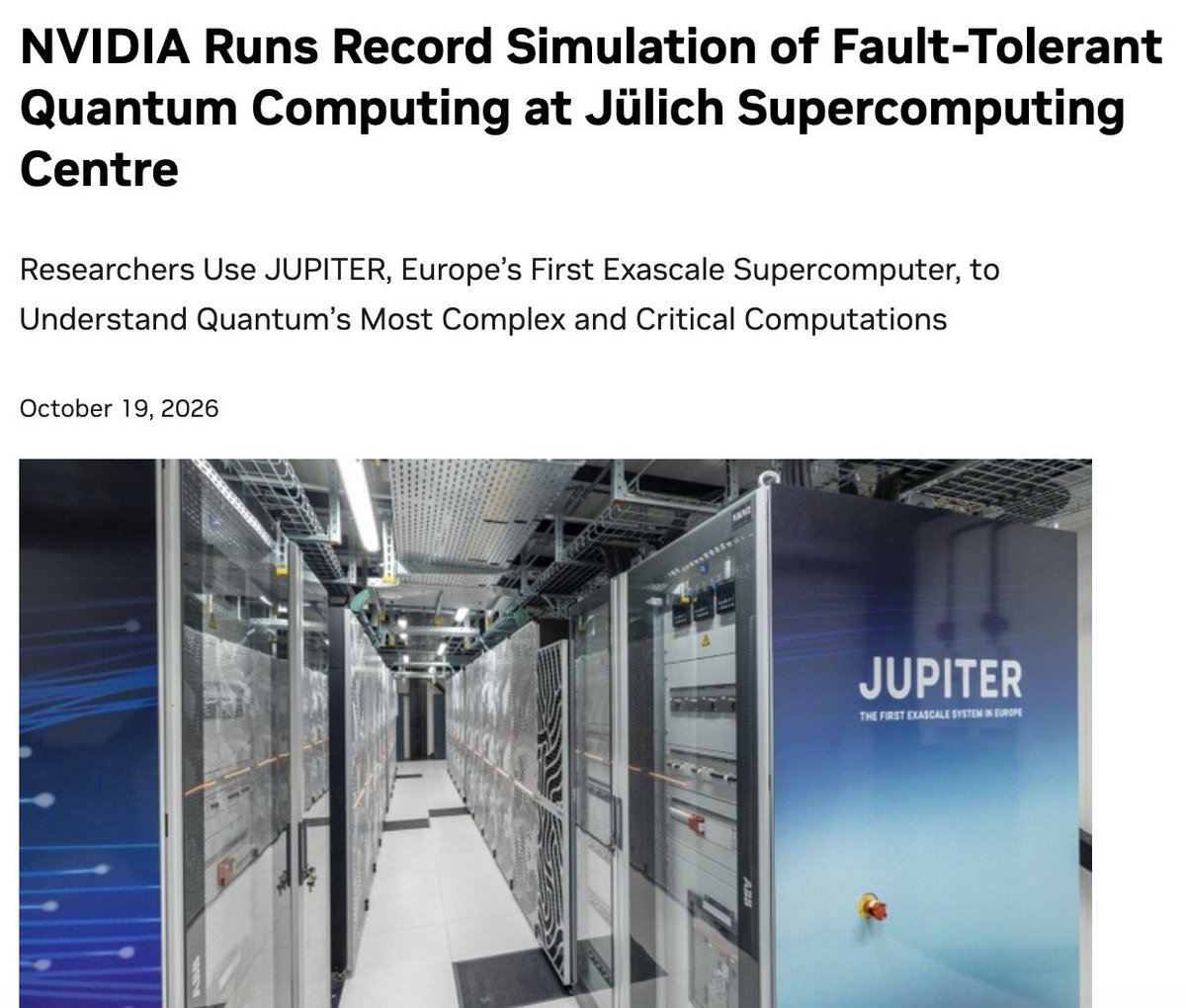
NVIDIA: We've run a record breaking fault-tolerant quantum computing simulation.
Let's get to work.
🦁 NEPTUNE CASH neptune-cash:native — A PRIVACY LAYER 1 THAT DESERVES MORE ATTENTION
Every cycle, thousands of crypto projects compete for attention. Most are fighting over the same narratives.
But occasionally, you come across something that makes you want to dig a little deeper.
For me, that's @NeptuneCash@CodewordNeptune .
I've been researching neptune-cash:native, and the deeper I go, the more interesting the underlying technology becomes.
Here's why I think it's worth putting on your radar.
1. NOT JUST ANOTHER PRIVACY COIN
Neptune Cash is an independent, open-source Layer 1 blockchain built from scratch.
It combines several technologies that could become increasingly important over the coming years:
• Privacy by default
• Post-quantum cryptography
• zk-STARK zero-knowledge proofs
• Proof-of-Work security
• Programmable transactions
• A roadmap towards blockchain succinctness
The ambition is to create private, programmable digital money without sacrificing security or decentralisation.
And importantly, this isn't just a whitepaper. Mainnet launched in February 2025, and development continues.
2. THE PEOPLE BEHIND IT
Co-founder @aszepieniec Alan Szepieniec is a cryptography researcher with an extensive record of published academic work.
In 2020, he co-authored Transparent SNARKs from DARK Compilers alongside Benedikt Bünz and Ben Fisch.
That research forms part of a broader field of cryptographic innovation explored by researchers associated with Microsoft Research and a16z.
To be clear, this does NOT mean Microsoft or a16z have partnered with Neptune Cash.
It does, however, demonstrate the calibre of research associated with one of Neptune's founders.
That's a meaningful distinction in an industry where technical claims are often much bigger than the technology behind them.
Research:
https://t.co/URhWuMQU6Q
3. TOKENOMICS — AN INTERESTING SUPPLY STRUCTURE
NPT has a maximum supply of 42 million coins.
• 42M maximum supply
• 1.98% initial premine
• Proof-of-Work issuance
• Approximately three-year halving intervals
• 50% of mining subsidies immediately liquid
• 50% time-locked for three years
That last point is particularly interesting.
Half of each new mining subsidy cannot immediately enter the liquid market.
This potentially reduces short-term miner selling pressure, although those coins eventually unlock and become available.
Of course, limited circulating supply doesn't guarantee price appreciation. Liquidity and demand matter just as much.
4. THE TECHNOLOGY
Neptune uses zk-STARKs to prove that transactions are valid without publicly revealing the underlying financial information.
Its Triton VM provides the cryptographic foundation for programmable transactions.
The network also separates mining into transaction proof upgrading, block composing and proof-of-work guessing.
One of the most ambitious developments is succinctness, which aims to allow participants to verify blockchain history using dramatically less information.
Full succinctness is not yet deployed, and broader smart-contract functionality is still developing.
If successfully delivered, these capabilities could make Neptune a very interesting competitor in the privacy-focused blockchain sector.
5. WHY I'M ACCUMALATING
Financial privacy is becoming an increasingly important conversation.
At the same time, quantum computing is raising questions about the long-term security of today's cryptographic systems.
Neptune is attempting to address both while building infrastructure for programmable financial applications.
That's an ambitious combination.
But let's be clear: this is an early-stage, high-risk project.
The network has previously required important security fixes, and wider adoption, developer activity, liquidity and delivery of its roadmap still need to be demonstrated.
I'm not suggesting any of this guarantees success.
I'm highlighting a project with serious technical ambitions and a research background that I believe deserves more attention.
6. HOW TO GET neptune-cash:native
Access to native Neptune Cash remains relatively limited.
The routes currently worth exploring are:
• SafeTrade: https://t.co/QY5Xl9PvDs — NPT/USDT market
• Mining: Participate in the network's proof-of-work mining process
• Approved community escrow: Private OTC transactions using a verified, community-approved escrow arrangement
For escrow transactions, independently verify the authorised service or contact through Neptune's official community before sending funds.
⚠️ Be particularly careful not to confuse native neptune-cash:native with XNT (Neptune Privacy) or wrapped neptune-cash:native on Base. These are not interchangeable native assets.
Official website and whitepaper:
https://t.co/up21OmuKB1
Technical documentation:
https://t.co/i4NnibfBb9
Research rabbit hole:
https://t.co/Rxel1FJJIO
Network statistics:
https://t.co/Gx3AbURqvc
Development discussions:
https://t.co/nRDP928R2H
I've been around crypto long enough to know that great technology doesn't always result in a successful investment.
But I also believe some of the most interesting opportunities are found before the wider market starts paying attention.
Neptune Cash is one I'm researching closely.
The question now is whether the team can turn that technical foundation into real adoption.
Has anyone else been researching neptune-cash:native? I'd be interested to hear your thoughts.
Strong disagree. Lattices have juicy mathematical structure, ripe for AI to attack. And the succinct versions based on module SIS are too new -- only around since 2012.
I recommend waiting another 3-5 years for AI to kick the tires, before entrusting serious $ with it.
DYOR; stay safe.
⚡ Neptune Core v0.19.2 is out!
Two days after v0.19.1, the P2P work continues, with a focus on protecting nodes from overload:
• Invalid blocks dropped early, before costly proof verification
• Rate limits on blocks served to peers
• More reliable connections for nodes behind routers and firewalls
• Mempool and mining fixes
🔗 Full notes:
https://t.co/59FxfrlXet
Thanks for the honest write-up, this kind of feedback is useful.
Have you tried the Neptune Wallet app? It's a desktop GUI wallet (Windows, macOS, Linux) that connects to a hosted remote node, so there's no need to run neptune-core or use the terminal. Your keys stay on your machine, so it's still secure even if you don't run a node yourself.
https://t.co/qzg2tbnPT5
⚡ Neptune Core v0.19.1 is here!
This release brings important P2P networking and security improvements, including:
• Smarter block requests & faster block delivery
• Stronger protection against oversized network messages
• Improved peer connection management
• New --blocks-only CLI flag
Building a more robust Neptune network, one release at a time.
🔗 Release notes:
https://t.co/nKmcxffnt5
@numeris24 The Android wallet was developed by a community member, but I'm not sure if he's still active or interested in maintaining it. Unfortunately, there's not much others can do about it.
https://t.co/Vaytxwo61j
This week some researchers warned AI may break elliptic curves before quantum computers.
🔐 Neptune's coins are safe: they rely on hashes.
Its proofs got up to 6.7x faster.
Next: succinctness, verifying the chain from 1 block.
Bulletin #6, 27 Sep–9 Oct: https://t.co/j9Ozdk3xup
@foukation@JimVandeHei Speculation: publicly disclosing that elliptic curve cryptography is fundamentally insecure due to a breakthrough in cryptanalysis
Sorry @QuantusNetwork, quantus:native is a clean narrative, but @NeptuneCash $NPT already did the harder version of this.
Neptune has been on mainnet since Feb 2025 with zk-STARKs at L1, mutator sets for private transfers that stay succinct, and private smart contracts.
Post-quantum from day one, hash-based, no migration later.
QTC launched Sept 2026 on ML-DSA, no contracts on-chain. Quantum-secure money is the pitch. Neptune shipped the privacy, the proofs, and the fairer issuance first.