🚨 ChatGPT Pro is getting a serious upgrade!
GPT-6 Astra Pro is moving closer to a future where multiple AI agents collaborate directly inside ChatGPT.
Less time spent waiting, more complex work handled efficiently, and a much more seamless experience.
GPT-6 Astra Pro in ChatGPT got an upgrade with faster responses and improved use of plugins and tools.
And now, multiple agents can tackle different parts of a task in parallel. You can follow each agent’s progress and open completed tasks to review their work.
Now available to Pro users in the Chat tab.
🚨 Codex users are celebrating resets more than actual improvements 💀
OpenAI is struggling to keep pace with Anthropic and Google while Codex users track their next usage refill like a major event.
The 28-day promise of daily improvements or full resets has only made those resets a bigger talking point.
If getting your limits back is more exciting than using the product, doesn’t that say something about Codex’s current state?
🚨 ChatGPT Plus and Pro users just got a big win!
The cap on creating Sites has reportedly been lifted.
For anyone constantly building prototypes, dashboards, mini apps, and Three.js experiments, this means more freedom to ship projects without worrying about hitting a site limit.
One less restriction between an idea and a finished project.
🚨 Day 11:
OpenAI is tackling Codex’s model capacity errors
"Tibo" says new changes and additional compute should significantly reduce “Selected model is at capacity” interruptions.
If the error still appears, Codex should eventually resume automatically instead of leaving users stuck.
Capacity errors are getting attention. Now it’s time to fix context compaction taking forever.
Day 11/
We've landed a series of changes and more compute to very significantly decrease the occurrence of the disruptive "Selected model is at capacity. Please try a different model". When it does happen, it should also eventually just continue by itself and not just block on it.
Let us know if you still see it out there in the wild and we'll take a look.
🚨 Tibo’s “significantly more usage” promise might have backfired
Same models, same workload, but my Codex limits are draining almost twice as fast since today’s reset.
“More usage” apparently means more usage consumed lmao.
Anyone else seeing this, or am I part of an early rollout?
🚨 Is OpenAI losing control of the Codex situation?
Users are fed up with usage limits and ongoing issues.
Tibo keeps sharing updates, but what’s happening behind the scenes?
Is OpenAI scrambling to fix Codex or preparing a new model to challenge Opus?
What’s OpenAI prioritizing right now?
🚨The data speaks for itself.
If Europe is such a valuable market, why are new features so often delayed there? European users constantly seem to be stuck at the back of the queue.
Why keep making users in such a promising region feel like they matter less?
European businesses are rapidly expanding their use of AI agents. More than half of the AI use among our EU enterprise and business customers now involves these tools, and the number of small business users has grown 8x across the region.
Our latest Economic Research report explores Europe’s shift toward agentic AI—and the opportunity to turn broader adoption into deeper use.
https://t.co/jUjCF5sW0B
🚨 Codex remote control needs improvement
OpenAI is currently running a 28-day improvement push, and fixing the remote Codex experience would be an easy win.
Right now, controlling the Codex extension in VS Code through the ChatGPT Android app is frustrating. I want to start a task on my computer and follow its progress from my phone, but selecting an active task gives me an error saying another Codex session is already using it.
We should be able to watch tasks run in VS Code from our phones, then send follow-up instructions from either device once they finish. Both sides should stay synchronized, regardless of where the original prompt came from.
Ideally, the desktop app, VS Code plugin, and mobile app would all act as different interfaces for the same tasks. No unnecessary session locks. If locking is unavoidable, users should at least be able to transfer control between devices when needed.
There’s another issue: starting a new task on my phone doesn’t even seem to make it appear in the VS Code plugin.
ChatGPT already handles this seamlessly. You can open a conversation in your browser, continue it on your phone, see the same messages and responses, and send another prompt without any issues.
Codex remote control should work the same way. One task, multiple devices, everything synced in real time.
🚨Are we really getting cheaper models, or just slower ones?
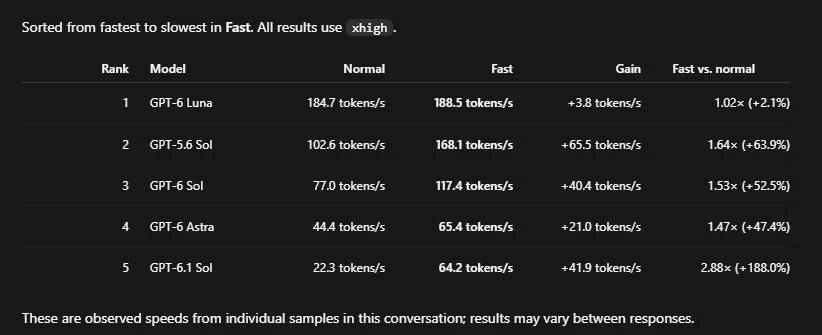
I benchmarked 5 GPT models at XHigh reasoning. Here are the results:
- GPT-5.6 Sol: 102.6 tokens/s (Normal) | 168.1 (Fast)
- GPT-6 Sol: 77.0 (Normal) | 117.4 (Fast)
- GPT-6 Astra: 44.4 (Normal) | 65.4 (Fast)
- GPT-6.1 Sol: 22.3 (Normal) | 64.2 (Fast)
- GPT-6 Luna: 184.7 (Normal) | 188.5 (Fast)
GPT-6.1 Sol is 4.6x slower than GPT-5.6 Sol in Normal mode, despite being marketed as 4–5x cheaper. Fast mode boosts its speed by 188%, but it still falls far behind GPT-5.6 Sol.
Meanwhile, the $200/month plan has reportedly lost half its previous quota, and a $500 tier has appeared.
In my experience, coding tasks that older GPT models or Claude finished in an afternoon have taken weeks with Sol 6.1 without satisfactory results. I've also seen Claude Opus 5.5 reach 300–400 tokens/s.
These benchmarks don't prove intentional throttling, but the question remains:
If a model is 5x cheaper but nearly 5x slower, while quotas shrink and speed costs extra, is it really a better deal?
I'd love to hear whether others are seeing similar results in real-world coding and agentic workflow.
🚨 OpenAI’s next big model may be facing a serious safety bottleneck.
The company has reportedly shifted 10% of its computing resources to alignment after concerns emerged around its upcoming flagship. Its more complex reasoning architecture could make the model harder to oversee, while government evaluations may delay launch by another month.
Still, OpenAI insiders reportedly expect more releases before 2027. The flagship’s timing, however, remains uncertain.
🚨 OpenAI is reportedly accelerating development of its next flagship model.
Reports suggest roughly 10% of its total compute has been redirected toward safety and alignment, especially after GPT-6.1 Astra’s release was previously held back over safety concerns.
With Meta’s latest releases adding more pressure, OpenAI may have even more reason to speed things up.
🚨Day 9:
OpenAI has introduced a new storage cleanup for ChatGPT and Codex desktop, cutting disk usage from stored app data by roughly 60%.
Not a massive change, but a welcome improvement for heavy users dealing with storage problems.
The best part? This update came straight from user feedback.
🚨 OpenAI Employee Caught Planting Recording Device Inside Office
OpenAI discovered a sophisticated recording device hidden inside one of its offices. Its AI models helped identify the device and trace it back to an employee.
The FBI moved quickly and made an arrest. The investigation is still ongoing.
Thankfully, there’s currently no indication that model weights, source code, or customer data were compromised.
The fact that AI helped OpenAI uncover a potential insider threat like this is wild.
We discovered a sophisticated recording device that was hidden inside one of our offices. We used our models to understand the device and where it had come from, identifying that a specific employee had planted it a few days earlier. We referred the matter to the FBI, and we’re grateful to the agents and prosecutors who moved quickly to make an arrest. The FBI’s investigation is ongoing and we will continue to support their work.
At this time, we have no indications of this individual inappropriately accessing or exfiltrating model weights, source code, or customer data. The employee was terminated.
We take protecting our technology, data, and people seriously, and as a matter of national importance. Our security program is designed to protect against a wide range of threat actors, from insider risks to cybercriminals to nation states, and this case is an example of how AI can help address these sophisticated security threats.
🚨Fable 5.5 or Astra 6.1?
- Fable is probably going to drop before Asta
- My guess is both of them will cut prices
- Lots of room for frontier models to improve on hard code and data analysis
Likely drop in the next two weeks. Google should drop Carbon as well
🚨 Gemini 4 Argon trails Fable and Astra, but still outperforms open-weight competition.
LiveBench 2.0 rankings show:
- GPT-6.1 Sol and Fable remain ahead of Argon 4
- DeepSeek Flash falls behind Google's latest model
- Muse Wonder scores considerably lower than Argon
- Muse only edges out DeepSeek by a small margin
These results come from LiveBench 2.0, a new benchmark built to make gaming the scores more difficult while measuring performance on real-world tasks.
The question is how these models perform outside the benchmarks.
Selected model is at capacity. Please try a different model.
Selected model is at capacity. Please try a different model.
Selected model is at capacity. Please try a different model.
Selected model is at capacity. Please try a different model.
Selected model is at capacity. Please try a different model.
Selected model is at capacity. Please try a different model.
Selected model is at capacity. Please try a different model.
Selected model is at capacity. Please try a different model.
Selected model is at capacity. Please try a different model.
Selected model is at capacity. Please try a different model.
Selected model is at capacity. Please try a different model.