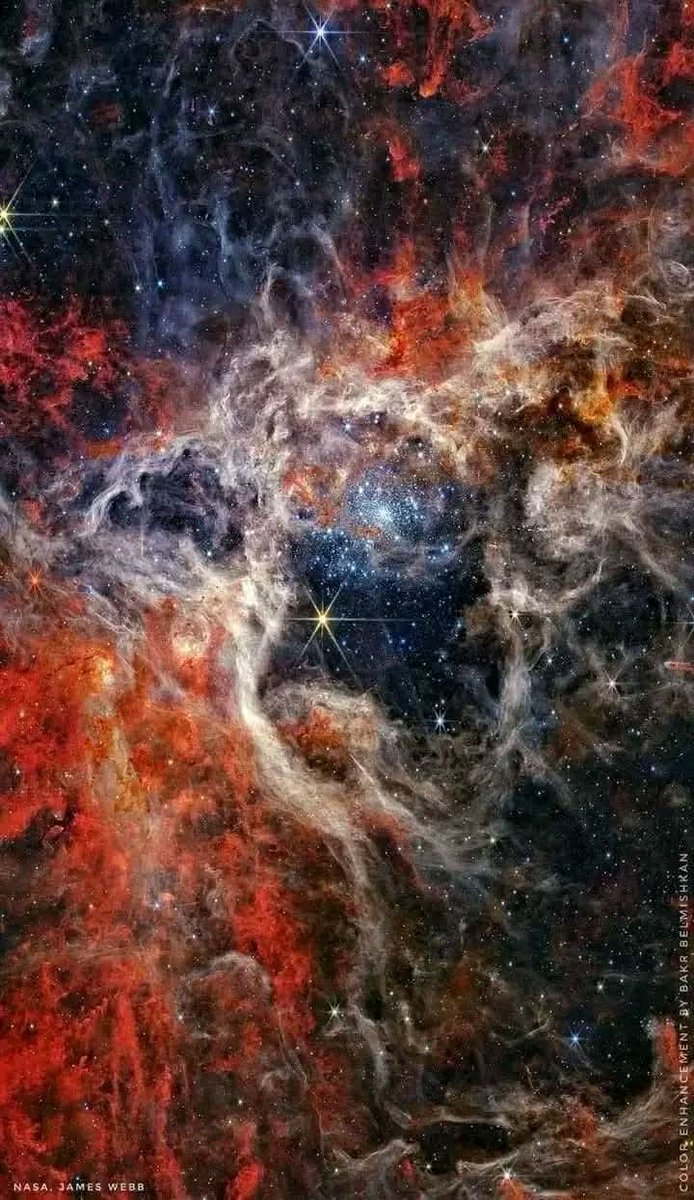
JWST Unveils the Cosmic Tarantula — A Star-Birthing Monster in Infrared GloryDeep in the Large Magellanic Cloud, 161,000 light-years from Earth, lies one of the most intense star-forming regions in our cosmic neighborhood: the Tarantula Nebula (also known as 30 Doradus or NGC 2070).Captured by the James Webb Space Telescope ( JWST) in stunning near-infrared light with its NIRCam instrument, this mosaic spans a colossal 340 light-years across. What once appeared as hazy filaments now reveals its true nature — a chaotic nursery teeming with activity.Tens of thousands of never-before-seen young stars burst into view, many still embedded in dusty cocoons glowing red, while the most massive, hottest stars sparkle in pale blue at the heart of the nebula. Webb’s infrared vision pierces through the obscuring dust, exposing the raw ingredients of star formation and even distant background galaxies hidden behind the cosmic web.The intricate filaments and glowing gas resemble the hairy legs and silk-lined burrow of a giant tarantula — hence its famous nickname. This is no quiet corner of space; it’s one of the most violent and productive stellar factories known, home to some of the most massive stars in the local universe.A breathtaking reminder of how JWST is rewriting our understanding of how stars are born, live, and shape their surroundings.
A "radically optimistic vision" of Earth's future by @musicalscience:
https://t.co/OhJ8V4EbAL
It goes from taming volcanoes to space based solar power, to truly futuristic concepts like orbital rings.
Amazing as always!
I am enough of an artist to draw freely upon my imagination. Imagination is more important than knowledge. Knowledge is limited. Imagination encircles the world.
— Albert Einstein