In the 70+ years of software languages and AI, progress was primarily about abstraction to reduce the gap between humans and machines so we can get machines to do things for us.
What does this mean in relation to allowing non-technical people to automate cognitive tasks like knowledge work?
In the 1950’s assembly language was used to code computers, requiring highly specialized engineers. Then high-level procedural languages like Fortran, Cobol and C were introduced, making it easier for engineers to code scientific and business applications.
Then C++ was introduced, using object-oriented programming – an abstraction layer that helped engineers develop and maintain complex software systems. Then Java and Python abstracted the language further to support code readability and transferability. There were various new languages introduced to support speed, safety and web systems.
However, coding software still required technical software engineers to write and maintain.
The invention of Large Language Models (LLM) in AI made it more human friendly for non-technical people to interact with machines, eg. via natural language.
LLMs also enabled ‘vibe coding’ which allowed non-technical people to create code (like Python) using natural language in order to build software apps or web sites.
However, vibe coding still requires engineers to interpret, debug, maintain the code that is generated. Importantly, these traditional software languages have been designed to build software systems and web sites. They were not designed to automate cognitive tasks which rely on thinking: reasoning, judgement, and decision heavy workflows.
A further complication is that the thinking needed to instruct computers how to automate cognitive tasks is tacit knowledge that lives in people’s heads. Eliciting this knowledge can be challenging if not done in the right way. This is especially the case for experts and professionals – their years of experience means thinking and actions have become routine and subconscious.
How do AI platforms like @CogFlowAI help?
Firstly, CogFlow uses cognitive science to elicit tact knowledge via a guided human-agent interaction in natural language. This allows people to teach the AI agent their expertise and thinking for how to perform cognitive tasks.
Secondly, CogFlow is based on a human cognitive architecture – which we call a cognitive workflow. It is effectively a new type of software language (or graph), at a level of abstraction that better reflects how people think about performing cognitive tasks (and not about developing software apps).
This is important because:
(1) it allows better translation from how people think about their work to creating cognitive workflows (code or graphs) that can be executed to automate their work; and
(2) it allows cognitive workflows to be more easily interpreted and maintained by non-technical people – i.e. updated, tested, debugged, shared, etc.
The CEO of AI company Decagon, now valued at $4.5 Billion, is a skeptic that Forward Deployed Engineers (FDE) should be needed to implement and maintain enterprise AI systems.
CEO Jesse Zhang said “Long-term reliance on an embedded engineer is evidence the software is too hard to use, not proof that deployment requires one.”
“[A] customer spent a year with Sierra’s forward-deployed engineers and built three customer service workflows in that time. Zhang described the arrangement as a black box. Any new workflow, or any deeper look inside the conversations, meant going back through the engineers, who were eventually reassigned to other accounts.”
“After switching to Decagon, Zhang said, the same customer built seven new workflows within about a month. He credits the product, which he said lets a client’s own staff, including non-technical employees, operate it directly instead of routing every change through an embedded engineer.”
This is exactly what I would have expected, which I talked about in a previous post (see link in comments).
It is not practical to rely on FDEs to implement and maintain AI agent workflows for non-technical employees to automate aspects of their work.
(Cognitive) Workflows that represent how people think, reason and break down tasks to do their work are dynamic and personalized to each individual. Employees will want to update their own workflows, create new ones for new types of work, and share their workflows (expertise) with others.
Relying on an FDE is an impractical bottleneck. AI tools should have the ability for non-technical people to create their own workflows, by capturing their tacit knowledge (expertise) that lives in their head.
This is why I’m building @CogFlowAI. It uses cognitive science to elicit tacit knowledge (expertise) from non-technical people via a human-AI agent interaction model to create what we call a cognitive workflow. Like teaching a new hire.
AI agents then use the cognitive workflows to help people automate cognitive tasks (e.g. advanced knowledge work performed by experts and professionals), as well as preserve previously inaccessible institutional knowledge.
https://t.co/ngwy3t3Cug
Data is useful, but it’s becoming commoditized, more accessible and less valuable (small incremental benefit to existing LLMs).
Knowledge is the new oil - tacit knowledge which is expertise that lives in people’s heads and not in data.
Knowledge is more valuable, rare and difficult to capture and operationalize even using highly experienced engineers, e.g. Forward Deployed Engineers (FDE).
The ability for non-technical experts to directly capture, represent and operationalize their own tacit knowledge will allow them to automate more of their advanced knowledge work and amplify their productivity.
This is the real gamechanger, not more terabytes of data.
@CogFlowAI
The tide is shifting toward neuro-symbolic AI for building more powerful AI models.
Some AI leaders acknowledge that LLM – Large Language Models like ChatGPT and Claude – alone are not enough to practically solve real world problems like automation.
LLMs are based on Machine Learning, neural networks, which train AI on data (e.g. the internet) by looking for statistical patterns. Whilst useful for interpreting or summarizing text, and retrieving stored knowledge, they have limited reasoning abilities and can be unpredictable.
Neuro-symbolic AI is where ML-based AI (LLM) is integrated with ‘traditional code’ (called symbolic AI) comprising rules, logic, procedures, variables, if-then conditions, loops, etc. Symbolic AI is deterministic (predictable) and better at reasoning and generalizing for problems where context varies.
Whilst LLMs are created by ‘learning’ from scratch using data, symbolic AI on the other hand is typically created using human knowledge – instructed (or ‘taught’) from what we already know about the world.
Unintentionally, the AI industry has gradually shifted to neuro-symbolic AI in the last 6+ months to get the LLMs working effectively, reliably and predictably.
It started with harnesses to support agent tools, memory, execution loops, and guardrails, as well as agent skills which are procedures instructing agents how to solve problems.
Then the re-emergence of ontologies, knowledge and context graphs, aka. ‘company brain’. This knowledgebase captures what things mean, facts, and relationships between objects (eg. users, customers, products), events, actions and decision traces.
Next was ‘agent loops’, a simple linear workflow (code) on how to prompt an LLM, autonomously and iteratively, until a goal (like build a software app) is achieved.
Most recently, the AI community realized that a simple linear loop without branching or if-then reasoning conditions won’t cut it, so they naturally shifted to ‘agent graphs’ and ‘graph engineering’, i.e. standard code/workflow.
How does @CogFlowAI fit in?
CogFlow provides the symbolic AI cognitive layer above LLMs – a graph based on a cognitive architecture which we call a ‘cognitive workflow’. CogFlow enables the creation of powerful neuro-symbolic AI models in agents to automate advanced knowledge work.
Importantly, CogFlow is targeted at non-technical people. Cognitive workflows are created by capturing the tacit knowledge in people’s heads (which can be challenging) via guided human-agent interaction using natural language. It’s like teaching the agent a recipe or how you want work to be done – how you think, break the problem down, reason and make choices.
Unlike traditional code, the cognitive workflow is at a suitable level of abstraction to be interpreted, tested, and audited by humans, and can also be shared and updated with new knowledge.
@elonmusk With @CogFlowAI natural language + cognitive architecture becomes the source code to automate knowledge work. Even Non-technical people can interpret, understand and build with it. Importantly it but comprises elements, logic and structure needed for procedural code.
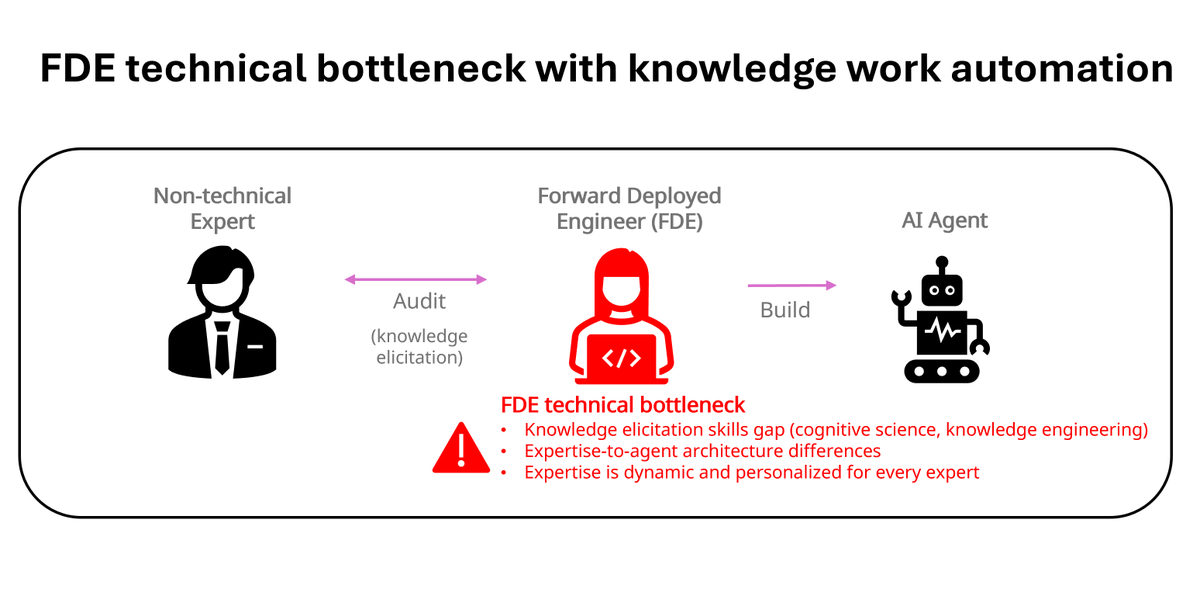
Forward Deployed Engineers (FDE) have gained popularity, helping AI companies deploy AI products into enterprise. However, the FDE model may not be practical or scalable when deploying AI for advanced knowledge work.
FDE is a customer facing engineering role aimed at deploying a highly technical product (AI, LLMs) for a non-technical customer (enterprise). The three major tasks are:
- Audit: interview staff to map out the business processes, workflows, cost, risk and business value.
- Build: develop the AI agent solution – models, prompts, evals, API/integrations with tools and data.
- Deploy: operationalize the AI system with the client, ensuring it’s used, working correctly and achieving KPIs.
For simple AI agent systems, like query-answer layer above enterprise data, or orchestration of tools, data and teams, this approach works well. It’s a standard technical solution, which engineers are good at.
However, when it comes to knowledge work, the task is more challenging.
Firstly, capturing expertise is different to capturing technical requirements. Expertise is tacit knowledge which is hard to extract without experience in cognitive science or knowledge engineering.
Even a ‘simple linear task’ can in reality be complex. There are many exceptions, failure and recovery points, decision points, judgment calls and reasoning. Even the experts themselves are not conscious of these unless they are probed effectively. This FDE experience gap can impact standardized quality across the enterprise.
Secondly, the technical process of translating expertise (cognitive knowledge) into standard code or graph can be challenging because they have different architectures.
Thirdly, expertise is dynamic and personalized. Experts will want to regularly update their AI agent with new learnt expertise. Different experts that perform the same work may do things differently. They will want to capture expertise how they like to work to amplify their productivity.
Needing an FDE between every expert and AI agent is a costly bottleneck. It’s not scalable or practical.
These are challenges I myself faced during my PhD and 20+ year career in an FDE type role capturing expertise to create AI agents for different industries and applications.
This is why I built @CogFlowAI . CogFlow removes the technical human bottleneck (FDE) between the non-technical expert and the AI agent for capturing and translating expertise.
@CogFlowAI uses cognitive science to ask the expert questions to capture the expertise (tacit knowledge). This cognitive knowledge is directly represented in a graph that uses a similar cognitive architecture (cognitive workflow) to how people describe the cognitive process. This means experts can interpret, understand, update, share, audit, test and have ownership over their AI agent’s cognitive workflows to reliably and predictably automate their knowledge work.
An emerging area in AI are knowledge graphs, context graphs and ontologies, used to capture a company’s institutional knowledge or “company brain”. The idea is to extract knowledge from unstructured data like messages, emails, and documents, and represent key data and events in a structured graph. This provides context for AI agents to improve responses to queries and for automation.
However, a critical component of knowledge capture and representation is conveniently ignored – one that is critical for advanced knowledge work automation.
It’s ignored because:
- It relies on capturing tacit knowledge which lives in people’s heads and not in the data. It must be extracted from people, i.e. knowledge elicitation.
- The knowledge is procedural and cognitive, which is difficult to formalize and represent.
To help unpack this - there are three types of (long-term) memory representing knowledge:
- Semantic memory (ontology): Describes factual knowledge and what things mean, e.g. using relationships between entities. E.g. people can represent a customer, user or employee, and ‘work at’ a company.
- Episodic memory (knowledge and context graphs): Represents historical data and events, e.g. actual users and customers, products they use, actions that were taken, and decision traces (why decisions were made, if data available). E.g. Jane is a customer and she was rejected for a loan because she has a bad credit score.
- Procedural memory (cognitive workflows, i.e. processes or ‘recipes’): Represents the procedures for how people perform cognitive tasks, including the thinking and reasoning process. This includes software code or scripts within AI agents, which can be represented either in text (code) or as a graph.
Currently, procedural memory is fragmented and represented in what the industry calls harnesses, skills, loops and graphs. These concepts have rapidly become popular because AI practitioners are rediscovering the importance of procedural memory to support intelligence and the practical application of automation for real-world problems.
Context graphs containing actions and decision traces can potentially be used to recreate procedures from existing data. However, in most cases it will be too fragmented, situation specific, and missing the cognitive model/processes (goals, intentions, and associated reasoning) needed to generalize to automate complex cognitive tasks.
Therefore, capturing procedural knowledge from humans and representing it as a graph is critical to automate advanced knowledge work.
This is what @CogFlowAI is all about. CogFlow uses cognitive science to capture expertise from non-technical experts - tacit knowledge that lives in their heads – via a guided Human-AI interaction that facilitates knowledge elicitation. Using a cognitive architecture which better maps human cognitive processes to a procedural graph, CogFlow represents this knowledge as a ‘cognitive workflow’ to allow AI agents to automate advanced knowledge work.
Achieving outstanding benchmark results by capturing the tacit knowledge (expertise) of a physicist and codifying this cognitive workflow in an AI agent.
This automates how a physicist thinks about and leverages LLMs to solve the problem.
Whether you call this cognitive workflow a harness, loop or skill - its just a (cognitive) procedure that represents the experts' judgement, reasoning and decision heavy workflows - necessary to automate their knowledge work.
@CogFlowAI
World Models are a new emerging type of AI model to help improve reasoning for applications like robotics. It’s different to the well-known Large Language Models (LLM) such as ChatGPT. However, a third critical type of AI model has been overlooked – Cognitive Models.
Large Language Models like ChatGPT train on data – text and language – to generate text in response to prompts. LLMs have been amazing for answering questions, generating code, summarizing documents, etc. However, LLMs have limited reasoning abilities needed for automation (e.g. of knowledge work).
World Models train on data like videos capturing the environment to enable AI to better understand the physical world and importantly cause-and-effect. E.g. if a box is pushed, it falls. These types of models will be critical in robotics to understand how their actions will influence the physical environment that they are in.
However, there are multiple dimensions to causation (the ‘why’) which is critical to reasoning for automation – both for the physical and digital worlds.
There is physical causation – push the box (cause, the ‘why’) and it falls (effect); or digital causation – query the database (cause) and receive the data (effect).
There is also cognitive causation – why did the person or robot push the box? What was the motive, goal, intention, or reasoning of alternative choices that led to the decision to perform the action of pushing the box in order to achieve the outcome of having it fall?
There could be many cognitive ‘whys’, such as break whatever is inside the box, turn it over to make it easier to carry, or squash a cockroach on the floor nearby. Understanding the cognitive model – the thinking - is critical to reasoning and intelligence, as is understanding cause-and-effect of actions in the digital or physical world as a result of those actions.
At CogFlow, we are building the Cognitive Model. Based on cognitive science and using a cognitive architecture, we allow AI agents to represent, reason and think at the cognitive level, in order to automate cognitive work – whether in the digital world (e.g. knowledge work) or the physical world (eg. robotics). Importantly, CogFlow allows the capture of tacit knowledge via guided interaction between people (e.g. experts) and AI agents to populate these cognitive models.
Whilst Large Language Models and World Models will be instrumental in intelligence and automation in the future, Cognitive Models will be a critical piece of the AI puzzle.
Excellent article by Thinking Machines who have raised $2 Billion, shared by their CEO Mira Murati (former OpenAI CTO) – “The future worth building is human”. The following says it all:
“Most AI in use today is trained in a handful of places and then frozen. It isn’t shaped by the people it serves, and doesn’t learn much from the work they do together. Extending human will and judgment calls for AIs as diverse and distributed as people themselves are. This is the path we have chosen.
…. We believe the future worth building is human — shaped by human knowledge, guided by human will, and decided by human judgment.”
The article highlights that AI models (LLMs) are generalized, centralized, with average intelligence. In the real-world people/organizations and their knowledge are decentralized and specialized. It also tacit knowledge that lives in people’s heads, so is not in the training data or represented in these AI models.
Knowledge transfer via what ThinkingMachines call ‘interaction models’ between humans and their AI agent is critical to make AI agents useful for people and organizations – intelligent, personalized, specialized, and proprietary. Both humans and AI together can amplify intelligence and capability, not AI alone. Interaction models can also enable the transfer of tacit knowledge (eg. expertise) that lives in people’s head to AI agents that can leverage that knowledge.
At @CogFlowAI, we have the same philosophy. We use cognitive science to create a guided interaction model between human and AI to capture tacit knowledge from non-technical experts. We then represent this knowledge using a cognitive architecture (cognitive workflow) in order to automate advanced knowledge work.
This allows people to leverage AI to automate chosen aspects of what they do, exactly how they like to do it, making their work easier and faster, amplify their productivity, and thus making them more valuable. We already see this with vibe coding for software engineers. I expect to see this expand to other areas of knowledge work.
I’m excited to see how Thinking Machines will progress and compete with some of the established ‘centralized and data-centric’ AI companies, as I love the ‘decentralized and knowledge-centric’ direction Thinking Machines are taking.
https://t.co/19ALTNQH5e
A key topic at AI Engineering World Fair in San Francisco was AI ‘Loops’ and ‘Loop Engineering’. This is not new. Loops are basically ‘traditional’ AI agents (before LLMs), and the loop itself is a cognitive workflow, or procedure, that captures and automates how software engineers vide code software.
What is a loop? A loop is when you give an agent a goal, and the loop prompts the coding agent (rather than the human prompting it) and continually iterates until the goal is achieved. This pretty much defines what an intelligent and autonomous AI agent is.
The loop, or cognitive workflow, at a high level is:
Reason & Decide -> Act -> Observe and Verify -> Repeat until the goal is achieved
The key steps in Loop Engineering are:
- Reason & Decide: the cognitive workflows that describe the steps, reasoning, and judgement calls (eg. agent skills) that the software engineer generally makes to perform the cognitive task to get closer to its goal; and
- Verify: a reliable check to know when the goal has been reached to stop the loop.
The recent popularity of Loops and Loop Engineering highlights the importance of cognitive workflows to support LLMs, and their role in capturing and automating how experts, professionals, or knowledge workers like software engineers do their work.
Importantly, these cognitive workflows will differ from expert to expert and enterprise to enterprise – it defines their unique intelligence and edge, i.e. their alpha.
Whilst it may be easier for software engineers to capture and code this tacit knowledge to automate software development, experts in other fields like finance, accounting, HR, sales, etc., are not technical. This makes it challenging to both capture and code their tacit knowledge in a way that makes sense to them.
This is why I developed @CogFlowAI . Cognitive science is used to help capture tacit knowledge from non-technical experts via guided natural language dialogue (like experts teaching a new hire). A cognitive architecture is then used to represent and automate this cognitive workflow in an AI agent – with the benefit of capturing, sharing and enhancing this institutional knowledge.
Excellent points from Microsoft CEO Satya Nadella: create ‘learning loops’ to ensure businesses don’t allow AI firms to capture all the value and lose ownership of their knowledge.
Winners won’t be those with the most advanced models, but rather those that “create a unique learning system built on their own expertise, decision-making processes, and institutional knowledge”
“every company should focus on building what he calls ‘human capital and [AI] token capital’. While human capital comprises the knowledge, judgment, relationships, ingenuity, and pattern recognition of its people, token capital is the firm's AI capability that it builds and owns.”
“Nadella argues that the key differentiator is a ‘learning loop’, a system that records interactions, feedback, and results, and continuously uses that information to improve AI performance for a specific business. … every organization can own the learning loop that encodes its institutional knowledge, compounding its human and token capital.”
Absolutely agree. A key component of the ‘learning loop’ includes encoding expertise that drives knowledge work - tacit knowledge that lives in people’s heads and not in data.
The transfer of tacit knowledge from people to AI, together with human oversight and control (goal setting, review, feedback), means:
- businesses can preserve, own and leverage institutional knowledge, without giving this valuable knowledge away to AI firms,
- experts and professionals can amplify their productivity – making their work easier and faster, and people in this learning loop more valuable.
This is why emerging AI platforms like @CogFlowAI are so important. It uses cognitive science to capture, encode and automate expertise (tacit knowledge) via guided human-AI interaction and knowledge transfer.
https://t.co/l2UqyUw1B8
Microsoft launches Scout, an OpenClaw-inspired personal assistant – and the VP says “…expects the real value to be in the skills users develop on their own”. Exactly!
The value and utility of personal AI agents are in enabling users to instruct, or ‘teach’, the agent how they like things done.
Includes how the user makes judgements, how they reason between options or choices based on their personal preferences or experience, and the decision heavy workflows and goals that they follow to get the task done their way.
The AI agent is not going to find these skills already predefined in AI models (LLMs), or generic off-the-shelf skill files, or in the users’ personal data – emails, messages and documents. Its tacit knowledge and lives in the users’ heads.
Users are typically non-technical, so they are not interested in creating skill files, which are insufficient anyway for many cognitive tasks.
Teaching an agent a new skill should be as natural as teaching a human personal assistant how you like things done – in natural language and a natural structured 2-way dialogue that makes sense.
This is what @CogFlowAI is all about.
https://t.co/DUMfzWsgWu
Bain & Co: 40% of executives thought AI could save up to 20%. It didn’t deliver.
Compute and usage costs for AI have increased. Companies like Amazon and Uber have had AI spend get out of control. This has forced companies to focus more on ROI and financial returns over product roadmaps.
“[AI] also created a new genre of workplace inefficiency … dubbed “workslop”: low-quality content that looks slick, but has little substance.”
As the cost of AI (tokens) increase to account for the real cost of delivering AI (LLM), I suspect:
- There will be a shift to applying AI to higher value problems, like more advanced knowledge work and cognitive tasks performed by experts/professionals. This will allow the productivity gains to justify the actual price of AI.
- More advanced cognitive techniques will emerge to augment LLMs that can actually automate knowledge work with predictability and reliability. Because LLMs with some simple skill files and better context (e.g. RAG, knowledge/context graphs, in the absence of expert tacit knowledge) are not going to cut it.
@CogFlowAI
https://t.co/nteAqsWceR
Global law firm Kirkland & Ellis are spending $500M to create their own legal AI, presumably to compete with AI companies Harvey and Legora.
As Aaron states on LinkedIn “how you develop competitive advantage when your competitor has access to the same AI models and intelligence as you? The companies that are able to best harness their internal institutional knowledge, existing data assets, and domain-specific workflows — connected with AI -- will be those that are able to stay ahead in the future.”
Everyone has lots of data. Enterprise most valuable asset are the experts, the people, the internal institutional knowledge (expertise).
However this tacit knowledge lives in the legal expert’s minds. The human judgement, reasoning and domain-specific (decision heavy) workflows accumulated over many years throughout the organization.
Companies that can capture and automate that expertise to amplify their productivity, making their work easier and faster, will have the competitive advantage.
@CogFlowAI
Exactly. Such an obvious missing piece to enable AI knowledge work automation but conveniently overlooked because the solution is different to how AI problems are typically solved – which is analyzing stored data rather than using cognitive science to capture stored knowledge.
Expertise that drives knowledge work, things like judgement, reasoning, decision heavy workflows, is not stored in data, it is tacit knowledge and stored in people’s heads.
Expertise is not typically general – it is specific to the person, the role, the team, the company, and can separate a good expert from a bad expert.
Expertise is a different type of data – its cognitive data – representing goals and intentions, procedures and reasoning for how cognitive work is performed. This is more complex than linear task based representation used in agent skill files.
Importantly, you can’t simply monitor or watch how people perform work (e.g. mouse clicks, or final decisions made in stored data) because that data is behavioral which is the outcome, and not cognitive that includes decisions made for what purpose/goal and how choices were made that led to that action.
Emerging platforms like @CogFlowAI use cognitive science to capture expertise to automate knowledge work – by interacting with people/experts to transfer the tacit knowledge from their heads into AI agents in order to automate knowledge work. It's like teaching a new hire and includes capturing and representing the complex cognitive data.
We are transitioning from Data-Driven AI to Knowledge-Driven AI to enable knowledge work automation.
Great article: Why AI Agents in Enterprise Run Into a Knowledge Problem, Not a Technology One
“…companies [are] passing incomplete data to their agents. As a Doctor of Pedagogical Sciences, I view this as a knowledge transfer problem. If a person cannot explain how they make decisions, their logic cannot be transferred to a new employee — let alone to an AI agent.”
Companies believe employee knowledge is stored in Confluence, SharePoint, Slack, etc, however “one crucial element is missing — the knowledge that lives in people’s heads. Knowledge that no one has ever written down”
“Cognitive scientists refer to this phenomenon as tacit knowledge — implicit knowledge that even its holder may not be fully aware of. This is why the bottleneck does not arise at the level of access to documents, but at the stage of converting expert experience into a format suitable for training an AI agent.”
“In knowledge management, this process is called externalization — converting tacit knowledge into explicit knowledge. In other words, a company needs to understand not only what an expert does, but how they think. This is typically done through a series of in-depth interviews with a top expert. Alongside them should be someone skilled in asking the right questions”
“Here, AI can help significantly: transcribing interviews, grouping similar cases, turning expert explanations into draft scenarios, and generating situations for validation. However, the final structure still needs to be reviewed and approved by the expert.
The result should be a working knowledge corpus. It can be used in two directions at the same time — to train new employees and to configure an AI agent. Both scenarios rely on the same foundation: structured experience from top specialists.”
Couldn’t have said it better myself. This is what @CogFlowAI does. Uses cognitive science to guide experts in teaching AI how they think and reason to perform tasks, using natural language. This process creates a cognitive workflow which AI agents can use to automate knowledge work – cognitive tasks with multi-step decision heavy workflows, human judgement and reasoning.
https://t.co/NL0FvAoeYS
Anthropic is pushing further into the AI legal services industry, competing with other AI legal startups such as Harvey ($11B valuation) and Legora ($5.6B valuation).
“Claude is making a deeper push into knowledge work, with the legal sector emerging as one of its most significant and fastest-growing industries.”
Makes sense that Anthropic will push hard in legal. Like coding, there is extensive data to train the AI (LLMs) and it is heavily language based. The LLM does a lot of heavy lifting.
However, other areas of knowledge work like banking, insurance, finance & accounting, real estate, back-office functions (e.g. HR, operations), healthcare, etc., will be more challenging.
Other types of knowledge work is less about language and more about multi-step decision heavy workflows, human judgement and reasoning.
LLMs are not great at reasoning.
Importantly, expertise needed to perform knowledge work is not documented - its tacit knowledge and is in the experts’ heads. It is not in the LLM training data. It is not in the messages, chats and emails that can automatically populate agent context/prompts.
This cognitive workflow (or ‘skill’) needs to be captured directly from the experts. It needs to represent how specific experts in specific companies perform the knowledge work (not just an ‘average of the expertise’). For most knowledge work, the cognitive workflow is more complex than the linear and simplistic skills used in today’s agents.
Therefore, whilst Anthropic may be doing well in legal and coding, entering other types of knowledge work which experts and companies alike can practically use ‘out of the box’ will be challenging.
A more practical solution is providing the ability for agents to capture expertise (tacit knowledge), create more comprehensive 'cognitive skills' (aka cognitive workflows), which can then be used by AI agents to practically automate other types of knowledge work.
@CogFlowAI
https://t.co/pfFAML6p7U
Has AI (LLM) already reached AGI? I would like to pose another question:
Has an LLM achieved AGI in a deserted forest if there is no one around to hear it hallucinate?
What does this deep philosophical question mean? I have no idea.
But the answer is no – we have not achieved AGI.
LLMs are like a new hire: intelligent, capable, lots of potential.
If you want a new hire to perform specialized tasks, like knowledge work, you get your experts to train or teach them. These incudes the decisions, reasoning, judgements, goal-directed procedures, i.e. you teach them the cognitive workflows.
What is taught is the tacit knowledge that lives in expert’s heads and is not documented.
AI agents are like new hires – they need to be taught the cognitive workflows by experts.
This is the idea behind AI agents ‘skills’, which is gaining popularity since Anthropic introduced them last year. Skills are instructions given (taught) to AI agents that explains how to perform tasks.
However, skills in their current form are limited. They are simple, task-based and linear, and mostly suited for trivial tasks.
For non-trivial knowledge work, skills need to be represented by a more comprehensive ‘cognitive workflow’ that better models how people think and reason about performing complex cognitive tasks.
@CogFlowAI
We are transitioning from Data-Driven AI to Knowledge-Driven AI to enable knowledge work automation.
There have always been two competing approaches to AI:
- data-driven AI like machine learning, LLMs, RL where AI is given a clean slate and learns everything on its own using data; and
- knowledge-driven AI where AI learns from humans, encoding hand-crafted rules, logic and procedures (workflow) about a problem domain.
They both have pros and cons, and are suited to different problems. My first startup used knowledge-driven (cognitive) AI to predict consumer behavior in new markets where there was limited data to train AI. My second startup used data-driven AI (deep learning) to assess images of embryos to predict their viability to improve pregnancy outcomes for IVF patients.
However, many researchers and practitioners claim that their approach is the right way, the only way to solve all problems.
That’s why you see data-driven (LLM) AI leaders and companies claiming they will soon create AI that can solve all the world’s problems (AGI). They just need more data, more data centers, more energy and a gazillion dollars. I’m a skeptic.
I believe that today’s data-driven LLMs are so powerful and useful because they also leverage extensive knowledge:
- text used to train LLMs comprises knowledge that people globally have documented about all topics,
- thousands of human data-labelers have injected knowledge to guide the LLMs training and outputs,
- recent leak by Anthropic shows LLMs leverage a lot of code (procedures and rules).
LLMs are great for language-based problems like query-answer, helping with an email, and summarizing a document. However, they have limitations when it comes to knowledge work.
LLMs have limited reasoning capability, and thus are not well suited to multi-step decision heavy workflows.
Knowledge work involves expertise like human judgement. This tacit knowledge is in people’s heads and hard to extract. It’s not documented in the data used for LLM training or context – documented data is typically behavioral and not cognitive.
Different people or businesses like to solve the same problem in different ways, e.g. good expert vs bad expert. A generalized LLM solution is not always appropriate.
Some leaders in the AI industry have recognized that you can’t just give an LLM a task and expect it to reliably figure out how to solve it. LLMs need knowledge (workflow) on how to solve the task, called ‘skills’.
Knowledge-driven AI is critical to leverage the true power of LLMs. We are already starting to see the emergence of new tools that help capture tacit knowledge (expertise) directly from those that hold it, e.g. non-technical experts.
Captured expertise can then form a new type of skill, which I call ‘cognitive workflows’, to allow AI agents to reliably automate knowledge work for businesses and consumers.
@CogFlowAI