@HynekCigler I don't necessarily think the fit is *too* good, if we look at other professional tests and their reported hierarchical CFA fit indices from their respective manuals, they're very similar.
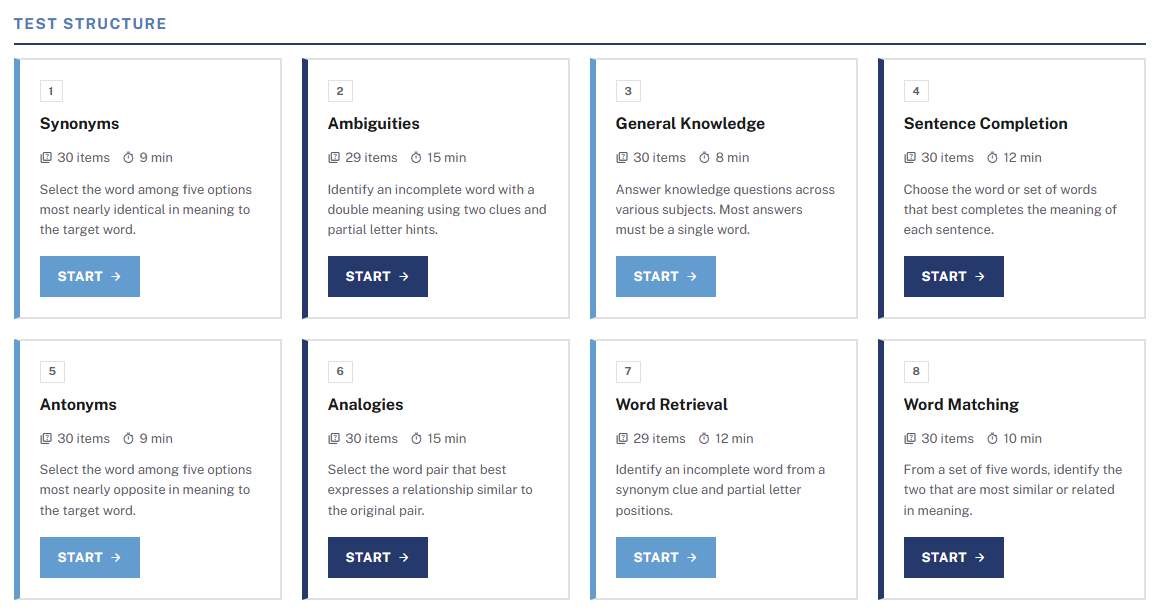
The Verbal Intelligence Scale for Adults (VISA) is a battery of eight subtests designed to assess general verbal intelligence. All subtests are composited into a single Verbal IQ score (the Verbal Comprehension Index; VCI), reflecting an individual's overall verbal ability.
By measuring verbal reasoning, abstraction, recall, and breadth of knowledge, the VISA aims to provide a highly accurate and comprehensive evaluation of verbal ability.
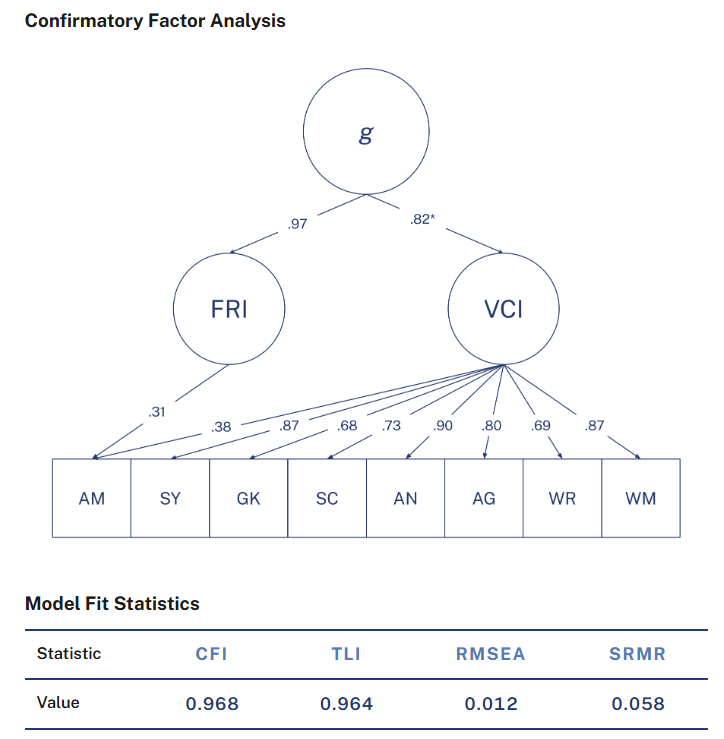
Validity data has now been released on the VISA (see attached figures). We found that VISA has a g-loading of .81 (corrected for SLODR). Additionally, the VISA has been renormed for the first time.
Overall, the evidence suggests that the VISA is a strong measure of verbal ability. You can take the VISA and check out its validity here:
https://t.co/9iIbQAynFb
We never made the claim that IQ is the “master variable” and showing "that within an already-selected top 1% sample, higher scorers have better average outcomes" exactly demonstrates how IQ explains success.
"Notice what’s missing: most high-IQ kids never get patents, doctorates, or elite academic jobs." This is a non sequitur and doesn’t undermine the point. Predictive variables don’t predict outcomes deterministically, for example, most smokers do not get lung cancer, yet, smoking still predicts lung cancer. The fact that most high IQ people don't become patent holders says nothing about whether IQ predicts patent production.
“...conscientiousness, ambition, family background, opportunity, health, and luck still explain enormous amounts of variance.” Yes, all of the listed factors explain variance in success, but this is perfectly compatible with IQ being highly predictive. The existence of multiple predictors to success doesn’t undermine IQ’s predictive validity.
Common misconception: “IQ doesn't measure anything meaningful beyond 120 IQ and is only good for telling apart intellectual disability."
To the contrary:
The Study of Mathematically Precocious Youth (SMPY) has tracked thousands of adolescents who scored in the top 1% (135 IQ; 390 or higher SAT-M at age 13) since the early 1970s.
The top quartile of this already-elite group went on, by their early 30s, to earn patents at roughly six times the rate of their peers in the bottom quartile, secure tenure-track jobs at top 50 research universities eight times as often, and have incomes in the top 5% of incomes nationwide three times as often (and more, as the attached graph shows).
These widening gaps, captured 20 years after the initial testing, show there is no loss in predictive power beyond some threshold of IQ, and that IQ can predict rarer and more prestigious accomplishments later on (Lubinski, 2009).
I gave some thoughts below on the VCI loadings and the SLODR correction, which you may be interested in:
https://t.co/cbfvgoWOVK
While I agree the SLODR correction is debatable, I believe its necessary to ensure comparability with other VCI tests which are normed on the general population.
We discuss the VCI factor's deflation in great detail in our Preliminary Technical Report.
The VCI subtests do not seem to be less g-loaded due to some fault of the test construction or administration, but rather reflect properties of the sample's high ability (~120 avg. FSIQ).
Not due to poor test construction because:
1. The verbal subtests are still highly correlated with other validated measures of verbal ability, such as the GRE-V, SAT-V, etc.
2. Factor analyzing other verbal tests in conjunction with the CORE battery reveals that the same effect applies to the verbal factor they fall under.
3. IRT analysis supports excellent discrimination and good spread of difficulty.
Not due to poor administration either, as attempts are thoroughly vetted for cheating and unfocused behavior.
Therefore, the deflation of the VCI factor is likely due to Spearman's Law of Diminishing Returns (SLODR), which posits that "the influence of 'general intelligence' on cognitive task performance decreases as a person's overall intelligence or skill level increases".
Our sample is of very high ability, centered at roughly ~120 IQ, and the middle 98% of the sample ranges from 80-160 IQ, which will influence our measurement of g and its subordinate broad factors, and exactly where SLODR would predict the influence of g decreases, while the influence of broad factors (such as VCI) increases.
While we had validated VCI tests to compare CORE VCI with, we don't have similar equivalents for CORE WMI, so I cannot make as detailed a hypothesis for it. But it is reasonable to assume SLODR is at play here as well, as CORE WMI's administration is very closely in alignment with WAIS-5's WMI administration.
CORE PSI isn't more g-loaded than WAIS-5 PSI; it's equivalent. The attached table has a comparison between CORE and WAIS's PSI indices. However, if VCI and WMI are affected by SLODR, it is a matter of speculation why CORE PSI seems to be entirely unaffected.
You can read the full technical report here: https://t.co/qXzl3JSSv4
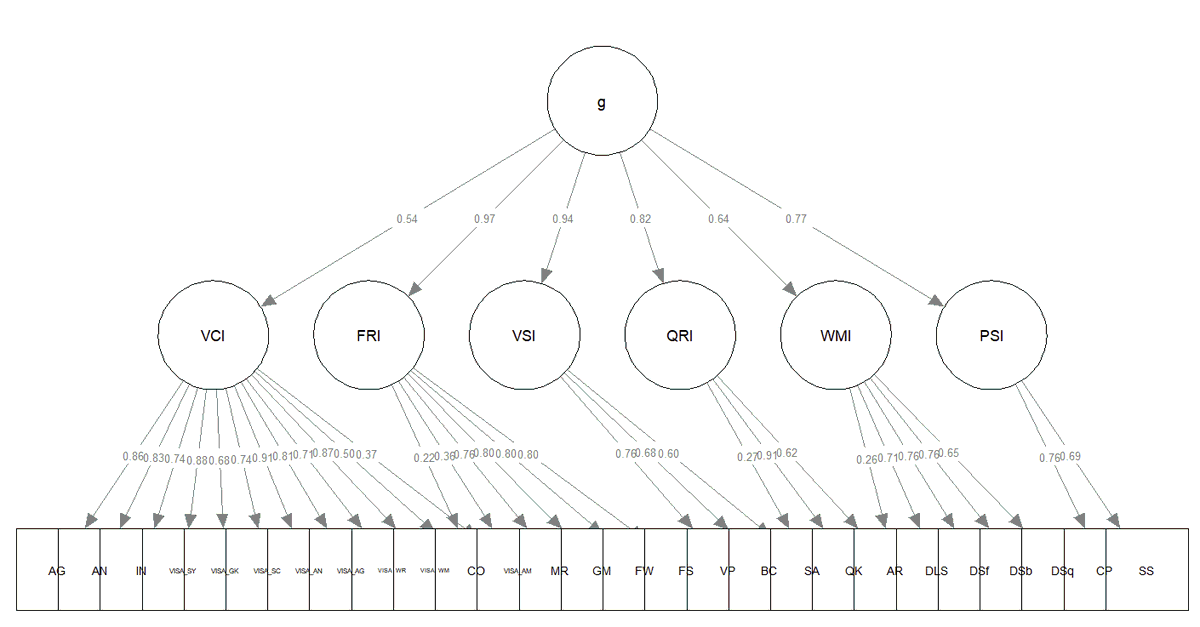
@HynekCigler As mentioned, the figure used was a simplified diagram showing only the relevant VISA subtests.
Here's the full higher-order model.
The fitted model converged normally after 197 iterations (N = 14,495) and showed excellent fit:
CFI = .968
TLI = .964
RMSEA = .012
SRMR = .058
You're describing a statistical artifact known as range restriction, which does reduce correlations when you select a narrow ability range. This is a real issue when you try to analyze the high range of a sample which is centered at the average range.
But range restriction is not the same thing as the construct itself (intelligence) losing validity in the high range.
If IQ really stopped mattering above some threshold, then among SMPY participants (who were already in the top 1%) higher scorers shouldn't systematically outperform lower scorers. But here, we can see that the highest-scoring quartile produced significantly more patents, publications, doctorates, and had higher incomes.
What you're mentioning is a real phenomenon, which is why studies like SMPY are valuable because they aim to address the problem of range restriction and show that intelligence remains predictive even among the top 1% by examining an already highly gifted sample.
@CL0CK_WORK Yeah, I would generally predict your fluid reasoning is stronger than your crystallized if AM was your highest subtest, but ofc, it is hard to tell from just one subtest.
What other completely independent metrics? Patents seem quite good, and the top quartile far outperforms the third quartile in that respect.
"Moreover, although number of patents measures only one of the many qualitatively diverse forms of creative expression, Huber (1999) has argued that patents are among the most objective criteria available for quantifying genuine manifestations of creativity in science and technology. Securing tenure at a top university reflects another form of creativity; candidates are evaluated internally and externally by leaders in the field for outstanding contributions to their discipline."
https://t.co/duBRfrS571
The SATs before 1994-2005 were a great IQ test that loaded very highly on general intelligence.
As pointed out by Frey & Detterman (2004):
"...it is evident from these results that there is a striking relation between SAT scores and measures of general cognitive ability. In fact, when one examines the results in [Fig. 2.], especially those in the ASVAB column, it appears that the SAT is a better indicator of g, as defined by the first factor of the ASVAB, than are some of the more traditional intelligence tests."
Further reading: https://t.co/6DAutf8iPn
Also, the SMPY shows no threshold effects even past the top 0.01%. Over 50% of SMPY sample members with IQs of 156 or higher earned doctorates, while “only” 30% of the top 0.5% (IQ of 139 or higher) earned a doctorate.
Professionals recruited by the US Army created the AGCT. The Educational Testing Service (ETS) created the GRE. These tests were normed on millions of people from the general population, and the IQ norms are derivable from publicly accessible data. And these tests have already been proven to be highly g-loaded. What are you talking about?









![CognitiveMetric's tweet photo. The SATs before 1994-2005 were a great IQ test that loaded very highly on general intelligence.
As pointed out by Frey & Detterman (2004):
"...it is evident from these results that there is a striking relation between SAT scores and measures of general cognitive ability. In fact, when one examines the results in [Fig. 2.], especially those in the ASVAB column, it appears that the SAT is a better indicator of g, as defined by the first factor of the ASVAB, than are some of the more traditional intelligence tests."
Further reading: https://t.co/6DAutf8iPn
Also, the SMPY shows no threshold effects even past the top 0.01%. Over 50% of SMPY sample members with IQs of 156 or higher earned doctorates, while “only” 30% of the top 0.5% (IQ of 139 or higher) earned a doctorate.](https://pbs.twimg.com/media/HKE0h83WQAA06xZ.png)


