We are a team of developers and data scientists who are passionate about technology. Our mission is to help you build the skills you need to change the world.
AI is becoming more capable than simply answering questions.
Modern AI agents can use tools, access information, and reason through tasks to provide more useful and informed results. As these systems continue to evolve, understanding how they work is becoming a valuable skill for developers and technology professionals.
In this guided project, you'll learn how to build a tool using AI writing assistant powered by Model Context Protocol (MCP), LangGraph, and OpenAI. You'll explore how custom Python tools can be exposed through an MCP server and then discovered and used by a LangGraph ReAct agent.
What you'll learn:
🛠️ Build custom MCP servers with FastMCP
🤖 Create tool using agents with LangGraph
🔗 Connect MCP servers and agents using LangChain MCP Adapters
🐍 Expose Python functions as AI callable tools
📝 Build a writing assistant that can analyze content and provide evidence based feedback
You'll also gain hands on experience with MCP, an emerging standard for connecting language models to external tools and data sources, along with LangGraph's approach to building stateful AI agents that can reason through tasks and make use of multiple tools.
Whether you're a Python developer, AI engineer, or someone interested in agentic AI systems, this project provides a practical introduction to the technologies helping shape the next generation of AI applications.
Start here 👉 https://t.co/3Rf2N87z2Z
#ArtificialIntelligence #GenerativeAI #AgenticAI #LangGraph #Python #IBMSkillsNetwork
AI assistants are becoming an important part of how people interact with technology.
From virtual assistants and customer support systems to smart devices and accessibility tools, AI powered voice applications are helping make technology more intuitive and accessible.
In this guided project, you'll learn how to build your own AI voice assistant using GPT 3 and IBM Watson technologies. You'll explore how speech can be converted into text, processed by a language model, and turned back into spoken responses.
What you'll learn:
🎙️ Build an AI voice assistant with Python
🗣️ Convert speech into text and text into speech
💬 Integrate GPT 3 to understand and respond to user questions
⚙️ Combine multiple AI services into a complete application
By the end of the project, you'll have a working voice assistant and a stronger understanding of how conversational AI systems are built.
Whether you're interested in AI, software development, chatbots, or voice applications, this project offers a practical introduction to some of the technologies powering today's intelligent assistants.
Start here 👉 https://t.co/wNeatRCwcz
#ArtificialIntelligence #GenerativeAI #Python #Chatbots #AIAssistants #IBMSkillsNetwork
Every successful business decision starts with understanding the numbers behind it.
Financial analysis is more than reading reports. It's about evaluating performance, identifying opportunities, forecasting outcomes, and turning data into informed business decisions.
In this course, you'll learn how to:
📊 Analyze financial statements and key performance metrics
📈 Build financial models for forecasting and planning
💰 Apply valuation techniques used in finance and consulting
📑 Create reports and recommendations backed by data
You'll also explore scenario analysis, cash flow evaluation, and business performance assessment through practical exercises designed to strengthen your analytical thinking.
Upon completion, you'll earn a shareable certificate that can be added to your LinkedIn profile, resume, or portfolio to demonstrate your knowledge of financial analysis and modeling.
Whether you're interested in finance, consulting, business strategy, or analytics, this course provides a strong foundation in the tools and techniques used to support data driven decision making.
Explore here 👉 https://t.co/sOZuVCq7QS
#FinancialAnalysis #FinancialModeling #BusinessStrategy #FinanceSkills #CareerGrowth #IBMSkillsNetwork
Language models become far more useful when they can interact with tools, data, and external services.
Instead of only generating text, modern AI systems can search for information, retrieve content, analyze data, and perform specific actions through tool calling.
In this guided project, you'll learn how to build and execute your own tools for LLMs while exploring concepts such as:
🔹 Custom tool development
🔹 Tool calling workflows
🔹 Content and metadata retrieval
🔹 LLM decision making
🔹 Python based AI applications
Understanding how language models use tools is an important step toward building more capable AI assistants and agentic applications.
Explore the guided project and start building your own tools for LLMs.
Start here 👉 https://t.co/1CUzgdB7fG
#ArtificialIntelligence #GenerativeAI #AgenticAI #ToolCalling #Python #IBMSkillsNetwork
Some of the most important ideas in artificial intelligence can be learned through a simple game.
TicTacToe may look straightforward, but it provides a great introduction to how AI agents learn from experience, evaluate outcomes, and improve their decision making over time.
In the guided project Build Your Own Unbeatable TicTacToe AI, you’ll learn how an AI agent improves its decision making through experience, using Python, OpenAI Gym, and the Monte Carlo Method.
Along the way, you’ll explore:
🧠 Reinforcement Learning fundamentals
🐍 Training AI agents with Python
🎮 Working with OpenAI Gym environments
🎯 Applying Monte Carlo techniques for decision making
📈 Evaluating and improving agent performance
Reinforcement Learning powers many modern AI systems by allowing agents to learn from interactions and improve their actions over time. Instead of following a fixed set of instructions, an agent receives feedback from its environment and gradually discovers which strategies lead to better outcomes.
This guided project introduces these concepts through a familiar game, making it easier to understand how intelligent systems learn, adapt, and optimize their performance. By building and testing your own TicTacToe AI, you’ll gain practical experience with core machine learning ideas that can be applied to more advanced AI applications.
Whether you’re exploring artificial intelligence for the first time or expanding your technical skills, this project offers a hands on way to understand the foundations behind intelligent decision making.
Start building your own TicTacToe AI 👉 https://t.co/gwGURuKvdZ
#ArtificialIntelligence #MachineLearning #ReinforcementLearning #Python #OpenAIGym #AIProjects #DataScience #LearningByDoing #TechSkills #IBMSkillsNetwork
Every business has challenges. The difference is how they approach solving them.
The organizations that consistently make better decisions aren’t always the ones with the most data. They’re the ones that know how to break down problems, evaluate options, and turn insights into action.
Those skills are becoming increasingly valuable as AI accelerates research, analysis, and access to information.
That’s why management consulting thinking is becoming relevant far beyond traditional consulting roles.
The IBM Management Consultant Professional Certificate on Coursera helps learners build practical skills in structured problem solving, business analysis, strategic planning, financial modeling, process improvement, data visualization, and AI assisted consulting workflows.
You’ll also learn how to communicate recommendations, evaluate business opportunities, and approach complex challenges with a more structured mindset.
Whether you’re interested in consulting, business strategy, analysis, or leadership, this program provides a strong foundation to build from.
Start here 👉 https://t.co/peH2KvsY6b
#ManagementConsulting #BusinessStrategy #ArtificialIntelligence #ProblemSolving #DecisionMaking #OnlineLearning #CareerDevelopment
What if a game could adapt to every choice you make instead of forcing you through the same fixed story every time?
Interactive story games have always been fun, but most still follow fixed paths and predictable choices. With modern AI workflows, stories can become much more dynamic, responsive, and immersive.
In this guided project, you’ll learn how to build an adaptive pick your path game using LangGraph, OpenAI’s GPT models, and structured outputs with Pydantic. Instead of relying on fixed choices and scripted paths, AI can help create stories that evolve naturally based on player decisions.
You’ll also explore how AI agents can be used beyond chatbots by applying them to interactive storytelling and game logic. The project introduces concepts like stateful workflows, conditional routing, structured LLM outputs, and dynamic scene transitions in a way that feels creative and hands on.
By the end, you’ll have a working AI powered game system that can respond to different choices and create unique story experiences every time someone plays.
A great project for developers interested in AI agents, LangGraph, GPT workflows, Python, and interactive applications.
Start here 👉 https://t.co/5d9wQ5p1Hj
#ArtificialIntelligence #AIAgents #Python #LangGraph #GenerativeAI #AIProjects #IBMSkillsNetwork
A lot of people try learning JavaScript by memorizing syntax, but things usually start making sense once you actually build something interactive yourself.
Games are one of the best ways to practice programming because they combine logic, user interaction, and dynamic updates all in one project. Even a simple game like Rock, Paper, Scissors introduces concepts that are used across modern web development.
In this hands on project, you’ll recreate the classic Rock, Paper, Scissors game using JavaScript while learning how interactive web applications work behind the scenes.
You’ll explore concepts like:
• variables and conditional logic
• functions and event handling
• DOM manipulation
• updating content dynamically on the page
• handling user input and game outcomes
• building interactive browser experiences
You’ll also see how JavaScript connects directly with HTML and CSS to create responsive and engaging applications that react to user actions instantly.
What makes this project especially useful is that you are not just reading theory or watching examples. You are actively building and testing functionality step by step, which makes it much easier to understand how JavaScript is actually used in web development.
If you’re getting started with JavaScript or want a more practical way to improve your coding skills, this is a fun project to build and experiment with.
Explore here 👉 https://t.co/kLyeiOHfwO
#JavaScript #WebDevelopment #CodingProjects #LearnToCode #FrontendDevelopment #Programming #IBMSkillsNetwork
Trying to decide what movie to watch usually ends up taking way longer than expected.
That’s why recommendation systems have become such a huge part of modern apps and platforms. From Netflix and YouTube to Spotify and online shopping platforms, recommendation systems help personalize content based on user preferences and behavior.
In this guided project, you’ll learn how to build your own movie recommender using Django. Instead of only learning the theory behind recommendation systems, you’ll actually create a working web application that suggests movies based on previously watched content.
You’ll also get hands on experience with:
• Django web development
• building personalized recommendation systems
• structuring backend logic
• working with Python and web frameworks
• creating a simple but effective recommendation algorithm
One of the best parts about this project is that you do not need advanced machine learning knowledge to get started. The recommendation system used here is simple, practical, and easy to understand, making it a great introduction to how personalized recommendation engines work behind the scenes.
If you’re interested in Python, Django, backend development, or recommendation systems, this is a great project to explore.
Explore here 👉 https://t.co/xg3pJHuwsH
#Python #Django #MachineLearning #WebDevelopment #AIProjects #DataScience #IBMSkillsNetwork
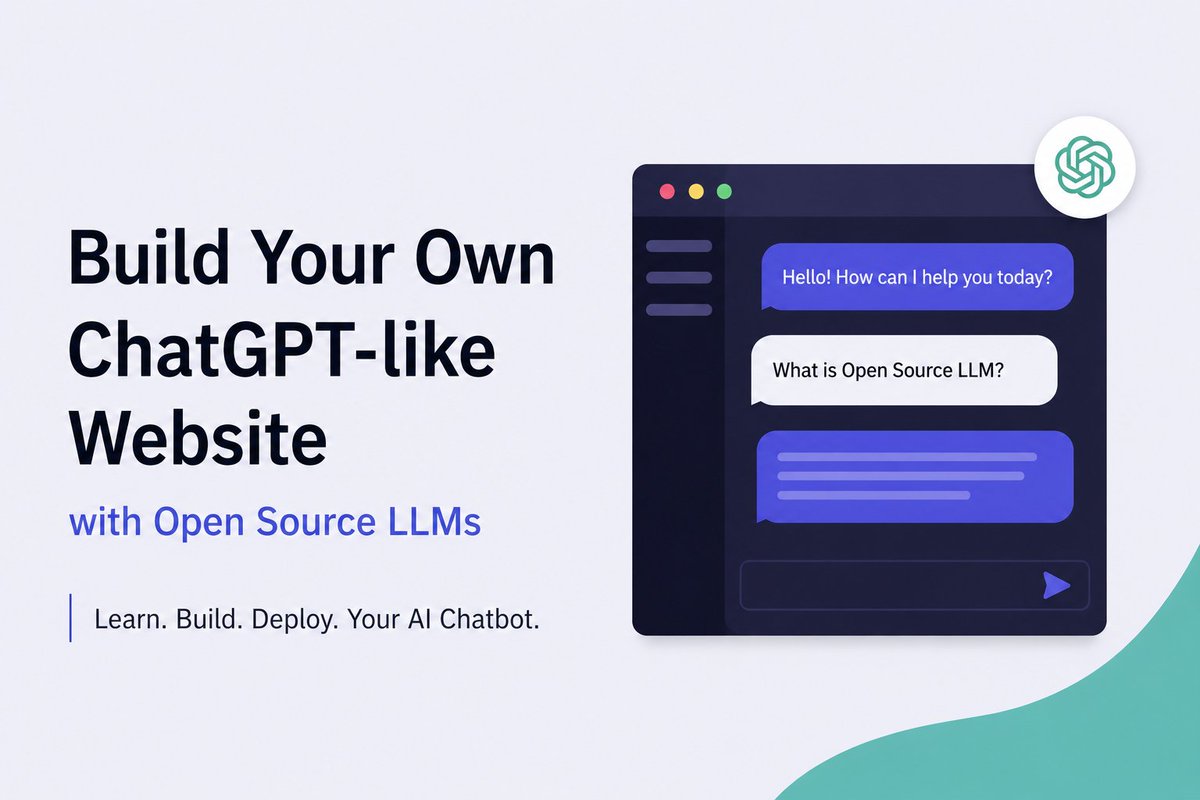
What if you could build your own ChatGPT style website instead of just using one?
A lot of people use AI tools every day, but very few understand how these systems are actually built and deployed behind the scenes.
In this guided project, you’ll learn how to create your own chatbot website using open source Large Language Models and host it on your own platform. Instead of only interacting with AI, you’ll go through the process of building a working conversational application yourself.
You’ll learn how to:
• work with open source LLMs
• host and run a chatbot on your own machine
• build a chatbot interface using HTML, CSS, JavaScript, and Python
• connect your frontend and backend together
• deploy your chatbot website to the web
This project also gives a good introduction to how conversational AI systems are structured and how chatbot applications are developed outside of closed platforms.
By the end, you’ll have a much better understanding of what goes into building and deploying an AI chatbot from start to finish.
If you’re interested in AI, web development, LLMs, or building your own applications, this is a really solid project to explore.
Explore here 👉 https://t.co/qF1mIAwrg4
#ArtificialIntelligence #LLM #WebDevelopment #Python #OpenSource #AIProjects #IBMSkillsNetwork
What if AI agents could work together like a creative team instead of just giving one response at a time?
Instead of relying on a single output, different agents can each handle their own part of the process from generating ideas to refining and improving the final result.
In this project, you’ll build a multilingual AI poetry system using GPT 5 and AutoGen/AG2, where multiple agents collaborate together to generate and refine poems in different languages.
Instead of relying on a single model response, each agent has its own role in the workflow. One agent helps generate ideas, another develops the poem, and another reviews and improves the final output.
You’ll learn how to:
• build multi agent workflows with AutoGen/AG2
• coordinate communication between specialized AI agents
• create poetry in different languages
• structure agent roles like Author, Muse, Verse, and Editor
• manage collaborative AI systems using Python
• understand how agent orchestration works with GPT 5
The project is beginner friendly, but it also gives a strong introduction to how collaborative AI systems are designed and managed.
By the end, you’ll have a much better understanding of how multiple AI agents can work together to complete creative tasks in a more organized and structured way.
This is a great project for anyone interested in AI agents, generative AI, AutoGen workflows, or building creative AI applications.
Start here 👉 https://t.co/M5SzhIDewr
#ArtificialIntelligence #AIAgents #GenerativeAI #Python #GPT5 #AIProjects #IBMSkillsNetwork
If you’ve ever wondered how prices or trends are predicted, it usually comes down to regression.
It’s one of the simplest ways to start understanding how data turns into actual predictions.
In this guided project, you’ll build regression models to predict car mileage and diamond prices using datasets. Instead of just learning theory, you’ll go through the full process of building a model from start to finish.
You’ll learn how to:
• work with datasets and understand the data
• clean and prepare your data before training
• select the right features that actually impact predictions
• build regression models in Python
• evaluate how well your model is performing
• understand what makes a model better or worse
By the end, you’ll have a clear understanding of how prediction models work and how they’re used in scenarios like pricing, forecasting, and decision making.
This is a solid project if you’re getting into data science or want something practical and hands on to add to your resume.
Start here 👉 https://t.co/RA4GsNLhCr
#DataScience #MachineLearning #Python #AIProjects #DataAnalytics #Regression #IBMSkillsNetwork
Most AI chatbots sound impressive… until you ask them something slightly complex.
That’s when things start to break down.
The issue isn’t always the model it’s the lack of structure. Without validation or clear formatting, responses can be inconsistent, hard to use, and unreliable, especially in cases like customer support.
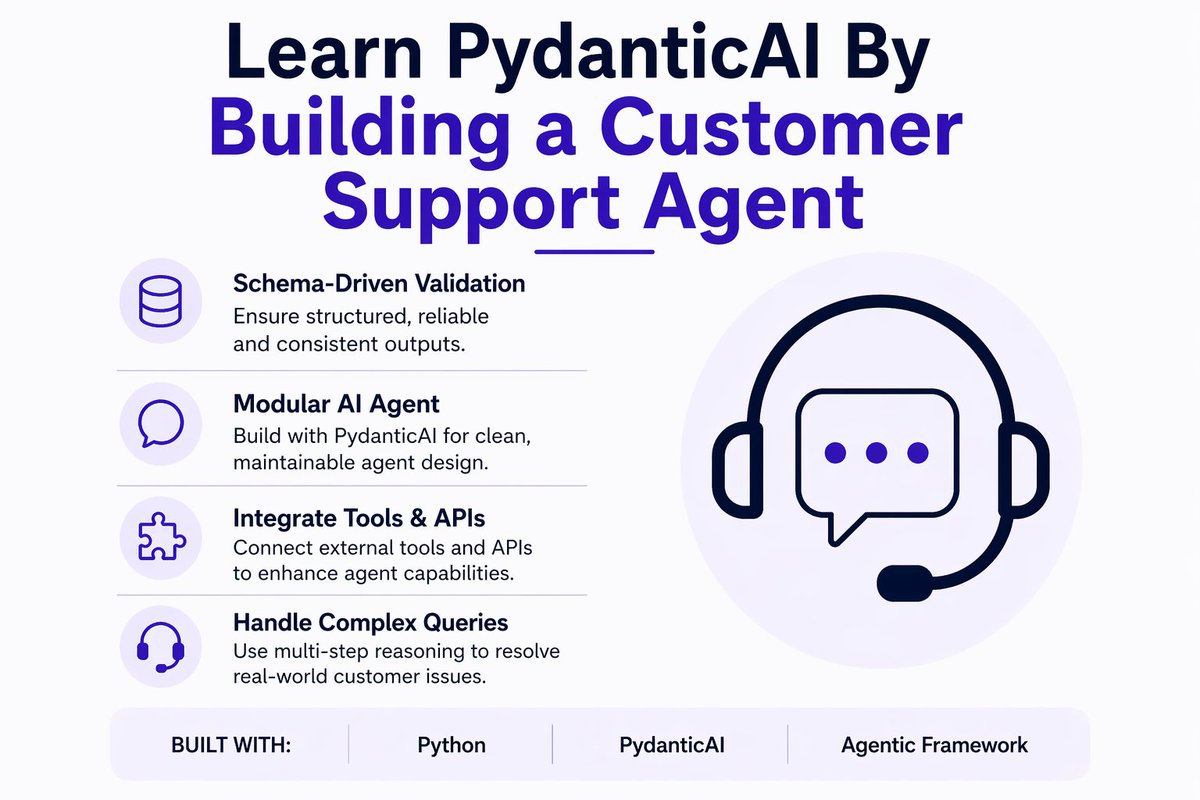
In this guided project, you’ll build a customer support agent using PydanticAI that focuses on structured, predictable outputs.
You’ll learn how to:
• use schema validation to control how your AI responds
• design modular agents that are easier to scale and maintain
• integrate external tools and APIs into your workflow
• handle multi step queries in a more organized way
At the end, you’ll have a system that’s structured, consistent, and much easier to work with compared to a typical chatbot.
It’s a strong project to showcase if you want something more practical and solid on your resume.
👉 https://t.co/7sTPc5yivH
#ArtificialIntelligence #MachineLearning #AIProjects #Python #DataScience #AIDevelopment #IBMSkillsNetwork
AI doesn’t actually “do” math.
It predicts what the answer should look like.
That’s why even simple questions can go wrong.
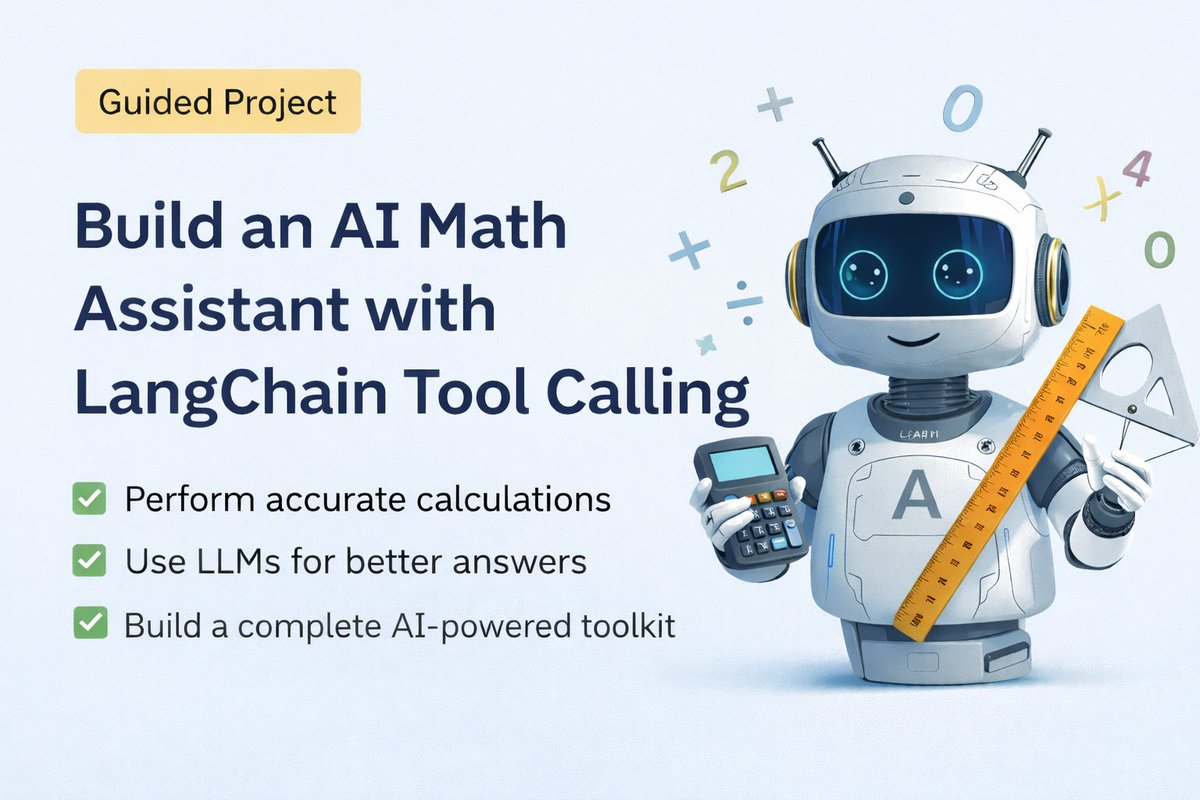
In this guided project, you’ll build an AI math assistant that uses LangChain tool calling to connect an LLM to mathematical functions.
Instead of relying on predictions, your system will:
• interpret the user’s query
• select the correct function (addition, subtraction, multiplication, division)
• execute the calculation
• return accurate, validated results
You’ll also see how tool calling works behind the scenes, passing inputs, handling errors, and making sure the output is reliable.
This is a practical example of how modern AI systems combine LLMs with tools to improve accuracy.
If you’re building projects to strengthen your portfolio, this is a solid one that actually shows how AI systems work beyond just prompting.
Start here 👉 https://t.co/mHIGaKmEvZ
#ArtificialIntelligence #MachineLearning #LangChain #Python #AIProjects #DataScience #IBMSkillsNetwork
What separates a basic AI project from one that actually stands out?
It’s not just the model… it’s how everything connects.
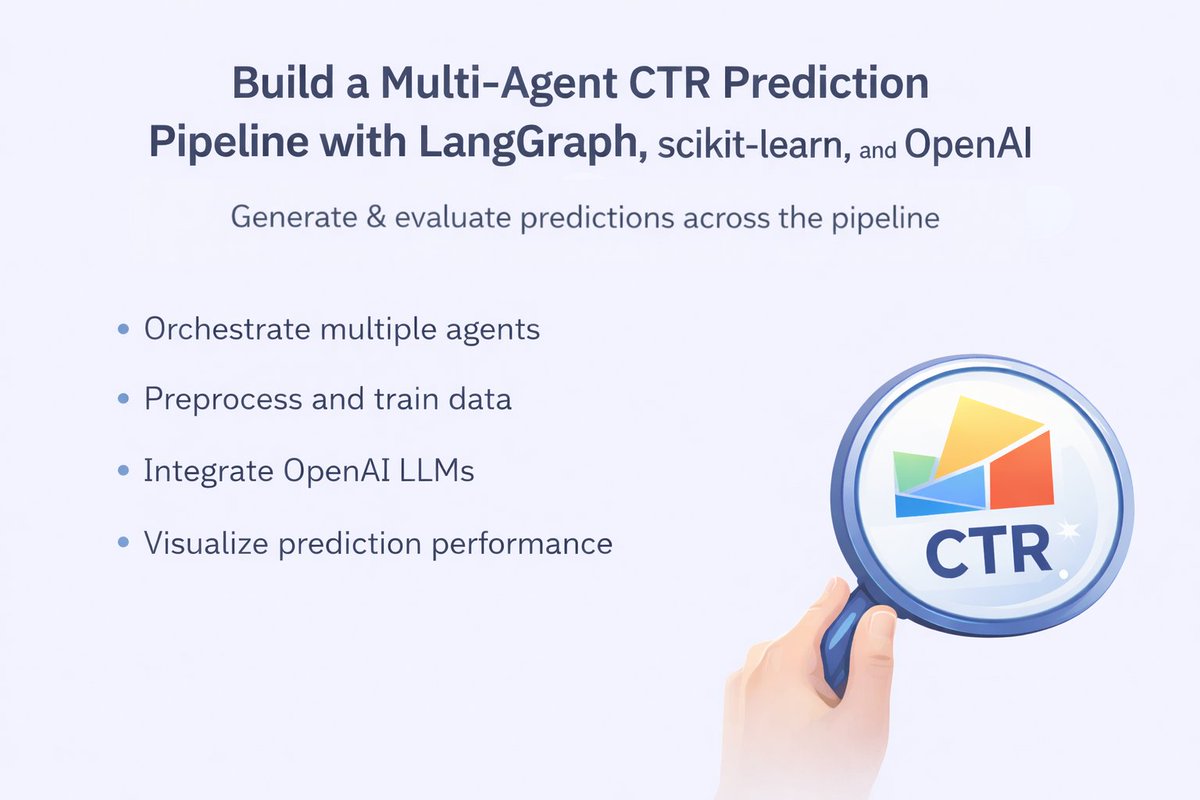
In this guided project, you’ll build a complete CTR (click-through rate) prediction system using LangGraph, scikit-learn, and OpenAI, structured as a multi-agent pipeline.
Instead of a single workflow, you’ll break the system into components that handle:
• data preprocessing and feature preparation
• training a Random Forest model for prediction
• managing data flow between steps using a shared state
• integrating LLMs to support decision-making in the pipeline
• evaluating and visualizing model performance
This gives you a clearer understanding of how AI systems are designed, where models, logic, and orchestration all work together.
It’s a quick 30-minute guided project, but it’s the kind of hands-on project you can actually put on your resume and speak about in interviews.
Explore here 👉 https://t.co/ylBVMMkzys
#ArtificialIntelligence #MachineLearning #DataScience #AIProjects #LangGraph #IBMSkillsNetwork
If you’re in UI UX, you’ve probably noticed how fast things are changing with AI.
Design workflows are evolving and knowing how to actually use AI tools is becoming a real advantage.
This course breaks down how to:
• use AI in your design process to speed up ideation and prototyping
• create more personalized and user focused experiences
• apply prompt engineering to get better design outputs
• work with tools like ChatGPT and Figma in real scenarios
It also includes hands on projects so you’re not just learning concepts but actually building things you can add to your portfolio.
It’s beginner friendly and can be completed in a few weeks, making it a solid way to start building skills that stand out.
👉 https://t.co/w5udGzOlYr
#UIUX #UXDesign #GenerativeAI #ProductDesign #AI #Figma #DesignCareer #TechSkills #IBMSkillsNetwork
If you’ve been working with AI, you’ve probably noticed this
LLMs can explain things well, but they’re not built for precise calculations they predict answers instead of actually computing them
That’s where this guided project comes in
You’ll build an AI math assistant using LangChain tool calling so it knows when to stop guessing and actually use real functions
You’ll learn how to
• connect LLMs to external tools for accurate calculations
• control when the model should call a function instead of responding
• handle errors and validate inputs
• turn a basic model into something more reliable and structured
It’s a practical way to understand how AI systems are built beyond just prompts
If you’ve been learning about LLMs and want to make them more useful, this is a solid project to check out and something you can actually showcase on your resume
👉 https://t.co/LJ6BZSAS6M
#AI #LLMs #LangChain #MachineLearning #AIProjects #DataScience #TechCareers #IBMSkillsNetwork
Most people learning AI right now are stuck in tutorial mode.
They understand concepts like RAG, LLMs, and agents,
but when it comes to actually building something end-to-end, that’s where things fall apart.
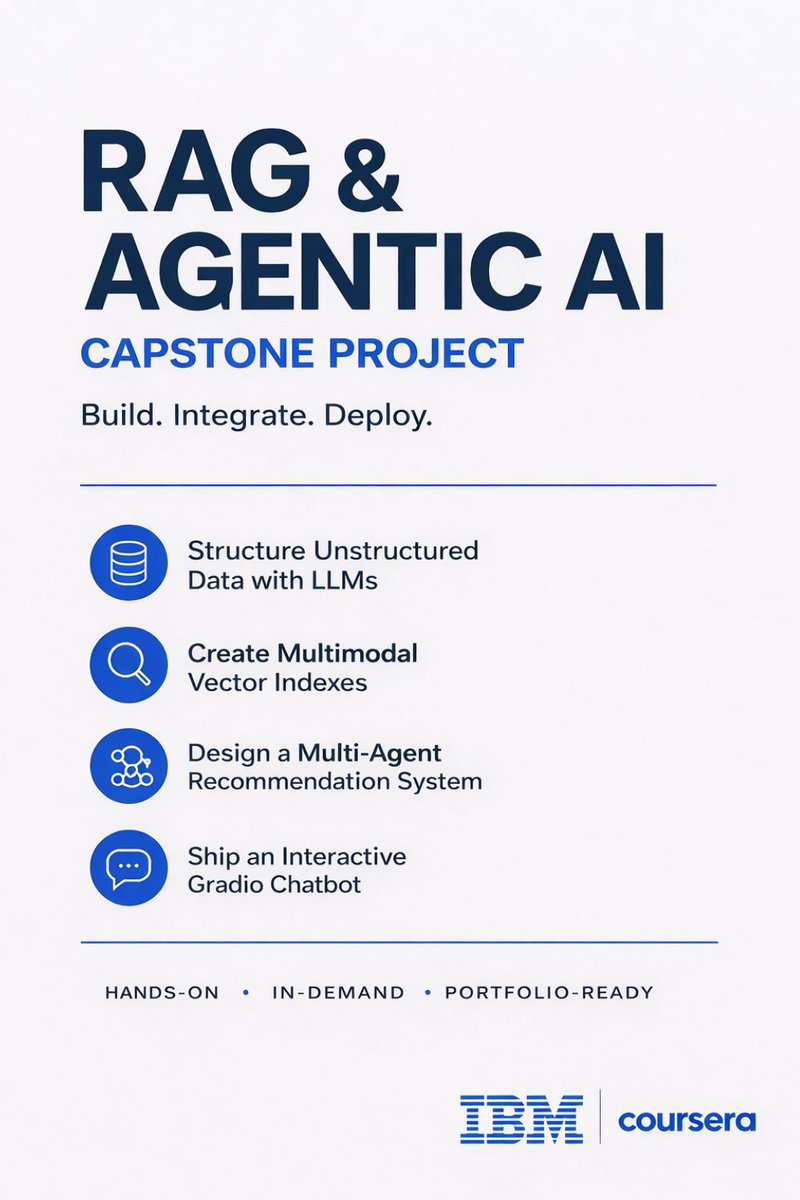
This capstone project is all about actually putting everything together.
Instead of just explaining ideas, it walks you through building a full AI system from scratch:
• structuring unstructured data using LLMs
• creating multimodal vector indexes
• designing a multi-agent recommendation system
• connecting everything into a working pipeline
• deploying an interactive chatbot
So you’re not just learning how each piece works,
you’re learning how everything fits together in a real system.
That’s the part most courses miss, and it’s what hiring teams actually care about.
Being able to say “I built this” hits way harder than “I learned this.”
If you’ve been learning AI and want something that actually ties it all together, this is definitely a project worth checking out.
👉 https://t.co/6Et1PVTapd
#AI #RAG #AgenticAI #MachineLearning #LLMs #DataScience #TechCareers #AIProjects #IBMSkillsNetwork