Reflexivity in support of the "leadership" status quo is breaking down:
$BTC -26% YTD
$ETH -41% YTD
$SOL -41% YTD
As it cracks, $BCH will transition from underperforming to overperforming.
3 big AI IPOs coming.
Silicon Valley, Wall St, Big Gov look to cash out $ Trillions. Big AI is PRmaxxing:
No rolling blackouts this summer- Bitcoin is the lamb.
Saylor gets the memo: stall the BTC psyop = Sell coin
That's my theory
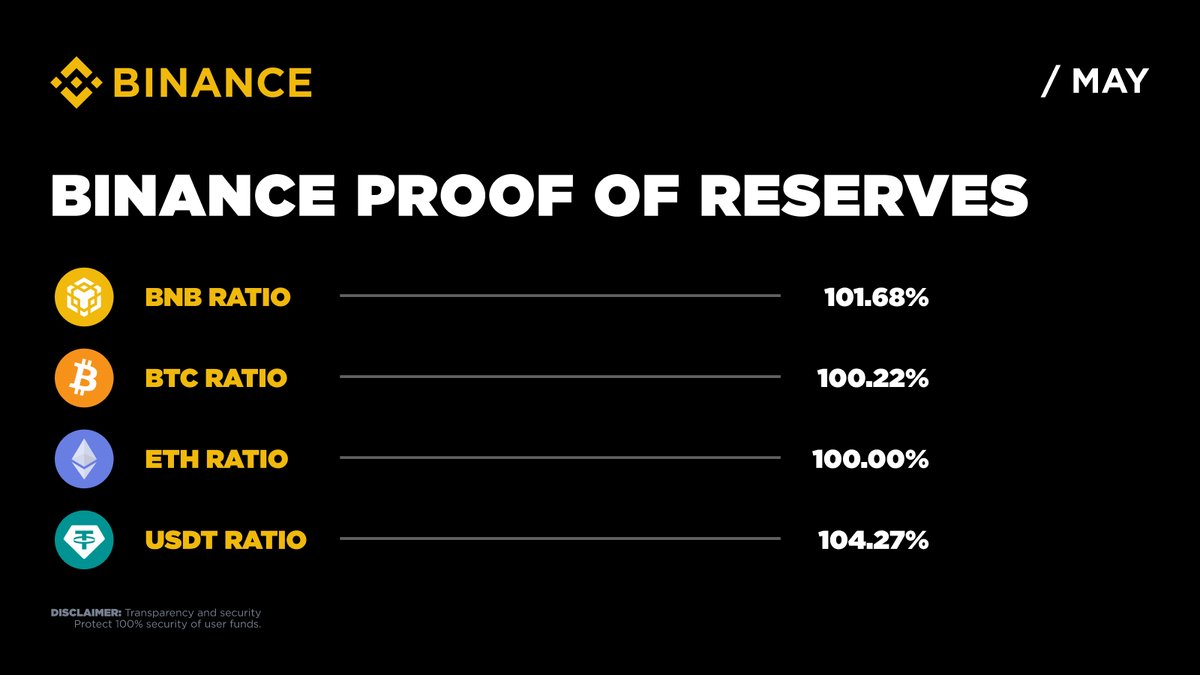
Binance only posts PoR for 4 PoW coins:
$BTC $DOGE $BCH litecoin:native
$BCH leads in on-chain capability
2 are Scrypt merge-mined along with bellscoin:native
No need to over-think crypto
Our #Binance Proof of Reserves (PoR) mechanism allows anyone to check that our user assets are backed 1:1. 🔐
This month, $CAKE was added to the reserves, bringing the total to 50 cryptocurrencies.
Check out this month's PoR here 👉 https://t.co/pPJZ1FM6NF
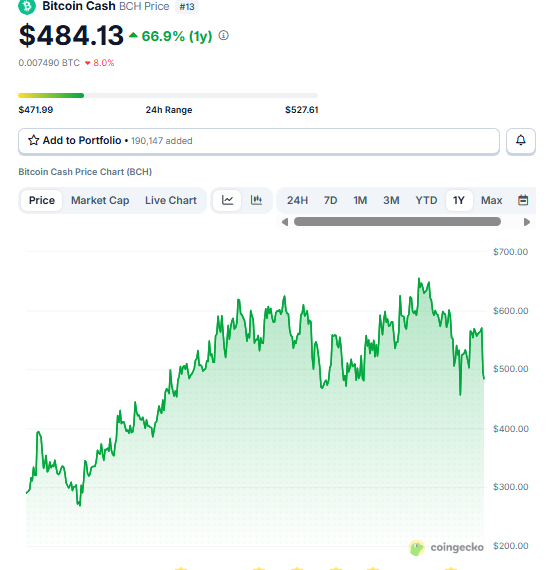
Never again thought I could put 300 $USD toward Bitcoin Cash and get over 1.0 $BCH
Watching BCH fall wasn't great, but the deal is pretty awesome long term.
The dumbing of Bitcoin was a loss for the public discourse. UTXOs work like having a cash bills in your pocket. People were never introduced to what this can do for them. Great to see this discussion from Bitcoin Cash bitcoin-cash:native community
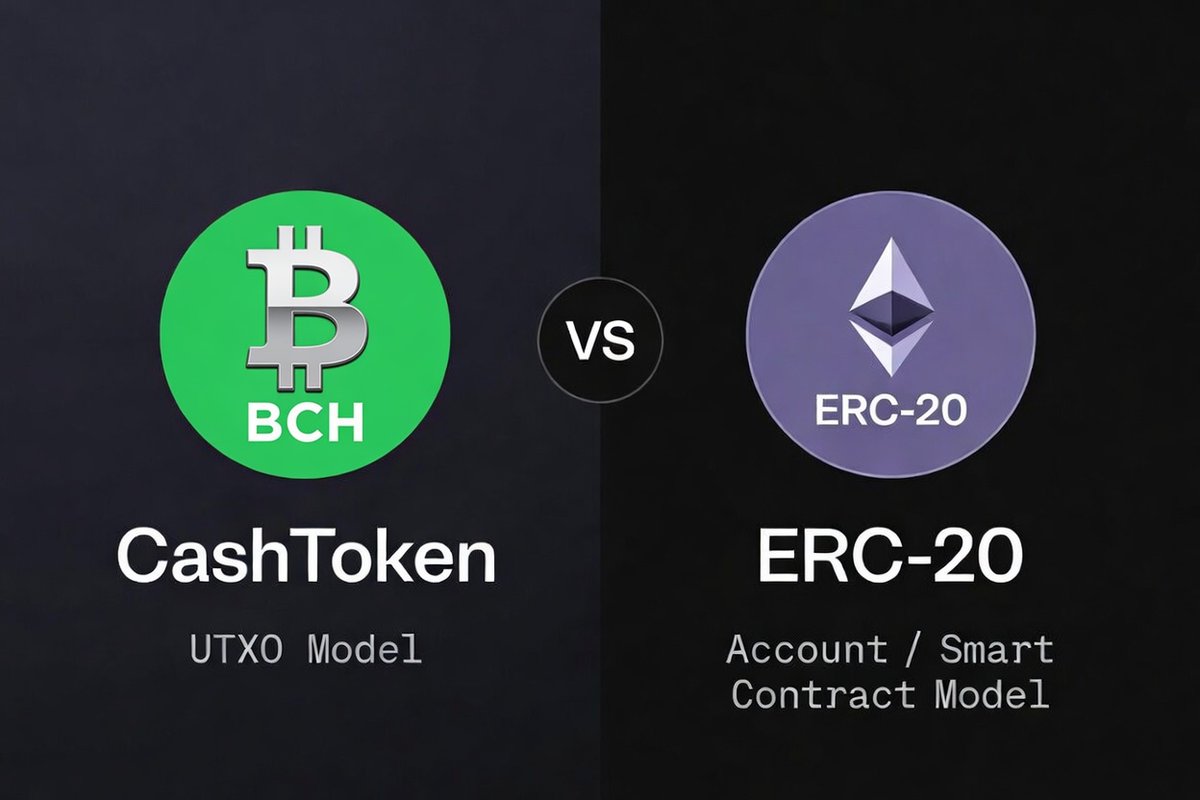
🧠 Mid-Week Geek Out: UTXO Tokens (CashTokens) vs ERC Tokens
Why the data model underneath tokens matters more than most people realise. Let's go deep on the tradeoffs.
This builds on the excellent comparison series exploring why Bitcoin Cash's approach is worth serious attention
.
1 The Fundamental Split
ERC-20 tokens live in smart contracts. Every transfer is a contract call. The EVM executes code, reads/writes a global balance mapping, and you pay gas for the computation + storage.
CashTokens (BCH's UTXO token standard) are different. Tokens are metadata attached to UTXOs - category ID, amount (fungible), optional NFT capability + commitment field. A transfer is just spending a UTXO and creating new one(s) with updated token data. The protocol itself validates the rules. No EVM-style execution for standard moves.
One is mediated by code. The other is enforced by consensus rules on explicit ownership.
2 Fees & Real-World Economics
This is where it gets practical fast.
CashTokens fees are basically regular BCH fees - tiny, predictable, and scale with data size, not computational complexity. Fractions of a cent to a couple cents, even during "congestion." Micropayments, daily rewards, in-game items, and high-frequency settlements stay economically viable on L1.
ERC-20 on L1 is variable and often painful. Gas spikes hurt. L2s help with cost but add bridging steps, finality delays, liquidity fragmentation, and extra UX surface area.
When your use case involves frequent or small-value movement, the UTXO model removes a major economic barrier.
3 Security & Attack Surface
CashTokens shrink the surface area dramatically for basic token operations:
- Rules are part of consensus (audited once at the protocol level).
- No reentrancy risk on simple transfers - there's no code running between "check" and "effect."
- No per-token deployment, no upgradeable proxies, no infinite approval footguns by default.
ERC-20 has a long, expensive history of contract-specific bugs (reentrancy, integer issues, access control, approval exploits). Even with mature tooling and audits today, every new token contract is a new potential failure point.
The tradeoff: ERC-20 gives you arbitrary logic in exchange for that expanded risk surface. CashTokens keep the base layer minimal and push advanced logic into covenants (more on that in a bit).
4 User Experience & Ownership
This one feels different in practice.
With CashTokens, tokens just appear in any compatible BCH wallet. You send and receive them like regular sats. No manual "add token" step, no separate gas token, no approval transactions for basic sends. Ownership is explicit - you hold the UTXO.
ERC-20 UX is more fragmented: contract addresses, approvals (and the risks that come with them), gas token management, and sometimes multiple transactions.
For mass adoption and everyday use, removing those extra steps matters enormously.
5 NFTs, Flexibility & The Real Magic
CashTokens have native, efficient NFT support with low fees and a powerful commitment field for arbitrary data (metadata, proofs, state hints).
But the deeper story is CashTokens + Covenants.
Covenants let you write scripts that introspect and constrain how a UTXO (and its tokens) can be spent in the future. You can build stateful, constrained logic - DEX logic, vesting, compliance rules, gaming mechanics, etc. - without exposing the full generality (and risk) of an EVM-style environment.
It's a different philosophy: powerful but deliberately constrained, auditable, and efficient.
6 Scaling, Composability & When to Use Which
- Throughput: UTXO model parallelises validation more naturally. BCH's scaling roadmap amplifies this for token-heavy activity on L1.
- Composability: ERC ecosystem wins on mature DeFi Lego and deep liquidity today (especially on L2s).
Best fit:
- CashTokens: Payments, micropayments, gaming economies, loyalty/rewards, high-volume simple transfers, anything where L1 cost and simplicity win.
-ERC-20: Complex financial primitives where maximum expressiveness and existing liquidity matter most.
They don't have to be enemies. Bridges and wrapped assets let value move between models. Specialisation is healthy.
7 The Bigger Picture
The UTXO approach isn't "dumber" or legacy. It's a deliberate design choice that prioritizes explicit ownership, parallel validation, minimal execution for common operations, and extremely low predictable costs on the base layer.
CashTokens bring tokens to Bitcoin's core strengths while adding just enough structure (categories, commitments, covenants) to make real applications possible without reinventing a global state machine for everything.
BCH isn't trying to clone Ethereum. It's extending the UTXO model that made Bitcoin work and applying it to tokens at the protocol level.
What use cases excite you most for this model? Payments? Gaming? Something with covenants?
Drop your thoughts below. Always happy to geek out more. 👇
#BitcoinCash #CashTokens #BCH
Important: I've also devised a way that some can *invest* in this hardfork, now, before the fork-date, in August:
- Satoshi has 1.1M coins in the so called "patoshi" pattern.
- We will be manually reassigning some of these coins (fewer than half) to investors today.
This will no doubt be a controversial decision. But I think it is necessary, and in fact, ideal:
- The pure fork, is a problem, because it leaves collaborators with no way to "get involved" ahead of time.
- This leaves the fork a "zombie project" -- until it launches.
- Thus, it is harder to ship the fork as a "finished project" -- with all of the work completed in advance.
- Ironically, that would centralize the project, and encourage dev-capture.
To avoid seedy grifter-style investment-promotion activities, I mostly do not mention this. But it is possible, for high-quality investors (ie, accreditted+).
Plus, it must be disclosed, for full transparency.
@blockchainchick Truth is BTC's drop is mostly due to major US BTC miners pivoting to HPC AI data centers- They have been selling their BTC stash to raise $. Bitdeer recently sold every Bitcoin they had, according to filing. There is nothing broken in the crypto market right now.
Large US bitcoin mining companies have been pivoting to AI data centers. This is not an easy, quick, nor cheap transition. They have been selling from their stacks to fund it. All other PoW coins will outperform $BTC this year.
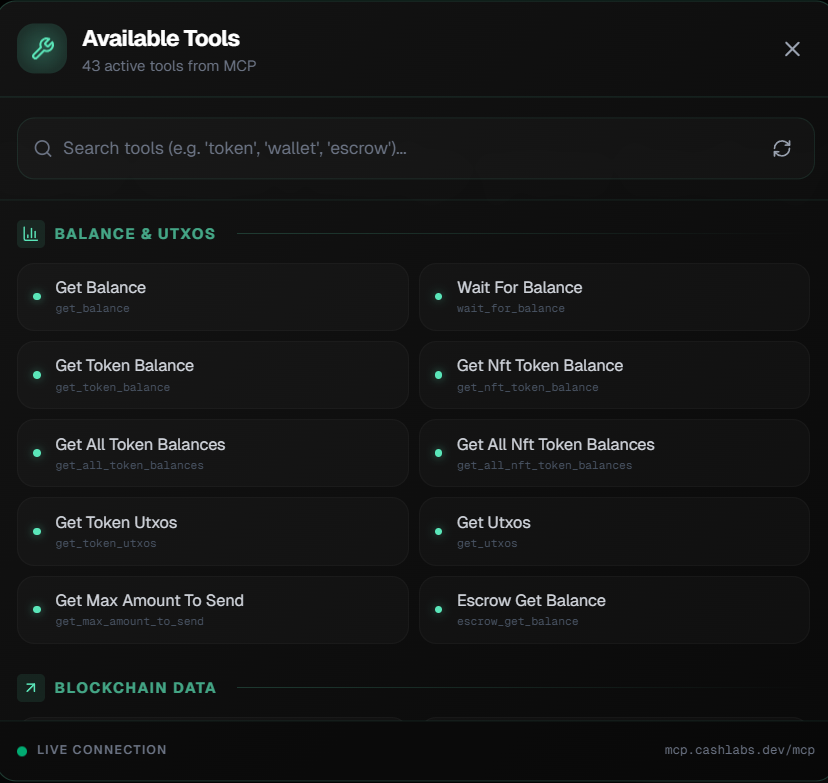
we also run an MCP server for BCH
basically gives AI agents real tools:
tx sending, token ops, chain reads, contract calls
not fake demos. real blockchain access.
mcp server deployed at https://t.co/LAIep9vhVf , the current tools supported are :
No limits for using mcp server!