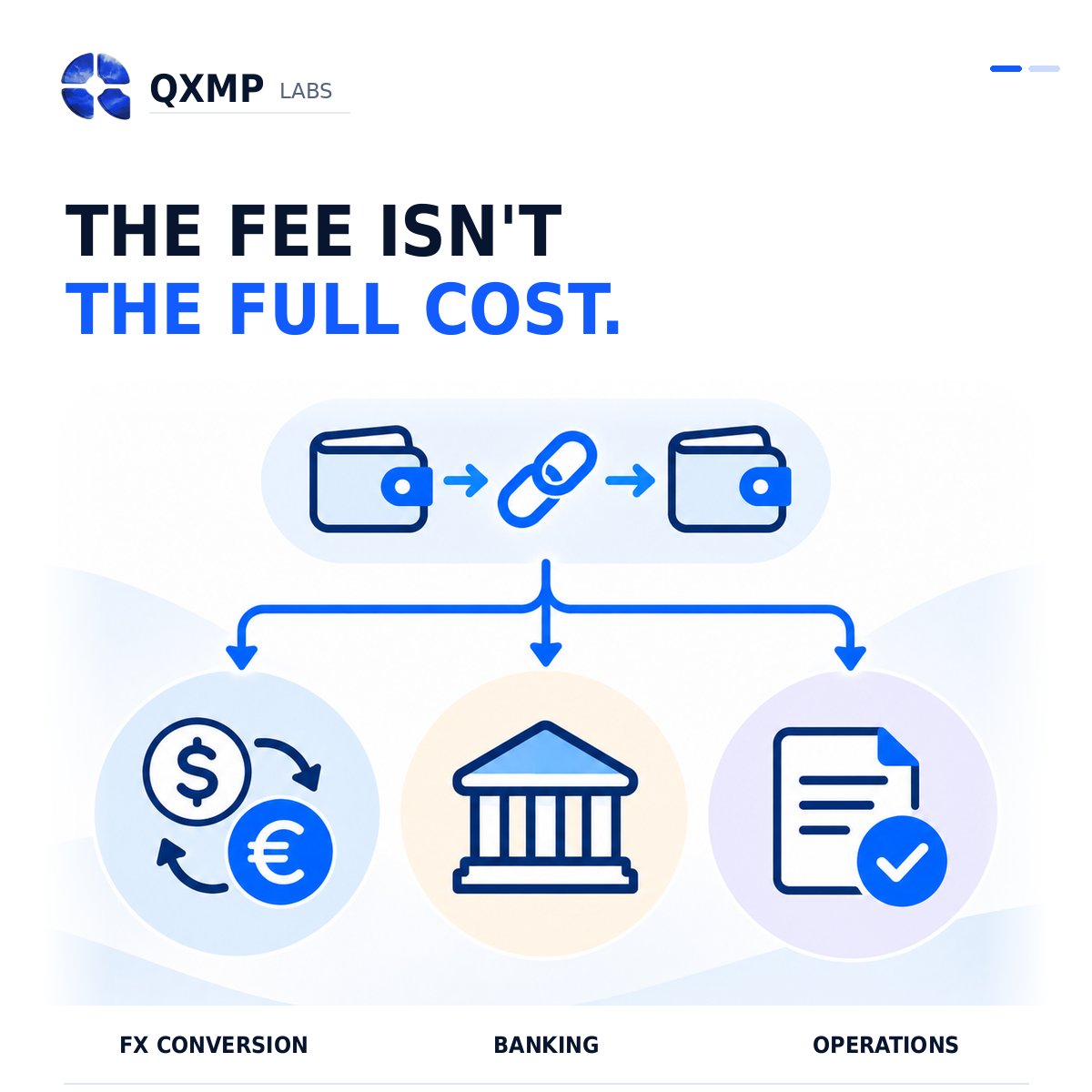
A transaction can cost pennies on-chain and still be an expensive international payment.
This is something the stablecoin industry needs to talk about more.
Crypto tends to measure payment efficiency through network fees and transaction speed.
But businesses calculate costs differently.
A cross-border payment can involve:
• Currency conversion spreads
• Liquidity provider fees
• Banking and off-ramp charges
• Compliance and operational costs
• Reconciliation and settlement delays
The blockchain transaction might be the cheapest part of the entire process.
And that's why low gas fees alone aren't enough to prove enterprise efficiency.
This is an important perspective when evaluating @QXMP_Labs.
Its focus on cross-border settlement, treasury movement, and operational liquidity targets a market where the economics of the complete payment process matter far more than isolated blockchain metrics.
For a corporate treasury team, the question isn't simply how cheaply digital dollars can move between wallets.
It's how efficiently value can move from one business to another, through every financial step involved.
That's where enterprise stablecoin infrastructure has an opportunity to prove its value.
Not through impressive transaction fees on a dashboard.
But through measurable improvements in the total cost, predictability, and operational efficiency of real-world payments.
The future of stablecoin payments won't be judged by what it costs to send a token.
It will be judged by what it costs to complete the payment.
@QXMP_Labs
Mint math, worked out. Put an amount in; the receipt shows the fee and the units you get.
Fees deducted at mint. KYC and supported jurisdictions apply.
Sign up: https://t.co/vSy3PWRPJC
From in-ground mineral resources to everyday digital dollars. See how QELT, QSRT and QXMP connect asset tokenisation to stablecoin issuance and QXMP Mint’s planned banking and card payments. https://t.co/GsqbVTxXWZ
#QELT#QXMP#RWATokenisation#Stablecoins#DigitalAssets
Not everywhere, not yet. QXMP Mint operates only in supported jurisdictions. Sign-up shows what applies.
KYC and supported jurisdictions apply.
Sign up: https://t.co/vSy3PWRPJC
QELT: From records to activity.
Convertible token, not direct equity.
Subscriptions open to eligible investors.
Verified U.S. accredited professionals only (506(c)).
Capital at risk.
Start Your Equity Journey Today
https://t.co/pWv6t20ySG
Two independent geologists can examine the same mineral deposit and arrive at different resource estimates.
Neither necessarily has to be wrong.
Different methodologies, assumptions, reporting dates, and technical interpretations can produce different conclusions.
Now imagine that asset entering a tokenised financial ecosystem.
Which estimate should the system recognize?
Who determines which assessment is authoritative?
And how should institutions evaluate the uncertainty between them?
This is where RWA infrastructure becomes much more complicated than putting verified documents on-chain.
The real challenge isn't just recording information.
It's establishing a framework through which that information can be assessed, compared, and trusted.
This is why Qeltblockchain's focus on strategic asset onboarding, reserve verification, and institutional integration is worth examining.
As more complex assets enter programmable finance, institutions will need more than a single valuation or verification label.
They'll need to understand the evidence, assumptions, and limitations supporting the information they rely on.
Blockchain can preserve multiple versions of the truth. It cannot automatically determine which interpretation is financially reliable.
And that distinction matters.
Because institutional-grade RWA infrastructure shouldn't be designed around the assumption that every asset has one simple, universally accepted value.
It needs to account for the complexity, uncertainty, and professional judgment that already exist in real-world finance.
That's where the next generation of serious asset infrastructure will be tested.
@QXMP_Labs
#QELT #QXMP #Stablecoin
Identity checks are normal. KYC confirms who you are. It applies in supported jurisdictions.
KYC and supported jurisdictions apply.
Sign up: https://t.co/vSy3PWRPJC
QELT: Scale needs standards.
Convertible token, not direct equity.
Subscriptions open to eligible investors.
Verified U.S. accredited professionals only (506(c)).
Capital at risk.
Start Your Equity Journey Today
https://t.co/pWv6t20ySG
QELT: Scale needs standards.
Convertible token, not direct equity.
Interest only; subscriptions not open.
Verified U.S. accredited professionals only (506(c)).
Capital at risk.
Start Your Equity Journey Today
https://t.co/pWv6t20ySG