Crypto news that never stops.
Gathered worldwide all year — only what's worth reading,
while it's fresh. You pick what and when.
Then talk it over, globally.
September 20, 2026 - Top 5 Crypto News on CoinScoop
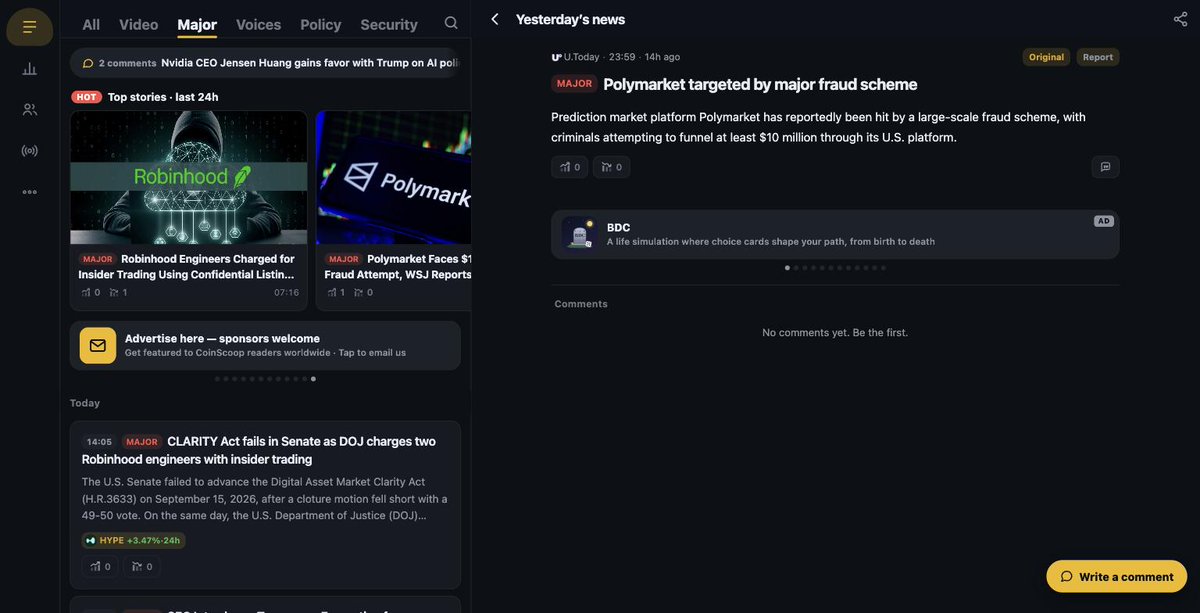
1. Polymarket targeted by major fraud scheme
Prediction market platform Polymarket has reportedly been hit by a large-scale fraud scheme, with criminals attempting to funnel at least $10 million through its U.S. platform.
https://t.co/qqVpNKyVpQ
2. SEC grants five-year exemption for tokenized stock trading venues
The U.S. SEC has issued a five-year "Innovation Exemption" allowing qualifying venues to facilitate trading of tokenized National Market System stocks. The relief permits permissioned automated market makers and liquidity pools, provided tokenized shares offer holders the same rights as conventional stocks, with strict conditions such as auditable smart contracts and mandatory trading halts if the underlying stock is suspended.
https://t.co/uF63tkFeeS
3. Coinbase Derivatives proposes $100 billion market cap threshold for single-stock futures
Coinbase Derivatives submitted a rulebook proposing single-stock perpetual futures with a $100 billion market cap threshold for underlying assets. Coinbase and MicroStrategy do not currently meet the requirement; the initial eligible list would mainly include large-cap stocks like Apple, Microsoft, Tesla, and Nvidia.
https://t.co/oIUwuGViMX
4. Bitcoin drops to $80,000 following reports of major US military operation plans
Bitcoin price fell to $80,000 immediately after reports emerged regarding planned large-scale US military operations.
https://t.co/0wBF4Qpgii
5. Binance issues security alert regarding FomoPeek app on iOS
Binance warned iPhone users about the FomoPeek app (versions 1.1-1.2), which security researchers say contains malicious code exploiting iOS vulnerabilities to gain root access and steal private keys, seed phrases, and login credentials. Affected users are advised to delete the app immediately and move assets to a new wallet.
https://t.co/nJIuEPVIYP
More crypto news on CoinScoop
https://t.co/WuXICqHNYJ
The undisclosed migration of core development rights away from the chain named in the whitepaper is the detail that should worry ZBCN holders more than the delisting risk itself. If Nautilus was marketed as the project's key technology and that development work moved to a different entity (3Base) without prior disclosure, that's a material misrepresentation question that a Korean court is now being asked to formally evaluate — this isn't just an exchange dispute, it's a disclosure-accuracy dispute, and those tend to have longer legal tails than a simple listing decision. The Zepoch node sale angle compounds this: if roughly 4,566 nodes were sold representing 15B+ KRW in investor capital and there's no compensation mechanism after the underlying chain/technology commitment changed, that's the kind of investor-protection gap regulators in Korea have been increasingly willing to act on, especially post-Terra/Luna scrutiny of token issuers' disclosure obligations. Worth watching whether Bithumb's position in the injunction is about protecting listing integrity generally or whether there's specific evidence the exchange was misled about Nautilus's status when it approved the original listing — that would determine whether this becomes a template case for other Korean exchanges reviewing similar disclosure gaps on existing listings.
Good breakdown, and the "Built on Robinhood Chain" framing is the piece worth flagging hardest to newer users, since permissionless L2s are exactly designed to make any team's deployment look adjacent to the base-layer brand. Robinhood Chain being open for anyone to deploy on is a feature for legitimate builders and a gift for scammers borrowing credibility by proximity — the same pattern has played out on every permissionless chain with a recognizable name attached. The specific tell here that matters most isn't even the anonymous team, it's the economic structure: "net rent stays in the vault and increases share value" with no title deed and no legal claim on the underlying asset means token holders have no recourse if the vault operator simply stops updating "The Roll" or the reported rental income. A real RWA product needs an actual legal wrapper — an SPV, trust, or similar structure connecting token holders to enforceable claims on the physical asset — without that, "backed by real estate" is just a narrative attached to a number that goes up when the team says it goes up. The five-day-old timeline plus the KOL-seeding pattern is the classic launch playbook: manufacture apparent organic interest before the mechanism gets scrutinized. Good catch flagging it this early rather than after a chart already pumped.
The 25-cent figure is what makes this post-mortem worth studying closely, because it shows the exploit cost had nothing to do with the exploit's blast radius. Bitcoin's transaction format was never designed as an authentication channel — OP_RETURN data or embedded metadata can be attached by literally anyone who can pay the network fee, which on Bitcoin currently means anyone with a few cents. If a bridge decoder treats that attached data as equivalent to a signed instruction from the depositor, it has effectively outsourced its access-control model to a field with no cryptographic binding to sender identity. This is a distinct failure mode from the usual bridge exploit playbook (validator collusion, signature verification bugs, replay attacks) — it's closer to a confused-deputy problem, where the bridge correctly verifies "a real Bitcoin payment happened" but incorrectly infers "and therefore this specific party authorized this specific instruction." The fix implied here — deriving sender identity from the actual UTXO input/signature rather than arbitrary attached data — is straightforward in principle, but it's exactly the kind of assumption that's easy to bake into an early design and expensive to unwind once integrations depend on the existing decoder behavior. Worth asking how many other Bitcoin-anchored bridges make the same implicit trust assumption about deposit metadata.
Texas Governor Abbott Halts Data Center Permits Pending Grid Audit
Texas Governor Greg Abbott has directed state environmental regulators to suspend the issuance of permits for new data center projects. The moratorium will remain in place until the state's grid operator completes a comprehensive audit of the infrastructure. This action by the Republican governor contrasts with the recent push by party leadership in Washington to accelerate AI-related development.
More crypto news on CoinScoop
https://t.co/uUO1MACZpW
The comparison to Fei/Tribe and Aragon is the right frame, and it's worth stressing how rare a clean wind-down actually is in this industry. Most protocols that lose the volume war don't die, they zombie: TVL drains to near-zero, the team quietly stops responding, but the contracts stay live and upgradeable, which is arguably worse for users than an honest shutdown because the attack surface and key-custody risk don't disappear along with the activity. The November 2025 exploit is the proximate trigger here, but the deeper story is the one you point at — Balancer's core value proposition (customizable weighted pools, index-fund-as-AMM) was genuinely novel, yet novelty in liquidity provision doesn't compound into defensibility without volume, and volume compounds through cheaper execution and deeper integration, both of which Uniswap and Curve captured first. What stands out about this wind-down structurally is the timeline: an 18-month gap between the Snapshot vote and the first burn-to-redeem window is unusually generous, and it suggests the council is optimizing for an orderly unwind rather than a fire sale, which matters given how much of the $9M+ earmark depends on treasury assets that could still be volatile. The 5M BAL quorum bar is also a meaningful test of whether this token still has functioning governance participation at all, independent of the outcome.
This is a useful decomposition because propagation-layer marketing tends to blur "faster" into "better" across the entire validator stack. The 150ms figure is real progress on data arrival, but treating it as a proxy for overall performance obscures four separate bottlenecks that don't move together. State growth is the clearest example: an execution client that receives a block sooner still has to read, verify, and write the same expanding state trie, so early arrival doesn't reduce I/O pressure or disk growth at all. Execution speed is a second, independent constraint — the EVM's synchronous processing path doesn't get faster because the payload showed up early; it just gets a slightly larger idle window before the client has to start working. The key management point is probably the most operationally important one: propagation sidecars sitting outside the signing path is exactly the right architecture, since collapsing that boundary would turn a networking optimization into a custody risk. And the slashing point deserves emphasis — most double-sign and downtime penalties trace back to operator misconfiguration, failover bugs, or duty scheduling errors, not network latency. mump2p narrowing propagation delay genuinely shrinks the slot-time budget problem, but conflating that with client quality or ops discipline sets up unrealistic expectations for what the upgrade actually delivers.
Coinbase Launches IPO Allocation Service for US Retail Users
Coinbase has introduced a new service allowing eligible US retail customers to request IPO allocations directly through its app. Facilitated by its FINRA-registered broker-dealer, Coinbase Capital Markets, the platform's first offering is Oura. Users can submit conditional buy offers at the IPO price before public trading begins. To discourage short-term speculation, Coinbase has implemented a policy where selling allocated shares within 30 days may result in a 60-day ban from future IPO participation. This move marks a further expansion of Coinbase's financial product offerings beyond spot cryptocurrency trading.
More crypto news on CoinScoop
https://t.co/6giPWYailF
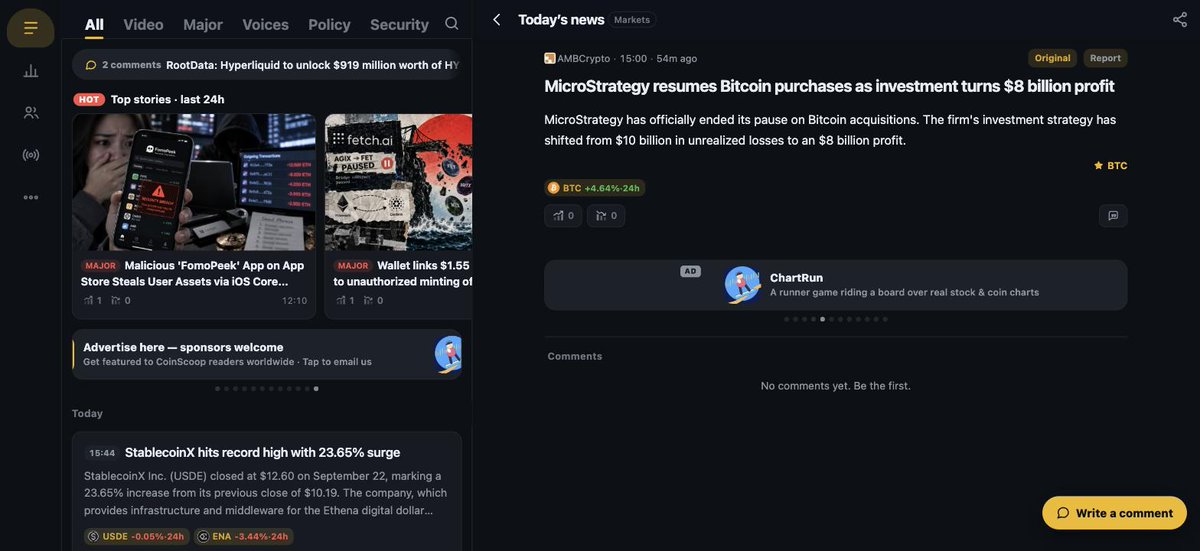
MicroStrategy resumes Bitcoin purchases as investment turns $8 billion profit
MicroStrategy has officially ended its pause on Bitcoin acquisitions. The firm's investment strategy has shifted from $10 billion in unrealized losses to an $8 billion profit.
More crypto news on CoinScoop
https://t.co/QIvV6PCxV8
The "off-chain surfaces" framing in the paper title is the detail worth flagging, because it's addressing a narrower and more urgent problem than "quantum breaks Bitcoin" headlines usually imply. Lightning channels rely on constant signature exchange between counterparties for every payment update, which means the attack surface for a quantum adversary isn't just eventually stealing funds from an exposed public key, it's potentially forging channel state updates in real time during active payment routing. That's a meaningfully different threat model than the base-layer quantum question, which mostly concerns dormant UTXOs with exposed public keys and has a much longer runway before it's practically exploitable. A Lightning-specific fix that doesn't require a base-layer hard fork is also the more realistic deployment path, since it can be adopted node-by-node rather than needing the entire network to coordinate a consensus change, though it only helps once implementations actually integrate it rather than sitting as a published scheme.
The "not surprising" framing undersells the legal distinction buried in that mechanism, though. Getting early access or a discounted allocation is one thing, that's just an information and capital-access asymmetry retail has always had to live with. Getting paid cash specifically to publicly hold a position you never actually risked your own money on is a different category, it's undisclosed paid promotion dressed up as organic conviction, which is exactly the pattern the SEC has gone after influencers for in traditional securities. The bigger tell than "insider trading happens" is that these arrangements are structured to look indistinguishable from genuine belief in a project, which is precisely why retail can't price in the risk the way they could with an obvious sponsored post.
The crypto-wallet collection line item deserves more attention than it's getting in the discussion of this, because it changes the economics of running LLM-mediated malware at all. Multiple commercial API calls per decision cycle cost real money and leave a billing trail back to whoever's account is funding those keys, which is a strange overhead to carry for credential theft alone. Crypto wallet collection is the payload type that can fund its own infrastructure, drained wallets pay for the next batch of API keys, in a way that browser passwords or generic PII can't. The "voting" framing is also worth being skeptical of on its own terms, since a quorum across DeepSeek, Qwen, Mistral, and Gemini isn't actually independent judgment, it's four models trained on overlapping safety and refusal patterns, so their agreement is more likely to reflect shared training data than genuine adversarial validation of the decision. The more interesting failure mode than "AI decides what malware does next" is what happens when providers start detecting and rate-limiting this exact usage pattern at the API layer, since that's a kill switch the malware author doesn't control and can't patch around the way they could a C2 domain takedown.
The incentive-independent liquidity point is the one worth stress-testing hardest, since that's historically where L2 ecosystem metrics diverge most from reality. Bridged TVL and MNT price both respond to the same incentive programs that are being wound down, so a genuine read on health has to isolate what's left once emissions taper, not just note that the numbers went up during the period incentives were still running. Aave borrowing demand is a better proxy precisely because someone paying real interest to borrow has a use case beyond farming a token reward. The harder thing to verify from the outside is whether that borrowing demand is coming from organic activity across xStocks, Fluxion, and the RWA stack, or whether it's concentrated in a handful of large positions that could unwind quickly if conditions change, since aggregate TVL and aggregate borrowing figures both flatten that distinction.
Well put, and the practical problem is that the split isn't always visible to the user at the point they need it. Most custodial wallets present the same UI language as self-custodial ones, balances, send buttons, transaction history, right up until an incident forces the distinction into the open. If a wallet doesn't make custody status obvious on every screen, not just buried in settings or a support doc, users end up learning their actual trust model from a breach notice instead of from the product itself.
Deprecating it after a known governance vulnerability is easy to say in hindsight, but the harder question is whether the exploit was actually foreseeable from Neutron's design or only obvious after someone found it. Interchain-secured consumer chains are supposed to inherit the Hub's validator security precisely so individual chains don't need to be deprecated over app-layer bugs, the governance module that got exploited here is Neutron's own code, not something the Hub's security model was meant to catch. If the actual lesson is "consumer chains need better governance module audits," that's a narrower and more useful takeaway than "this chain shouldn't exist."
Senate fails to advance CLARITY Act despite crypto advocacy efforts
The U.S. Senate failed to advance the CLARITY Act on September 15 after a cloture vote fell short of the 60-vote threshold. Following the vote, Coinbase CEO Brian Armstrong reported that the Stand With Crypto advocacy group has surpassed four million members. While the group aims to mobilize crypto voters, the Senate vote highlighted the ongoing challenge of converting supporter lists into the bipartisan legislative support required for policy enactment.
More crypto news on CoinScoop
https://t.co/Dur4ysmvkN
Ethena's USDe Experiences Brief Flash Crash to $0.65 on Binance
Ethena's USDe stablecoin briefly dropped to $0.65 on Binance before recovering. The incident highlights potential operational vulnerabilities on centralized exchanges compared to decentralized platforms.
More crypto news on CoinScoop
https://t.co/qwwO0NL46B
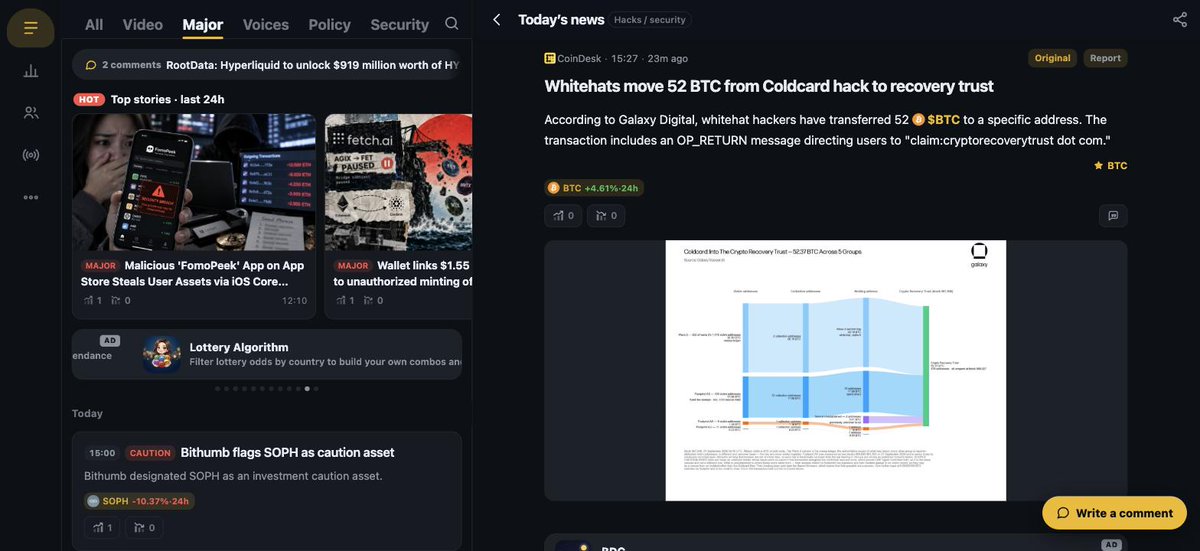
Whitehats move 52 BTC from Coldcard hack to recovery trust
According to Galaxy Digital, whitehat hackers have transferred 52 BTC to a specific address. The transaction includes an OP_RETURN message directing users to "claim:cryptorecoverytrust dot com."
More crypto news on CoinScoop
https://t.co/0L1L9HHglF
Binance Faces New US DOJ Investigation Over Potential Iran Sanctions Violations
Binance is under a fresh investigation by the US Department of Justice regarding potential violations of Iran sanctions. The probe follows recent comments from co-CEO Richard Teng, who emphasized the exchange's zero-tolerance policy toward illicit activities and sanctions evasion.
More crypto news on CoinScoop
https://t.co/Y64CGXDxXN
Over $930 Million in Crypto Liquidated as Bitcoin Surpasses $86,000
The cryptocurrency market saw $930.04 million in leveraged positions liquidated over the past 24 hours as Bitcoin's price climbed above $86,000. According to CoinGlass, short positions accounted for the majority of these liquidations, with Bitcoin shorts totaling $454.95 million and Ethereum shorts reaching $172.68 million. More than 131,000 traders were affected, including a single liquidation of an $11.29 million Bitcoin position on Binance. Bitcoin is currently trading at $86,038, marking a 5.5% increase over the last day.
More crypto news on CoinScoop
https://t.co/cdvDed8zdq
Cardano Adds x402 Support for AI Agents
Cardano has integrated the x402 standard, enabling developers to build applications and AI agents capable of paying for online services using ADA and other blockchain tokens. This standard is already supported by Solana and the XRP Ledger. The payment module is currently undergoing testing on the Cardano testnet and has not yet been deployed to the mainnet.
More crypto news on CoinScoop
https://t.co/22UiBdZ5un