The U.S. sanctioned an Italian hacker collective, Autistici/Inventati or A/I, as a Specially Designated Global Terrorist and subjected it to sanctions.
The designation warrants close scrutiny because much of what the government alleges as its basis is, effectively, the provision of communications and privacy infrastructure. https://t.co/aWE7m40hjf
Protected political beliefs cannot alone justify watchlisting but a recent White House memo may give an AI room to blur that line. https://t.co/J69b4tHvB7
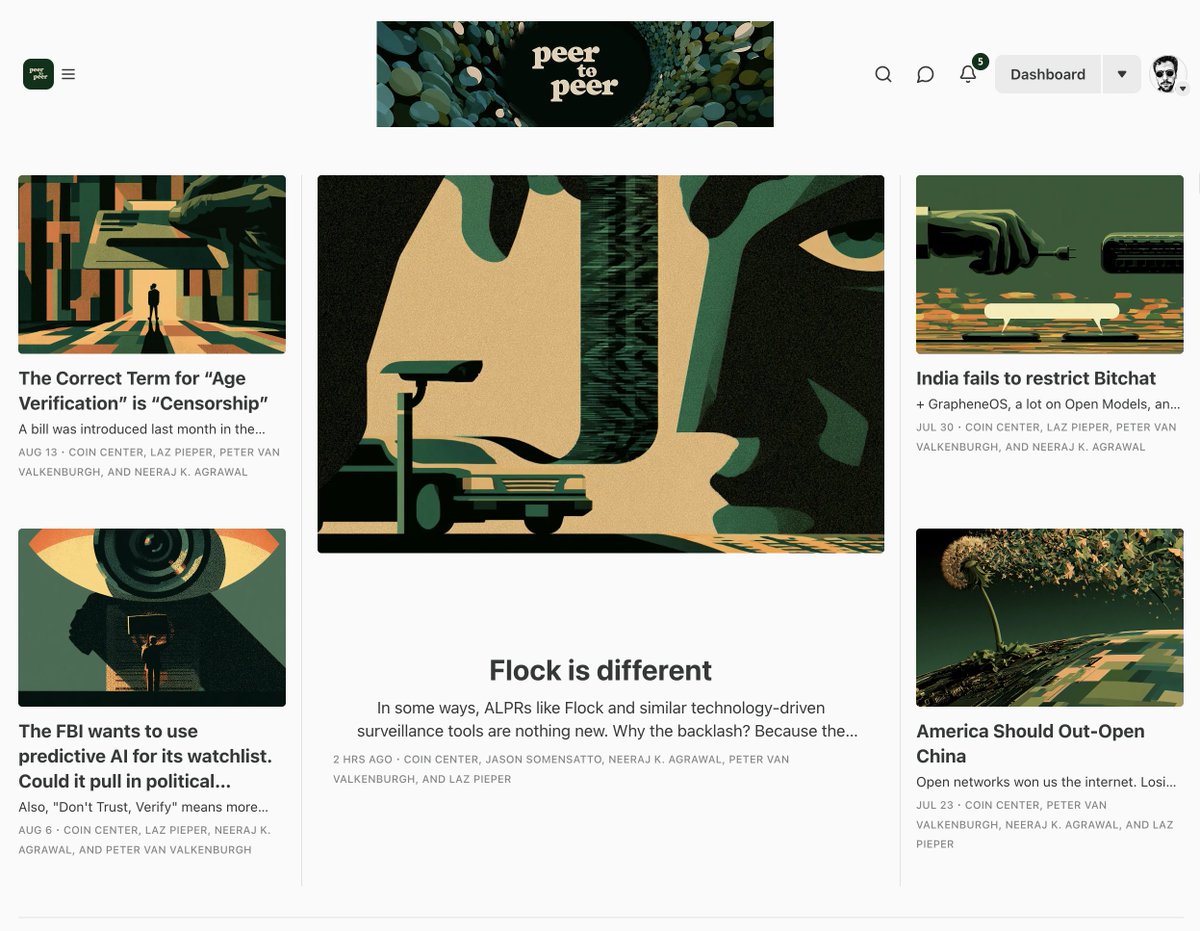
A few weeks ago Coin Center started Peer to Peer .
It's a newsletter about the rise of
Technological Authoritarianism
and how we can fight back with
American Values, Open Tech, and the Constitution.
Authors include @LazPieper@NeerajKA@jasonsomensatto and myself. I'm thrilled with how it has come together and feel lucky to have such a talented and ideologically based team.
If you care about geopolitics—and perhaps, more specifically, American hegemony—open weight models are increasingly demonstrating their value to countries and businesses around the world over proprietary ones.
The most advanced open weight models are coming from China and mostly funded by Beijing, meaning they will be trained on and exert CCP values. In a global competition for influence, that’s a winning strategy for China and a losing one for America. https://t.co/s6gGr2XDPg
Flock leaves us with no meaningful way to avoid surveillance absent legal protections.
We can conceivably turn off location tracking, leave a phone at home, use encrypted messaging, or decline to use a particular service.
But we are legally required to display license plates, and driving is practically indispensable for millions of people. Privacy therefore cannot realistically depend on individual technological self-defense.
https://t.co/WzjbkN8i1K
I wrote about Flock for our latest edition of peer2peer and why this moment feels different, including whats driving the public backlash to surveillance tech and the unsettled Fourth Amendment questions.
https://t.co/mH2Mrq2pLi
Peer-to-Peer:
Automated license plate readers (ALPRs) like Flock and similar technology-driven surveillance tools are nothing new. So why the blowback?
There is something demonstrably creepier about Flock.
https://t.co/B990g5b5db @jasonsomensatto
“Don’t Trust, Verify” is one of the foundational principles of Bitcoin. You don’t have to trust a central operator. You don’t have to trust everyone else in the system to act honestly. You can run the software, check the ledger, and verify both the rules and good behavior of others for yourself.
The same principle extends to all open systems. You can verify the software you are running is secure without trusting the author or an auditor, or millions of other people saying “well, it’s worked fine for me.” You can see for yourself. At least, in theory. In practice, however, the level of skill needed for such an evaluation is not something we can expect everyone to have.
The Coldcard hack was a disaster. I feel terribly for the victims. Setting that aside, it has been an instructive example of how security and open source software could work in the post-AI world.
This democratization of verification lowers the cost of questioning the software we trust for everything. Expertise is still preferred, but it does make expert-ish scrutiny more widely available than it used to be. By the way, thus far only open-weight models have given people this power. Closed models trigger safety lockouts when a user tries anything that looks like hacking, even if it’s for good reason.
Of course, that only applies if the code is open in the first place. Closed software still asks you to trust the vendor. Open software gives the public something to inspect.
I’ll admit, in the past I thought the naysayers had a bit of a gotcha when they pointed out it was impossible for a nontechnical person to truly be trustless while still being reliant on experts. Now I’m not so sure.
Open-source software proved its resilience as the Indian government was ineffective in restricting access to Bitchat and repos live on.
Even more impressive, the Bitchat application can now be shared from phone-to-phone with no internet required on Android devices. https://t.co/60tk7L830y
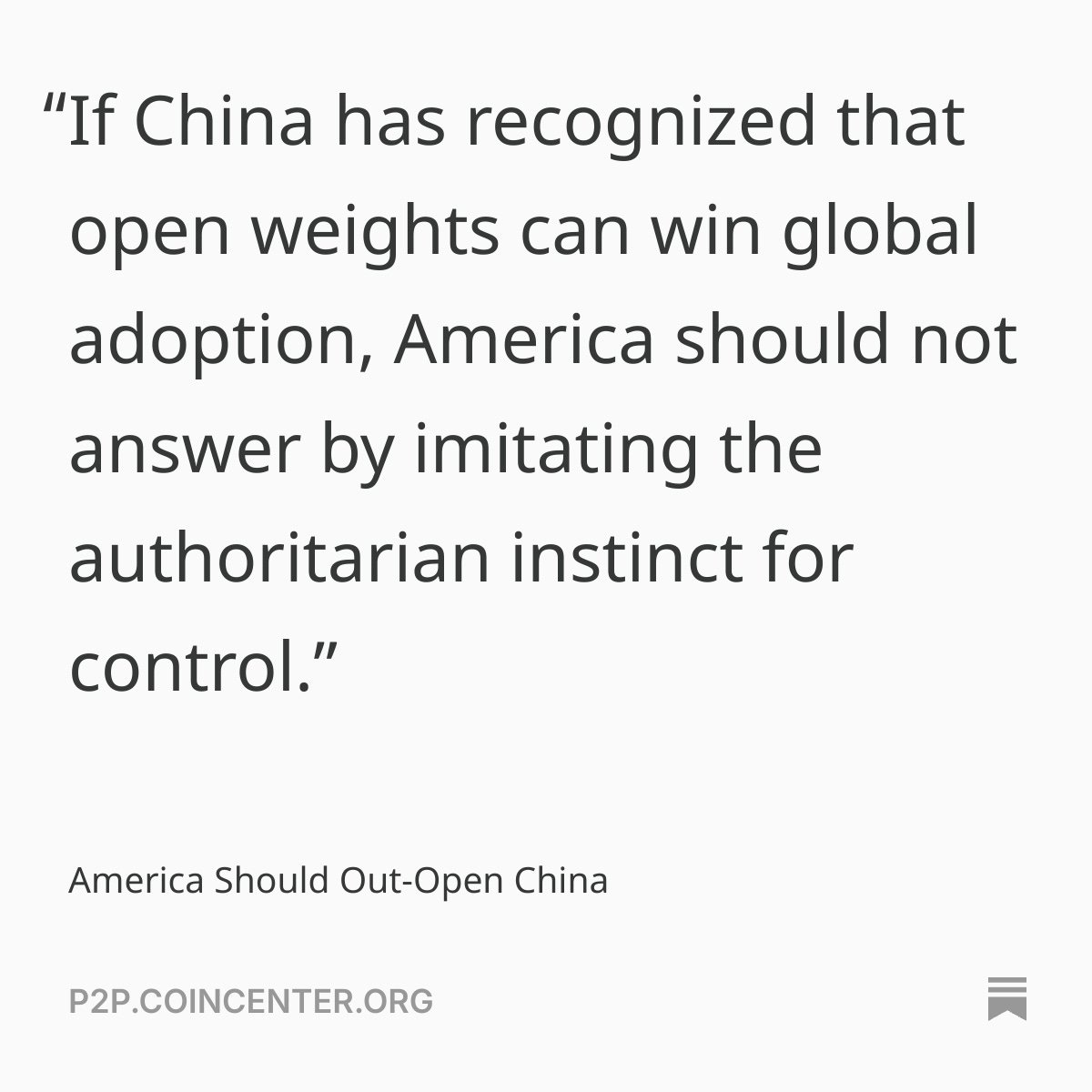
"If China has recognized that open weights can win global adoption, America should not answer by imitating the authoritarian instinct for control. I don’t want the 21st century to be a rerun of the 20th but with me on the wrong side of the oceans."
https://t.co/cuyWiFliO9
"Open weight AI, strong encryption, and permissionless cryptocurrency are therefore all fronts in the same fight over whether lawful technology may exist without a government-accessible chokepoint." https://t.co/cuyWiFliO9