There's exactly one wall standing between Bitcoin and the $10 trillion sitting inside America's 401(k)s. It's not a law, not technology, and not the fear of getting sued — and Washington is one document away from tearing it down.
Go to https://t.co/qh5coBnnSR or tap the link in my bio and see exactly how we position early on moves like this, for a dollar a month.
Here's what nobody explains about your 401(k): you don't really pick your investments — you pick from a menu, and the people who build that menu carry legal responsibility for every option on it. Add something risky, you get sued. So for years crypto never made the menu — too much lawsuit risk. Now watch the wall come down, step by step. May 2025: the Labor Department deletes its old warning telling retirement plans to use "extreme care" with crypto — completely gone. August: the president signs an executive order opening alternative assets to 90 million Americans in these plans. September: the department says in writing it is "boldly implementing" that order. March this year: the actual rule drops — follow a six-part checklist and the law will presume you acted responsibly, even when adding crypto. Remove the lawsuit risk and the menu opens. June 1, 2026: public comments closed, and the rule is in final review right now. Wall Street is already in position — Fidelity launched a crypto retirement account back in April 2025, four months before the executive order even existed. Now the math that matters: 401(k)s hold $9.9 trillion. Say just 1% moves — that's $99 billion. Bitcoin creates about 450 new coins a day, roughly $10 billion a year at today's prices, so a 1% trickle from retirement accounts would swallow years of new supply by itself — and there will only ever be 21 million coins. Not everyone's cheering: Bernie Sanders and Elizabeth Warren demanded the rule be scrapped the day comments closed. But the decision now sits on one desk at the Labor Department. Doors like this only open once — and they never close.
Follow so you catch the next move before the headlines do.
Coinbase will now lend you $5 million against your Bitcoin, and you never have to sell a single coin to get it.
Go to https://t.co/qh5coBnnSR or tap the link in my bio and see exactly how we're taking advantage of news like this, for a dollar.
On March 5, 2026, Coinbase raised the cap on its Bitcoin backed loans to $5 million, and for the first time rolled out Ethereum backed loans too, capped at $1 million.
The program only launched in January 2025 and it already crossed $1 billion in loans in just eight months. CEO Brian Armstrong says the next target is $100 billion.
Normally, if you want cash out of your crypto, you sell it. But the second you sell, you trigger a taxable event, capital gains tax on your profit.
A crypto backed loan flips that. You lock up your Bitcoin as collateral and they hand you cash against it. You never sold anything, so there's no tax bill. You keep your coins, and if Bitcoin keeps climbing you still own all of that upside.
This is the retail version of a move the ultra wealthy have run for decades, called buy, borrow, die. The rich do not sell their best assets and pay the tax. They borrow against them, spend the cash, and keep holding. What used to live behind private bankers is now a button inside an app you probably already have.
But this is leverage, and leverage cuts both ways. If the price drops hard, the lender can liquidate your collateral at the worst possible time. Borrow far below the max, watch your loan to value, and treat the interest as the true cost of that cash.
The bigger signal is that crypto is quietly becoming collateral the whole financial system can lend against.
That is exactly what we hunt for every day.
Follow for the next breakdown.
Five things just happened in six months that each would have been unthinkable five years ago — and together, more than $800 trillion is moving toward crypto rails on a schedule.
Go to https://t.co/qh5coBnnSR or tap the link in my bio and see exactly how we position early on moves like this, for a dollar a month.
One: on March 4, the Federal Reserve gave a crypto exchange — Kraken, through the Kansas City Fed — a federal master account, the first ever. It's limited and only a year, but that's a key to the front door of the US banking system, and the Fed has already proposed a new account type so more can follow. Two: Swift went on-chain. The network banks use to move money across borders — about $150 trillion a year — started building a shared blockchain ledger with more than 40 banks on March 31, committing to real transactions before year-end. Three: on June 5, 17 of America's biggest banks — JPMorgan, Bank of America, Citibank, Wells Fargo — announced they'll turn customer deposits into digital tokens wired into a network that settles $2 trillion a day, targeting 2027. Four: Securitize became the first company ever to put its own stock on a blockchain the same day it went public — on July 2, on Solana and Avalanche — and when the exchange closed for July 4th, the stock kept trading. Five: the DTCC — the vault that actually holds America's stocks and bonds, $114 trillion worth — starts settling real tokenized trades this month with the SEC's full blessing, full launch in October. Add it up: $114 trillion in the vault, $44 trillion listed on the NYSE, over $650 trillion a year flowing through payment networks — north of $800 trillion, all touching systems that just committed to blockchain with dates on the calendar. If you hold crypto, that list is your answer to everyone who laughed. You weren't wrong — you were early. And the next date is already set: July 18, the deadline for six federal agencies to publish the official rulebook for digital dollars.
Follow so you catch the next move before the headlines do.
Four of Wall Street's biggest names just quietly made the exact same crypto move, and the newest one to do it is 234 years old.
Go to https://t.co/qh5coBnVIp or tap the link in my bio and see exactly how we position early on moves like this, for a dollar a month.
State Street just launched a stablecoin reserve money market fund, ticker SSCXX. Its own bank seeded it right next to Anchorage Digital, the first federally chartered crypto bank in America. It came in with about 121 million dollars in early assets, a 3.51% yield, and a rock bottom 0.18% expense ratio. Here is the part that matters. State Street is not first, it's the fourth. BlackRock did it, Goldman Sachs did it, BNY did it, and now a 234 year old giant joins the line. When the biggest names quietly lay the same plumbing one after another, that is not a fad. It is a new system for money being built in front of you, and a whole sector of coins underneath it is forming right now.
Follow so you catch the next move before the headlines do.
North Korea just stole 76% of all the crypto taken on Earth this year and almost nobody connected the dots.
Go to https://t.co/qh5coBnVIp or tap the link in my bio and see exactly how we turn news like this into a shortlist of coins before the market catches on, for a dollar a month.
The FBI blamed a North Korean group for draining about 1.5 billion dollars from the exchange Bybit, the single largest crypto theft in history. TRM Labs tracked their share of global crypto theft climbing every single year, from under 10% in 2020 to 76% so far in 2026. But here is the part nobody talks about. Every heist teaches the on chain detectors exactly how these attacks work, and a whole security sector is being built right now to trace stolen funds, audit code and freeze wallets before the money moves. The projects that make crypto safe are about to get very valuable while almost nobody is watching them yet.
Follow so you catch the next move before the headlines do.
Three of the biggest names in crypto just lined up behind one AI coin most people have never heard of.
How we're taking advantage of all of this is inside https://t.co/qh5coBnnSR, link in my bio.
The coin is Bittensor and its token is TAO, a network that pays people in TAO for real machine learning work.
On June 27, Yuma, backed by Digital Currency Group, launched the Yuma Total Market Fund, one institutional product bundling TAO plus a basket of AI subnet tokens.
On April 2, Grayscale filed its amended registration with the SEC to convert its Bittensor Trust into a spot TAO ETF on NYSE Arca under the ticker GTAO. Bitwise has a TAO filing in the queue too, with a decision window expected around August.
When institutions build the on ramps this early, the sector is forming before the crowd knows the name. You do not need to guess which subnet wins. You just need to see the sector forming.
Follow so you catch the next move before the headlines do.
A trillion dollar Wall Street giant just made its first public move into altcoins, and the timeline is tighter than you think.
Go to https://t.co/qh5coBnnSR or tap the link in my bio and see exactly how we're taking advantage of news like this, for a dollar a month.
On May 27, DTCC, the company that settles almost every stock trade in America, named Stellar as the first public blockchain for its tokenization service, targeting DTC custodied assets on chain in early 2027.
Twenty seven days later the capital moved. On June 23, Franklin Templeton closed its acquisition of crypto investment firm 250 Digital and stood up Franklin Crypto, a division built to put money into liquid crypto strategies beyond Bitcoin and Ethereum.
Then Western Union, a 175 year old payments giant, launched its USDPT stablecoin on Solana, with a consumer rollout across Mexico, Argentina, Colombia and the Philippines.
Institutions never announce the buying. They show you the infrastructure choices, the acquisitions, the chain picks. Those are the footprints. Walk in them early instead of waiting for the press release that says it is safe.
Follow so you catch the next move before the headlines do.
A Bitcoin company just bought a licensed Japanese brokerage so it can sell Bitcoin products straight to the public.
Go to https://t.co/qh5coBnVIp or tap the link in my bio and see exactly how we're taking advantage of news like this, for a dollar a month.
On June 12, Metaplanet agreed to buy 100 percent of Siiibo Securities for about $13 million. Siiibo holds a Type 1 Financial Instruments license, the license that lets a firm sell investments to the Japanese public. After the July close it rebrands as Metaplanet Securities.
Metaplanet already holds 43,000 Bitcoin after adding another $170 million worth this week, the third largest corporate stack on earth, and its stated plan is 100,000 by the end of 2026 and 210,000 by the end of 2027.
The play is called Project Nova. Japanese households sit on roughly $7.4 trillion in cash and deposits earning almost nothing. Metaplanet wants to sell them Bitcoin backed yield products through its own broker.
When a company buys distribution just to move Bitcoin products, Bitcoin backed finance is forming as a sector. The companies and coins plugged into that rail are the ones to watch.
Follow for the next breakdown.
Banks are about to start making real loans on a blockchain, and the vote to switch it on is happening right now.
I break down what this means and the tokens that plug into it inside our group. Join at https://t.co/qh5coBnVIp, the link is also in my bio.
On June 29, Ripple published something called the XRPL Lending Protocol. In plain English, that is a proposed set of rules that would let licensed banks and lenders originate real loans directly on the XRP Ledger. Real credit, the kind that runs the entire economy, not crypto swapping.
Be precise about what this is. These are fixed term, uncollateralized loans with a set payback date, backed by real world underwriting and a first loss safety cushion, not by coins you locked up. The bank still decides who gets a loan off chain, the same way it does today. The ledger just handles the boring, expensive plumbing: origination, interest, repayment, and what happens if someone defaults. Ripple wants to move that off slow, closed banking software and onto an open blockchain that settles in seconds for fractions of a cent.
Here is the key word: proposing. It is not live yet. It is built on two upgrades and it is in early voting. Right now about 20 percent, 7 of 35 key validators, have voted yes. It needs 80 percent support held for two full weeks before it switches on.
So we are watching a financial rail get built in real time, in public, before the headlines catch up. A brand new lending sector forming from scratch, and you are seeing it at the proposal stage, not after it is priced in.
Position while the vote is still open, not after it clears.
While everyone was watching crypto crash, the biggest banks in America quietly announced they are replacing the dollar's plumbing.
I break down exactly what this means and how we position for it inside our group. Join at https://t.co/qh5coBnnSR, the link is also in my bio.
There is a company most people have never heard of called The Clearing House. It is owned by the biggest banks on Earth, JPMorgan, Bank of America, Citi, Wells Fargo and the rest, and it already moves more than 2 trillion dollars every single day. That is what your paycheck rides on right now.
And they just announced they are putting your bank deposits on a blockchain. Tokenized deposits. 24/7, programmable, instant settlement, everything stablecoins do, launching in the first half of 2027.
Here is the part nobody says out loud. Those same banks lobbied for a law, the GENIUS Act, that bans stablecoin companies from paying you any yield. Then they turned around to launch their own version, where your tokenized dollar never leaves their balance sheet and still funds their lending. They looked at Tether and Circle holding 263 billion dollars and said that is our money, we want it back.
And this is not just America. The same month, Japan's three largest banks, MUFG, SMBC and Mizuho, announced their own joint stablecoin. Same window, same playbook. The Clearing House CEO himself said the banks are moving to a radically different future built on on chain payments. That is not a crypto influencer talking. That is the man who runs the pipes your money flows through.
So while everyone panicked over red candles, the institutions that control the money itself committed to crypto rails. By the time this goes live, the people who understood it will already be positioned inside it.
Follow so you are one of them.
The Entire Banking System Just Got Wired Into Crypto
The entire global banking system just got wired into crypto, and almost nobody noticed.
I break down what this means and how we position for it inside our group. Join at https://t.co/qh5coBnVIp, the link is also in my bio.
You know the network that moves money between banks. It is called Swift, it connects more than 11,000 banks, and it has been the backbone of global finance for 50 years. Back in November 2025, Swift quietly switched on a blockchain layer. And the system routing messages between the banks and the blockchains is governed by Chainlink.
Chainlink already connects more than 70 blockchains and moved over 18 billion dollars in a single month. It also became the data layer feeding the US stock market as it gets tokenized. So Chainlink is now sitting underneath both the banking system and the stock market at the same time.
This is not theoretical. Around 47 banks across Europe and Korea are building to settle real currency trades in stablecoins, on a system built with Chainlink. Even Western Union, the 175 year old giant, launched its own stablecoin on Solana to move money outside of Swift.
Here is the part that should stop you. Chainlink has been a public coin anyone could buy since 2017. Nine years. And this is what they chose to build the future of the global economy on top of.
You do not get to position after the world figures this out. You position before.
Follow so you are early, not late.
The same country that shouts "Death to America" on national TV just got caught buying American crypto.
I break down what this really means and how we position for it inside our group. Join at https://t.co/qh5coBnVIp, the link is also in my bio.
While the US was dropping bombs on Iran this month, it also went after Iran's financial system and the crypto infrastructure Iran was using to launder money around sanctions. And when they cracked it open, they found something nobody expected.
Iran's own central bank, the financial core of a nation at war with America, was sitting on around 507 million dollars in Tether, a US dollar stablecoin. A crypto dollar. They were holding it as a secret shadow reserve because their own currency was spiraling to death.
Sit with that. Iran spends every breath trying to escape the US dollar and break American power. But when their survival was on the line, they did not reach for gold. They did not reach for the Chinese yuan. They did not reach for their own currency. They reached for the American dollar, just the digital crypto version of it.
That is your answer to everyone who says crypto is a fad. The country that hates America the most just proved crypto dollars are the most trusted money on earth by betting its survival on them.
And Iran is not alone. Stablecoins are quietly becoming the emergency money for anyone the old system shuts out. Billions of people who cannot get a bank account can hold a crypto dollar in seconds, and entire governments are doing the same.
The people who see this early are the ones who position before everyone else figures it out.
Follow so you are one of them.
MoneyGram just plugged a stablecoin into nearly 500,000 retail locations, and almost no one is pricing in what that does to crypto adoption.
Everything we break down lives inside the community, link in bio, one dollar a month.
On June 2, 2026, MoneyGram launched MGUSD, its own U.S. dollar stablecoin built on Stellar. This is not a small crypto experiment. MoneyGram serves over 60 million customers, reaches nearly half a million retail locations, and has spent 85 years moving money around the world.
The part that matters: more than 70% of MoneyGram transactions are already digital. So this is not an old company randomly chasing a trend. It is a legacy payments network turning its existing rails into stablecoin infrastructure.
Here is the second order effect. Once MoneyGram does this, it gives every other remittance company, payment app, and legacy finance giant permission to do the same thing. Western Union, PayPal, and other institutions are already moving in this direction.
What it means for your money: crypto adoption is not waiting for permission anymore. The companies that move cash around the world are starting to use stablecoins because the rails are faster, cheaper, and global by default.
Follow for the moves the news skips.
The Government Just Created Bitcoin’s Biggest Supply Shock on Purpose
The government just made it possible to buy a house with your Bitcoin without selling a single satoshi, and almost no one is pricing in what it does to supply.
Everything we break down lives inside the community, link in bio, one dollar a month.
Better and Coinbase launched the first ever crypto-backed Fannie Mae conforming mortgage. You pledge your Bitcoin as collateral, cover the down payment, and get a standard 30-year loan, while your Bitcoin stays yours and keeps growing. This is not a waitlist. The first loan already closed for a married couple in their early 30s in Ann Arbor, Michigan, and it is going nationwide this summer.
The part that matters: they guarantee no margin calls. Even if Bitcoin drops hard, you are not liquidated. The only way you lose the collateral is if you stop paying the mortgage. And because you never sell, there is no taxable event. JPMorgan is already rolling out its own crypto collateral lending right behind them.
Here is the second order effect. When your Bitcoin is locked into a 30-year mortgage, it is off the market for decades. Combine millions of coins getting locked up like that with the halving, which keeps cutting new supply, and you get a supply squeeze most people are not thinking about.
What it means for your money: you no longer have to choose between owning a home and holding Bitcoin. The smartest move is understanding how to use the asset without selling it, before this goes mainstream.
Follow for the moves the news skips.
The government just found a loophole to duplicate every dollar using crypto.
The same foreign dollar can now fund the United States twice, and it runs entirely on the blockchain.
For fifty years the petrodollar funded America. Countries sold oil, got paid in US dollars, and parked those dollars back into US bonds or the US stock market. The money flowed right back home. That was the trick.
Now there is a new version. Countries are moving into stablecoins, which are digital dollars that live on a blockchain. Under the GENIUS Act, every stablecoin has to be backed by US treasuries. So the moment a country buys one, the dollars behind it already bought US government debt. That is the first dip.
Then that country holds the stablecoin like cash, and to outrun inflation it reinvests into tokenized money market funds or tokenized stocks. US debt and US markets, again. That is the second dip. The same dollar funds the country twice. Treasury Secretary Scott Bessent even said publicly that he is counting on stablecoins and money market funds to absorb America's short term borrowing.
What it means for you. The demand for stablecoins and tokenized assets is being built into the system on purpose, and the rails it runs on are the same ones you can already access. Take the time now to understand how stablecoins and tokenization actually work, because the people who learn the plumbing early are the ones who position early. Start by learning which assets and blockchains this new system is being built on.
Follow for the next breakdown.
SWIFT was built to keep crypto out. Now 30 of the banks inside SWIFT's new payment framework are already running on Ripple's rails.
Santander. HSBC. Standard Chartered. Deutsche Bank. JPMorgan. The same institutions that spent a decade calling this stuff a scam are now operating inside both systems at once. SWIFT's messaging on one side. Ripple's infrastructure on the other.
Here's the part nobody's saying out loud: SWIFT never mentioned Ripple once in the announcement. They didn't have to. The overlap is the story. The legacy system that was supposed to replace XRP just filled its new framework with banks that already settle on it.
They're not choosing one over the other. They're quietly wiring both together. And the rails most people thought were enemies are about to share the same plumbing.
The dam isn't breaking later. The banks already walked through.
This same name mix-up has happened before and it will happen again.
We score every coin on three things: liquidity, team, and demand.
Follow CoinPicks for more case studies.
Link in bio to the strategy we use to find coins like this before they pop off.
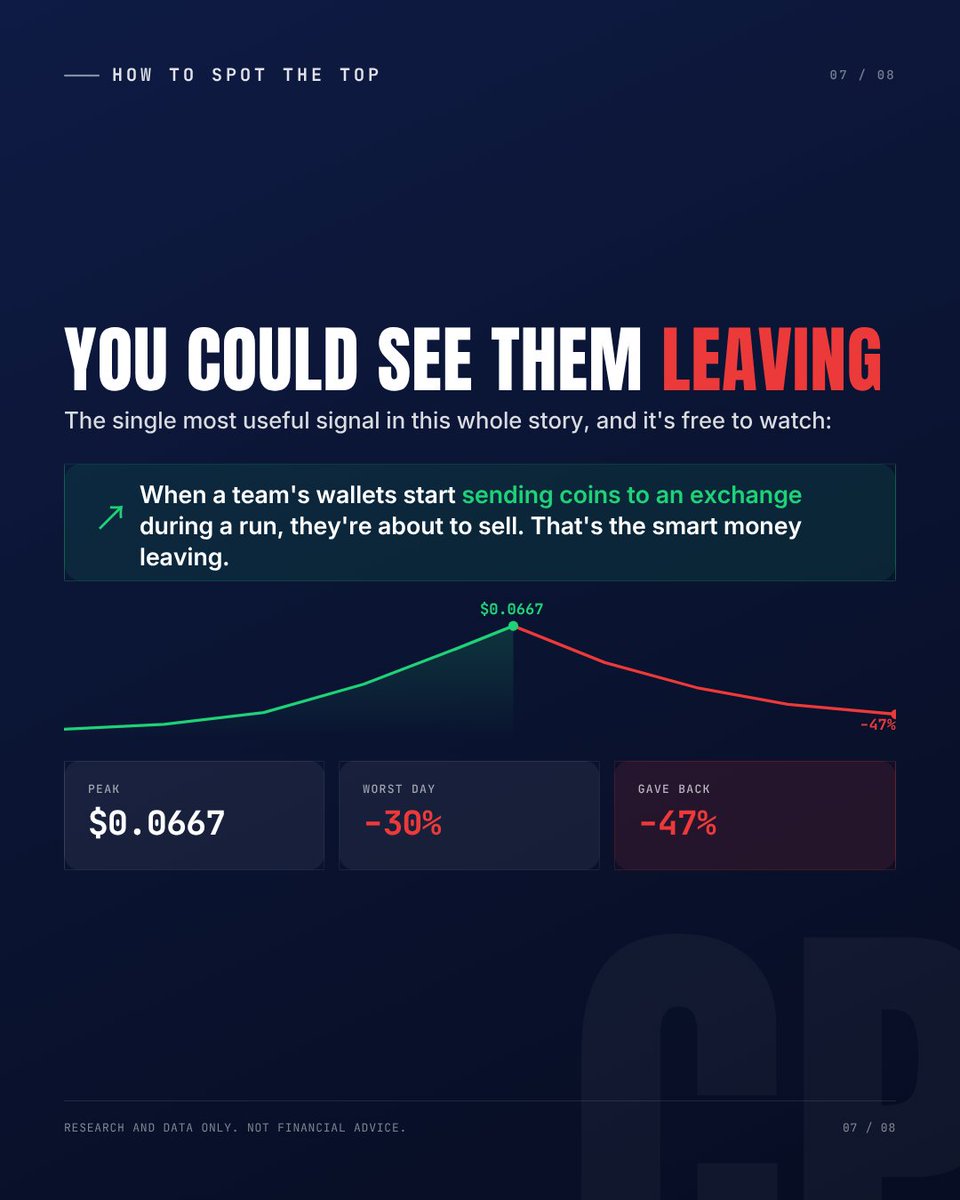
The most useful signal here was free to watch.
When a team's wallets start sending coins to an exchange during a run, they are getting ready to sell.
That is the smart money leaving.
BICO peaked at $0.0667, then dropped 47%.