A signature program of @colgateuniv, Living Writers is a master class in how works of literature come to be. Join the discussion using #ColgateLivingWriters
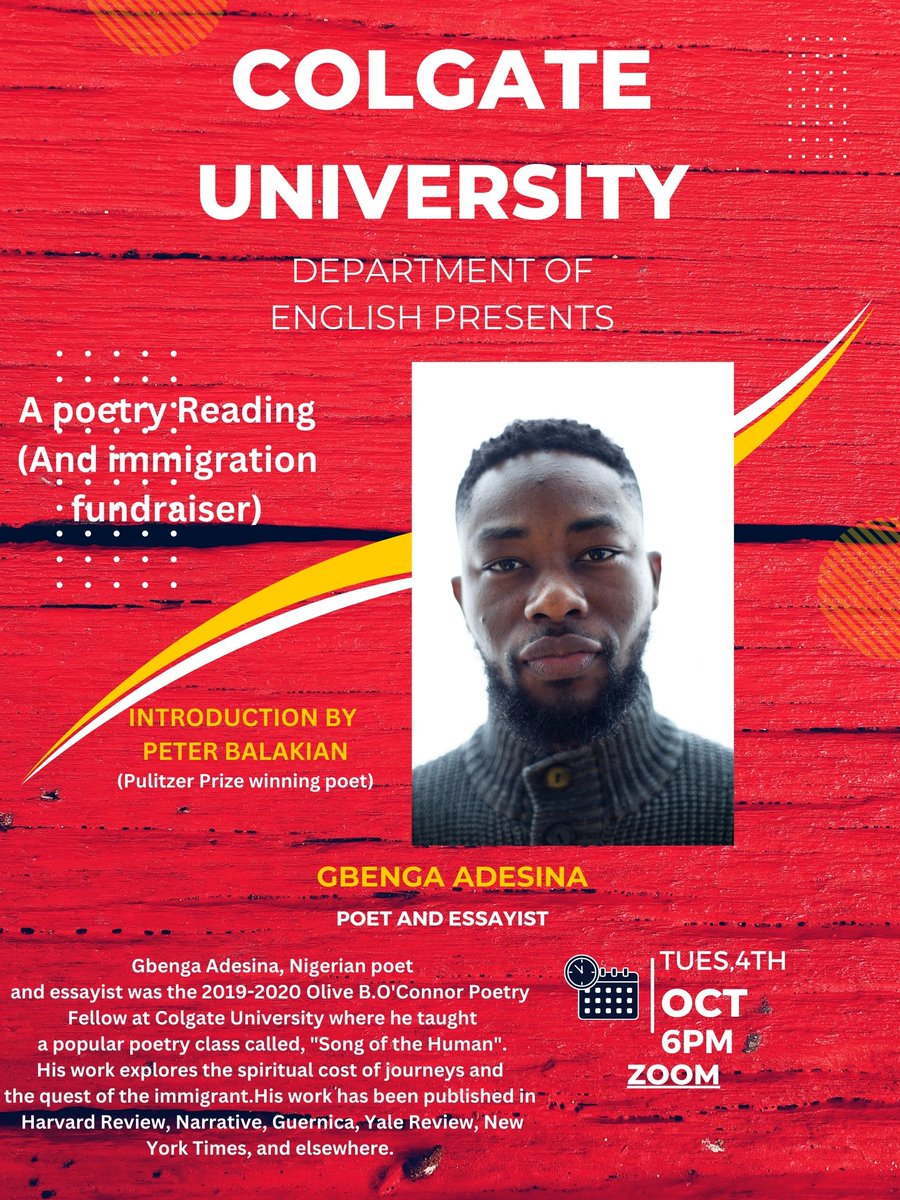
Help Gbenga stay in the US & keep writing poems!
#ColgateLivingWriters
https://t.co/xjNQ4IIUrx
"The maplines crackle, they run
in my maplewood veins.
I would that you know
what is hidden is what is broken
is what is holy."
—from "The Lovers of Modena," by Gbenga Adesina
Join us next Tuesday for a poetry reading & fund-raiser for a former Olive B. O'Connor fellow in creative writing.
#ColgateLivingWriters
Zoom link here:
(3/3) That word, "succeeded," leads me to my last question (until tonight), & it's a big one that I'm still mulling for myself: What constitutes success in this novel? Who (or what) succeeds? What about failure?
#ColgateSummerRead#ColgateLivingWriters
(1/3) Last Tweets of summer! In "Notes of a Native Son," James Baldwin writes, “Hatred, which could destroy so much, never failed to destroy the man who hated and this was an immutable law"—a line that came to my mind ...
#ColgateSummerRead#ColgateLivingWriters
(2/3) when the (new) Children observe "Our Thula was angry, but she'd long lost her capacity for hatred" (352). What's the distinction they're making, b/w anger & hatred? Had Thula been motivated by a different set of emotions, would she have succeeded?
#ColgateLivingWriters
The novel flirts w/ but refuses to fall into easy polarities, doesn't it? The court decision (rendered by a female judge!) is heartbreaking. My paraphrase: "A US company is doing evil overseas, but that is not a problem the US court system can address."
#ColgateSummerRead
Yes. As Nubia tells Juba, "smart bitches know how to carry their burdens w/ style, & how to lay them down" (339). An angry woman (Thula, w/her skinniness & stringy hair [dreadlocks?]) seems unable to do either.
#ColgateSummerRead#ColgateLivingWriters
Yes—there was a whiff of subversiveness in him, wasn't there? And also a sense of a world beyond the village's & even the country's borders. He was an early inspiration & model for Thula, for sure.
#ColgateLivingWriters#ColgateSummerRead
@ColgateLW Teacher Penda taught the children government-sanctioned material but also English, life in America, and the oil industry. Thula's college degree would implore her to take action to help Kosawa
#Colgatelivingwriters
@ColgateLW Being a woman, in some ways, grants Thula autonomy. Specifically as an unmarried woman with no children, Thula is not held responsible for anyone but herself. If Thula were a man, she would be held responsible for others, as explained in an earlier (1/2)
That's an interesting thought. If one of the other Children—the other 7 (then 5, then 0) age mates, all male—had shown Thula's initiative & intelligence, do you think he wouldn't have been allowed to go to America?
#ColgateSummerRead#ColgateLivingWriters
@ColgateLW section-"we would only become men the day we became responsible for other lives"(282). Perhaps, if Thula was not a woman, she would not get the chance to go to America and gain the knowledge to become a leader. She would have been needed in Kosawa.
Page 341
And yes, as you note, her being a woman meant she wasn't taken seriously by either side—w/ (sometimes) the exception of the younger generation of villagers.
#ColgateSummerRead#ColgateLivingWriters
@ColgateLW her to continue spreading her ideas of a revolution was because she was a woman with high academic achievements. Because, after all, what could a woman accomplish?
@ColgateLW I believe that without this unbalanced belief that women are lesser than men, her revolution would have been squashed the moment it sprouted.
Yes—teaching seems to be an upwardly mobile profession in this particular country, & the gov't (as you say) seems to value education so much it pretty much leaves Thula alone to fling insults at His Excellency!
#ColgateSummerRead#ColgateLivingWriters
@ColgateLW The government values education but prioritizes the school in Lokunja which has better facilities and pathways to modern jobs where the district officials send their kids. Interestingly, teachers earn enough money to afford stone houses #ColgateLivingWriters
(2/2) A related question: Nubila & Thula both are daughters of men murdered for daring to dream of change; both women love Juba. Why aren't they allies or even friends? How about the b**** word that Nubia uses to describe herself?
#ColgateSummerRead#ColgateLivingWriters
(1/2) Today's section reminds me how intertwined the liberation of women is from the liberation of a country—& how many forces are arrayed against them both. Do you sense there are things Thula has accomplished that she could *not* have done if she were a man?
#ColgateSummerRead
Looking forward to tomorrow's real-time Zoom conversation about #HowBeautifulWeWere. If you want to join us from 7-8 p.m., you can find the registration link on the Living Writers website: https://t.co/ctXlffEuk4.
#ColgateLivingWriters#ColgateSummerRead
The question of when non-violent protest has to be abandoned in order to bring about change is the one that hangs over the whole novel.
#ColgateLivingWriters#ColgateSummerRead
Yes. I'm struck, though, by the fact that their numbers had already shrunk at this point (from 7 to 5), & that 2 out of 3 were vociferously opposed to the ritual. As a group, they become less monolithic as the novel goes on, don't they?
#ColgateLivingWriters