Service design firm based in Indy helping businesses design amazing customer experiences. • Customer Research 🔎 • Experience Design 👍 • Team Training 👥
These 5 things brought down Blockbuster and Toys R Us:
• Wrong priorities
• Confirmation bias
• Only looking at the data
• Solving the wrong problem
• Not monitoring/updating the customer journey
Got customer churn?
Before framing the problem, make sure you don’t involve anyone whose salary directly depends on the customer or employee experience.
Confirmation bias haunts primary research.
This is key – Before rolling out any customer or employee experience changes, test them with a small group.
Plug holes and solve the problem, yes.
But make sure you’ve solved the right problem.
How do you avoid the fate of Blockbuster and Toys R Us?
1. Avoid confirmation bias
2. Prioritize your customers
3. Consider more than the numbers
4. Solve the root problem – and the right problem
5. Continually monitor and update your customer journey
Solving a problem in your customer or employee experience? Avoid shiny object syndrome.
You’re here to solve one problem.
Not all the issues plaguing your customer experience.
Business is about solving problems.
You can’t expect to have loyal customers or turn a profit if you’re not solving the root problem.
Lessons learned from Steve Jobs 🧠
During customer experience research, confirmation bias is your worst enemy. 😈
You can easily taint your audit results with what you think is the problem.
You wouldn’t have churn if you knew your customers’ thoughts already.
• Barnes & Noble
• Blockbuster
• Toys R Us
They ignored innovations in their industries, provided a poor customer experience and destroyed their companies.
Collabo XD is the solution.
Priority.
Before anything else, you need to solve your customers’ problems. And you can’t do that without going directly to them.
Business isn’t about …
• Fulfilling your passion
• Building your hobby
• Loving what you do
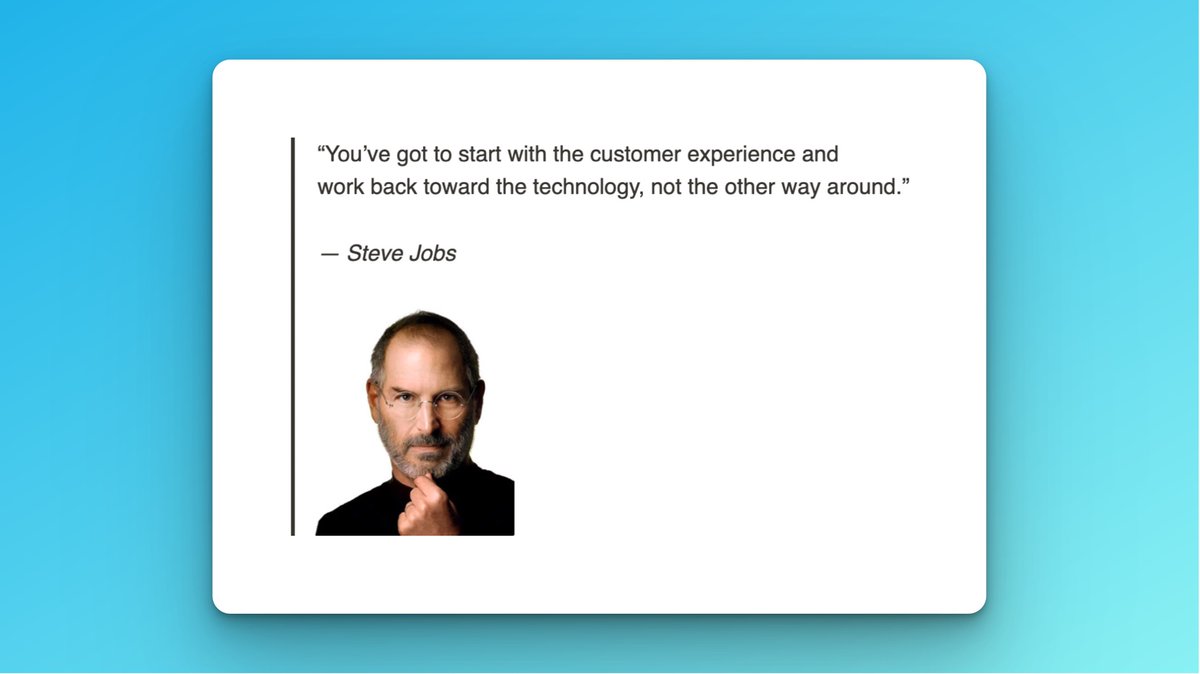
Take it from Steve Jobs.
Business isn’t about …
• Fulfilling your passion
• Building your hobby
• Loving what you do
No.
It’s about solving problems for the people you care most about.
Start with the customer & work backwards to your products/services.
No more bland “Give us your feedback for a chance at a $10 Amazon gift card” gimmicks.
Go straight to the source (your customer) and ask them how they feel about your services.
✨ That ✨ is how you improve customer experience.
A bad customer experience destroys companies. Ex:
• Barnes & Noble
• Blockbuster
• Toys R Us
Instead, do these 5 things:
1️⃣ Solve the root problem
2️⃣ Avoid confirmation bias
3️⃣ Consider more than data
4️⃣ Prioritize your customers
5️⃣ Update the customer journey
Untech the customer journey 🙅♀️
You can’t automate yourself out of the customer experience.
Ask yourself …
• How can you offer a helping hand?
• How many touchpoints are tech-enabled?
• Where can you add a human to personalize the experience?
Barnes & Noble, Blockbuster, Toys R Us.
They didn’t innovate or meet demand fast enough.
Avoid this fate and continually monitor and update your customer journey.
Experiencing customer churn? Surveys only tell half the story.
To solve the actual problem, you have to frame it first.
𝐃𝐚𝐭𝐚 𝐢𝐧 𝐚𝐧𝐝 𝐨𝐟 𝐢𝐭𝐬𝐞𝐥𝐟 𝐢𝐬𝐧’𝐭 𝐞𝐧𝐨𝐮𝐠𝐡.
What insights can you pull from conversations with customers?
No one does customer experience like Apple. Steve Jobs prioritized it.
Here are 3 lessons you can take to your company:
👉 Start with the customer & work backwards to your product
👉 Journey mapping isn't a one-time deal
👉 Be the best in your category
Buying decisions aren’t quantifiable.
Your customer experience is innately human. Human experiences require human conversations.
Do primary research the right way:
1️⃣ Avoid confirmation bias
2️⃣ Untech the customer journey
3️⃣ Outsource your primary research
A poor customer experience will bring your company crumbling down.
Collabo XD knows.
We help organizations avoid this fate and instead, turn record profits. With continual customer experience improvements and intentional service design.
Why are customers leaving?
Frame the problem.
Surveys only tell half the story. So go directly to your customer and ASK (novel idea).
Then you can solve the most problematic gap.