New for @CollegeFrontO : thinking through how a one-time transfer rule could change athlete contracts and negotiations
Read here: https://t.co/3XMeyPgEvf
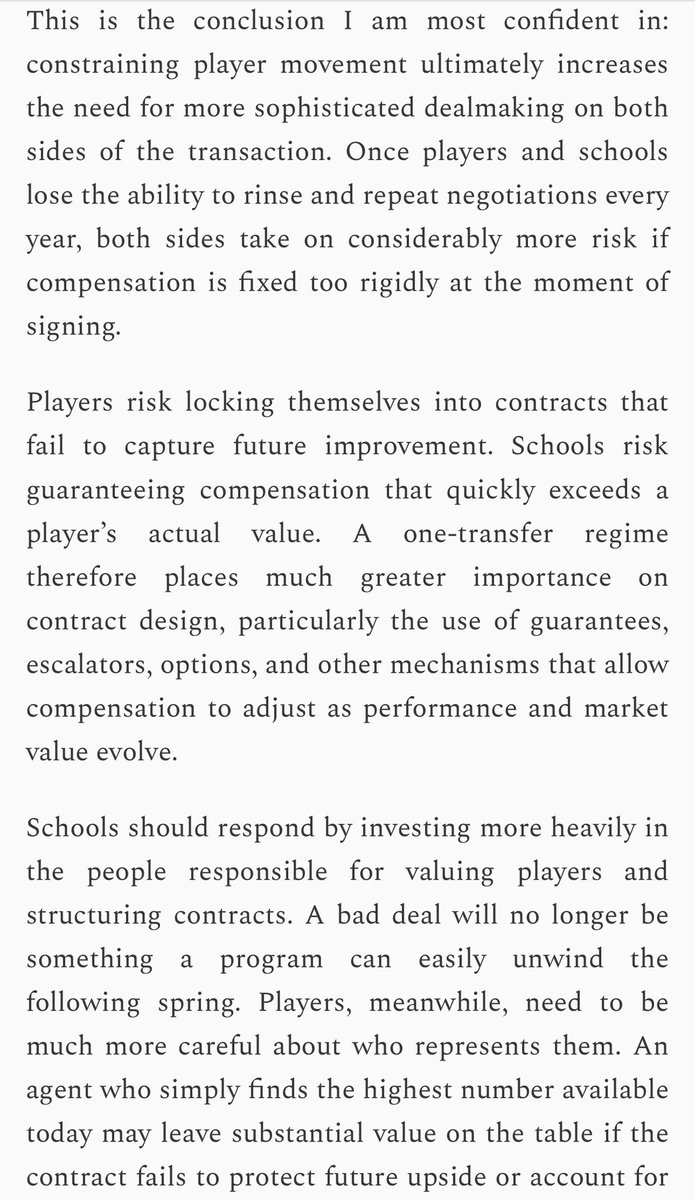
Great look at how reimposing the one-time transfer rule in DI athletics would change the considerations schools & athletes need to account for in contract negotiations.
Player contracts would need to become more sophisticated & complex to account for the new variables at play.
Noah is right.
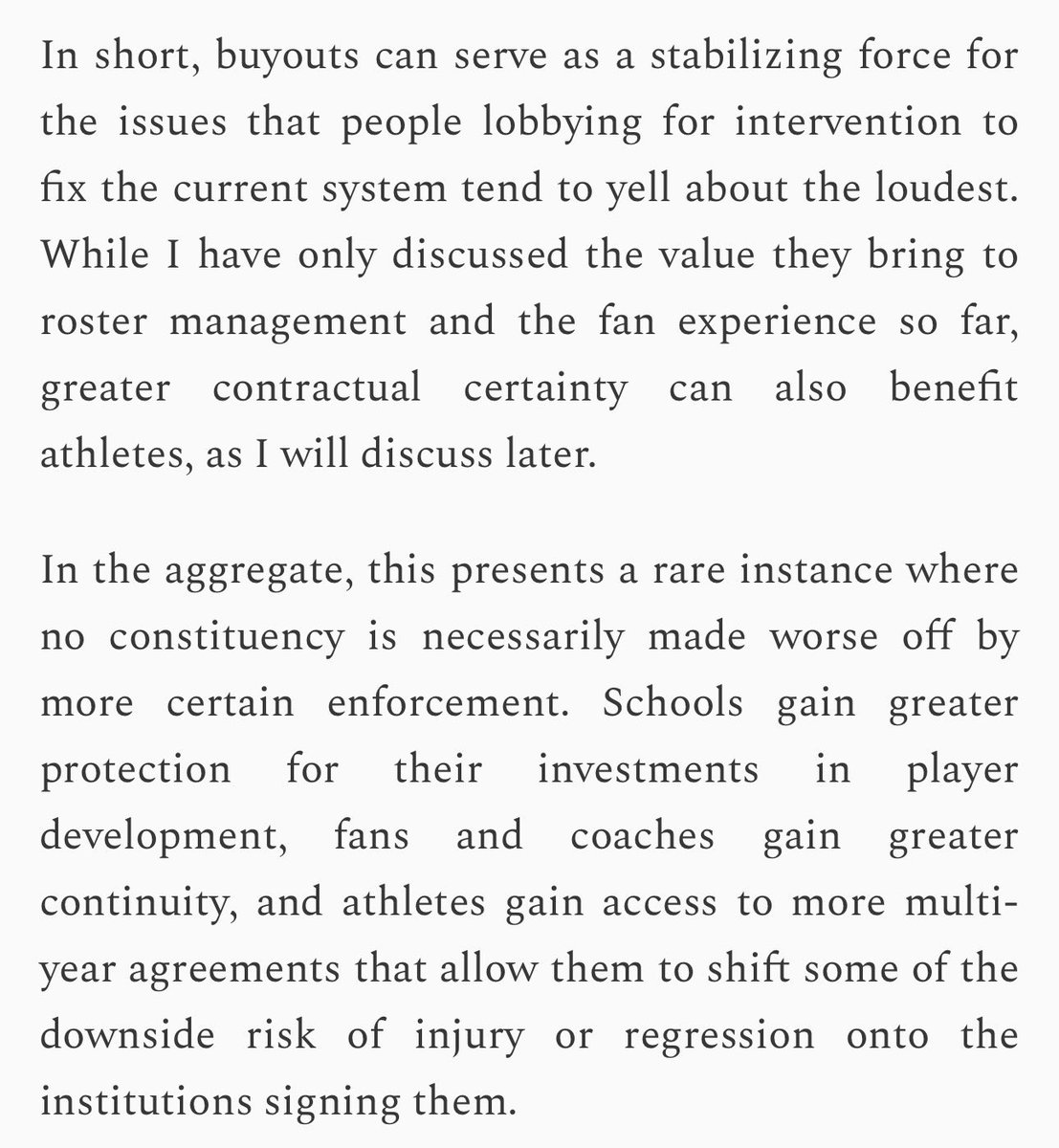
Multi year contracts with enforceable buyouts would help bring more roster stability to college sports.
Employment contracts would greatly increase the enforceability/certainty of buyouts, when compared to the novel NIL/rev-share agreements we have now.
Many schools won't offer multiyear contracts because judicial enforcement of buyouts remains uncertain
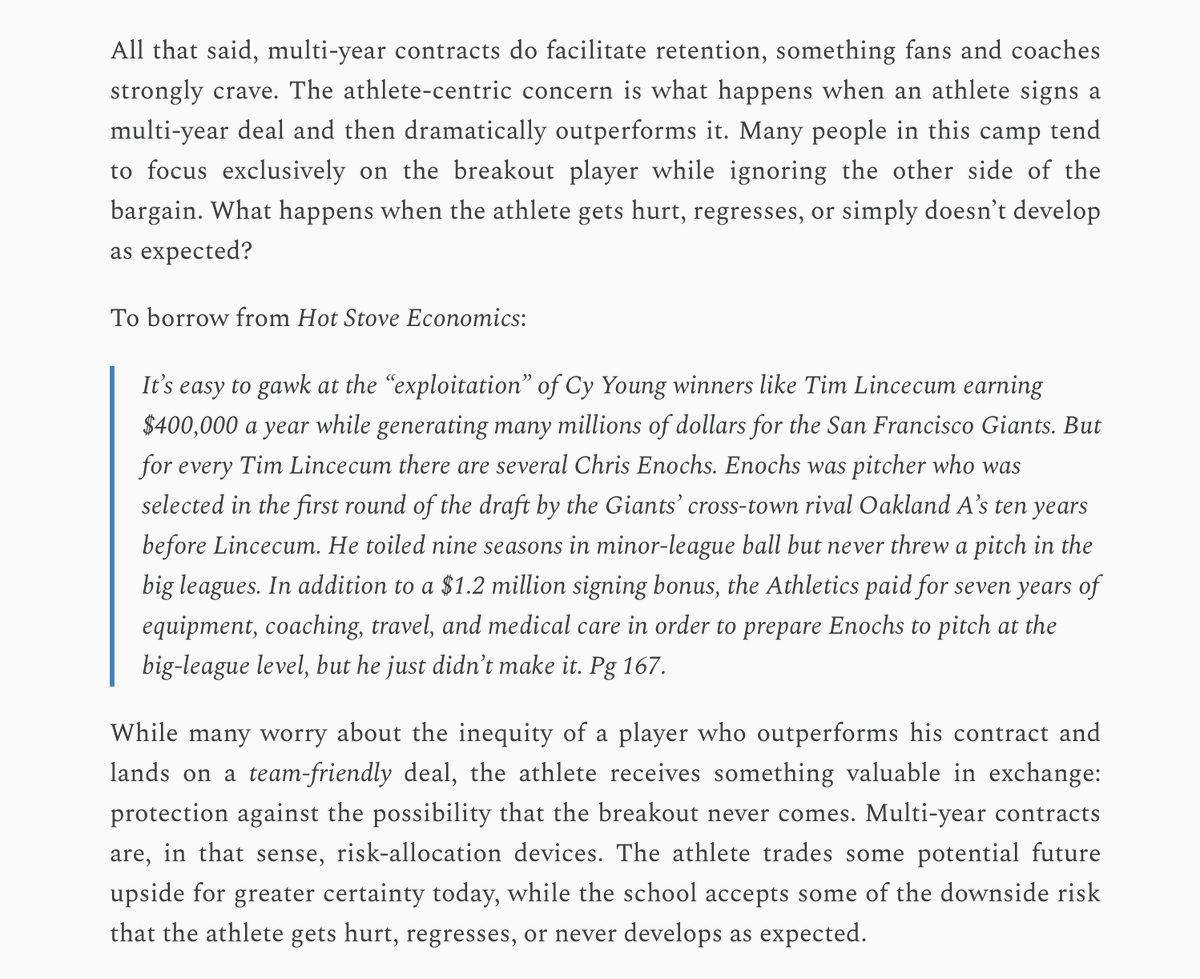
We worry about overperforming athletes losing short-term upside
That focus can be shortsighted, foreclosing earnings protection for athletes who suffer injury or regression
My latest on @CollegeFrontO: https://t.co/FwOwYpDp7N
Excited to share my new scholarship, The Price of Exit: Why Buyouts Fail in College Athletics, in @CalifLRev Online.
Amid a barrage of Hail Mary federal legislative attempts, there's one fix that could bring massive stability to college sports overnight: enforceable buyouts.
The current problem? Courts are being asked to rule on these provisions without any direct precedent, leaving their enforceability under the penalty doctrine largely uncertain.
Under a law-and-economics lens, a buyout is only useful if it functions as a credible price signal: a known cost of exit that lets both sides make informed decisions up front. When enforcement is uncertain, that price signal breaks down, and departing athletes are rationally incentivized to negotiate a discount in the shadow of the law rather than honor what they signed.
Done right, credible enforcement reduces roster churn, promotes efficiency, and rewards programs for evaluating prospects well and investing in their development. It also makes schools more likely to engage in multi-year contracts in the first place: deals that do all of the above while giving athletes real income stability if they regress or get injured. We talk a lot about the athletes who outperform their contracts and cash in; we talk a lot less about the ones with no such cushion.
Where a buyout is clearly disclosed and negotiated at arm's length with counsel, courts should give real deference to its terms, recognizing the unique context of athletics, where an institution's investment in an athlete's development is genuinely difficult to value at the time of signing, and the buyout serves more as a risk-allocation device than a traditional accounting of suffered harms.
This is, as far as I can tell, the first scholarly article on the subject. I'm already hard at work on the next piece and am excited to share more soon: https://t.co/z59RSee0Yu
Why are payrolls in college basketball exploding? The answer is not simply "rich boosters."
Over the past month, I spoke with coaches, general managers, and agents across the country about how this year's transfer portal actually unfolded.
I came away convinced that the biggest driver of today's market isn't irrational decision-making. It's an incentive structure where nearly everyone is rewarded for winning today's negotiation, while almost no one is rewarded for protecting the institution's long-term interests.
The transfer portal is built on panic and the result is a predictable cycle: reservation prices drift, BATNAs deteriorate, negotiating leverage disappears, and today's overpayment becomes tomorrow's market rate. Yet a handful of programs appear to be approaching negotiation with far greater discipline than everyone else.
My latest piece for @CollegeFrontO explores why payrolls keep rising, how behavioral economics helps explain the market, and why disciplined negotiation is a competitive advantage in roster construction. Link in comments.
This week @CollegeFrontO turned 1 year old.
At the same time, I was invited to speak on roster construction at @TopConnectLead to 50 of the top assistant coaches in the country (s/o @CoachAFarrell)
One hell of a year. Excited for Year 2.
Link: https://t.co/Vtd0wlU7Ky
Our final session of the morning at the 2026 TopConnect Basketball Symposium presented by @JustPlaySS featured @NoahImgLikeness to discuss Roster Building and Roster Management
Yesterday, the CEO of the College Sports Commission said, “It is totally fine with us if the rules end up changing if there is consensus to change,” in response to calls to amend college sports’ failed salary cap
Here’s why I think the rules will change:
https://t.co/HnoFA8vwqD
I was asked to join WDWS Newstalk 1400 (Champaign) this Saturday to help clear up some confusion surrounding Illini Football valuations and “The College Front Office” branding
I’ve operated @CollegeFrontO for over a year as a college sports publication covering NIL, roster construction, and the professionalization of college athletics
A separate NIL service using the same name recently emerged, and I want to make clear that I have no involvement or affiliation with that entity
It has come to my attention that a separate entity is now using “The College Front Office” name in connection with NIL valuations.
That project is not affiliated with me, and those valuations are not endorsed by me in any way.
Even assuming this survives antitrust scrutiny, it will still not deliver the intended effect
Good luck getting any player to sign into a multi-year deal now!
Keep movement available during the portal window and let their buyout price their exit cost
Semester just ended and I was SWAMPED the last couple weeks
Tons of GM movement I haven’t tracked yet on @CollegeFrontO
If you’ve got a new role or are the first GM at your school, send it my way. I’ll update the database this week
Excited to feature @kerrykeating3 on the future of AI in player evaluation
Everyone has the data. The new differentiator could be who can turn feel into a scalable system as recruiting timelines compress: https://t.co/e2HOrVxJxR
College teams are starting to fine athletes like pros
But in the pros, discipline is governed by a CBA... at public schools, it’s bound by the Constitution
IMO, that distinction sets up fines as a likely next wave of college sports litigation
Link: https://t.co/edVKg2DVOM
I got a ton of flack (and even threats via burner accounts) for my article when I wrote about this almost a year ago... nice to be vindicated
https://t.co/CPpcw7N5WT
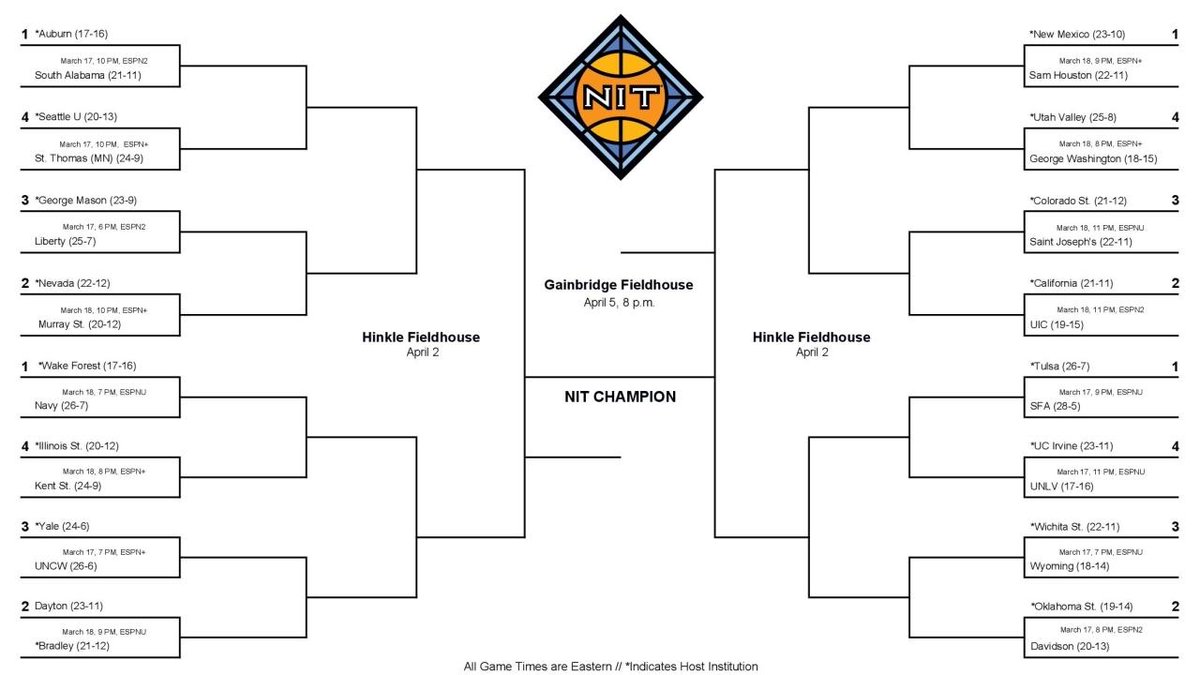
The College Front Office NIT Bracket Challenge is now live... see if you have what it takes to be crowned the #1 college basketball sicko
Play for free here: https://t.co/HeMo5OvYEE
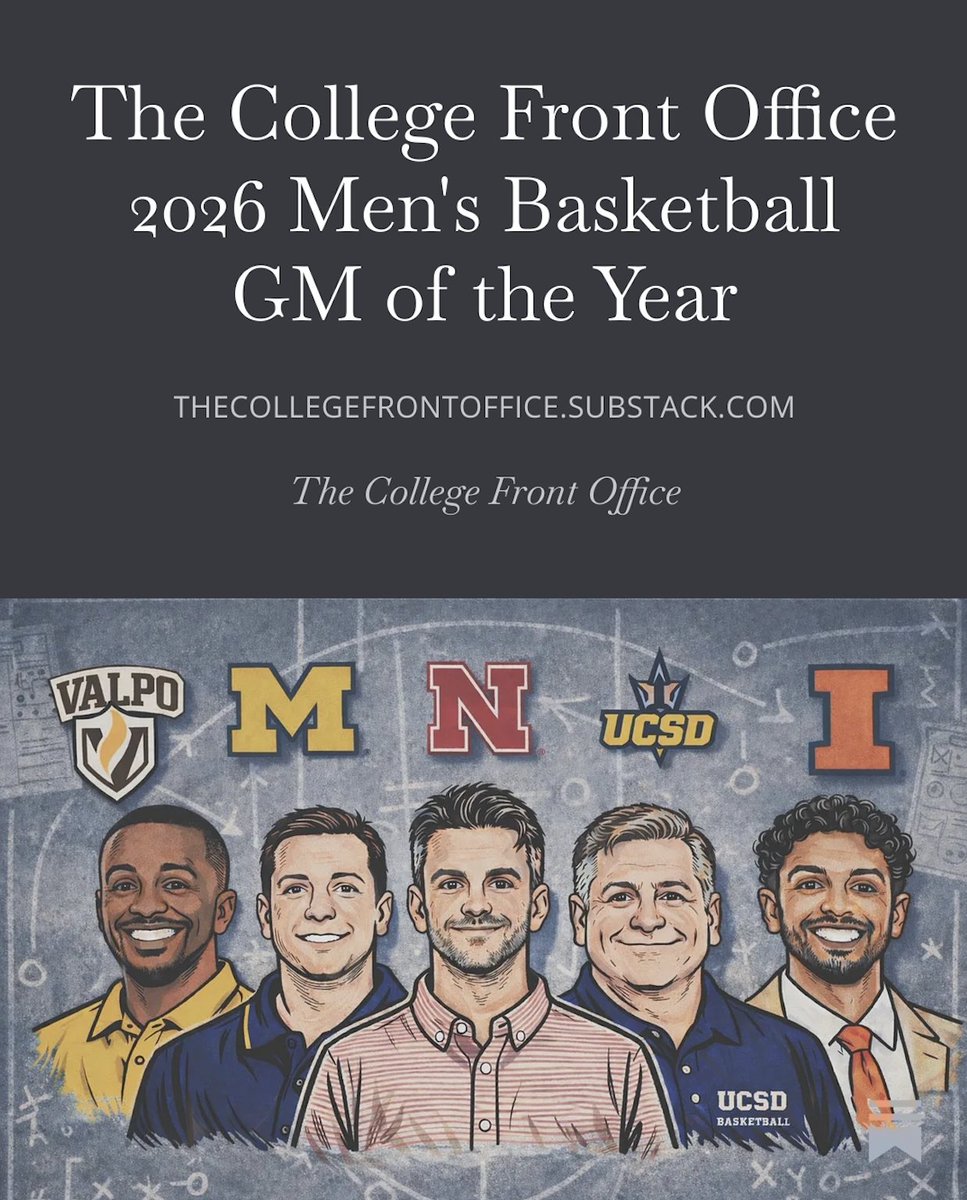
Introducing the first annual College Front Office Men’s Basketball GM of the Year
Honorable mentions, finalists, and the winner: https://t.co/zKknjUNUQh
I've been thinking/talking about this general "feeder" concept for a while now, but Noah has worked it out at a much deeper level, to the point where I'm surprised he's still a free agent and not working on a staff.
Another must read from one of my favorite CBB thinkers.