.@CollinMartinCS joins #MorningTradeLive with host @sam_vadas to share his Big 🖼️ views on the Fed, bond yields, and strategies for bond investors.
📽️ @SchwabNetwork
Affiliation Disclosure: https://t.co/NtgcFM7a5B
https://t.co/Sv8fzWGQ06
The bar for a Federal Reserve rate hike is falling as the job market remains robust in the face of stubborn price pressures, according to Collin Martin at the Schwab Center for Financial Research. https://t.co/eXeNXgY94b
Starting the week at Bloomberg x2. Looking forward to chatting with the @BloombergTV team about the bond market and my midyear outlook on Monday morning (June 8). Radio at 7a ET with @tomkeene and @ptsweeney. Then TV at 7:45a with @FerroTV, @lisaabramowicz1 and @annmarie.
It's been a bumpy ride in the bond markets so far this year, and that trend may continue. Our broad message for the second half of 2026 is this: Income still matters, but investors should be selective. My midyear outlook explains in more detail: https://t.co/o2wojM1Gq6
Another good convo with @LizAnnSonders on our #OnInvesting podcast, including a discussion about the initial public offerings that are in the pipeline.
https://t.co/LQaX18XULA
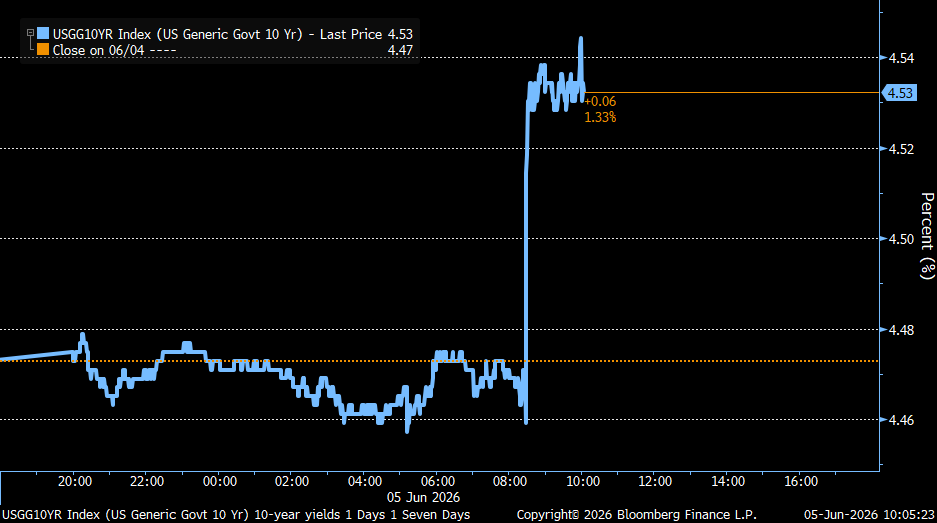
The 10-year Treasury yield jumped following the release. We continue to see more upside risks than downside risks to the 10-year Treasury yield, including high and rising inflation and ongoing fiscal concerns.
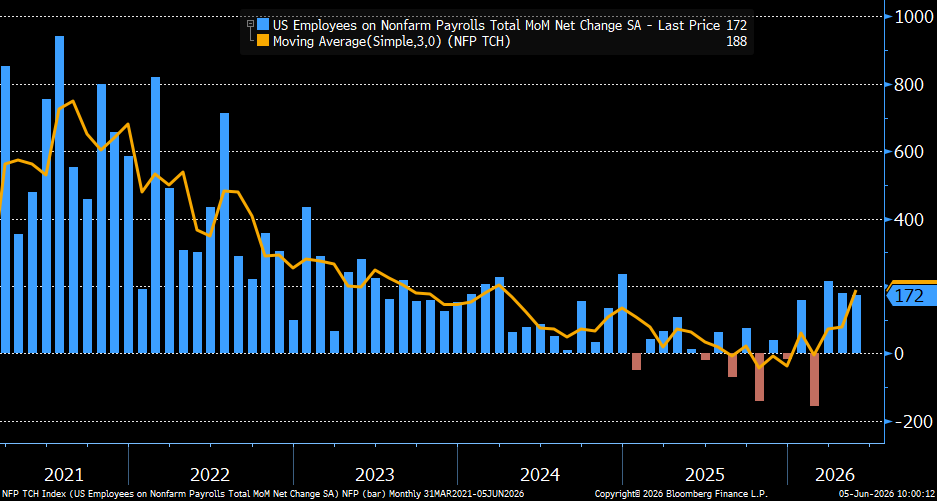
Nonfarm payroll gains came in well above expectations, with the three-month average at its highest level since early 2024. The Fed enters its communications blackout period tomorrow, so we'll need to wait until the upcoming Fed meeting to gauge how policymakers are viewing the recent labor market strength.
Nonfarm payroll gains came in well above expectations, with the three-month average at its highest level since early 2024. The Fed enters its communications blackout period tomorrow, so we'll need to wait until the upcoming Fed meeting to gauge how policymakers are viewing the recent labor market strength.
Fed expectations continue to shift, with the fed funds futures market now pricing in a hike by early 2027. We take longer-term implied probabilities like that with a grain of salt as the expected path of Fed policy has shifted a lot lately, as this chart highlights.
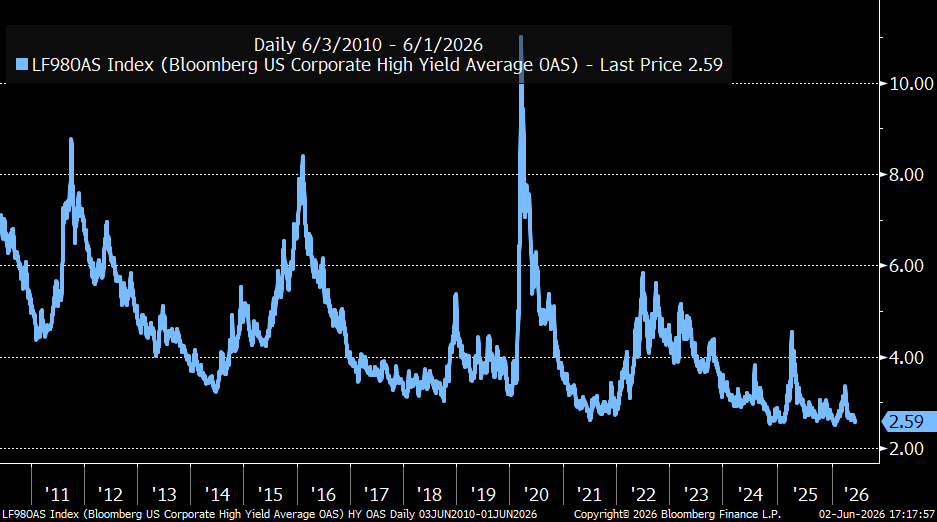
That doesn’t tell the whole story though since the credit quality has been improving over the years. Yes, spreads are tight, but a majority (roughly 56%) of the index is actually comprised of BB/Ba bonds.
After the March increase, spreads are low again. The average OAS of the Bloomberg US Corporate High-Yield Bond Index is back below 2.6%, only a few basis points off its January low and not far off its all-time low of 2.33% from 2007.
Another great episode of our #OnInvesting podcast has dropped, on which @CollinMartinCS and I riff on markets and I sit down with the always-insightful @joebrusuelas to discuss the “new era of uncertainty”
https://t.co/ORPKmQwPSB
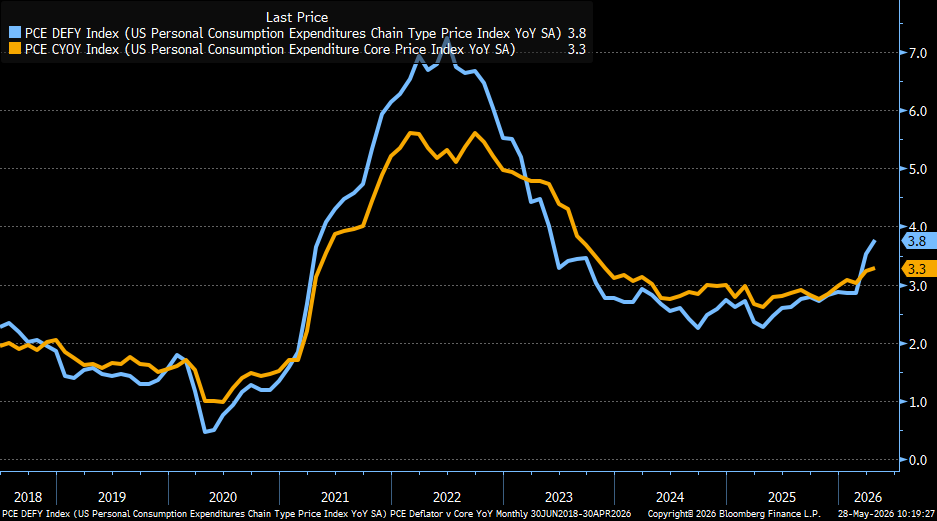
Yields just dropped on optimism around a deal with Iran, but inflation is still high. Good news in the Middle East could make a rate hike less likely, but with core PCE still coming in at +3.3% y/y, cuts don't seem likely anytime soon.
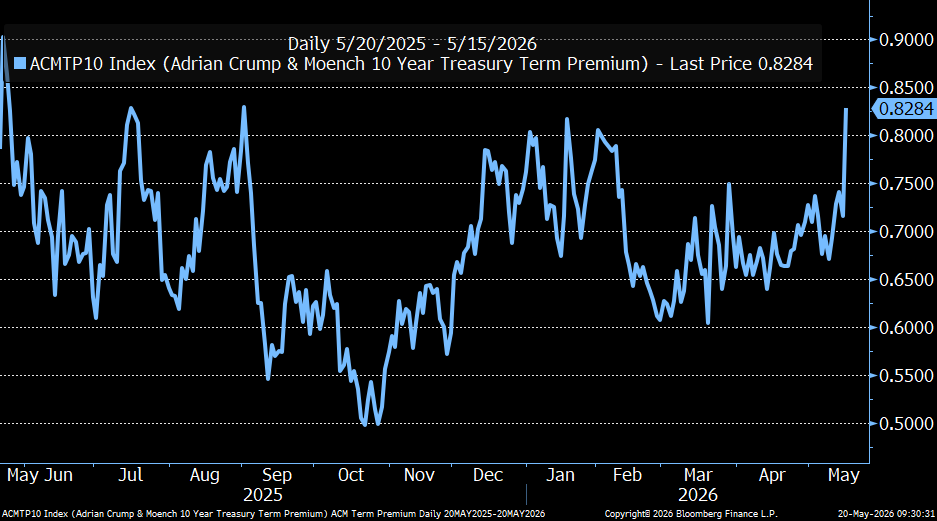
Looks like much of the recent rise in the 10-year Treasury yield is due to the term premium - it rose 11 basis points last Friday (it takes a couple of day to update). It's near its one-year highs, but well below levels seen in the '90s and early 2000s.
Good morning! Catch me today on Bloomberg Surveillance at 8:45am ET. Looking forward to talking about the latest in the bond market with @FerroTV, @lisaabramowicz1 and @annmarie.
Re: rising global bond yields. This is not just a domestic issue. Yields for many developed government bonds have been rising since the end of February. (This chart represents the change in each yield). The 10-year gilt yield is up 80bps since then, and the 10-year Japanese yield is at its highest level since 1997.
The 10-year Treasury yield is up sharply today and is at its highest level since last May. Lots of factors are likely driving up yields: oil prices, inflation concerns, shifting Fed expectations, and rising global bond yields.