Postdoctoral research associate studying evolution, Earth history and the genetics of microbes! Born at 355 ppm CO2. Most active on @earlylife.bsky.social
Great to see our perspective in print! Chad, Eva, and I suggest that geological and genomic records support the idea that Earth’s first oxygenated habitats formed on the seafloor, especially in shallow benthic settings along continental shelves
#geobiology#astrobiology
Perspective: The oxygenation of Earth's atmosphere about 2.45-2.30 billion years ago may have initiated in the oxidised bottom waters of marine shelves
@ColoradoJo19
https://t.co/GEZiddKOml
Our lab is looking for a new PhD student to contribute to research on the early evolution of microbial life with @sanchez_baracal and @LewisAlcott at @BristolUni . Deadline coming-up soon on Monday 19th Jan.
Our lab is looking for a new PhD student to contribute to research on the early evolution of microbial life with @sanchez_baracal and @LewisAlcott at @BristolUni . Deadline coming-up soon on Monday 19th Jan.
Super excited to share the first paper published from my PhD, which utilises stable isotope geochemistry and metagenomics to reveal the dominant controls on biological N cycling in Mars analogue systems!
Link: https://t.co/Dny8rUvdGl
#astrobiology#mars#nitrogen#hotsprings
My entire team wrote an opinion paper about Common misconceptions of speciation research. Each section is written by 1-2 team members. The bulk of the writing happened during two writing retreats. It was a lot of fun and I am very happy with the result. https://t.co/4UHcFFODlG
Some of the amazing, microscopic algae and animals that float at the sea surface. (From my plankton net tows) It is shocking that this vital world of life is so overlooked by natural history TV programmes. In fact, I'd say it is a dereliction of duty. @zeiss_micro
@lithologuy Enjoyed listening to this last week! Some thought-provoking ideas about life's origins (maybe cryoconite holes should be added to our list of potential places) and intelligent life in the Universe (can it take less than 4.6 billion years to make a space-exploring-species?).
We are pleased to announce that the 2024 GBGM Division awards go to Nagissa Mahmoudi (pre-tenure; @NagissaM), Eva Stüeken (post-tenure), and Alan Kaufman (distinguished career). Check out the full announcement on our website and the thread below (1/10)! (https://t.co/i77aWNnsP2)
I'm hiring a postdoc, for bioinformatics work on amino acid substitution models. I think they are key for understanding biophysics of selection on proteins, mutation patterns, and ancient life, as well as improving phylogenetic methods. https://t.co/qNGlXk6LMM
Some great insights into how RuBisCO has evolved and changed through time, with potential impacts on the efficiency of oxygenic photosynthesis through time!
📢 New preprint from us! ➡️ Ancestral structure prediction reveals the conformational impact of the RuBisCO small subunit across time
h/t grad student @Kaustubh_2797 and @BrZuviria!
https://t.co/AogK3ZIzSK @UWMadBiophysics, @UWBact, #Rubisco
Are you involved in PhD admissions? Do you advertise projects or assess candidates?
Check out this paper, the latest publication from our Equator project. Doctoral recruitment is often biased against students from marginalised backgrounds- we propose changes to improve equity:
Update: here's a primer and best practice suggestions for discussing toilets and periods on #geology and #geoscience fieldtrips. It's released under a CC-BY-4.0 license, so please share widely with students and staff and adapt as necessary. https://t.co/LqBWyEFVZK
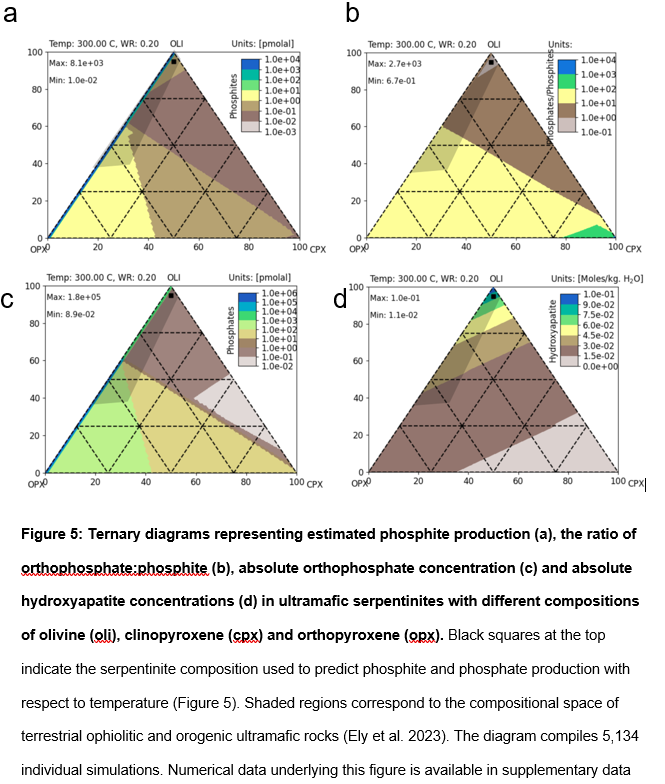
#5 Unless pure olivine minerals were more common during the early evolution and establishment of life on Earth, phosphite from serpentinizing vents probably didn't supply life with the phosphorus it needed to grow.
Serpentinizing hydrothermal vents have been proposed as cradles for the origin and evolution of life on Earth, but did they also supply early microbial communities with phosphite?
https://t.co/cCGggxM5sX
#4 Geochemical models made to simulate the chemical reactions which occur in serpentinizing vents calculate that little phosphite can be produced, and to generate any at all requires precise temperatures, lithologies and water:rock ratios.
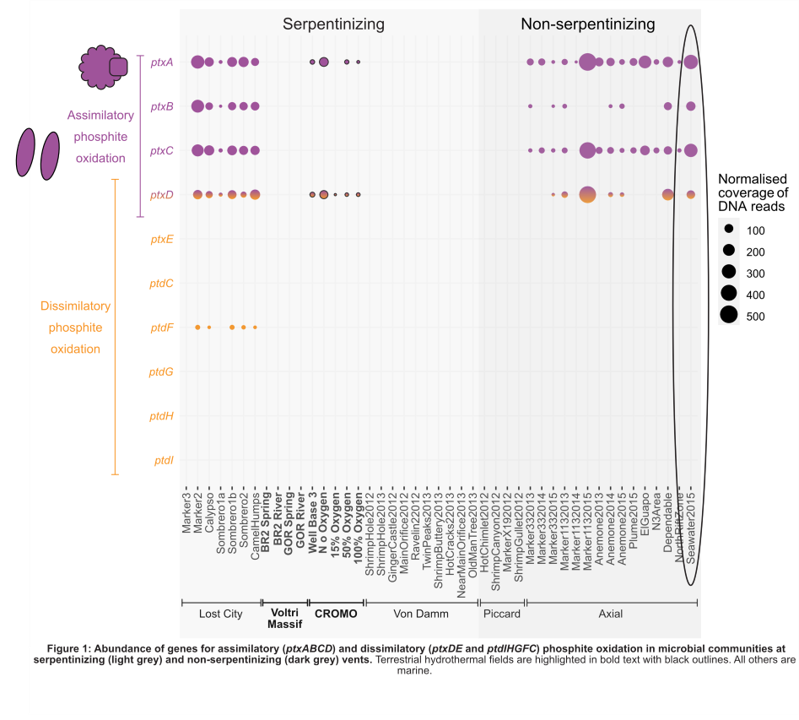
#3 We found that microbes were equipped with genes to access phosphite at some of the serpentinizing sites, but not others. We think this might be because phosphite isn't emanating from the vent itself.
#2 @sanjoymarcel, @wbrazelton, Rika, Eva and I investigated by characterizing the phosphorus-uptake capacities of microbial communities at four different serpentinizing hydrothermal vents.