BREAKING: Polkadot launches dotUSD, a native stablecoin with no issuer, governed by DOT holders after 98.4% OpenGov approval. dotUSD mints 1:1 against USDT, with DOT-backed minting planned next.
@Polkadot
🚨 POLKADOT IS WAKING UP! 🚨
The U.S.-based project $DOT pumped over 15% today & is showing good signs of a potential breakout on the weekly timeframe.
With annual token issuance cut by 54% & a native stablecoin launched, DOT could be entering a new era of growth. 🚀
Polkadot now has its own native stablecoin
@Polkadot has deployed $dotUSD on mainnet.
The blockchain now has an immutable, decentralized stablecoin governed entirely through its on-chain OpenGov framework.
The release offers an alternative to the $250B corporate stablecoin market, which remains concentrated among a handful of centralized issuers that can freeze assets and restrict wallet access.
Operating without a private issuing corporation or centralized point of control, $dotUSD functions as a sovereign monetary layer native to the broader Polkadot ecosystem.
JUST IN: Polkadot launches its own native stablecoin, $dotUSD
The stablecoin runs directly on Polkadot and is governed through OpenGov, with no private issuer controlling its supply or user access.
dotUSD is now available in Nova Wallet!
🔁 Send, receive, and swap dotUSD using Nova Wallet!
dotUSD is Polkadot's native decentralized stablecoin.
Download Nova Wallet!
https://t.co/NGMwictjv5
dotUSD is live on Polkadot.
Today a handful of companies issue and control most of the world's stablecoins worth more than $250B.
Like banks, they decide who can hold them and who can’t.
dotUSD is based on a different premise. It has no issuing company and no single point of control.
The DOT DAO governs it through OpenGov.
Polkadot now has a stablecoin that belongs to its network.
@Kekius_Sage Now I know AI cops a lot of "slop" hate. But as a tool for learning it's hard to beat. I love chatting to it about quantum physics l,. entanglement and the like. Explaining it to me in a way I can understand.
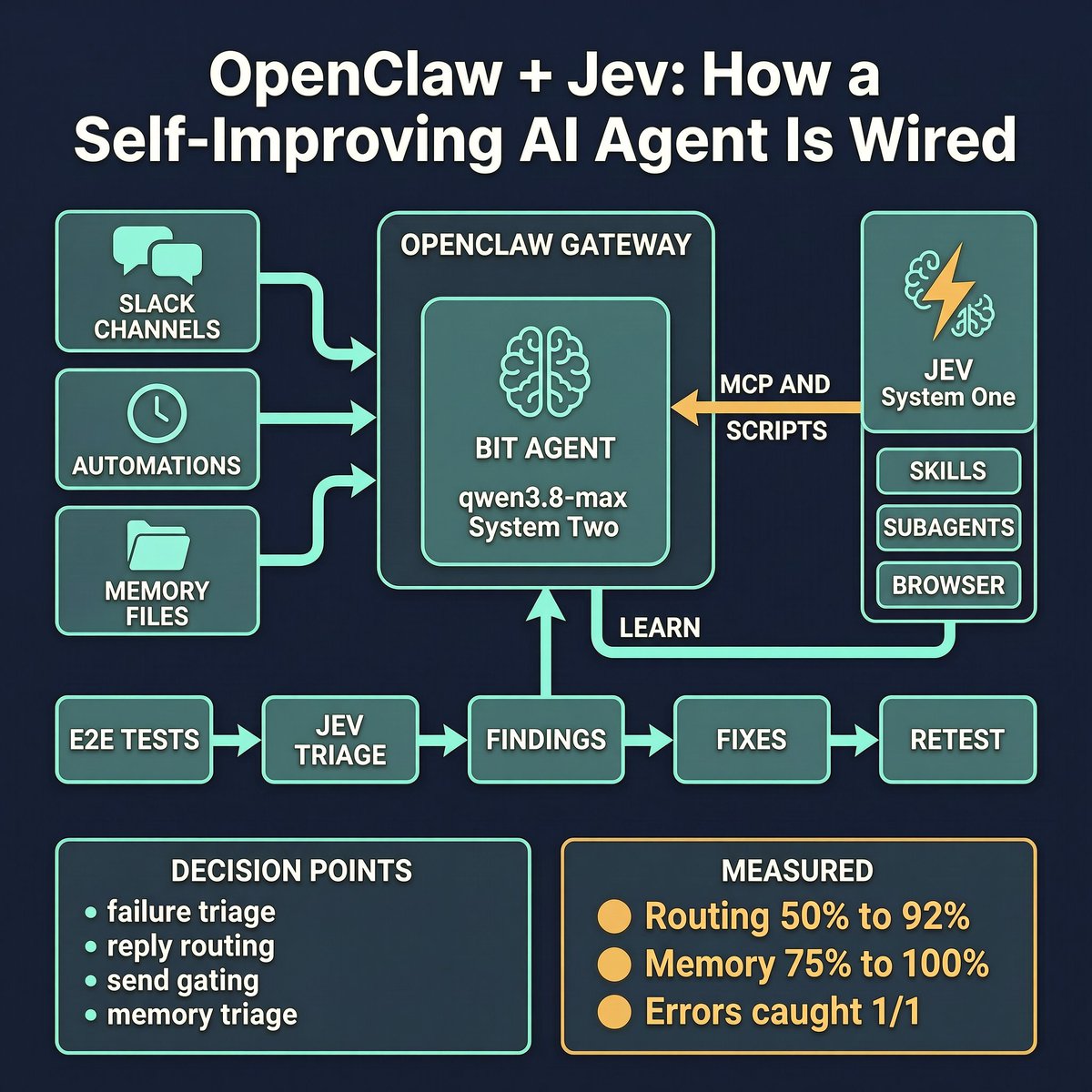
I wired Jev into my OpenClaw AI agent — then benchmarked it before and after. Here's the entire setup:
The problem: LLM agents are brilliant reasoners but terrible switchboards. Every judgment our agent's code had to consume — "is this test failure a harness bug, an app regression, or a flake?", "does this event deserve a reply or silence?", "is this action safe unapproved?" — forced a prose engine to emit structured decisions, then parse and pray. Slow, uncalibrated, occasionally silently wrong.
The fix: Jev — TypeSafe AI's System One model — wired into OpenClaw as the agent's fast-intuition layer. Typed questions (Choice / Score / Noul) → typed answers with calibrated probabilities. No prose. No parsing. Sub-second, ~450 tokens a call, content-addressed cache so repeat judgments are free.
How it plugs into OpenClaw (diagram below):
→ Gateway: jev-mcp registered as an MCP server, so Jev's judgment tools are first-class for the agent and every subagent it spawns. Key on disk — never in config, transcripts, or model context.
→ Policy: the agent's instruction file codifies deterministic-first: when code can determine the only legal action, no model call happens at all. Jev classifies only the genuine semantic choices among legal candidates.
→ Decision points: salience routing (reply / react / silent), external-send safety gates, expected-value action gating (probabilities from Jev, values from the owner's goals, arithmetic from code), and a calibration loop that logs agent-vs-Jev disagreements.
→ QA pipeline: every red e2e run auto-triages — failures grouped by error signature, classified harness / app-bug / env / flake / data, each with a player-impact score.
→ Memory: nightly dream cycles use Jev to decide which daily notes earn long-term memory, and whether each new friction event matches a growing error taxonomy or is genuinely novel.
→ Delegation: subagent deliverables are scored against their brief before anything gets relayed.
Confidence gates everything: ≥0.9 act + log · 0.6–0.9 act + flag · <0.6 escalate to the big model or the human.
The honest part — we benchmarked on real labeled incidents, including the agent's own mistakes:
• Attention routing: 50% → 92% ("before" was literally reply-to-everything — the exact spam humans notice)
• Memory triage: 75% → 100%; durable-fact detection 92% → 100%
• The calibration loop caught 1 of 1 genuine agent errors on its first run
• The self-eval harness scored a real past failure 0.69/3 with 92% redo-probability — it flags its own screwups before a human has to
Negative result included, because credibility matters: Jev scored 50% on workspace facts it cannot observe. It's a judgment classifier, not an oracle — so we feed it evidence, or restrict it to interpretation. Knowing what your tools can't do is part of the architecture.
Why this is an good move: intelligence isn't only reasoning horsepower. It's attention allocation, metacognition, memory consolidation, calibrated self-doubt. Humans already run this stack — fast intuition, slow deliberation, sleep-time consolidation. We're building the same one inside an agent (OpenClaw + Jev + qwen3.8-max), and graphing the progress weekly instead of vibes-checking it.
Fun detail: the agent built the benchmark datasets from its own incident log. Its favorite datapoint — routing a stale duplicate system event to "silent" at 96% confidence, the exact event class it used to spam the channel about.
#AI #AIAgents #OpenClaw #Jev #LLM #AGI
@dev_maims It's understanding that as long as it runs efficiently with correct outputs and the AI is able to maintain it successfully that how many files becomes irrelevant.
JUST IN: @Polkadot could soon introduce its own native stablecoin, dotUSD, backed by $DOT if the current governance proposal is approved.
The plan would use treasury funds to bootstrap initial liquidity, while Phase 1 could allow users to swap $USDT for dotUSD. The initiative would add a native stablecoin layer to the Polkadot ecosystem and potentially expand its on-chain liquidity infrastructure.
The proposal is still subject to a community vote, with the final outcome depending on governance approval.