Updates on innovations in #cancer research, prevention, care, and education from the Herbert Irving Comprehensive Cancer Center at @columbiamed/@nyphospital.
Proud to announce that HICCC at @columbiamed / @nyphospital has once again earned the NCI’s Comprehensive Cancer Center designation with a $27M, five-year renewal supporting research, clinical trials, education, and community outreach at @Columbia https://t.co/uR6oezClA3
This July, thousands of high school students from around the world joined HICCC's Scientific Enrichment Month, a virtual program exploring cancer science, public health, professional development, and careers in biomedical research and healthcare. See this year's impact! 🌎
New Columbia research shows gliomas hijack healthy brain cells, causing seizures and cognitive decline. An experimental drug rapidly reversed this damage in mice. Led by Dr. Peter Canoll and Dr. Jeffrey Bruce at @ColumbiaCancer. 🧠https://t.co/QJT21Q0VG8 #Glioma#BrainCancer
A new study by @columbiacancer researchers found a new way to evaluate breast cancer, using mathematical tools known as topology to develop biomarkers that objectively measure tumor organization. This approach replacing decades-old methods that rely on pathologists visually assessing tissue samples under a microscope. https://t.co/hXuUHGLlud
Researchers from the Gabriele Bartoli Brain Tumor Laboratory have found that some damages to the brain caused by gliomas may be reversible with AZD8055, opening the door to new ways to treat symptoms such as seizures and cognitive problems. Read more: https://t.co/BTL2AQvbuu
The skin is one of the first places where the effects of cancer and its treatment show up, causing discomfort and even delays in treatment. @ColumbiaMed research shows these proactive skin care habits during treatment can help. 🙌 Read more: https://t.co/PRU9KVjTCL
Researchers at @ColumbiaMed led by @CicciaAlberto have identified a potential new therapeutic target for some of the most aggressive tumors. The study found ALT-positive tumors depend on the protein SMARCAL1 to survive, opening the door to new treatments. https://t.co/8MDtDOH5M6
As cases of uterine cancer rise, a new non-invasive test being studied in clinical trials at @ColumbiaMed could offer a simpler, more comfortable way to diagnose the disease and help some patients avoid an invasive biopsy. Here's what to know: https://t.co/DzvdaCMPEd
Squamous cell carcinomas were some of the first cancers to see approvals for immunotherapy, but less than 1 in 5 patients see a lasting benefit. A new clinical trial from @BHenickMD at @ColumbiaMed is testing a new drug designed to tackle this challenge. https://t.co/iEoVE94IIX
In our latest State of Care: Sarcoma updates, Igor Matushansky, MD, PhD, breaks down the advances in genomics, precision medicine, and immunotherapy reshaping how sarcomas are understood and treated. https://t.co/gmIKiU2bkr
New research from @ColumbiaMed transforms breast cancer tissue patterns into topology-based biomarkers that improve predictions of patient survival and treatment response, with less variation across racial and ethnic groups. Learn more: https://t.co/dZKvrnhAd1
A Translational Grant from @TheVFoundation will accelerate @BizarMD's work in advancing a first-in-class therapy developed at @ColumbiaMed that could transform treatment for cancers driven by chromosomal instability. Read more- https://t.co/0cPVk6NmCV
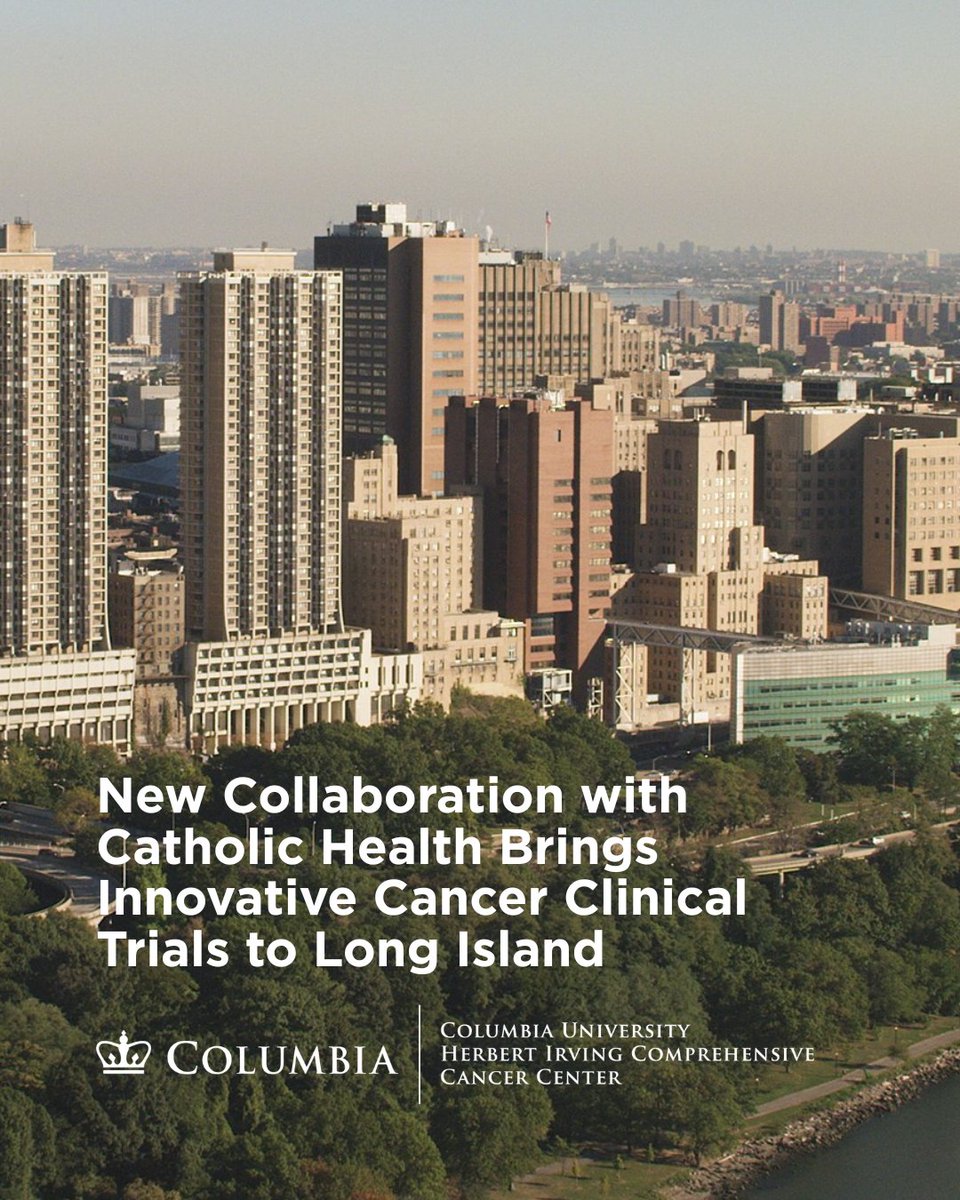
A new collaboration between @CatholicHealthX and the HICCC at @ColumbiaMed/@nyphospital is expanding access to innovative cancer clinical trials for patients across Long Island. Read the announcement: https://t.co/DOoYXfJcyQ
Better cancer treatments are helping more people live beyond cancer. Researchers at @ColumbiaMed are working to understand the long-term challenges survivors face and develop new ways to help them thrive long after treatment ends. https://t.co/xZ1Zklbkte
New research‼️🩸 from Sergei Doulatov and Philip Creamer introduces the first experimental model of AML-CK, identifying chromosome 5q loss as a key driver of disease progression and a shared genetic signature that could guide new therapies. @ColumbiaMed https://t.co/HgFRlPaOyk
A former NYC law firm partner decided to take an unconventional path to cancer research following a family history of cancer. "My heart wasn’t in law anymore. Suddenly, all I could think about was why my brother died and how I could stop the same thing from happening to me," says @columbiacancer researcher Filko Prugo. https://t.co/79wM1shG3z
💊 Early results from a recent @columbiacancer clinical trial showed that a new targeted therapy nearly doubled overall survival in patients with previously treated metastatic pancreatic cancer.
Highlights from HICCC’s Cancer Survivors and Thrivers Day, held in celebration of National Cancer Survivors Month, to honor every stage of survivorship with our cancer community at @ColumbiaMed / @nyphospital ❤️ 🎗️
Determined to find answers to his family's history of cancer, former law firm partner Filko Prugo is now pursuing a PhD at @ColumbiaMed, researching BRCA2— the inherited mutation that has impacted generations of his family, including himself. https://t.co/vclvPCGTjJ
Why do some pancreatic cancers spread while others don't? 💭 Researchers led by @Chiolaboratory have uncovered a mechanism that drives the most aggressive forms of the disease, offering new clues for predicting risk and tailoring emerging therapies. https://t.co/u4enMUPIk1
Congratulations to @ColumbiaMed researchers @SwarnaliAchary5 and @tdanino on receiving the 2026 Lotus Award from @PershingSqFdn to support their innovative ovarian cancer research. 👏 Read about their winning projects below: https://t.co/GNT3RzaC85