The law has changed. The culture hasn’t. Exposing threats to academic freedom in UK universities — and pushing institutions to meet their free-speech duties.
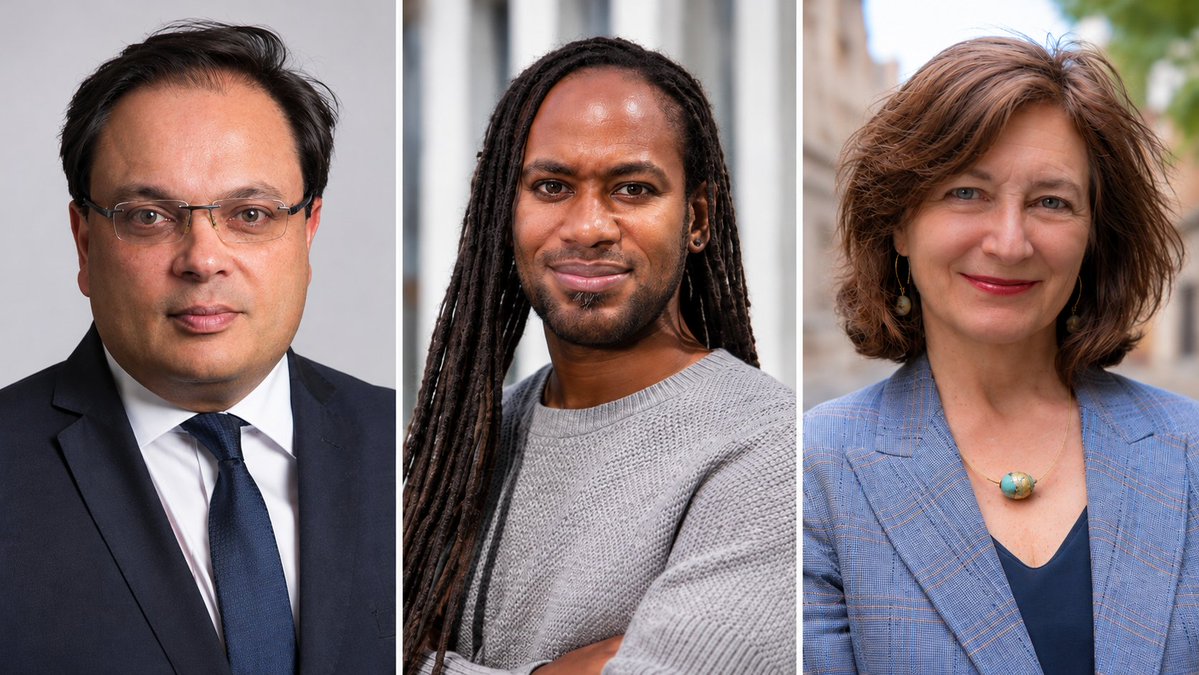
🚨 EXCLUSIVE: In 2023, David Harris, Professor Emeritus at Plymouth Marjon University, became one of the first academics to raise serious questions about the scholarly standards of Professor Jason Arday’s published work, shortly after Arday had been appointed Professor of Sociology of Education at the University of Cambridge.
Since Arday’s death, Harris’s role in scrutinising his work and highlighting possible evidence of plagiarism has made him the target of online abuse and personal smears, including potentially defamatory public allegations that he was motivated by racism. In this interview with the Committee for Academic Freedom (CAF), he gives his own account of what happened, explains how he came to investigate Arday’s work, and reveals previously unreported details about his attempts to raise his concerns privately with senior figures at Cambridge.
Among them was Professor Hilary Cremin, Head of Cambridge’s Faculty of Education, whom Harris approached with detailed concerns about Arday’s scholarship. He recounts Cremin’s response, including her apology for the tone and manner of emails in which Arday threatened to report him to the police for harassment, and her invitation to Harris to visit Cambridge “for tea” to discuss their differences.
But Cremin was not the only senior figure at Cambridge whom Harris approached. He reveals that he separately took his concerns to the University’s Head of Policy, Governance and Integrity, only to be told that the issues he had identified pre-dated Arday’s arrival at Cambridge and were therefore not the University’s responsibility.
The interview also sheds new light on suggestions that scrutiny of Arday’s work formed part of a wider campaign against him — a “vicious campaign”, as Diane Abbott has described it. Harris is categorical that he had no contact whatsoever with Dr Nathan Cofnas, and says that his own investigation was conducted independently, privately and through conventional academic channels.
His account raises important institutional questions about academic scrutiny, research integrity — and what Cambridge knew about concerns surrounding Arday’s work years before they became a matter of public controversy.
The CAF-commissioned independent investigation into Cambridge University’s appointment of Jason Arday is now up and running, and needs the assistance of those who know Cambridge best.
We strongly encourage current and former academics, students and other members of the University community, as well as others with relevant knowledge, to come forward with information.
Anyone wishing to contribute can contact the Investigator directly at: [email protected]
The website provides further guidance on submitting information, including arrangements for particularly sensitive material:
https://t.co/nHeER66NUY
The University of Cambridge has finally published the terms of reference for the academic standards and integrity strand of its review into the Dr Jason Arday affair. But for all the apparent comprehensiveness of its stated remit, concerns remain that questions raised with the Committee for Academic Freedom (CAF) by academics and students regarding the institution’s assessment of his scholarly record, its handling of research integrity concerns, and the possible influence of positive action on recruitment may remain unanswered.
Following weeks of uncertainty over the precise scope of what is formally Part Two of the inquiry, the appointment of Jason Beer KC and publication of his remit provide the clearest indication yet not only of how Cambridge intends to examine the circumstances surrounding Arday’s appointment, but also of how the University’s review differs from the separate independent investigation commissioned by CAF.
Full story:
https://t.co/VImlUqj3IK
The Office for Students’ new free-speech complaints scheme gives academics a free-to-use route for challenging restrictions on lawful speech and #academicfreedom.
For the first time, eligible complainants can ask the regulator to determine whether a university has breached its statutory #freespeech duties. Where a complaint is justified or partly justified, the OfS can recommend meaningful redress, including restoration of an invitation to speak, reinstatement of a research programme, changes to university policies and financial payments to complainants.
CAF has created a new Casework Support page designed to help ensure that cases reaching the OfS are as clearly framed and carefully prepared as possible. It includes practical guidance on getting a complaint right, why identifying the relevant issues from the earliest internal university stage matters, and how CAF can help.
https://t.co/ohNWsvrRkX
There’s also a quick interactive checker that takes you through no more than nine questions about your circumstances, explains why each matters, and gives an initial indication of whether the OfS scheme may apply and when it may be worth contacting CAF. For those who want to understand the law beneath the scheme, our legal guide explains the statutory duties underpinning it.
If you think your freedom of speech or academic freedom is being restricted, email CAF at [email protected]
And please do spread the word. There will be academics across the country who do not yet know that the landscape changed this week, including some at institutions where the new complaints scheme may not receive quite the prominence any of us would like.
CAF has intervened on behalf of a former Cardiff University professor who was denied emeritus status after criticising senior management over a cost-saving institutional restructuring, and who is now seeking to prevent the University from using his published research in the next Research Excellence Framework, whose results help determine the allocation of billions of pounds in public research funding.
https://t.co/Djr3zJdczM
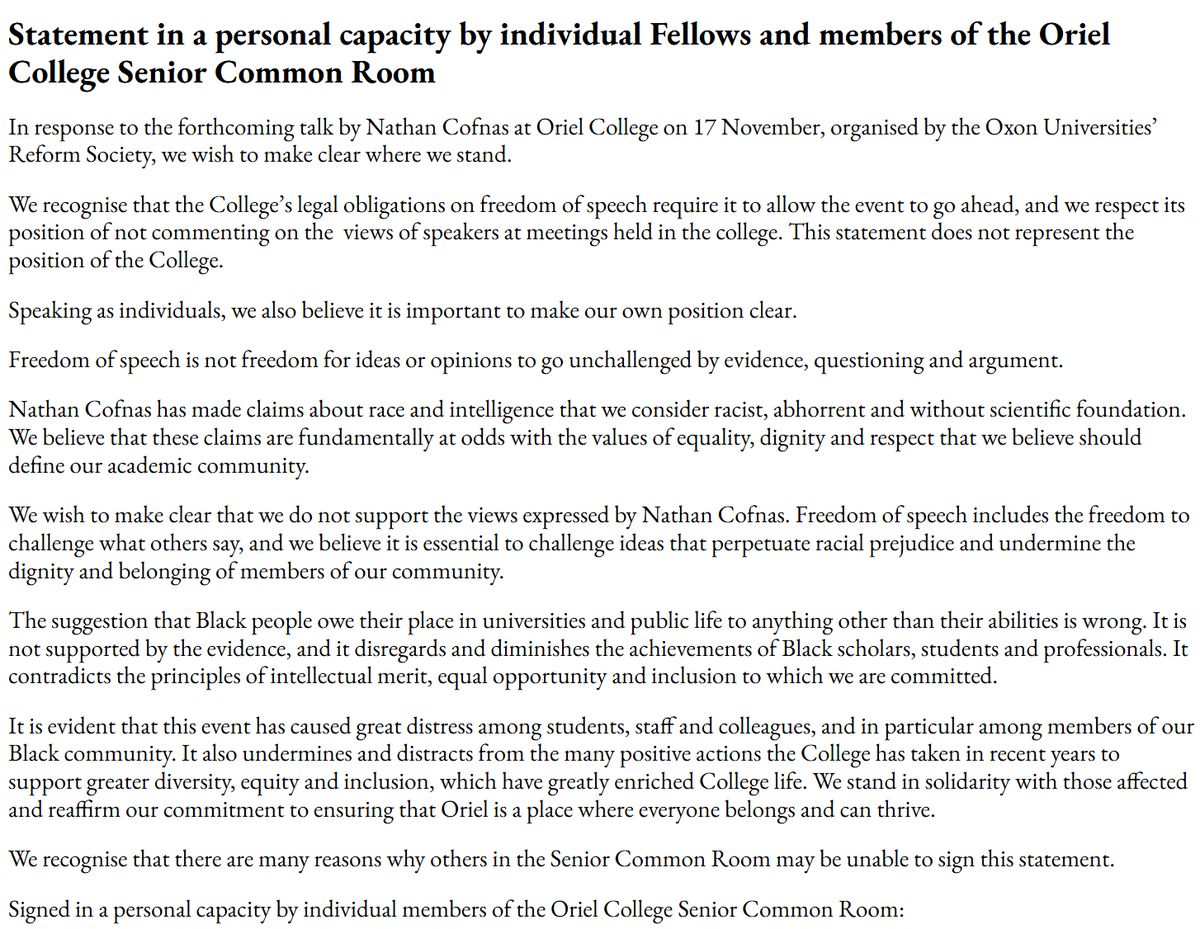
Whatever one’s views on Dr Nathan Cofnas’s forthcoming talk at Oriel College, Oxford, organised by the Oxon Universities’ Reform Society, this statement by 49 members of the College’s Senior Common Room, acting in their personal capacities, is a breath of fresh air.
The signatories condemn Cofnas’s views on race and intelligence in the strongest terms. Yet they also recognise the College’s legal obligations to protect freedom of speech and, crucially, make no demands that the event be cancelled, its organisers sanctioned or Cofnas prevented from speaking.
Freedom of speech cuts both ways, and between intellectual agreement and the exercise of a heckler’s veto lies a vast space on campus for disagreement, criticism, evidence and argument, whether courteous or combative.
Full statement here:
https://t.co/gszASEDXj5
The Office for Students’ new free-speech complaints scheme gives academics a free-to-use route for challenging restrictions on lawful speech and #academicfreedom.
For the first time, eligible complainants can ask the regulator to determine whether a university has breached its statutory #freespeech duties. Where a complaint is justified or partly justified, the OfS can recommend meaningful redress, including restoration of an invitation to speak, reinstatement of a research programme, changes to university policies and financial payments to complainants.
CAF has created a new Casework Support page designed to help ensure that cases reaching the OfS are as clearly framed and carefully prepared as possible. It includes practical guidance on getting a complaint right, why identifying the relevant issues from the earliest internal university stage matters, and how CAF can help.
https://t.co/ohNWsvrRkX
There’s also a quick interactive checker that takes you through no more than nine questions about your circumstances, explains why each matters, and gives an initial indication of whether the OfS scheme may apply and when it may be worth contacting CAF. For those who want to understand the law beneath the scheme, our legal guide explains the statutory duties underpinning it.
If you think your freedom of speech or academic freedom is being restricted, email CAF at [email protected]
And please do spread the word. There will be academics across the country who do not yet know that the landscape changed this week, including some at institutions where the new complaints scheme may not receive quite the prominence any of us would like.
Another important piece of work by CAF to protect freedom of speech within the law.
One of the UK’s leading professional bodies has amended its Code of Conduct after adopting our recommendations in full, following a constructive process of engagement over concerns that its harassment provisions inadvertently risked restricting lawful expression.
Full credit to the Royal Microscopical Society for engaging so positively with the concerns we raised and acting on them.
Full story here:
https://t.co/w3nxKmF19g
If you are worried that your organisation’s policies or training materials risk encouraging an over-broad approach to harassment, protected belief or lawful professional disagreement, please get in touch at [email protected].
Concerning to see masked pro-Palestinian activists at City St George’s University of London, using loudspeakers to chant for the sacking of Professor Michael Ben-Gad, apparently because he — an Israeli citizen — served in the IDF in the early 1980s.
The demonstration took place in a main circulation area of the University Building at Northampton Square, through which anyone entering or leaving would have to pass.
Other allegedly pro-Israeli academics have recently been singled out in an Instagram campaign, with their names and photographs circulated alongside accusations of racism and Islamophobia that implicitly question why the university continues to employ them.
Under the newly strengthened Higher Education and Research Act 2017, English universities have a statutory duty to take reasonably practicable steps to secure the freedom of speech of their staff and students — a duty that also protects students’ rights to protest against academics, criticise their views and call for their dismissal.
But what students are legally entitled to say is not quite the same as what universities, as centres of scholarship and intellectual provocation, should expect from members of their community.
Central to the Humboldtian ideal of the university is the notion that even the sharpest political disagreements, and the personal enmities they engender, should be handled with civility, rather than allowed to descend into crude public denunciations and demands for someone’s sacking.
Sadly, this tendency is by no means confined to one side of the Israel–Palestine debate.
The Committee for Academic Freedom (CAF) knows of a recent case at King’s College London where a pro-Palestinian academic faced a hostile campaign following a student complaint about a seminar on the history of Palestine and Israel. Although the university closed two investigations without taking action, posters appeared on campus accusing the academic of supporting terrorism and demanding their sacking. Perhaps unsurprisingly, the academic subsequently described how persistent harassment undermined their professional confidence and made them think twice about what they could safely say in their teaching.
The political positions of Ben-Gad and the KCL academic may differ, but the underlying dynamic of cancellation is all too similar. And beyond the direct impact on each, hundreds — perhaps thousands — of their colleagues take note and silently resolve to keep quiet rather than risk becoming the next target.
Statutory protections may be necessary to secure academic freedom at an institutional level. But they are not sufficient to sustain it in practice. For that, universities depend on something no legislation can manufacture: a culture of intellectual tolerance and a willingness to engage with people whose views we profoundly reject.
A rare Equality Act 2010 challenge to a referral under Prevent, the UK’s counter-terrorism programme for identifying and responding to suspected signs of radicalisation, has ended with a County Court finding that a school unlawfully discriminated against a 13-year-old Muslim pupil.
Although a first-instance decision, the ruling has important implications for universities.
As well as foregrounding a risk inherent in Prevent’s precautionary referral process, that the lawful expression of staff and students may be recast as evidence of radicalisation through a linguistic gloss unsupported by the underlying facts, it points to a potentially underused route to legal redress where such reinterpretations result in discriminatory treatment because of a protected philosophical belief.
CAF Research Manager Freddie Attenborough writes for Verfassungsblog, the leading European platform for constitutional law and public law commentary:
https://t.co/UemSPEiAb3
A new report by Amnesty International raises serious concerns about restrictions imposed on the academic freedom, freedom of speech and peaceful assembly of students and academics at UK universities in response to controversial but lawful expressions of support for Palestinians and criticism of Israel.
https://t.co/jZiEFJJKe0
CAF has written to Cambridge’s Vice-Chancellor on behalf of several academics who fear professional repercussions if they raise concerns in their own names about a University-wide communication offering “support and advice” specifically to black members of staff.
The communication came from five members of Cambridge’s “Senior Black Leaders Group”, including two Deputy Vice-Chancellors and college heads.
That academics feel unable to raise concerns of this kind within their university without protecting their identities is something Cambridge’s senior leadership might wish to reflect upon. CAF therefore agreed to raise the matter on their behalf. In our letter, we ask Cambridge what that support comprised, whether access was afforded or facilitated on the same basis irrespective of race, and the legal and evidential basis for any difference.
Full story:
https://t.co/w39DIhWip8
CAF is deeply concerned by the Home Office’s decision to cancel Andreas Malm’s Electronic Travel Authorisation, preventing the climate academic and associate professor of human ecology at Lund University in Sweden from travelling to Britain for a series of speaking engagements this week.
In a liberal democracy, the state should be exceptionally reluctant to substitute executive exclusion for argument and debate in settings whose purpose is to explore controversial claims.
Read more and sign the petition calling on the Home Secretary to reconsider the decision here:
https://t.co/ks6ndQswRd
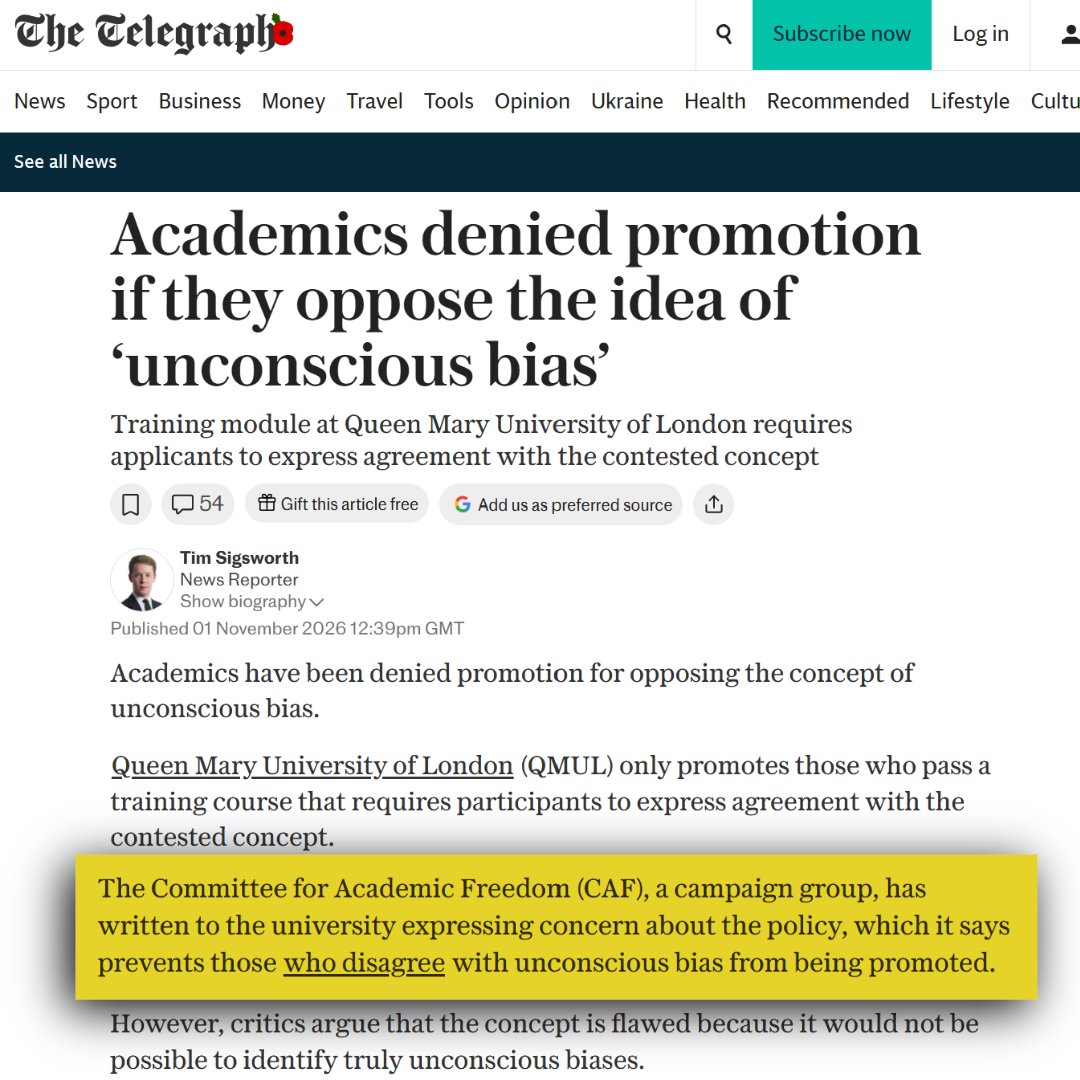
🚨 BREAKING: The Committee for Academic Freedom (CAF) has written to Queen Mary University of London (QMUL) on behalf of two senior academics who are refusing to complete mandatory training requiring assent to contested theoretical propositions about “unconscious bias”, potentially jeopardising their career progression and professional opportunities.
The dispute concerns an assessment within What is Unconscious Bias? — part of QMUL’s Introducing Inclusion course, which is “mandatory for all staff”.
The assessment requires participants to affirm that “unconscious biases help us to react quickly but can cloud our judgement”, and to identify accepting that “we have unconscious biases” as helpful. The accompanying feedback declares that such acceptance is “the first step to combating their negative effects”.
Informed by their scholarly research, the academics we’re supporting dispute these propositions and have refused to complete the assessment rather than give answers contrary to their convictions.
Under the assessment’s all-or-nothing marking system, refusing to affirm both propositions caps a participant’s score at 60%, below the 80% pass mark. Yet passing is a condition of eligibility for promotion, professorial review, including decisions on remuneration, and participation in recruitment and promotion panels.
Although influential in social-justice-oriented scholarship, the concept of unconscious bias is contested within psychology, with researchers disagreeing about what it means, whether the processes in question are necessarily unconscious, and whether they exert a causal influence on judgement. Peer-reviewed research also questions whether acknowledging such biases improves behaviour.
QMUL is of course entitled to provide training on its preferred theory of bias. But it remains just that: a theory. When such training is mandatory, requires staff to pass an assessment, and is tied to professional opportunities, there is a clear risk of compelling academics to affirm propositions they simply don’t believe.
That’s why we’ve proposed a simple solution: amend the assessment so that academics who don’t all think alike can demonstrate understanding without having to endorse its underlying assumptions.
Should QMUL decline to address these concerns, CAF is prepared to fund legal counsel to assist the academics, should they wish, in pursuing an internal grievance and subsequent complaint to the OfS.
We believe there are strong grounds for such a complaint, given that such training may breach QMUL’s statutory duties to secure freedom of speech and academic freedom. Consistent with Article 10 protections against compelled expression, the Office for Students has also warned that universities “should not require training or induction that imposes a requirement on the person completing the training actively to endorse any viewpoint or value-judgement”.
Sadly, this isn’t an isolated case. As CAF knows from its casework, universities often impose mandatory training in which the distinction between “understanding” and “endorsing” contested ideas becomes blurred.
That’s why we hope this intervention marks the beginning of a wider pushback against compelled intellectual conformity on campus.
If you’re an academic with similar concerns about mandatory training at your institution, get in touch. CAF can assess your case and, where appropriate, secure specialist legal advice and raise the matter with your university on your behalf.
Contact us at [email protected]
Full story via The Telegraph:
https://t.co/se2AAC6bFw
CAF’s dedicated Legal Fighting Fund enables us to provide casework and legal support to academics and students facing professional or disciplinary consequences for exercising their lawful right to freedom of speech.
Thanks to the generosity of our supporters, the fund has grown, enabling us to draw more extensively on specialist external legal counsel and strengthen our interventions on behalf of those facing stressful and sometimes hostile working environments, prolonged disciplinary investigations, threats to their careers, and other forms of institutional pressure for speaking out, expressing unpopular beliefs or, sometimes, of course, simply doing their jobs as scholars.
Donations to the fund are ring-fenced exclusively for this work. We are enormously grateful to everyone who has contributed, but sustaining and expanding this support is essential if we are to continue challenging universities when they overstep the mark.
If you can, please help us build on that progress by donating below:
https://t.co/gnkRJyPZ0y
🚨 BREAKING: The Committee for Academic Freedom (CAF) has written to Queen Mary University of London (QMUL) on behalf of two senior academics who are refusing to complete mandatory training requiring assent to contested theoretical propositions about “unconscious bias”, potentially jeopardising their career progression and professional opportunities.
The dispute concerns an assessment within What is Unconscious Bias? — part of QMUL’s Introducing Inclusion course, which is “mandatory for all staff”.
The assessment requires participants to affirm that “unconscious biases help us to react quickly but can cloud our judgement”, and to identify accepting that “we have unconscious biases” as helpful. The accompanying feedback declares that such acceptance is “the first step to combating their negative effects”.
Informed by their scholarly research, the academics we’re supporting dispute these propositions and have refused to complete the assessment rather than give answers contrary to their convictions.
Under the assessment’s all-or-nothing marking system, refusing to affirm both propositions caps a participant’s score at 60%, below the 80% pass mark. Yet passing is a condition of eligibility for promotion, professorial review, including decisions on remuneration, and participation in recruitment and promotion panels.
Although influential in social-justice-oriented scholarship, the concept of unconscious bias is contested within psychology, with researchers disagreeing about what it means, whether the processes in question are necessarily unconscious, and whether they exert a causal influence on judgement. Peer-reviewed research also questions whether acknowledging such biases improves behaviour.
QMUL is of course entitled to provide training on its preferred theory of bias. But it remains just that: a theory. When such training is mandatory, requires staff to pass an assessment, and is tied to professional opportunities, there is a clear risk of compelling academics to affirm propositions they simply don’t believe.
That’s why we’ve proposed a simple solution: amend the assessment so that academics who don’t all think alike can demonstrate understanding without having to endorse its underlying assumptions.
Should QMUL decline to address these concerns, CAF is prepared to fund legal counsel to assist the academics, should they wish, in pursuing an internal grievance and subsequent complaint to the OfS.
We believe there are strong grounds for such a complaint, given that such training may breach QMUL’s statutory duties to secure freedom of speech and academic freedom. Consistent with Article 10 protections against compelled expression, the Office for Students has also warned that universities “should not require training or induction that imposes a requirement on the person completing the training actively to endorse any viewpoint or value-judgement”.
Sadly, this isn’t an isolated case. As CAF knows from its casework, universities often impose mandatory training in which the distinction between “understanding” and “endorsing” contested ideas becomes blurred.
That’s why we hope this intervention marks the beginning of a wider pushback against compelled intellectual conformity on campus.
If you’re an academic with similar concerns about mandatory training at your institution, get in touch. CAF can assess your case and, where appropriate, secure specialist legal advice and raise the matter with your university on your behalf.
Contact us at [email protected]
Full story via The Telegraph:
https://t.co/se2AAC6bFw