I retweeted this earlier today and received some hostile comments, so I thought I'd share a story.
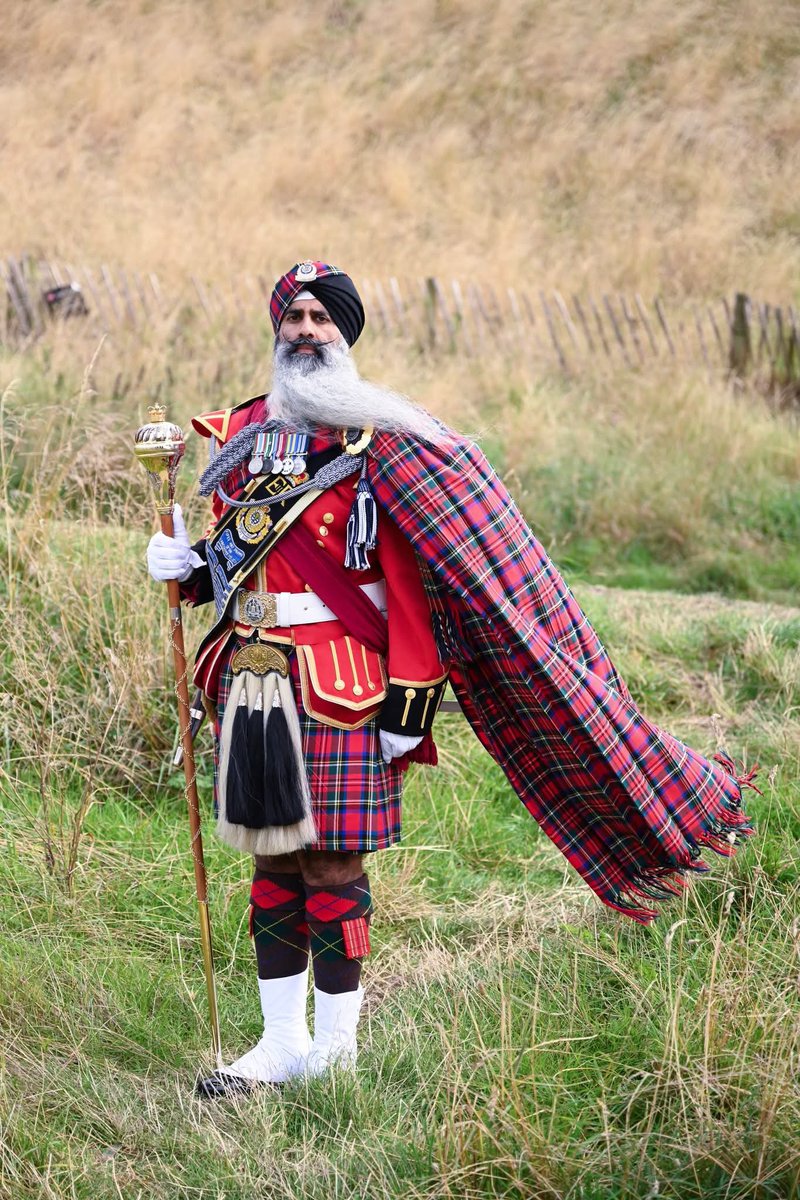
The photo on the left shows Constable Sukhvinder Singh Sunger, a Canadian Sikh police officer who recently led the Vancouver Police Pipe Band at the Royal Edinburgh Military Tattoo. The event is held at Edinburgh Castle, and it celebrates military bands from around the world. Thus, for the event, Constable Sunger wore traditional Highland dress with a ceremonial dastār (Sikh turban).
I think he looks resplendent for all the reasons I've mentioned in my previous threads: the use of "shape and drape," texture, and the semiotics of clothing.
But some were less enthused about a Canadian man of South Asian descent wearing Scottish clothing.
So I thought I'd share a story about Alexander Haughton Campbell Gardner, an adventurer and mercenary born in 1785 in what would become modern Wisconsin. By his own account, his father was Scottish, and his mother was Anglo-Spanish, although at least one of his contemporaries thought he was Irish. Either way, he would be considered "white" today.
At the age of 24, he traveled to Europe and, shortly after, began exploring Russia and Central Asia. It was in Central Asia, he claims, that he started to adopt the local customs and mores, often presenting himself as Muslim. Although one wonders how easily he was able to blend in, as he stood six feet tall and had a penchant for drinking.
According to him, he was captured in Afghanistan in 1824, but ended up joining a rebel force, commanding 180 horsemen, and marrying a local woman, with whom he fathered a child near Parwan. His wife and child were later killed after his patron's defeat, which drove him to Punjab.
It was in Punjab, he claims, where he joined the Sikh Army, eventually rising to the level of Colonel. He claims to have been present at Lahore, then the capital of the Sikh Empire, and says he killed 300 men during a fierce clash.
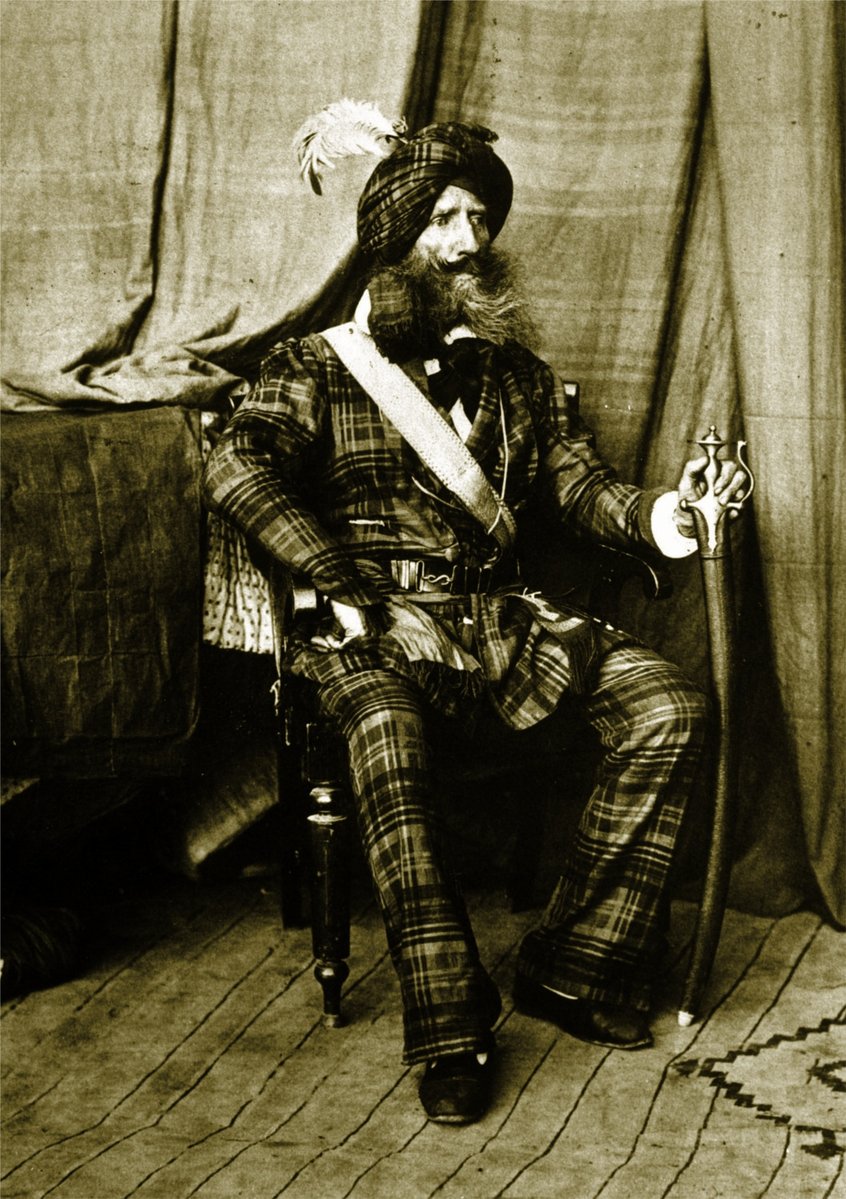
Much of Gardner's life is hard to verify, as many of his fantastical claims come from his much-contested memoir, which has little to no third-party corroboration. However, one thing is certain, if only because we have photographic evidence. Later in life, he had a striking style of self-presentation. In the photo on the right, you can see him in a tartan suit and Sikh turban. His facial hair is long because many Sikhs believe not cutting your hair shows respect for God's perfect creation.
Gardner was a man of American descent, European lineage, and Central/ South Asian cultural identity. He died with the name Gordana Khan. This complex form of diasporic identity goes back to 1785, shortly after the United States declared independence from Britain. In my opinion, it goes to show that culture is porous and identities can be complex, not as clear and "pure" as many would like to pretend.
Academic publishers say they make research more accessible.
Meanwhile researchers do the work, write the paper, often review for free, and universities pay to read it back.
Sometimes researchers even pay to make it open access.
Am I British?
I hold a British passport, but I’m not a Brit by heritage. Travel anywhere and people still see me as Indian.
Am I English? No.
I believe in British values: freedom, fairness, democracy, the rule of law, and standing up for what is right.
I’m grateful to Britain for the opportunities, freedoms and home it has given me. I stand with fellow English and British citizens who believe our communities, traditions and freedoms are worth defending.
My heritage is Indian (I’m Afghan-born). My citizenship is British.
My loyalty is to the values and future we share.
My kids were born in England but can never be seen as British. That’s fine with me, it’s the harsh reality.
Grateful for where I belong. Proud to stand for Britain. 🇬🇧🇮🇳
Captain Priya Adhikari, Nepal’s first female helicopter captain, has flown nearly 100 missions in just days - navigating treacherous valleys and unstable ground, to bring survivors to safety and dignity to the dead.
Canada at its best.
I can’t love this enough.
Constable Sukhvinder "Suki" Singh Sunger of the Vancouver Police Pipe Band made history as the first turbaned Sikh drum major to lead the march at the 2026 Royal Edinburgh Military Tattoo. 🇨🇦
Two centuries, two continents, and the turban still carries a presence of its own.
Maharaja Ranjit Singh’s army had Col Alexander Gardner,a Scots-American artillery officer who wore a tartan turban.
Today, a Sikh Canadian in tartan turban leads a Scottish pipe band in Edinburgh.
Dieu a vraiment tout créé et donné le savoir à chacun selon son espèce.
Cet oiseau a construit une maison entièrement étanche à la pluie avec de la boue, une petite pelletée à la fois.
🚨Only 5 days left to register for LMH! Don’t miss it!
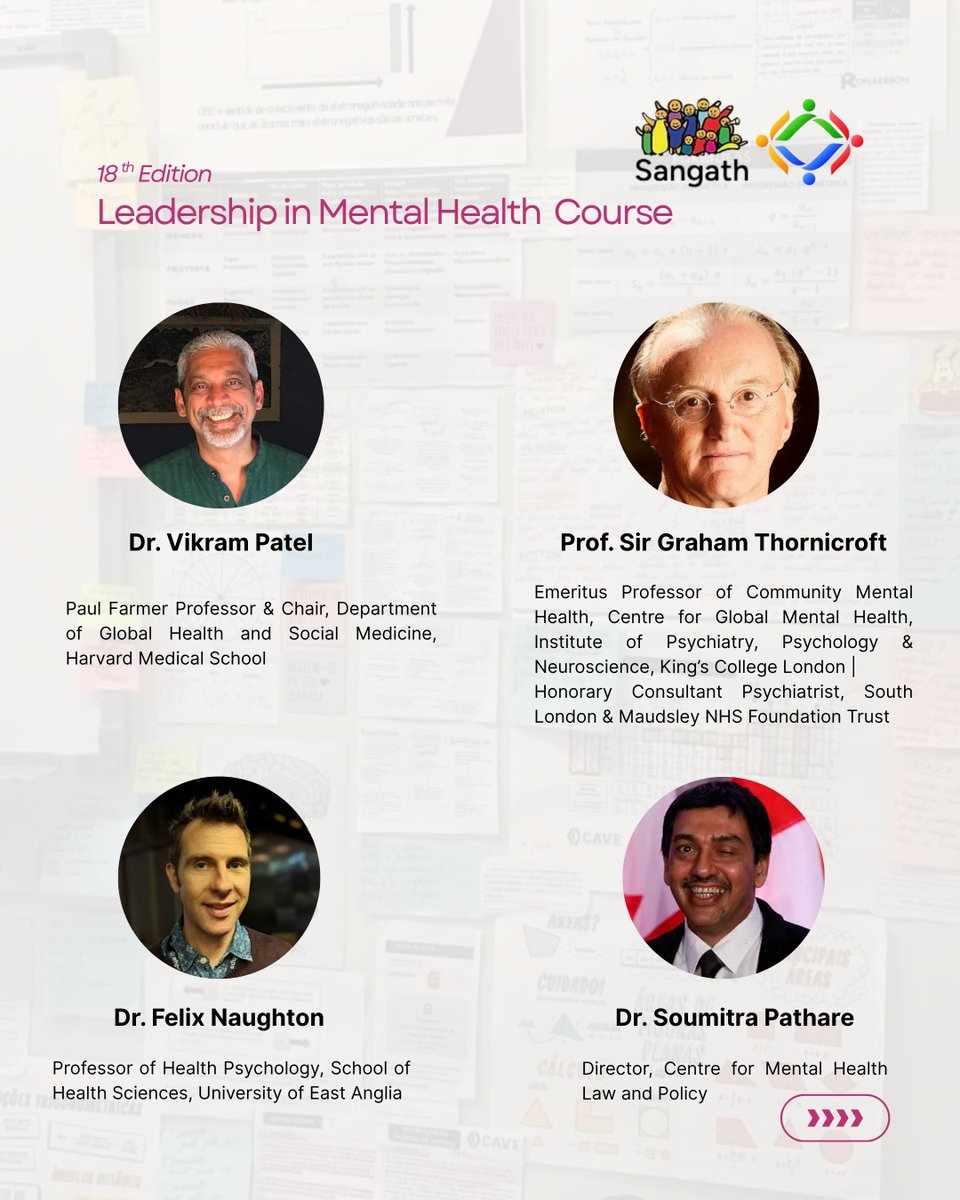
Meet the exceptional #faculty behind Phase I of the 18th edition of Leadership in Mental Health (LMH) Course.
LMH: Looking Back, Moving Forward 🌱
At LMH, the journey doesn’t end when the course concludes - it continues through a growing community of accomplished alumni and a shared commitment to shaping what comes next.
NIMHANS inaugurates ಆಟ-ಪಾಠ (Aata Paata) — a reimagined crèche for staff children. Designed to support play, exploration & nature-based learning, the space reflects the belief that early environments shape mental health.
Sometimes, the simplest words carry the strongest message. 🇮🇳
A little girl from Arunachal Pradesh proudly reminds everyone — we are not Chinese.
Respect our identity.
Call us Indian 🇮🇳