Vented > occlusive. Monitor either way. Getting worse? Burp the seal.
If the only seal in your kit is non-vented, what changes about how you watch that patient, and why?
#combattraumalab#chestseal#tccc
Whatever you cover the wound with, monitor. Hypoxia, distress or hypotension and you suspect a tension? Burp the seal first. Lift an edge, let the air out, reseat it. Still worsening? Decompress if that's in your scope, and consider leaving the seal off.
Where I stand: I use chest seals selectively. When I do, I use vented. Mechanistically it's sound, and the animal work is consistent. Vented seals can still fail, so you can't automatically let your guard down.
Taped on 3 sides is an attempt at a vent, not one of the 2 TCCC options. In blood and sweat the free edge sticks down and you're back to occlusive without knowing it. Wrapper and tape is all you have? Tape all 4 sides. I'd err on treating it as occlusive.
In one of many swine studies, 8 pigs breathing on their own got both seal types, air added 0.2 L at a time. Unvented: tension in every animal at about 1.4 L. Vented: no significant change out to 2 L. Vents can clog. A clogged vent is now occlusive. No human outcome data.
I have 4 posts telling you what a chest seal can't do. In those I mostly showed occlusive seals. There's a second option.
Occlusive: closes the defect completely. Nothing in, nothing out.
Non-occlusive: the dressing has a valve, a mechanism that allows air out but not in.
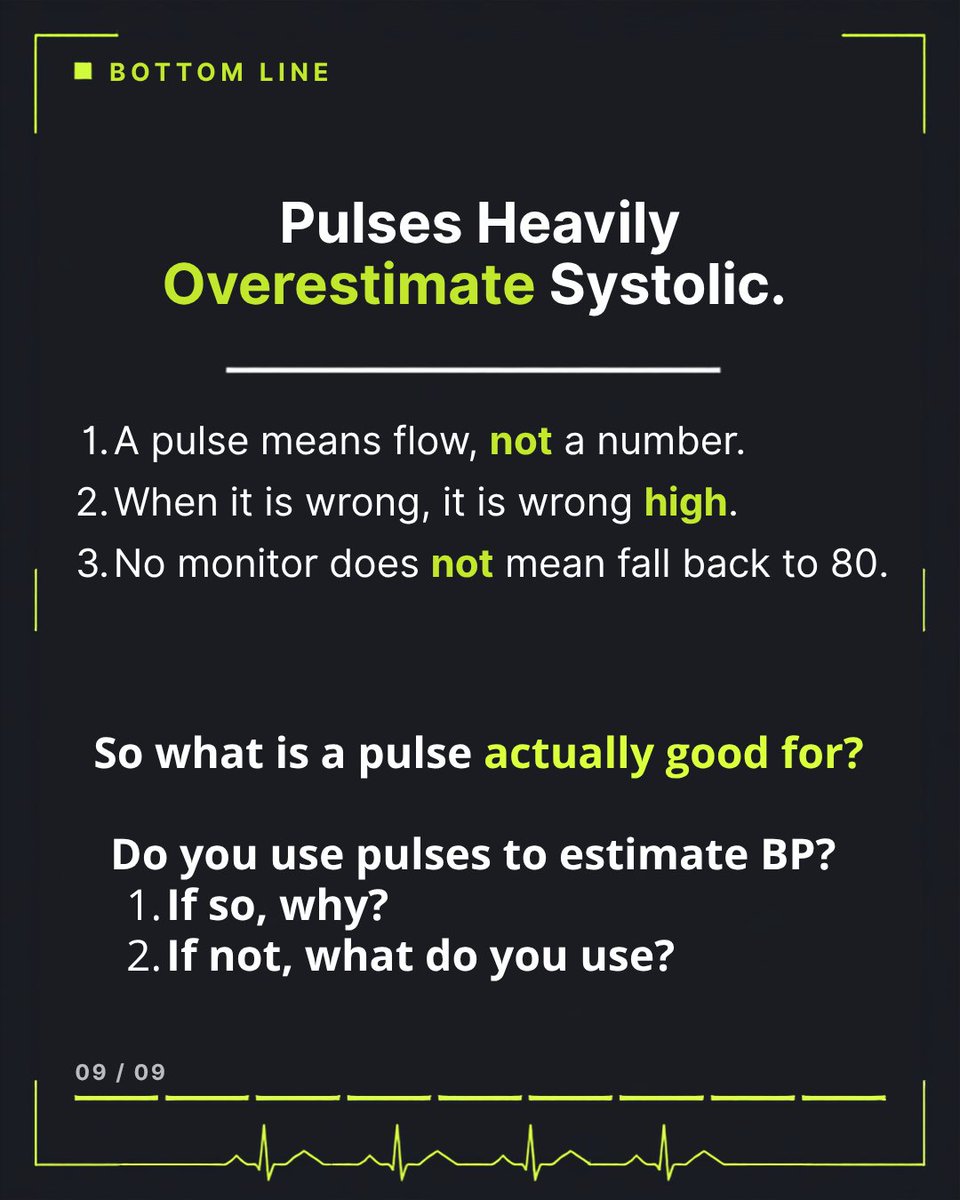
So the answer to the last post is D. A pulse does not give you a number.
What replaces it: watch the trend. Pulses you are losing or regaining over minutes tell you more than any single check.
If a pulse is not a number, what are you actually doing with it?
Last post I asked you to finish the medic's sentence.
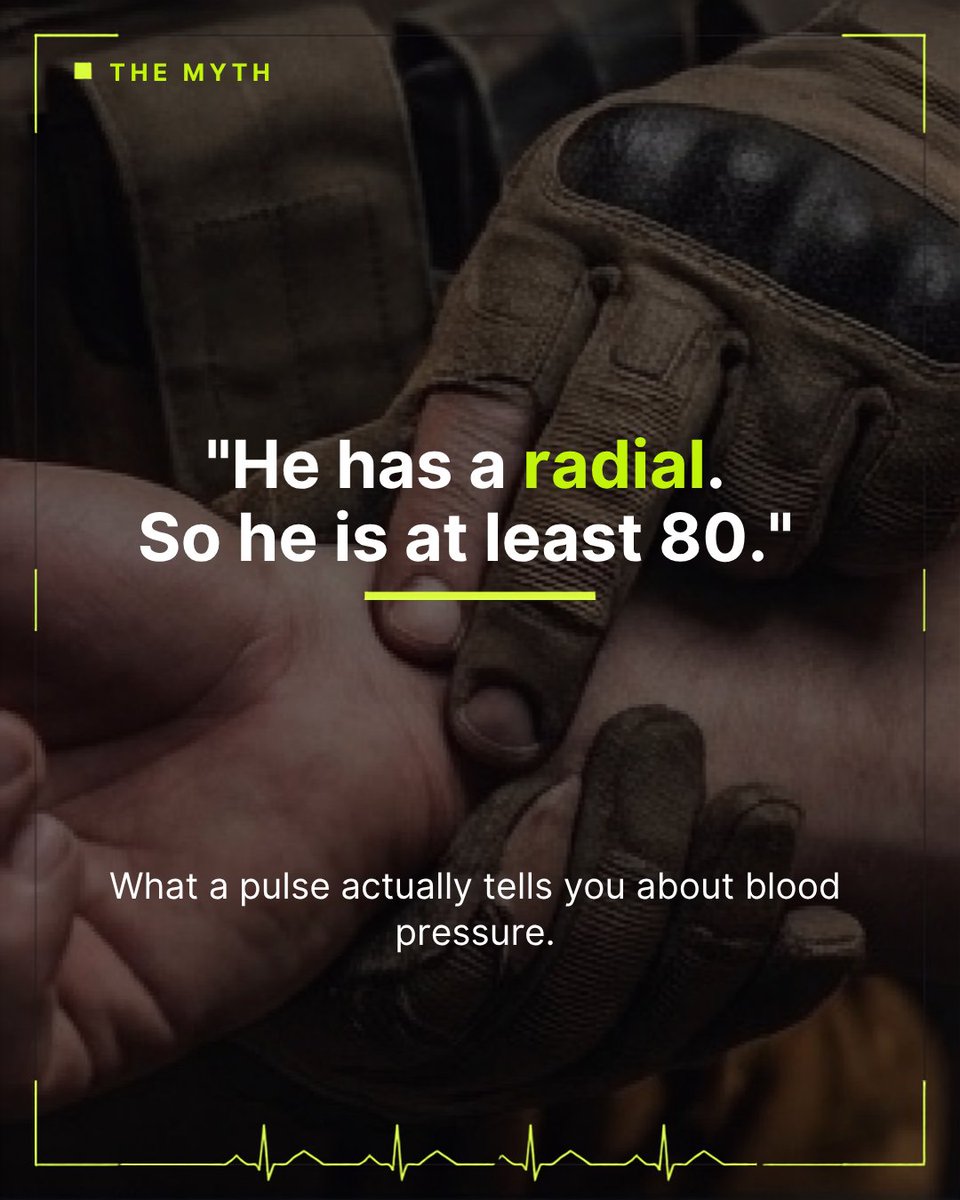
"He has a fast radial, so his pressure must be at least..."
Most of you said 80. That is what nearly all of us were taught:
Carotid → 60
Femoral → 70
Radial → 80
Every rung failed, and it failed the same direction every time. High.
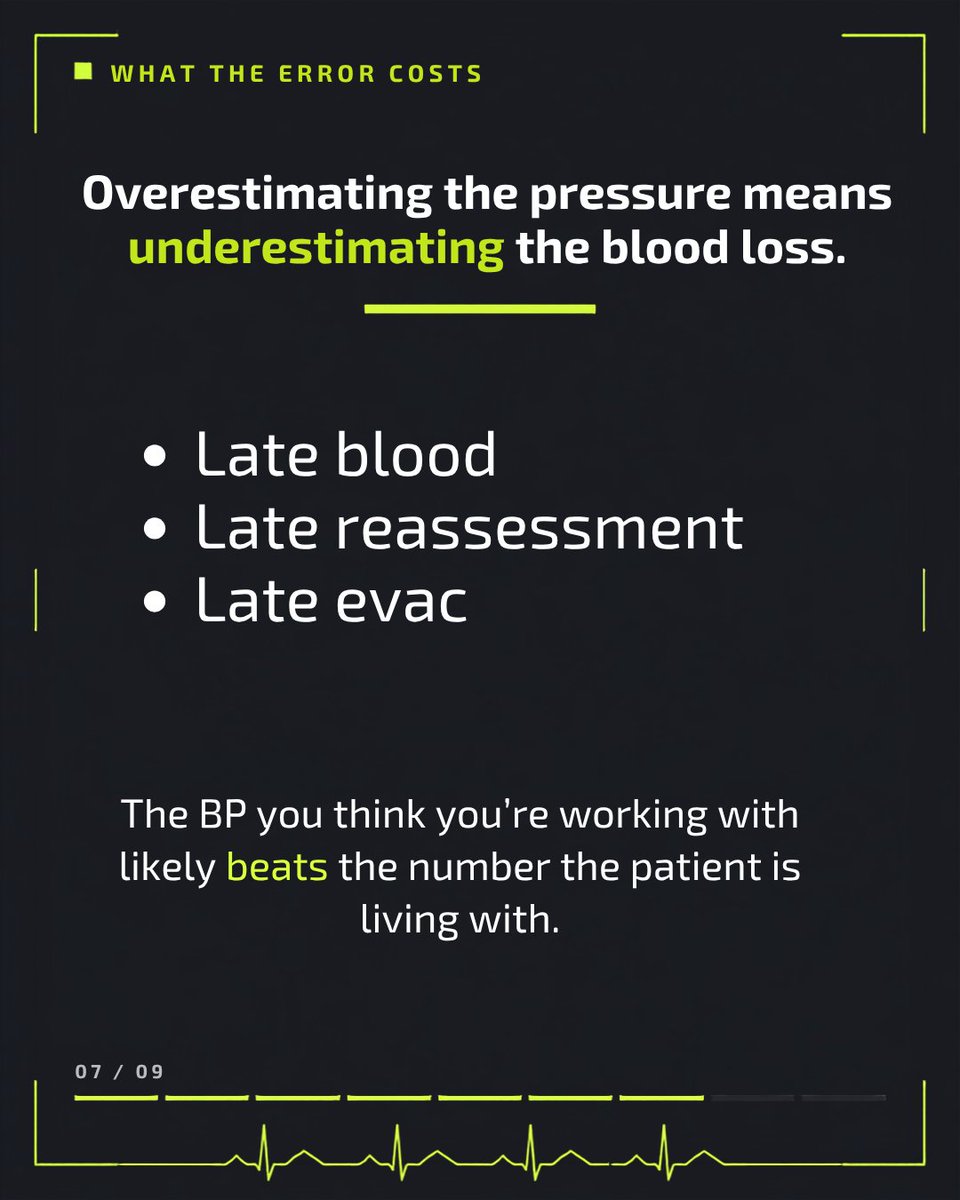
Here is what that error costs you. Overestimating the pressure means underestimating the blood loss. Late blood, late reassessment, late evac.
This is not an argument against needling. We do it because someone is about to die.
It is an argument for knowing what the procedure costs when you reach for it.
You place the needle. What are you watching, and how long do you give it?
Needle decompression is a core TCCC procedure. Here is the part that rarely gets taught alongside it.
Roughly 1 to 2 percent cause a cardiac or vascular injury, weighted to the anterior second intercostal space.
Whatever your level of training, we can all agree that putting a large needle into the heart or a great vessel of an already shocky patient is physiologically suboptimal.
None of that means do not needle.
It means the needle is a hypothesis, not a treatment.
A procedure was done. That is not improvement. So what are you watching, and how long do you give it?
You decide to needle.
It is a core TCCC procedure, and most of us would say we are confident with it.
Here is what the prehospital data actually looks like.
The data is heterogeneous and every clinician, patient and scenario is different. But prehospital needle decompression success is far from a given.
And remember what this procedure is. Not routine, not preventative. We do it because someone is about to die.
You vented the seal.
That was the least invasive move on the table, and it was a reasonable one. Air had a way out again.
Except he did not get better.