Commodore Lokesh Batra (retired), the RTI applicant who was refused the information, pointed out that the CBI "itself occupies a central role in politically sensitive investigations, making questions of transparency … particularly significant".
https://t.co/acq2yHc0Nx
Siddaramaiah left the high political office of Chief Minister with style and great dignity. He was an excellent administrator. I have interacted with him closely and intimately over the last three decades, both as Leader of the Opposition and as Chief Minister. He invited me three times to address the Cabinet during the 2016–17 Cauvery crisis. His departure is a loss to Karnataka. However, he had to step down to make way for the next generation of leaders in Karnataka.
#WATCH: Justice B.V. Nagarathna and Justice Ujjal Bhuyan are one of most upright, brilliant, and intellectually rigorous judges who have consistently stood up for civil liberties and constitutional freedoms.
The two’s disapproval of another two-judge bench’s decision denying bail to #UmarKhalid and Sharjeel Imam is a significant internal dissent against the Supreme Court’s own failure to take a sustained and holistic view when it comes to fundamental right to liberty.
The judges even observed that “judicial discipline” required Justices Aravind Kumar and N.V. Anjaria to follow the 2021 Najeeb judgment which recognised prolonged incarceration as a ground for bail in UAPA cases in Khalid and Imam’s bail plea.
It took over 4 months, 02 RTIs followed by 02 Appeals for the DoPT to upload the files of appointments of 08 Information Commissioners and Chief Information Commissioner.
Js Muralidhar among Rahul Gandhi's choices for CIC post rejected by PM-led panel; Rahul also suggested former IAS officer Sumita Dawra and Faizan Mustafa could be considered for CIC post; He objected to one of the eight names chosen as Info Commissioners
https://t.co/iw4cdL3B6A
Selection Comm meeting to choose CIC in Dec 2025:
* Rahul Gandhi recommended ex-IAS officer Sumita Dwara as CIC
* He also suggested Justice (retd) S Muralidhar and Prof Faizam Mustafa could be considered @DeccanHerald 1/2
@PMOIndia@DefenceMinIndia Day of reckoning 15 Apr 26, NFFU, hearing in HSC. While all other Gp A Services had been gtd NFFU, Def Forces which fulfill all six conditions are still awaiting. Hope to see justice gtd Armed Forces.
Want to know the names of the govt officials in Andhra Pradesh on whose watch 16 people died due to adulterated milk? Well, you can’t anymore - the Data Protection law has amended the RTI Act to prevent disclosure of all personal information, including names of govt officials, under section 8(1)(j). Watch - https://t.co/y1VDoQ8TRO
@naukarshah@ECISVEEP I am a retired Indian Naval Soldier (Service 1986 to 2010) and presently a pensioner. I have submitted my 10th pass certificate (1985) and pension documents during the SIR hearing. Still my name has been deleted after adjudication.
AC: 82-Nakashipara
Part: 24-Akandadanga Nadia
#News: An extremely important hearing took place today before the Delhi High Court.
A single-judge bench of Justice Purushaindra Kumar Kaurav heard arguments in my case seeking disclosure of information regarding corruption and misconduct complaints against former Acting Chief Justice of the Madras High Court, T. Raja. I was present during the hearing and it seems that the scope of the case has been widened which the High Court said would have “wider ramifications” for the institution of the judiciary.
Mr. Prashant Bhushan (@pbhushan1) argued that information about complaints received cannot be denied on the technical ground that it is “not maintained in the manner sought for”, the stand taken by the Supreme Court. To this, we submitted that the Supreme Court Registry could indicate the format in which such information is maintained, and we would be willing to file a fresh RTI accordingly.
The Court observed that an applicant can file hundreds of applications in different formats, but that is not the point, and that the SC Registry cannot rely solely on such a technical ground to deny information.
Mr. Bhushan also pointed out a striking inconsistency that had come to light recently. While the Supreme Court claimed that it does not maintain information on the “total number of complaints received against T. Raja,” it has recently furnished the total number of complaints received by the Office of the Chief Justice of India against sitting judges over the past ten years (8,630 complaints) to the Government of India, which was then placed before the Parliament.
In response, the Supreme Court’s counsel argued that while aggregate figures were maintained (something which they didn’t previously disclose, clearly lying on affidavit), judge-specific data was not maintained.
This claim is quite bizarre. At a minimum, basic data—such as the name of the judge against whom a complaint is made—would necessarily and logically would have to be captured while recording such complaints. Otherwise, how did that figure of 8,630 appear?
The High Court repeatedly questioned how it is possible that no such data is maintained. It also expressed concern about the public perception created when large aggregate figures are disclosed without any clarity on how those complaints were handled, clearly leading to an impression that the judiciary may not be acting on them. This is detrimental to the image of the judiciary, the High Court said.
We submitted that, at the very least, the Supreme Court ought to disclose a break-up of how such complaints are dealt with—how many were closed, how many remain pending, how many were dismissed as frivolous, and how many led to inquiries. Such disclosure would not weaken the judiciary but would rather strengthen public confidence and reinforce institutional independence. The Court appeared to agree with this line of reasoning and repeatedly questioned the Registry’s refusal to provide such information.
The counsel for Supreme Court read out parts of the judgment in Subhash Chandra Agarwal and Lokesh Batra to support its non-disclosure of information, but the High Court did not appear to be convinced. At one point, Justice Kaurav even asked if the Supreme Court is arguing against its own case!
On the specific information sought regarding T. Raja, the High Court indicated that it would examine the extent to which disclosure could be made. It raised a legitimate concern about the possibility of disgruntled litigants filing 10 or 15 complaints to malign a judge and then filing an RTI to create misleading narratives about so and so number of complaints received against the judge. Our side did acknowledge this risk but suggested that it can be mitigated by disclosing the action taken on these complaints, especially where they are found to be frivolous. This would protect honest judges while ensuring transparency.
Ultimately, the Court directed both parties, us and the Supreme Court, to propose a mechanism that balances both the safeguarding of reputation of honest judges and ensuring public access to information on how complaints are handled and through which mechanism.
We will be submitting our suggestions to the Hon’ble High Court. I invite all well-meaning citizens to share their ideas on what such a mechanism should look like, one that ensures transparency, accountability, and institutional integrity, without enabling misuse against honest judges.
{The End}
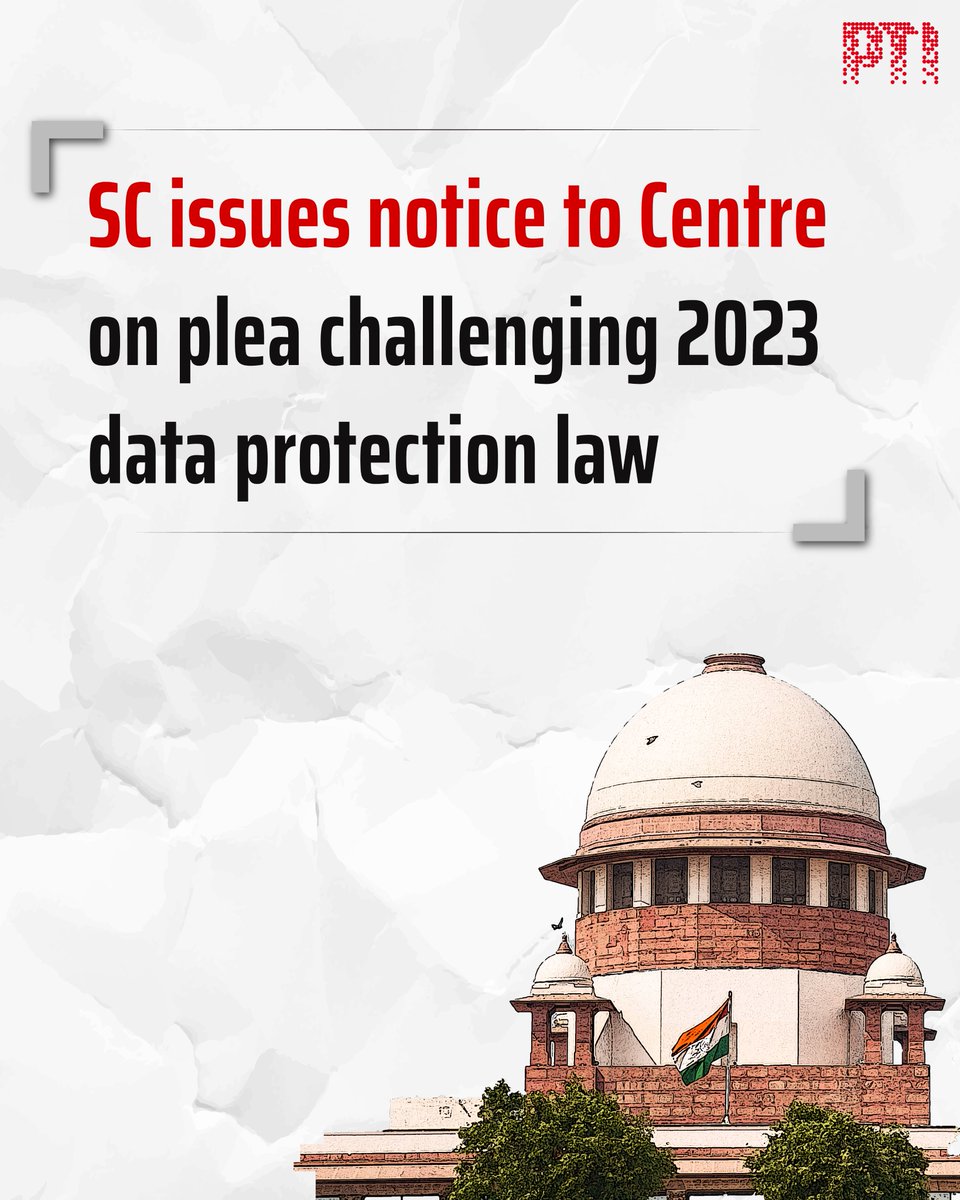
STORY | SC issues notice to Centre on plea challenging 2023 data protection law
The Supreme Court on Monday issued a notice to the Centre on a plea challenging the constitutional validity of several provisions of the Digital Personal Data Protection (DPDP) Act, 2023.
The plea, moved by The Reporters' Collective and renowned journalist Nitin Sethi, argues that the new data regime severely dilutes the Right to Information (RTI) Act and grants the Centre "sweeping powers" over personal data.
A bench comprising Chief Justice Surya Kant and Justices Joymalya Bagchi and Vipul M Pancholi, while agreeing to examine the legal complexities of the Act, refused to grant an interim stay on the impugned provisions.
READ: https://t.co/x1D6FGzHry
Statement by The Reporters' Collective @reporters_co.
On its case before the Supreme Court
For Citizens' Right to Information and Journalists' Rights to hold the Gov't and the Powerful to Account.
https://t.co/iZLjxGx2Fa
VIDEO | Delhi: On the Supreme Court’s notice to the Centre on the Data Protection Law, Advocate Prashant Bhushan says, “Arguments on the Data Protection Act were heard by the Supreme Court. The main provisions challenged were the amendments made to the Right to Information Act, under which the exemption from disclosure of information on the grounds of privacy has been drastically altered. Earlier, the law stated that only such personal information would be exempt which had no relation to public activity or public interest. But now there is a blanket exemption for all personal information, which means no personal information will be disclosed... Today, the Supreme Court has issued notice in these petitions and has listed the matter for further hearing.”
(Full video available on PTI Videos - https://t.co/bIyFWTfmBd)