$PLTR My thoughts on Palantir's valuation and why I'm planning on significantly decreasing my % allocation towards Palantir:
To start, my current allocation is 79%.
Palantir is very rich at these prices, no matter how you slice it. I am still extremely bullish about the future of Palantir's business as they capitalize on an AI revolution that is just beginning. However, I am also continuously keeping an eye on valuation because it matters a great deal to me. At a market cap of 82.4B, I think we are due for a sharp reversal unless the company can return to a sustained period of 40%+ top-line growth. And even then, I'm concerned Mr. Market may favor Palantir for another year or so and then slash their valuation back to a more reasonable price.
Attached is a list of companies I wanted to compare Palantir to. Some are roughly in the same industry, and I included many of the large companies and high-growth stocks that everyone knows to get an idea of how the market values them:
At today's price of $37 ...
P/E for Palantir is 208x, compared to the average at 55.9x. I don't give much credence to this since they just turned profitable. P/S for Palantir is now 33x, compared to the average of 9.9x. I believe this is a problem, and we will see a reversal to the downside due to this extension. I have seen many people online say that Palantir's valuation "does not matter" and to "look at Salesforce or Tesla." On a P/S basis, they are not the same at all. Salesforce P/S is 7x, and Tesla's is 9x, both much lower than Palantir. P/FCF is a great metric, as cash flow is a much purer number to evaluate and judge a business than earnings, which can be manipulated. Palantirs P/FCF is now 116x. I remember when it was below 40x, and I would tell everyone that there was a lot of upside ahead due to the expansion of this multiple as the company continued to grow. The average in my list for P/FCF was 72x, which is very common to see. But now that we are over 100x, there can be a reversion back to the mean, in my opinion. Palantir's P/EBITDA is 250x, against the list average of 114x.
On the upside, of course, Palantir is now one of the fastest-growing companies and is primed for continued growth. As of last quarter, its YoY growth was 27%, compared to the list average of 23%. If all goes well, I wouldn't be surprised to see Palantir reach 40%+ top-line growth rates again as it continues to capitalize on the AI revolution.
As an experiment, I calculated the stock price of Palantir would theoretically drop if the market corrected the price back to the averages of the stocks I compared it to. You can see the calculations per each multiple at the bottom of the Excel post. I then took the average of all of them, excluding the P/E since it's not fair to value them yet in that way. The average, in this case, is $16.89. This aligns with my belief that the stock is worth $15-$25, depending on who you are asking.
Of course, multiples only capture what the company is producing today and are not a valuation of future cash flow & projections. That's why another way of evaluating Palantir could be with DCF models to derive a fair price by discounting projected cash flows x years into the future. There are so many variables that you could theoretically tweak in these models to "justify" today's price, which is my main contention with this form of valuation. Furthermore, I find it almost entirely impossible to accurately project the future cash flows of Palantir, the DoD spend, AI market growth, etc, over the next ten years. Due to this, I end up being very conservative in my projections for Palantir in my DCF, which, of course, creates a fair value of much lower than we are today. A great example of why relying on DCFs can be harmful is the crash of 2021-2022. Back then, if investors had given more weight to a valuation based on the present cash flows and figures at that time, many investors would not have entered Palantir until below $10 or at least below $15 dollars. However, many ultra bullish investors who created fancy DCFs outputting a fair value of $35 per share bought the stock at $25 and suffered tremendous losses for almost two years. I say this as someone who, at my fault, listened to many people who fall into this category. Again, I'm not saying DCFs are bad, but it's just a point of contention to consider.
I also want to caution investors who are being influenced by "analysts" for Palantir who continue to publish increasingly bullish price targets. They are simply slapping large multiples on far-out figures. That is not a reasonable way to derive a price target. I appreciate that they understand the Palantir story and are aligned with their mission, but again, be cautious of their numbers and do your due diligence.
I believe the birth of the internet back in the early 2000s was one of the most, if not the most, impactful transformations for businesses ever. There are quite literally millions of companies that operate entirely online (including the one I run), which was not feasible before the internet and cloud. In 2001, when $MSFT was at 50 dollars per share, an investor who thought that every business and person in the world would use their software one day ended up being entirely right. Yet, if that same investor had gone all in on Microsoft, it would have taken them 17 years to generate a positive return on their investment. I'm not saying the same thing will happen with Palantir, but it is a genuine concern of mine.
To wrap this up, I want to say that the stock is not the company. I believe in Palantir and its future more so than any other company in the market. My conviction is tremendous, and I have no doubt Alex Karp and the team will continue to shatter expectations, albeit with some bumps along the way, and continuously grow over the next ten years as they pave the way for actionable applications of AI in both the defense sector and of course commercial. I have followed this company for years and will continue to do so, no matter my share count. But I will be decreasing my Palantir position significantly with CC's and considering selling puts and scaling out completely.
Much love, thanks for reading.
I started this account to share the insights I've gained from nearly a decade of corporate strategy experience at Fortune 500 companies with retail investors.
My goal was to transparently show you my journey of growing a $100K portfolio into $1M by the end of this decade -- a milestone that just hit $300K last week thanks to a few winners like $PLTR, $TMDX, $CRWD & $TSLA.
Along the way, I've discovered the immense satisfaction that comes not only from sharing my strategies but also from empowering you to master your own portfolios. After years of helping the rich get richer -- it's been incredibly rewarding to offer these tools to a wider audience.
A recent comment from a subscriber really brought home why I'm doing this and how excited I am about the journey we're all on together 🙌
What is happening in China?
Just days ago, China announced MASSIVE economic stimulus as their economy crashed.
Now, retail investors are piling into stocks like pandemic-era stimulus is back.
Something is seriously wrong in China and it's too late for stimulus.
(a thread)
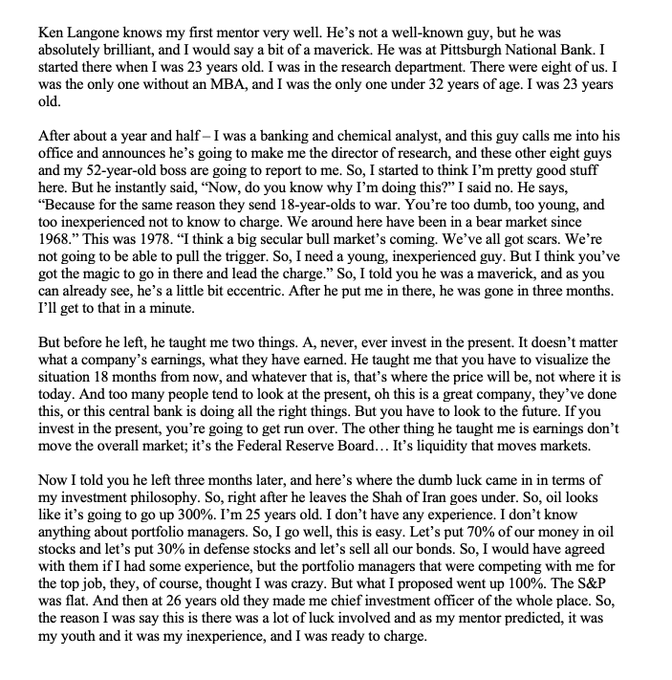
Druckenmiller on why you should never invest in the present.
"It doesn't matter what a company's earning, what they have earned - you have to visualise the situation 18 months from now - that's where the price will be".
I’m convinced that with this sustained move (another 7% gain) in the Hang Seng Tech Index, there’s a mountain of margin calls slamming those holding short positions. It’s buying and volume like I haven’t seen in years for this market. I wonder if we’ll hear of a few hedge funds imploding in the coming weeks. $KWEB $KTEC $BABA $JD $BIDU
The Mag 7 vs 2000 Tech Bubble Leaders. What do we see? The Mag 7 has a lot more cash, lower forward PE ratio's, while their net margins are significant higher than the tech leaders during the dot com bubble. $MSFT $AAPL $NVDA $AMZN $META $GOOGL $TSLA
Big news!
$LVMH has purchased a 10% stake in Double R, the investment vehicle that owns ~16 % of $MONC and is controlled by its CEO, Remo Ruffini. With funding from LVMH, Double R plans to increase its Moncler stake to 18.5% over the next 18 months.
Arnault's take on the news:
$AMZN's ad business is already making over $51B revenue annually. It is bigger than $GOOGL's YT ad revenue and 35% of $META's revenue.
It is also growing fast with 8 years CAGR at 36.55% far higher than other peers.
& Prime Video Ads just getting started.
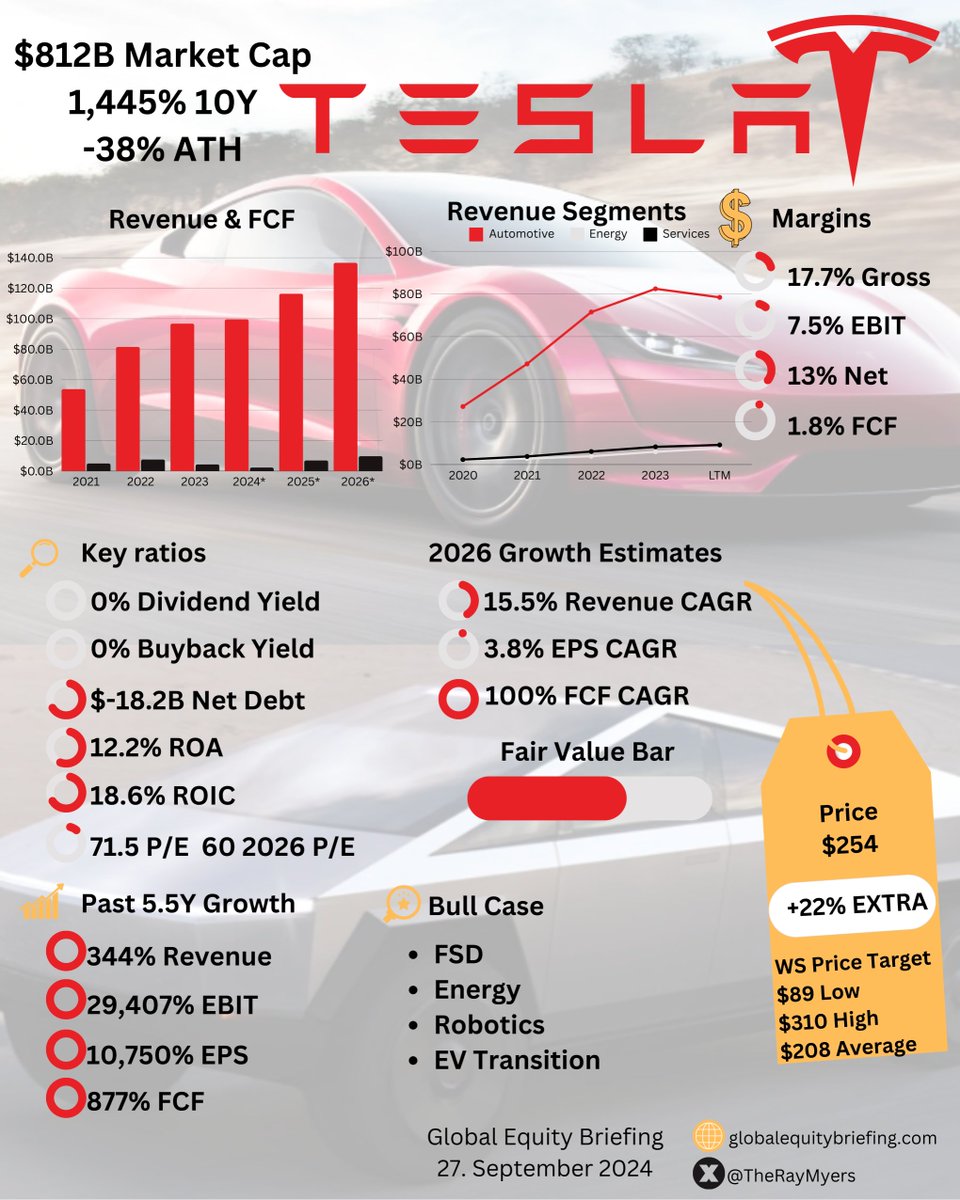
📢Tesla One Pager!
$TSLA is down 38% from its ATH, here is why!
1️⃣ Automotive revenue has plateaued
2️⃣ Gross Margin is down to 17.7%
3️⃣ FCF has collapsed
4️⃣ Model 2 is delayed
5️⃣ 3.8% Slow 2026 EPS CAGR
Can $TSLA recover?
A sober valuation analysis on $MEDP 🧘🏽♂️
•NTM P/E Ratio: 25.91x
•5-Year Mean: 30.16x
•NTM FCF Yield: 4.46%
•5-Year Mean: 3.98%
As you can see, $MEDP appears to be trading slightly below fair value
Going forward, investors can receive ~16% MORE in earnings per share & ~12% MORE in FCF per share 🧠***
Before we get into valuation, let’s take a look at why $MEDP is a great business
BALANCE SHEET✅
•Cash & Short-Term Inv: $510.89M
•Long-Term Debt: $0
$MEDP has a great balance sheet & 3.51x FFO Interest Coverage Ratio
RETURN ON CAPITAL✅
•2019: 16.0%
•2020: 17.6%
•2021: 18.0%
•2022: 46.8%
•2023: 46.4%
•LTM: 41.5%
RETURN ON EQUITY✅
•2019: 15.3%
•2020: 19.0%
•2021: 20.7%
•2022: 36.6%
•2023: 59.8%
•LTM: 58.9%
$MED has strong return metrics, highlighting the financial efficiency of the business
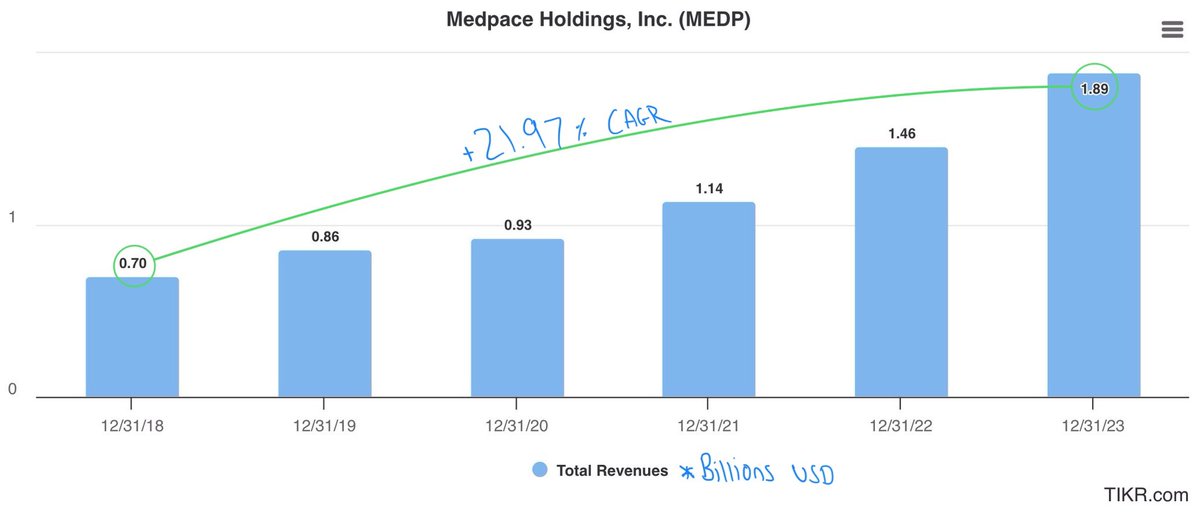
REVENUES✅
•2018: $0.70B
•2023: $1.89B
•CAGR: 21.97%
FREE CASH FLOW✅
•2018: $140.56M
•2023: $502.80M
•CAGR: 29.0%
NORMALIZED EPS✅
•2018: $2.81
•2023: $8.92
•CAGR: 25.98%
SHARE BUYBACKS✅
•2018 Shares Outstanding: 36.91M
•LTM Shares Outstanding: 31.93M
By reducing its shares outstanding 13.5%, $MEDP increased its EPS by 15.6% (assuming 0 growth)
MARGINS✅
•LTM Gross Margins: 66.9%
•LTM Operating Margins: 18.8%
•LTM Net Income Margins: 16.7%
***NOW TO VALUATION 🧠
As stated above, investors can expect to receive ~16% MORE in EPS & ~12% MORE in FCF per share
Using Benjamin Graham’s 2G rule of thumb, $MEDP has to grow earnings at a 12.96% CAGR over the next several years to justify its valuation
Today, analysts anticipate 2024 - 2026 EPS growth over the next few years to be slightly less than (12.96%) required growth rate:
2024E: $11.81 (32.4% YoY) *FY Dec
2025E: $13.16 (11.4% YoY)
2026E: $15.01 (14.0% YoY)
$MEDP has a great track record of meeting analyst estimates ~2 years out, so let’s assume $MEDP ends 2026 with $15.01 in EPS & see its CAGR potential assuming different multiples
30x P/E: $450.30💵 … ~15.3% CAGR
29x P/E: $435.29💵 … ~13.6% CAGR
28x P/E: $420.28💵 … ~11.9% CAGR
27x P/E: $405.27💵 … ~10.1% CAGR
As you can see, $MEDP appears to have attractive return potential if we assume >27 earnings, a valuation that may not necessarily be justified by its reduced growth rate & still may be subject to some multiple compression
Yet, today at $326💵 $MEDP appears to be a decent consideration for investment
I’d consider $MEDP a great buy with a margin of safety closer to $290💵(~23.50x NTM EPS), or roughly 9.3% below today’s share price
This is where I can reasonably expect ~12% CAGR assuming a more conservative 25x 2026 earnings estimates
#stocks #investing
___
𝐃𝐈𝐒𝐂��𝐎𝐒𝐔𝐑𝐄‼️: 𝐓𝐡𝐢𝐬 𝐢𝐬 𝐍𝐎𝐓 𝐈𝐧𝐯𝐞𝐬𝐭𝐦𝐞𝐧𝐭 𝐀𝐝𝐯𝐢𝐜𝐞. 𝐁𝐚𝐛𝐲𝐥𝐨𝐧 𝐂𝐚𝐩𝐢𝐭𝐚𝐥® 𝐚𝐧𝐝 𝐢𝐭𝐬 𝐫𝐞𝐩𝐫𝐞𝐬𝐞𝐧𝐭𝐚𝐭𝐢𝐯𝐞𝐬 𝐦𝐚𝐲 𝐡𝐚𝐯𝐞 𝐩𝐨𝐬𝐢𝐭𝐢𝐨𝐧𝐬 𝐢𝐧 𝐭𝐡𝐞 𝐬𝐞𝐜𝐮𝐫𝐢𝐭𝐢𝐞𝐬 𝐝𝐢𝐬𝐜𝐮𝐬𝐬𝐞𝐝 𝐢𝐧 𝐭𝐡𝐢𝐬 𝐭𝐰𝐞𝐞𝐭.
𝐓𝐡𝐞 𝐢𝐧𝐟𝐨𝐫𝐦𝐚𝐭𝐢𝐨𝐧 𝐜𝐨𝐧𝐭𝐚𝐢𝐧𝐞𝐝 𝐢𝐧 𝐭𝐡𝐢𝐬 𝐭𝐰𝐞𝐞𝐭 𝐢𝐬 𝐢𝐧𝐭𝐞𝐧𝐝𝐞𝐝 𝐟𝐨𝐫 𝐢𝐧𝐟𝐨𝐫𝐦𝐚𝐭𝐢𝐨𝐧𝐚𝐥 𝐩𝐮𝐫𝐩𝐨𝐬𝐞𝐬 𝐨𝐧𝐥𝐲 𝐚𝐧𝐝 𝐬𝐡𝐨𝐮𝐥𝐝 𝐧𝐨𝐭 𝐛𝐞 𝐜𝐨𝐧𝐬𝐭𝐫𝐮𝐞𝐝 𝐚𝐬 𝐢𝐧𝐯𝐞𝐬𝐭𝐦𝐞𝐧𝐭 𝐚𝐝𝐯𝐢𝐜𝐞 𝐭𝐨 𝐦𝐞𝐞𝐭 𝐭𝐡𝐞 𝐬𝐩𝐞����𝐢𝐟𝐢𝐜 𝐧𝐞𝐞𝐝𝐬 𝐨𝐟 𝐚𝐧𝐲 𝐢𝐧𝐝𝐢𝐯𝐢𝐝𝐮𝐚𝐥 𝐨𝐫 𝐬𝐢𝐭𝐮𝐚𝐭𝐢𝐨𝐧. 𝐏𝐚𝐬𝐭 𝐩𝐞𝐫𝐟𝐨𝐫𝐦𝐚𝐧𝐜𝐞 𝐢𝐬 𝐧𝐨 𝐠𝐮𝐚𝐫𝐚𝐧𝐭𝐞𝐞 𝐨𝐟 𝐟𝐮𝐭𝐮𝐫𝐞 𝐫𝐞𝐬𝐮𝐥𝐭𝐬.
𝐈𝐧𝐟𝐨𝐫𝐦𝐚𝐭𝐢𝐨𝐧 𝐜𝐨𝐧𝐭𝐚𝐢𝐧𝐞𝐝 𝐢𝐧 𝐭𝐡𝐢𝐬 𝐭𝐰𝐞𝐞𝐭 𝐡𝐚𝐬 𝐛𝐞𝐞𝐧 𝐨𝐛𝐭𝐚𝐢𝐧𝐞𝐝 𝐟𝐫𝐨𝐦 𝐬𝐨𝐮𝐫𝐜𝐞𝐬 𝐛𝐞𝐥𝐢𝐞𝐯𝐞𝐝 𝐭𝐨 𝐛𝐞 𝐫𝐞𝐥𝐢𝐚𝐛𝐥𝐞, 𝐛𝐮𝐭 𝐢𝐬 𝐧𝐨𝐭 𝐠𝐮𝐚𝐫𝐚𝐧𝐭𝐞𝐞𝐝 𝐚𝐬 𝐭𝐨 𝐜𝐨𝐦𝐩𝐥𝐞𝐭𝐞𝐧��𝐬𝐬 𝐨𝐫 𝐚𝐜𝐜𝐮𝐫𝐚𝐜𝐲.
📢Celsius One Pager!
Although $CELH hasn't done well this year, it's still up 2,716% in 5Y. Here is why!
1️⃣ 2,732% Revenue Growth
2️⃣ 22X Increase in FCF
3️⃣ Strong Unit Economics (50.4%)
4️⃣ 50% ROIC
5️⃣ Global Expansion still to come
👜 Great day for luxury due to the Chinese demand stimulus
Here is the % of revenue in Asia (excl. Japan) for each luxury stock
🇫🇷 Hermes $RMS 46.7%
🇮🇹 Moncler $MONC 43.2% (Asia)
🇫🇷 Kering $KER 35.0%
🇫🇷 LVMH $MC 30.8%
🇮🇹 Brunello Cuc. $BC 26.9% (Asia)
🇨🇭 Richemont $CFR 26.7%
🇮🇹 Ferrari $RACE 20.6%
🇮🇹 San Lorenzo $SL 11.4% (Asia)
Why using Asia excl. Japan and not just China? Because most of these companies do not report Chinese revenues alone