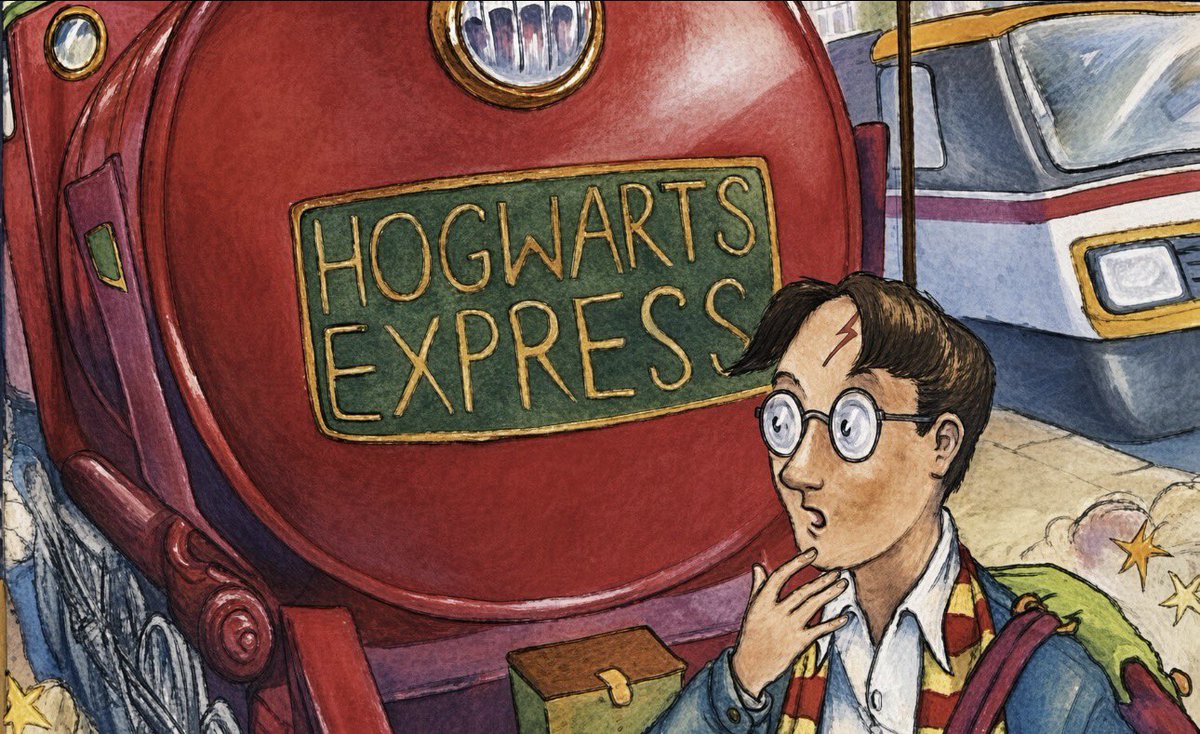
How is Avada Kedavra considered an Unforgivable Curse and illegal to use, yet apparently turning someone into confetti is perfectly acceptable in the wizarding world?
If the Spacing Guild depended so heavily on spice to maintain its monopoly over interstellar travel, why did it allow the Emperor and the Great Houses to become so dependent on a single planet that could potentially fall under one man's control? #Dune
I’m confused ,how were Tony, Peter, and Doctor Strange able to breathe comfortably on Titan?
Isn’t the atmosphere supposed to be completely different from Earth’s?
How would JK Rowling get her first novel published if she were starting today? The industry has changed a lot since then. Would she eventually find a publisher this time? Has the market changed so much that her first book would still be a hit?
J.K. Rowling would ride the same crazy train she rode in 1997 if she was to finish the first Harry Potter novel tomorrow.
So, let's get on the Hogwarts Express (2017 edition) and see where it takes us.
In my opinion, nobody, and particularly no writer, is "destined to be great". The Harry Potter books are a good example of the 'wizard school' genre, but they're very comparable to dozens of similar books that were only minor successes.
What J.K. Rowling had that a thousand other authors didn't have was that unknowable element: luck. Unbelievable, spectacular, 'hard to comprehend how lucky she really was', luck.
(Which isn't to say her books are not good. You have to be preternaturally good and supernaturally lucky to be a success).
When the manuscript of Harry Potter and the Philosopher’s Stone was finished, early in the New Year of 1996, Rowling visited Edinburgh Central Library to look up the Writers’ and Artists’ Year Book in search of a literary agent.
Her first approach was unsuccessful: a brief rejection letter. She then posted a sample of three chapters and a covering letter to Christopher Little Literary Agents, based in Fulham. It was here that a young reader, Bryony Evans, read the first chapter and laughed. Evans passed the chapters to Fleur Howle, a freelance reader, who agreed with her assessment and together they persuaded Little to sign up Rowling.
A few days later Rowling received a letter asking for the remainder of the manuscript. The agency sent Rowling’s 200-page script to 12 publishers, all of whom, to their eternal regret, turned down the book. Harper Collins showed interest but was too slow in formulating a bid and so the first book by the [future] most lucrative writer in the world was picked up by Bloomsbury for an advance of £1,500.
This is still the process for getting a novel published.
Unless you self-publish. But you know how many copies HP1 would have sold if she did that? Single figures is my guess. If you think first novels by unknown, self-published authors with no publicity budget sell well then I have some bad news for you...
So, this is the how 'getting published' goes, in 1997 and now:
1You finish the book.
2You send it to agents.
3No one is interested. They all write back saying they liked it but didn't love it. What this means is they didn't even read it.
4You send it out again and again and again until you want to kill yourself.
5Eventually, if you're very lucky you find an agent who thinks your book might sell and they agree to represent you.
6The agent sends it to the publishers
7No one is interested. They all write back saying they loved it but it didn't quite work for them in some way or other. They go to lunch. You want to kill yourself.
8Eventually, if you're very lucky you find a publisher who thinks it might sell a few copies. (JK Rowling got her book picked up by Bloomsbury because an editor happened to let his daughter read the first chapter and she loved it. That's what I mean by the level of luck you need.)
9They buy it for a derisory sum. (Note the £1,500 that JK Rowling got.)
10They make 'limited' efforts to publicise the novel (limited to giving review copies to people they have lunch with).
11The novel sells a few copies (the first edition of HP1 sold a few hundred copies, mostly to libraries).
12Your dreams of fame and fortune are shattered. You want to kill yourself.
13If you do kill yourself then that's the end.
14Unless you are Stieg Larsson, in which case death is the best career move you ever made and you sell 75 million copies of your weird, self-indulgent crime thrillers.
15But you're dead. Which is a bit of a downer.
Check comment section for 16 to 19
Ginny Weasley was supposed to be a popular, attractive girl who attracted plenty of male attention. I always imagined her as the equivalent of a popular cheerleader in a Muggle high school. She was athletic, energetic, witty, confident, independent and incredibly brave. She had a lively personality and wasn’t afraid to speak her mind. She was also described as being quite beautiful, with several boys showing an interest in her.
Hermione, on the other hand, was initially portrayed as the more plain-looking, academically driven girl. She was exceptionally intelligent, hardworking and studious, often more concerned with books, schoolwork and proving herself academically than with her appearance. She wasn’t particularly interested in being popular or attracting male attention.
Yet the films seemed to reverse these characterisations entirely. Movie Ginny was rather reserved and lacked much of the confidence, charisma and fiery personality that made her so memorable in the books. Hermione, meanwhile, was portrayed as exceptionally beautiful, with her intelligence, bravery and academic achievements often accompanied by an almost effortless glamour.
It’s interesting how the film adaptations shifted the visual and personality dynamics between the two girls. Book Ginny had the confidence and popularity of someone who naturally drew attention, while book Hermione was the brilliant, bookish girl who didn’t particularly concern herself with fitting conventional beauty standards.
I sometimes feel the films missed an opportunity to capture that distinction between them.
ATLA fans aren’t ready to admit Zuko never actually defeated Azula in a fair 1v1 in canon 😭
The moment she regained her mental stability, she low-diffed Fire Lord Zuko like he was fodder 💀💔
The more I think about it, the more disappointing this feels.
Katara and the Southern Water Tribe were among the franchise's strongest representations of Inuit and Arctic Indigenous-inspired cultures. Their clothing, environment, traditions, community structure and relationship with water were all central to that identity.
Now, with the cultural diversity being explored in Avatar: Seven Havens, Republic Forest appears to introduce a different cultural identity, with darker-skinned, Black-coded characters.
But I think we need to be careful not to confuse the two things: introducing more Black representation doesn't automatically mean removing Inuit representation.
What I really hope is that the franchise hasn't abandoned the cultural roots of the Water Tribes. Katara's heritage deserves to remain part of Avatar's world, even as that world evolves.
We can celebrate new representation without losing the old one.
Duke Leto’s decision to accept Arrakis wasn’t simply an act of loyalty to the Emperor or blind confidence in his own abilities. It was a calculated gamble driven by political necessity, House Atreides’ long-term survival, and his belief that the Fremen could become powerful enough to change the balance of power in the Imperium.