Alongside Palestinian resistance factions—including Hamas, Palestinian Islamic Jihad (PIJ), the Popular Front for the Liberation of Palestine (PFLP), the PFLP–General Command, and the Al-Aqsa Martyrs' Brigades—the text targets Lebanon’s Hezbollah and the Islamic Group, Yemen’s Ansar Allah (the Houthi movement), six Iraqi organizations (such as Kata'ib Hezbollah and Asa'ib Ahl al-Haq), and branches of the Muslim Brotherhood in Egypt, Jordan, and Sudan.
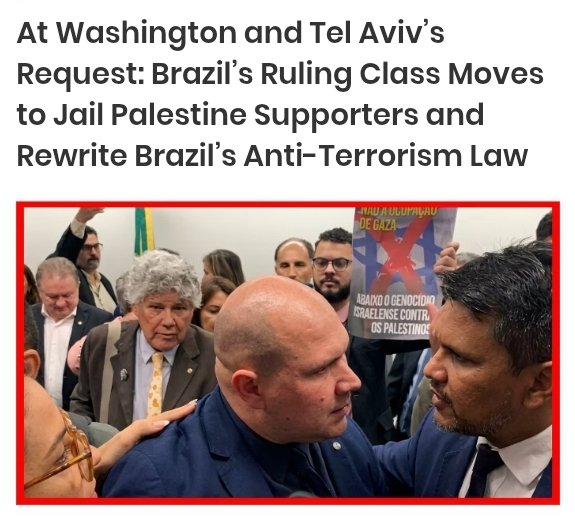
In November 2026, a major legislative battle erupted in Brasília over the future of Brazil’s foreign policy, constitutional guarantees, and the right to political dissent. On November 11, the Chamber of Deputies’ Foreign Relations and National Defense Committee (CREDN) approved a substitute text for Bill PL 4894/2023, a measure that seeks to rewrite Brazil’s Anti-Terrorism Law (Law 13.260/2016), formally classify 17 organizations across West Asia and North Africa as "terrorist" entities, and impose severe prison sentences on individuals accused of publicly supporting or promoting them.
While supporters of the legislation argue that nominal classifications provide necessary legal tools to combat illicit financing and recruitment, left-wing outlets, Palestinian solidarity organizations, and anti-imperialist commentators characterize the bill as a coordinated effort by pro-Zionist lawmakers to align Brazilian law with U.S. and Israeli foreign policy—at the direct expense of national sovereignty and domestic free expression.
The Political Forces Behind the Expansion from Two to 17 Groups
Originally introduced on October 9, 2023, by right-wing Deputy Abilio Brunini (PL) and several co-authors, PL 4894/2023 initially aimed to impose political and economic sanctions on Hamas and Hezbollah. Over the subsequent three years, however, the legislation was merged with three related proposals and underwent a dramatic expansion. In October 2026, the bill’s rapporteur, Deputy Carla Dickson (PL-RN)—who serves as coordinator of the Brazil–Israel Parliamentary Front—submitted an alternative text that broadened the list from two organizations to 17, alongside subordinate military formations.
As documented in a strategic report by the Latin Palestinian Forum cited by the independent Palestinian media outlet FiMED, the expanded list stretches far beyond the immediate Palestinian-Israeli arena. Alongside Palestinian resistance factions—including Hamas, Palestinian Islamic Jihad (PIJ), the Popular Front for the Liberation of Palestine (PFLP), the PFLP–General Command, and the Al-Aqsa Martyrs' Brigades—the text targets Lebanon’s Hezbollah and the Islamic Group, Yemen’s Ansar Allah (the Houthi movement), six Iraqi organizations (such as Kata'ib Hezbollah and Asa'ib Ahl al-Haq), and branches of the Muslim Brotherhood in Egypt, Jordan, and Sudan.
According to the Brazilian socialist publication Diário Causa Operária (DCO), the committee’s November 11 symbolic vote—in which Workers' Party (PT) Deputy Miguel Ângelo cast the sole recorded dissenting vote—reflected the institutional weight of the Zionist lobby inside Congress. DCO notes that out of the 40 deputies present at the session, 26 are signatories of the Brazil–Israel Parliamentary Front, a bloc uniting roughly 180 lawmakers. For anti-imperialist observers, expanding the bill to encompass 17 disparate movements across multiple Arab nations represents a sweeping ideological assault on anti-colonial and national liberation struggles across West Asia and North Africa, attempting to legally define armed resistance against foreign occupation and U.S. hegemony as inherently criminal.
Abandoning Diplomatic Sovereignty for Imperialist Alignment
Historically, the Brazilian state has maintained a posture of diplomatic neutrality regarding foreign militant or political organizations, adhering strictly to designations established by the United Nations Security Council. None of the 17 organizations listed in Deputy Dickson’s substitute text have been classified as terrorist groups by the UN Security Council, meaning the Brazilian federal government does not currently recognize them as such.
By bypassing the UN framework, right-wing lawmakers are effectively attempting to subordinate Brazil’s independent foreign policy to the geopolitical priorities of Washington and Tel Aviv. Official legislative tracking from Atlas Público outlines how the substitute text empowers the Executive Branch to compile and publish an annually reviewed list of foreign states, individuals, and entities accused of financing these 17 groups. Those placed on the list face severe administrative and economic penalties, including bans on public contracting, restrictions on commercial and financial operations within Brazil, and the potential suspension of political and economic cooperation with targeted foreign states.
Critics argue that because Brazil faces no domestic security threat or history of attacks from any of the 17 listed organizations, the legislation serves no genuine national defense purpose. Instead, it functions as a foreign policy instrument designed to isolate movements opposing Israeli occupation and U.S. military intervention in the Middle East, pulling Latin America’s largest nation into the orbit of Western security agendas.
Criminalizing Solidarity and Political Speech at Home
Beyond its geopolitical implications, anti-capitalist and anti-Zionist commentators warn that the primary target of PL 4894/2023 is domestic political organizing within Brazil. As reported by the revolutionary Brazilian newspaper A Nova Democracia, the bill establishes harsh criminal penalties that threaten to chill grassroots solidarity with Palestine. Under the approved committee text, expressing public support for listed organizations through incitement, encouraging recruitment, or "exalting" acts classified as terrorist carries a prison sentence of five to eight years plus a fine. Producing, selling, distributing, or displaying propaganda, emblems, or symbols associated with these groups to encourage recruitment or militant action carries an additional two to five years in prison. Furthermore, foreign residents convicted under the law face forced deportation and permanent reentry bans.
Although the text includes formal clauses exempting journalistic, scientific, historical, educational, artistic, and critical works—as well as peaceful advocacy for human rights and impartial humanitarian aid—critics contend these safeguards are dangerously ambiguous. In practice, vague legal thresholds around what constitutes "exaltation" or "propaganda" hand police, prosecutors, and right-wing advocacy groups broad discretion to investigate political speech. A Nova Democracia draws parallels to North American counter-terrorism laws used to sanction Palestinian prisoner solidarity networks and activists, arguing that the Brazilian ruling class is importing similar legal mechanisms in reaction to growing public sympathy for Palestine—citing a 2025 Pew Research Center survey showing that 59% of Brazilians hold an unfavorable view of Israel.
for full article, click link below
https://t.co/1EPGierVi9
For anti-Zionists and anti-imperialists, the connection between missing trillions at home and destruction abroad is unmistakable. Nowhere are the stakes of this untraceable slush fund more lethal than in West Asia. The Pentagon’s ninth audit failure comes alongside aggressive demands for emergency supplemental funding tied to escalating U.S. military intervention against Iran and ongoing regional militarism.
If an ordinary working person misplaces a few hundred dollars on their taxes, the Internal Revenue Service garnishes their wages. If a small business owner fails to keep receipts for nine consecutive years while demanding an annual raise, they are shuttered and audited into oblivion. If the United States government were a human being, its financial practices would immediately trigger a sprawling federal indictment for money laundering, racketeering, wire fraud, and criminal embezzlement. Yet because this apparatus wears the uniform of the Department of Defense (DoD), it is rewarded with a record-shattering $1 trillion-plus budget and complete immunity from basic democratic oversight.
In November 2026, the Pentagon failed its ninth consecutive annual financial audit, cementing its status as the only major federal agency to have never passed a department-wide financial review. As reported by Common Dreams, independent auditors examining more than $4.8 trillion in total DoD assets issued yet another "disclaimer of opinion"—accounting shorthand for admitting that the Pentagon’s books are so hopelessly chaotic, incomplete, and unverifiable that auditors cannot even determine whether the numbers are accurate. Specifically, over $2 trillion in Pentagon assets remain completely untraceable.
To dismiss this decade-long accounting failure as mere bureaucratic incompetence or clerical sloppiness is to fundamentally misunderstand the nature of the American empire. A system that repeatedly loses track of trillions of dollars while seamlessly delivering weapons systems to every corner of the globe is not broken; it is functioning exactly as designed. The Pentagon’s financial opacity is not an accident—it is the world’s largest money-laundering scheme, engineered to transfer trillions of dollars in public wealth from the American working class directly into the coffers of private defense contractors while shielding endless imperialist war from public scrutiny.
Austerity for Workers, Blank Checks for War Profiteers
From a socialist, class-struggle perspective, every dollar funneled into the military-industrial complex represents stolen labor and dismantled social infrastructure. In fiscal year 2026, official U.S. military spending surpassed $1 trillion for the first time in history. Even as auditors admitted they could not account for half of the Pentagon's assets, lawmakers began pushing a $1.1 trillion GOP appropriations package, while Defense Department officials floated requests for up to $1.5 trillion next year. Meanwhile, working people across the United States face crushing rents, unaffordable healthcare, crumbling public transit, and stagnant wages. The ruling class insists there is never enough money for universal healthcare, public housing, or debt relief—yet when it comes to the war machine, the treasury doors are blown off their hinges. Tax dollars extracted from workers' paychecks are laundered through opaque defense contracts, disappearing into a labyrinth of shell subsidiaries, cost-plus contracts, and unverified balance sheets, only to re-emerge as record profits, stock buybacks, and executive bonuses for weapons manufacturers like Lockheed Martin, RTX, and Northrop Grumman.
Burying the Receipts of Empire
When the institutions of empire are caught red-handed, their response is never transparency; it is deeper concealment. Following its own audit failure alongside the broader DoD, the Department of the Air Force made the extraordinary decision to skip publishing its standalone, hundreds-of-pages Agency Financial Report for the first time in at least two decades, according to Air & Space Forces Magazine. Instead of laying its books bare for the public, the Air Force folded its numbers into the broader Pentagon report, claiming it needed to reallocate staff toward fixing fundamental accounting failures—such as lacking an agreed-upon method to value spare parts—in hopes of passing a future audit. Burying a major military branch’s financial report under the pretext of "efficiency" exemplifies how the imperial security state operates entirely above democratic accountability. When public scrutiny threatens to expose systemic waste, the paperwork is simply eliminated.
for full article, click link below
https://t.co/07F5lpLNCi
Criminalizing these storytellers is an admission of vulnerability by a settler-colonial regime losing the battle for global legitimacy. Yet prison walls, secret files, and solitary cells have failed to extinguish Palestinian journalism. Every displaced reporter who continues broadcasting from a tent in Gaza, and every West Bank photojournalist who returns to the streets after interrogation, demonstrates that truth-telling itself is an act of anti-colonial resistance. F
Across occupied Palestine, carrying a camera or a press vest has been transformed by the Israeli state into a punishable offense. Throughout November 2026, a coordinated wave of predawn raids, arbitrary arrests, and prolonged solitary confinement has underscored a core reality of settler-colonial rule: the machinery of ethnic cleansing and military occupation cannot function smoothly in the light of day. To maintain impunity—and to shield its Western imperialist backers from the unfiltered reality on the ground—the Israeli regime has waged a systematic war against the Palestinian media workers who document its crimes.
The political objective behind this escalating crackdown is straightforward: to blind the world to ongoing dispossession, military assaults, and settler terror. Whether in the besieged Gaza Strip or the occupied West Bank, Palestinian journalists serve as the primary witnesses to colonial violence, bridging the gap between communities under siege and the global public. By criminalizing the act of bearing witness, the state seeks to enforce an information blackout, ensuring that state-sanctioned narratives go unchallenged while land theft, home demolitions, and massacres proceed unchecked.
Predawn Raids and the Case of Mohammad Ateeq
The reality of this campaign is starkly illustrated in the predawn hours of November 15, 2026, when Israeli occupation forces stormed the home of 34-year-old Palestinian photojournalist Mohammad Ateeq in the town of Burqin, west of Jenin. As documented in reporting by Middle East Eye, soldiers blew open the family’s front door, ransacked the house, tossed Ateeq’s camera outside into the street, and initially ordered his eight-months-pregnant wife to prepare for arrest before relenting. Ateeq, a seasoned freelance video journalist who has contributed to Agence France-Presse (AFP) for three years, was hauled away in a military vehicle with his whereabouts initially concealed from his family.
Following his arrest, Reporters Without Borders (RSF) highlighted Ateeq's scheduled appearance before an Israeli military judge as press freedom organizations demanded accountability. Rather than producing credible evidence in an open court, the Israeli military floated unsubstantiated allegations of ties to Hamas before placing Ateeq under administrative detention—a colonial-era legal instrument that permits indefinite imprisonment without formal charges or trial.
Ateeq’s abduction was far from an isolated incident; it formed part of a sweeping November offensive against West Bank reporters. Just days after Ateeq’s arrest, Arab News reported that Israeli forces detained at least five more Palestinian journalists within a single week, including Palestine TV cameraman Mohammed Anaya in Qalqiliya—whose non-functioning drone was seized as supposed contraband—and Khabar News Agency cameraman Amjad Al-Arabeed in Ramallah, alongside Al-Ghad TV reporters Raed Al-Sharif and Jamil Salhab near Hebron. Earlier that same month, Al Jazeera documented a similar predawn raid on the home of its correspondent Montaser Nassar in Dura, south of Hebron, where soldiers assaulted his wife, confiscated his phone, and subjected Nassar to hours of blindfolded beatings, stress positions, and threats from Shin Bet interrogators before releasing him.
The Carceral Machinery of Settler-Colonial Repression
To suppress reporting without the burden of proof, the Israeli occupation relies on an interlocking carceral apparatus designed to exhaust, isolate, and break Palestinian political prisoners and media workers alike. At the center of this system is administrative detention, inherited from British colonial mandate regulations and weaponized against thousands of Palestinians. Under this regime, military judges rubber-stamp detention orders based on "secret evidence"—files that neither the accused journalist nor their legal counsel is permitted to examine.
Even when Israeli courts nominally order a prisoner's release, the state manipulates procedural loopholes to keep reporters behind bars. In Nablus, journalist Samer Khweira—arrested on November 2 after previously spending nine months in administrative detention—was kept in custody despite a judicial release order after prosecutors demanded a 144-hour extension to draft a fresh administrative detention file. Meanwhile, the state routinely deploys vague, catch-all charges of "incitement" to criminalize basic journalism and social media commentary, extending this repression even to Palestinian citizens of Israel, such as journalist Saeed Hassanein, who has faced prosecution for his reporting and political stances.
Inside the prison walls, isolation serves as an instrument of psychological and physical attrition. Palestinian journalist Bushra al-Tawil has been held in solitary confinement for over two months, enduring repeated cell raids, physical assaults, tear gas, constant surveillance, and the obstruction of visits from her attorneys. Similarly, the family of detained journalist Islam Amarneh, held since May, reported that she was thrown into solitary confinement after protesting prison authorities photographing her without her hijab.
for full article, click link below
https://t.co/T9R50MoP3H
The bill establishes harsh criminal penalties that threaten to suppress grassroots solidarity with Palestine. Under the approved committee text, expressing public support for listed organizations through incitement, encouraging recruitment, or "exalting" acts classified as terrorist carries a prison sentence of five to eight years plus a fine.
In November 2026, a major legislative battle erupted in Brasília over the future of Brazil’s foreign policy, constitutional guarantees, and the right to political dissent. On November 11, the Chamber of Deputies’ Foreign Relations and National Defense Committee (CREDN) approved a substitute text for Bill PL 4894/2023, a measure that seeks to rewrite Brazil’s Anti-Terrorism Law (Law 13.260/2016), formally classify 17 organizations across West Asia and North Africa as "terrorist" entities, and impose severe prison sentences on individuals accused of publicly supporting or promoting them.
While supporters of the legislation argue that nominal classifications provide necessary legal tools to combat illicit financing and recruitment, left-wing outlets, Palestinian solidarity organizations, and anti-imperialist commentators characterize the bill as a coordinated effort by pro-Zionist lawmakers to align Brazilian law with U.S. and Israeli foreign policy—at the direct expense of national sovereignty and domestic free expression.
The Political Forces Behind the Expansion from Two to 17 Groups
Originally introduced on October 9, 2023, by right-wing Deputy Abilio Brunini (PL) and several co-authors, PL 4894/2023 initially aimed to impose political and economic sanctions on Hamas and Hezbollah. Over the subsequent three years, however, the legislation was merged with three related proposals and underwent a dramatic expansion. In October 2026, the bill’s rapporteur, Deputy Carla Dickson (PL-RN)—who serves as coordinator of the Brazil–Israel Parliamentary Front—submitted an alternative text that broadened the list from two organizations to 17, alongside subordinate military formations.
As documented in a strategic report by the Latin Palestinian Forum cited by the independent Palestinian media outlet FiMED, the expanded list stretches far beyond the immediate Palestinian-Israeli arena. Alongside Palestinian resistance factions—including Hamas, Palestinian Islamic Jihad (PIJ), the Popular Front for the Liberation of Palestine (PFLP), the PFLP–General Command, and the Al-Aqsa Martyrs' Brigades—the text targets Lebanon’s Hezbollah and the Islamic Group, Yemen’s Ansar Allah (the Houthi movement), six Iraqi organizations (such as Kata'ib Hezbollah and Asa'ib Ahl al-Haq), and branches of the Muslim Brotherhood in Egypt, Jordan, and Sudan.
According to the Brazilian socialist publication Diário Causa Operária (DCO), the committee’s November 11 symbolic vote—in which Workers' Party (PT) Deputy Miguel Ângelo cast the sole recorded dissenting vote—reflected the institutional weight of the Zionist lobby inside Congress. DCO notes that out of the 40 deputies present at the session, 26 are signatories of the Brazil–Israel Parliamentary Front, a bloc uniting roughly 180 lawmakers. For anti-imperialist observers, expanding the bill to encompass 17 disparate movements across multiple Arab nations represents a sweeping ideological assault on anti-colonial and national liberation struggles across West Asia and North Africa, attempting to legally define armed resistance against foreign occupation and U.S. hegemony as inherently criminal.
Abandoning Diplomatic Sovereignty for Imperialist Alignment
Historically, the Brazilian state has maintained a posture of diplomatic neutrality regarding foreign militant or political organizations, adhering strictly to designations established by the United Nations Security Council. None of the 17 organizations listed in Deputy Dickson’s substitute text have been classified as terrorist groups by the UN Security Council, meaning the Brazilian federal government does not currently recognize them as such.
By bypassing the UN framework, right-wing lawmakers are effectively attempting to subordinate Brazil’s independent foreign policy to the geopolitical priorities of Washington and Tel Aviv. Official legislative tracking from Atlas Público outlines how the substitute text empowers the Executive Branch to compile and publish an annually reviewed list of foreign states, individuals, and entities accused of financing these 17 groups. Those placed on the list face severe administrative and economic penalties, including bans on public contracting, restrictions on commercial and financial operations within Brazil, and the potential suspension of political and economic cooperation with targeted foreign states.
Critics argue that because Brazil faces no domestic security threat or history of attacks from any of the 17 listed organizations, the legislation serves no genuine national defense purpose. Instead, it functions as a foreign policy instrument designed to isolate movements opposing Israeli occupation and U.S. military intervention in the Middle East, pulling Latin America’s largest nation into the orbit of Western security agendas.
Criminalizing Solidarity and Political Speech at Home
Beyond its geopolitical implications, anti-capitalist and anti-Zionist commentators warn that the primary target of PL 4894/2023 is domestic political organizing within Brazil. As reported by the revolutionary Brazilian newspaper A Nova Democracia, the bill establishes harsh criminal penalties that threaten to chill grassroots solidarity with Palestine. Under the approved committee text, expressing public support for listed organizations through incitement, encouraging recruitment, or "exalting" acts classified as terrorist carries a prison sentence of five to eight years plus a fine. Producing, selling, distributing, or displaying propaganda, emblems, or symbols associated with these groups to encourage recruitment or militant action carries an additional two to five years in prison. Furthermore, foreign residents convicted under the law face forced deportation and permanent reentry bans.
Although the text includes formal clauses exempting journalistic, scientific, historical, educational, artistic, and critical works—as well as peaceful advocacy for human rights and impartial humanitarian aid—critics contend these safeguards are dangerously ambiguous. In practice, vague legal thresholds around what constitutes "exaltation" or "propaganda" hand police, prosecutors, and right-wing advocacy groups broad discretion to investigate political speech. A Nova Democracia draws parallels to North American counter-terrorism laws used to sanction Palestinian prisoner solidarity networks and activists, arguing that the Brazilian ruling class is importing similar legal mechanisms in reaction to growing public sympathy for Palestine—citing a 2025 Pew Research Center survey showing that 59% of Brazilians hold an unfavorable view of Israel.
for full article, click link below
https://t.co/1EPGierVi9
The Pentagon does not fail its audits because it lacks the software, the personnel, or the expertise to balance a ledger. It fails because passing an audit requires a paper trail, and a paper trail is an existential threat to an empire built on endless war and private plunder.
If an ordinary working person misplaces a few hundred dollars on their taxes, the Internal Revenue Service garnishes their wages. If a small business owner fails to keep receipts for nine consecutive years while demanding an annual raise, they are shuttered and audited into oblivion. If the United States government were a human being, its financial practices would immediately trigger a sprawling federal indictment for money laundering, racketeering, wire fraud, and criminal embezzlement. Yet because this apparatus wears the uniform of the Department of Defense (DoD), it is rewarded with a record-shattering $1 trillion-plus budget and complete immunity from basic democratic oversight.
In November 2026, the Pentagon failed its ninth consecutive annual financial audit, cementing its status as the only major federal agency to have never passed a department-wide financial review. As reported by Common Dreams, independent auditors examining more than $4.8 trillion in total DoD assets issued yet another "disclaimer of opinion"—accounting shorthand for admitting that the Pentagon’s books are so hopelessly chaotic, incomplete, and unverifiable that auditors cannot even determine whether the numbers are accurate. Specifically, over $2 trillion in Pentagon assets remain completely untraceable.
To dismiss this decade-long accounting failure as mere bureaucratic incompetence or clerical sloppiness is to fundamentally misunderstand the nature of the American empire. A system that repeatedly loses track of trillions of dollars while seamlessly delivering weapons systems to every corner of the globe is not broken; it is functioning exactly as designed. The Pentagon’s financial opacity is not an accident—it is the world’s largest money-laundering scheme, engineered to transfer trillions of dollars in public wealth from the American working class directly into the coffers of private defense contractors while shielding endless imperialist war from public scrutiny.
Austerity for Workers, Blank Checks for War Profiteers
From a socialist, class-struggle perspective, every dollar funneled into the military-industrial complex represents stolen labor and dismantled social infrastructure. In fiscal year 2026, official U.S. military spending surpassed $1 trillion for the first time in history. Even as auditors admitted they could not account for half of the Pentagon's assets, lawmakers began pushing a $1.1 trillion GOP appropriations package, while Defense Department officials floated requests for up to $1.5 trillion next year. Meanwhile, working people across the United States face crushing rents, unaffordable healthcare, crumbling public transit, and stagnant wages. The ruling class insists there is never enough money for universal healthcare, public housing, or debt relief—yet when it comes to the war machine, the treasury doors are blown off their hinges. Tax dollars extracted from workers' paychecks are laundered through opaque defense contracts, disappearing into a labyrinth of shell subsidiaries, cost-plus contracts, and unverified balance sheets, only to re-emerge as record profits, stock buybacks, and executive bonuses for weapons manufacturers like Lockheed Martin, RTX, and Northrop Grumman.
Burying the Receipts of Empire
When the institutions of empire are caught red-handed, their response is never transparency; it is deeper concealment. Following its own audit failure alongside the broader DoD, the Department of the Air Force made the extraordinary decision to skip publishing its standalone, hundreds-of-pages Agency Financial Report for the first time in at least two decades, according to Air & Space Forces Magazine. Instead of laying its books bare for the public, the Air Force folded its numbers into the broader Pentagon report, claiming it needed to reallocate staff toward fixing fundamental accounting failures—such as lacking an agreed-upon method to value spare parts—in hopes of passing a future audit. Burying a major military branch’s financial report under the pretext of "efficiency" exemplifies how the imperial security state operates entirely above democratic accountability. When public scrutiny threatens to expose systemic waste, the paperwork is simply eliminated.
for full article, click link below
https://t.co/07F5lpLNCi
Zionist thugs have shot dead 3 Palestinian children in Gaza.
Zionist thugs have shot dead 3 Palestinian children in Gaza.
Zionist thugs have shot dead 3 Palestinian children in Gaza.
Zionist thugs have shot dead 3 Palestinian children in Gaza.
“You cannot have a successful revolution if people don’t have charity, if you are not willing to sacrifice.”–Jamil Abdullah Al-Amin (formerly known as H. Rap Brown)
Jeffries won the Speaker vote 251 to 11 but democratic operatives are trying to smack down a handful of people. Why? Because Jeffries is a creature of the ruling class (that's why he has the job) and his popular support is tenuous. If even 11 people say the emperor has no clothes then their corrupt project is tenuous too.
Everyone expected Iran to lose the war—they didn’t. The professor recalls how Russians and Chinese were shocked, and even Putin praised Iran’s resilience. Decades of preparation, not emotion, explain Iran’s win.
This Giving Tuesday, the Black Alliance for Peace will launch our 10th Anniversary Fundraising Campaign.
For ten years, BAP has worked to reclaim and redevelop the anti-war, anti-imperialist, and pro-peace traditions of the radical Black movement.
https://t.co/eCM0HWhJDD
Bernie Sanders’ role in this political theater is essential to the ruling class. By staging toothless "Fighting Oligarchy" tours, teaming up with CIA Democrats like Elissa Slotkin, and appearing on friendly pseudo-left podcasts to promise that the Democratic Party can be reformed from within, Sanders acts as a political safety valve. He exists to absorb anti-capitalist, anti-Zionist, and anti-imperialist anger before it can coalesce into an independent movement capable of challenging both parties of big business.
On the witness stand, Brand’s defense relied on the classic bourgeois framing of systemic abuse as mere personal "excess." Taking the stand in his own defense, Brand admitted to an "obsession" with sex and acknowledged that using his fame to facilitate sexual access was "wrong," yet he insisted every encounter was consensual. He framed his past through the lens of individual pathology—calling himself a former drug addict and sex addict—while blaming the 2023 investigative media reports for ruining his reputation.
El-Sayed is a textbook representative of the Professional Managerial Class (PMC). Unlike organized workers whose material interests stand in direct antagonism to corporate power and imperial war, the PMC thrives on institutional legitimacy, Foundation grants, media access, and proximity to state authority.
If the Flatbush collapse exposes the ruthlessness of private developers, it equally indicts the capitalist state apparatus tasked with regulating them. Defenders of the status quo often claim that tragedies like this merely require stricter laws or better enforcement. Yet the paper trail at 2625 Bedford Avenue proves that existing regulations are little more than window dressing designed to legitimize capital accumulation while shielding corporate offenders from accountability.
Abdul El-Sayed’s victory in Michigan demonstrates how effectively the Democratic Party can rebrand itself after alienating anti-war and working-class voters. By placing a charismatic, articulate Muslim physician at the top of the ticket, party leaders successfully coaxed disillusioned voters in Dearborn and Detroit back into the fold without conceding an inch on capitalism, NATO expansion, or U.S. empire.