🤖🎓 Want to learn robotics from one of the top robotics programs in the world?
The Michigan Robotics GitHub organization is packed with free course materials, textbooks, projects, lecture notes, and robotics resources.
Topics Covered
📐 ROB101 – Computational Linear Algebra
🔗 https://t.co/JS2kkiANb7
Topics:
• Matrices
• Linear Algebra
• Numerical Methods
• Intelligent Systems Applications
---
🤖 ROB311 – How to Build Robots and Make Them Move
🔗 https://t.co/oIvAvFCsTE
Topics:
• Robot Design
• Motors & Transmissions
• Sensors
• Microcontrollers
• Control Systems
• Robot Manufacturing
---
🧠 ROB501 – Mathematics for Robotics
🔗 https://t.co/rW5G2fBJia
Topics:
• Linear Algebra
• Probability
• Kalman Filters
• Optimization
• Least Squares
• Convexity
• Linear Programming
---
🦾 Additional Resources
• MBot Robotics Platform
• Human-Robot Interaction
• Autonomous Vehicles
• Robot Kinematics
• SLAM & Localization
• Biped Robotics
• Open Source Leg
• Vision & LiDAR Datasets
Learning Path:
Math
→ Programming
→ Control Systems
→ Perception
→ Robotics
→ Autonomous Systems
A goldmine for anyone serious about robotics. 🚀
🔗 https://t.co/GpwtUF3zM9
The University of Michigan put their entire robotics degree on GitHub.
Not one course. The whole curriculum.
ROB 101 — Computational Linear Algebra for Robotics
ROB 311 — How to Build Robots and Make Them Move
ROB 501 — Mathematics for Robotics
ROB 530 — Mobile Robotics
Every lecture video on YouTube. Every textbook on GitHub. Every problem set, every exam, every line of code.
Professor Jessy Grizzle said it best when they launched it:
"Linear algebra has become the language of computer vision, machine learning, robotics, and autonomy."
So instead of making students wait four semesters of calculus before touching a robot... they built a curriculum that starts with the math that actually matters, applied to real robotics problems from day one.
This is what open education looks like when a top-10 engineering school decides to mean it.
Free. GitHub. YouTube.
📌 [https://t.co/3STu1hzAz2]
Follow for more robotics resources!
——
Weekly robotics and AI insights.
Subscribe free: https://t.co/9Nm01QUcw3
MIT Press published a robotics textbook.
Then put it on GitHub for FREE. 📌
"Introduction to Autonomous Robots" covers everything:
kinematics, sensors, actuators, motion planning, localization, computer vision, and neural networks... from mechanisms all the way to algorithms.
It's written for undergraduates. Which means it's actually readable.
Most robotics textbooks assume you're already deep in the field. This one builds everything from the ground up, step by step, with real examples. Stanford's Mac Schwager called it "much-needed" (because it genuinely is).
Four professors at the University of Colorado Boulder spent years building it from lecture notes. MIT Press published it. Then they open-sourced the whole thing under Creative Commons.
PDF. Free. GitHub.
If you're trying to understand how autonomous robots actually work (not just the frontier research, but the foundations), this is where to start.
📌 [https://t.co/bw8zoK8MmB]
Share this with your fellow roboticist!
——
Weekly robotics and AI insights.
Subscribe free: https://t.co/9Nm01QUcw3
@schmittpaula Jesus, que desfaçatez! Por isso que eu digo que, por mais besteiras que a Internet tenha, a verdade aparece muito mais rápido simplesmente pelo número elevado de pessoas dando informações.
A plataforma de streaming do governo federal, o TelaBrasil, utiliza para entrega dos vídeos a CDN da Amazon. Isso gera um custo ao governo por cada minuto assistido por cada espectador.
Considerando um longa-metragem de 1h30min de duração e 5,4 GB de tamanho de arquivo, cada exibição dele custaria ao Tela Brasil cerca de 0,46 dólares em taxas da nuvem da Amazon, R$2,31 na cotação de hoje.
Existem alternativas mais baratas que não envolvem a nuvem da Amazon e possuem custo fixo baseado na quantidade de espectadores simultâneos, não nesse taxímetro em que se paga por cada minuto de vídeo assistido.
Procurei e não achei licitação pública da compra desse serviço. Se alguém conhecer e me mandar, eu ficaria agradecido.
Também é curiosa a escolha por um fornecedor dos EUA em detrimento das brasileiras GoCache, CDN Star, Azion e até a própria Globo, especializadas no fornecimento do mesmo serviço.
SpaceX has almost finished writing V1.0 of an in-house AI training stack in C that exact-maps to 220k GB300s with 800G NICs, making heavy use of pipeline parallelism and getting as close to bare metal as possible.
The potential speed improvement vs JAX for large training runs is over an order of magnitude.
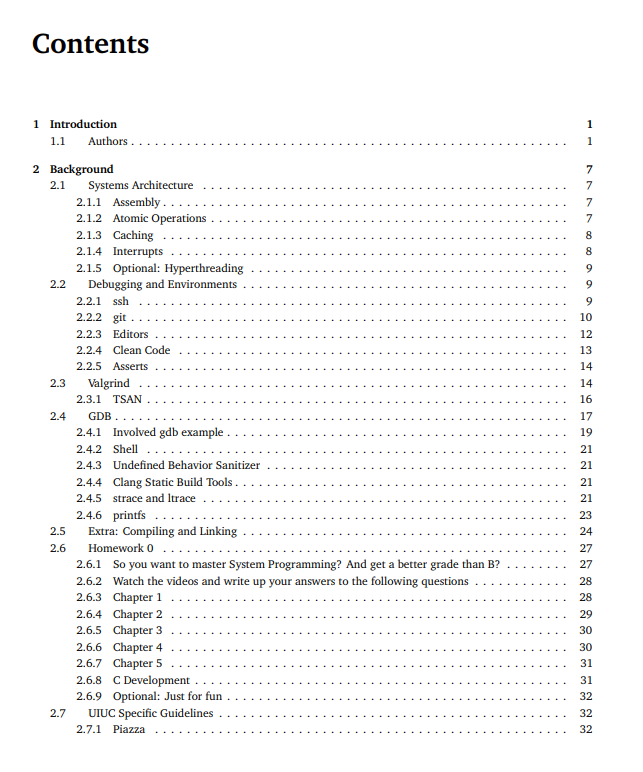
a professor at Illinois got frustrated with existing systems programming textbooks
so he started a wikibook project and had students help write it
it covers C, processes, threads, synchronization, memory allocation, networking, filesystems, scheduling and security
all in one free PDF
it eventually became the official textbook for CS 241 at UIUC with more than 1000 students taking the course every year
written for people who already know how to code and want to understand what actually happens underneath
Start learning mobile robotics now! 📚
University of Michigan released a course on autonomous mobile robotics.
It's all for free on YouTube as a series of 29 video lectures covering theory and application of probabilistic and geometric techniques for autonomous mobile robotics.
Topics include Bayesian filtering, stochastic representations of the environment, motion and sensor models for mobile robots, algorithms for mapping and localization, and application to autonomous marine, ground, and aerial vehicles.
Lecture series includes:
→ Bayes Filters and Kalman Filtering
→ Nonlinear Kalman Filtering
→ Particle Filtering
→ Symmetry & Rigid Body Motion
And more covering the fundamentals of mobile robotics perception and navigation.
University courses on mobile robotics typically cost thousands in tuition. UMich-CURLY is releasing the full lecture series for free, democratizing access to robotics knowledge (which I simply LOVE! 🫶🏼)
For anyone wanting to start working in autonomous systems, these fundamentals: Bayesian filtering, localization, mapping, are essential.
Now they're available to anyone with internet access. 🎓
🔗 Start here: https://t.co/v8kgMQSanp
~~
♻️ Join the weekly robotics newsletter, and never miss any news → http://
https://t.co/GoA3ZuwoPB
A corte assumiu a gestão do país e passou a tutelar os políticos. Esse era o problema "A". Então surgiu o problema “B” - B de Banco Master.
Não há solução visível para essa crise porque a constituição determina que a corte julgue a si mesma.
https://t.co/dgaPNd9gSB
🦔A researcher invented a fake eye condition called bixonimania, uploaded two obviously fraudulent papers about it to an academic server, and watched major AI systems present it as real medicine within weeks.
The fake papers thanked Starfleet Academy, cited funding from the Professor Sideshow Bob Foundation and the University of Fellowship of the Ring, and stated mid-paper that the entire thing was made up. Google's Gemini told users it was caused by blue light. Perplexity cited its prevalence at one in 90,000 people.
ChatGPT advised users whether their symptoms matched. The fake research was then cited in a peer-reviewed journal that only retracted it after Nature contacted the publisher.
My Take
The researcher made the papers as obviously fake as possible on purpose. The AI systems didn't catch it. Neither did the human researchers who cited it in real journals, which means people are feeding AI-generated references into their work without reading what they're actually citing.
I've covered the FDA using AI for drug review, the NYC hospital CEO ready to replace radiologists, and ChatGPT Health launching this year. All of that is happening in the same environment where a condition funded by a Simpsons character and endorsed by the crew of the Enterprise was being presented as emerging medical consensus. The people making these deployment decisions seem to believe the pipeline from research to AI to patient is more supervised than it actually is. This experiment suggests it isn't supervised much at all.
Hedgie🤗
https://t.co/8Kg8FOrgHW
O vídeo do @nikolas_dm pressionando Davi Alcolumbre ultrapassou a impressionante marca de 100 milhões de visualizações.
Essa é a maior campanha digital pela libertação dos presos políticos do 8 de janeiro.
Liberdade aos inocentes!
Milei deu a letra: não se pode ceder um único milímetro para a esquerda. Enquanto tudo ao nosso redor prega que valores são descartáveis e negociáveis na política, @nikolas_dm rema na direção oposta. Ouviu Olavo, acima de tudo: ouviu os seus próprios princípios.
Venho aqui, no auto da minha insignificante, mas na tentativa de ser uma voz de mediadora e tentar ajudar o @FlavioBolsonaro:
@BolsonaroSP e @nikolas_dm, pelo amor de Deus, abaixem as armas.
Precisamos salvar o país e os presos de 8 de janeiro.
Precisamos salvar o Jair.
Precisamos salvar as milhões de família que estão endividadas.
Precisamos colocar o Brasil no eixo.
Sei que vcs estão com problemas pessoais reais. Objetivos políticos diferentes. Mas nós, povo brasileiro, dependemos de união para eleger o Flávio.
Isso que está acontecendo vai causar um impacto real na vida de milhões.
Por favor, conversem!


![IlirAliu_'s tweet photo. The University of Michigan put their entire robotics degree on GitHub.
Not one course. The whole curriculum.
ROB 101 — Computational Linear Algebra for Robotics
ROB 311 — How to Build Robots and Make Them Move
ROB 501 — Mathematics for Robotics
ROB 530 — Mobile Robotics
Every lecture video on YouTube. Every textbook on GitHub. Every problem set, every exam, every line of code.
Professor Jessy Grizzle said it best when they launched it:
"Linear algebra has become the language of computer vision, machine learning, robotics, and autonomy."
So instead of making students wait four semesters of calculus before touching a robot... they built a curriculum that starts with the math that actually matters, applied to real robotics problems from day one.
This is what open education looks like when a top-10 engineering school decides to mean it.
Free. GitHub. YouTube.
📌 [https://t.co/3STu1hzAz2]
Follow for more robotics resources!
——
Weekly robotics and AI insights.
Subscribe free: https://t.co/9Nm01QUcw3](https://pbs.twimg.com/media/HKywBztXIAAKMZV.jpg)
![IlirAliu_'s tweet photo. MIT Press published a robotics textbook.
Then put it on GitHub for FREE. 📌
"Introduction to Autonomous Robots" covers everything:
kinematics, sensors, actuators, motion planning, localization, computer vision, and neural networks... from mechanisms all the way to algorithms.
It's written for undergraduates. Which means it's actually readable.
Most robotics textbooks assume you're already deep in the field. This one builds everything from the ground up, step by step, with real examples. Stanford's Mac Schwager called it "much-needed" (because it genuinely is).
Four professors at the University of Colorado Boulder spent years building it from lecture notes. MIT Press published it. Then they open-sourced the whole thing under Creative Commons.
PDF. Free. GitHub.
If you're trying to understand how autonomous robots actually work (not just the frontier research, but the foundations), this is where to start.
📌 [https://t.co/bw8zoK8MmB]
Share this with your fellow roboticist!
——
Weekly robotics and AI insights.
Subscribe free: https://t.co/9Nm01QUcw3](https://pbs.twimg.com/media/HKmR6oLXoAE50Fm.jpg)