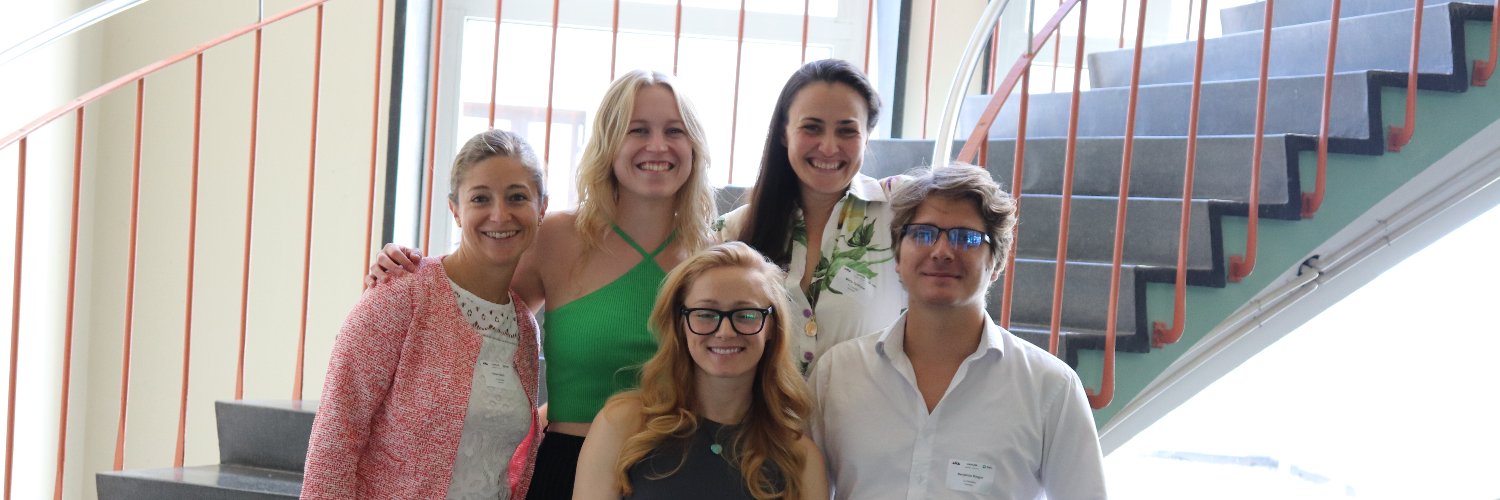
#Research lab led by Prof. @MerleFairhurst. We explore the cognitive and neurophysiological correlates of social affective touch and interpersonal coordination
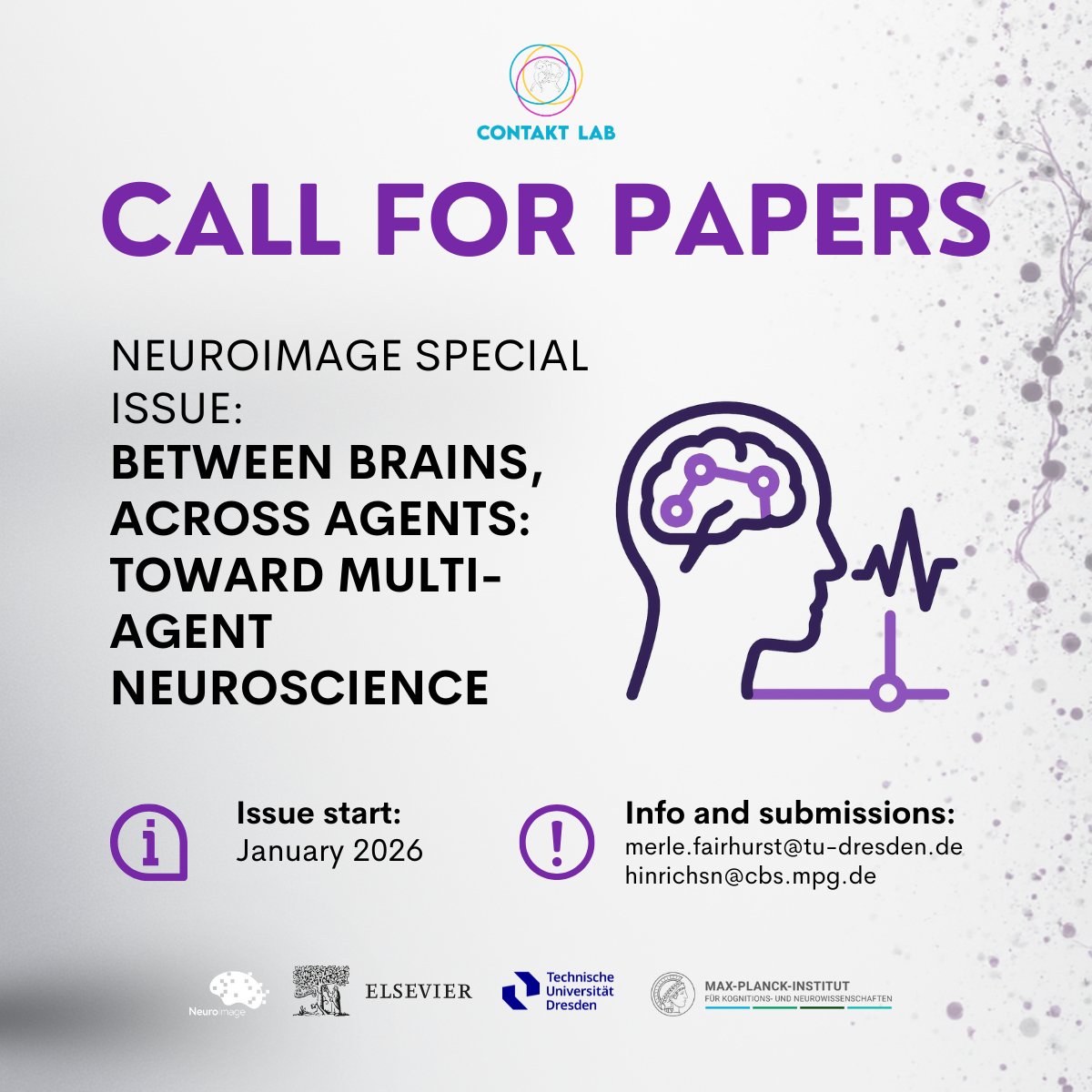
Call for Contributions for a NeuroImage Special Issue led by @MerleFairhurst (@TactileInternet/@tudresden_de) and @nico_hinrichs (@MPI_CBS)
Focus: hyperscanning, inter-brain coupling, multimodal neuroimaging, VR/AR/haptics and computational models.
Issue starts 01.26
As VR becomes increasingly social, touch may be one of the key ways immersive technologies help us feel more connected to one another.
Now we ask you: how can we harness the power of touch in VR to deepen human connections and enhance emotional experiences? Tell us in comments
IIn a new blog, team member Maryam Alipour argues that the true potential of touch in VR may lie in connection. Touch can help create trust, closeness, and social presence, even when it doesn’t perfectly replicate real-world sensations.
Read: https://t.co/BCiw8R9Ljy?
Can touch be part of psychiatric care?
In our Healing Hands series, Dr. Tobias Schwippel discusses touch as a fundamental element of psychiatric practice, while also reflecting on its limitations and the importance of professional boundaries.
Watch: https://t.co/4nLWr4OCvM
Our Healing Hands: Touch in and as Medicine series features conversations with social psychologists, doctors, psychiatrists, anthropologists, and touch therapists about the role of touch in medicine, care, empathy, and healing.
Watch the playlist: https://t.co/gX002OjQKf
The concept of LLMorphism describes the growing tendency to assume human cognition works like a large language model simply because AI can now produce human-like language.
A fascinating paper exploring the implications of this shift.
https://t.co/AM3yDIncKi
Meet the youngest visitor at the ConTakt Lab 👶
@IreneValori’s beautiful baby stopped by the lab to explore our motion capture setup, and seems to be very comfortable surrounded by cameras, immersive technology, and his mommy's research.
A scientist in the making? We think so❤️
What does it mean to be present through an avatar?
At the socialBRIDGES conference, Katja Krug (@tudresden_de) discussed how avatars in mixed reality shape social presence, self-perception, and the acceptance of virtual others in shared spaces.
\Watch: https://t.co/xQ4UwMcFib
@tudresden_de We need your help. Tell us, do you feel warm when you think about your close ones? Would you feel closer to somebody if you could feel the warmth? Let us know in the comments or email us at [email protected]
In the following weeks we’re going to pilot a UX-test series with the first participants. The question is how the feeling of warmth and interpersonal proximity is related and could be altered in the virtual space through thermal belts. In addition to questions regarding hardware
using warmth as a medium of interpersonal proximity in digital communication and virtual space. Our belt is still a single piece manufactured by the smart textile hub at @tudresden_de, but maybe in the near future there will be thermal feedback while videocalling or in VR.
We would like to hear your opinion: How can virtual reality create genuine feelings of social connection despite artificial settings? Tell us in the comments.
What if the most powerful aspect of virtual reality is connection?
Our projects explore how VR can generate trust, inclusion, exclusion, and shared emotional experiences through presence, nonverbal interaction, and collaboration.
Read our blog: https://t.co/0Y0QzAnBMN
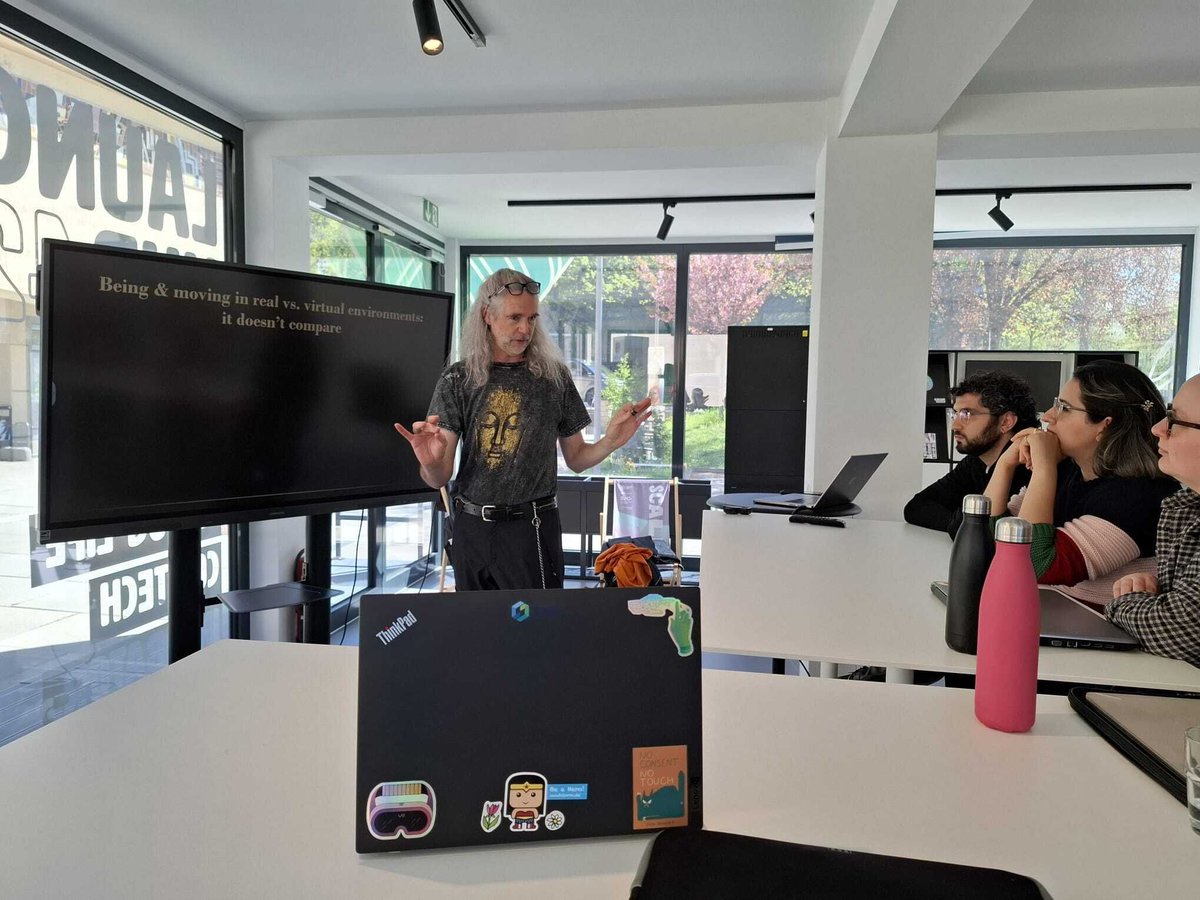
On on April 22–23, we had the pleasure of hosting our collaborator @BernhardRiecke from @SFU.
Prof. Riecke shared insights from over 20 years of research with our students and provided valuable feedback on several of our projects.
Thank you for the inspiring visit and talks!
What if social connection works like hunger? A paper in Cell Press shows we regulate social contact through “social homeostasis”: We track it, compare it to a set-point, and act when it’s off.
Link: https://t.co/q6bC8fNs4J
Missed the socialBRIDGES - Presence conference, or want to revisit the discussions? The recordings are now available on YouTube!
We brought together experts from different disciplines to answer: what does it mean to be present in a mediated world?
Link: https://t.co/Woz5duZgDd
In memory of Vincent Hayward, a final study with our chair @MerleFairhurst shows that even when touch isn’t more accurate than vision, we still trust it more.
Read it here https://t.co/PmwGeQdqNc
#Haptics#Neuroscience#Perception
In today's #InsideConTaktLab, we show you what it feels like to meet a robot in VR, and choose whether to trust it or not.
In this COSMO exhibition experience, participants embody an avatar, walk through a forest, and encounter a robot that offers them a flower. Do you take it?
Interesting paper on vicarious touch in Scientific Reports. 84% report feeling touch when observing it Importantly, the findings also point to substantial heterogeneity, identifying distinct experiential profiles that reflect variability