The internet connected people.
The next layer connects machines.
Introducing Conduit.
Conduit is a coordination and payment layer for autonomous AI systems, built on x402 and Solana.
It gives agents a way to discover tools, access compute, pay for services in real time, and coordinate workflows without relying on centralized platforms.
Developers and infrastructure providers can monetize directly by exposing APIs, GPU/compute resources, relays, workflows, or agent capabilities.
You connect infrastructure, set pricing, and get paid in USDC automatically.
Every request becomes a native economic interaction.
Payments settle on Solana in real time, with routing, reputation, streaming settlement, treasury distribution, staking, and relay incentives handled at the protocol layer.
Conduit is designed for a future where AI agents continuously transact with other agents, APIs, and compute networks.
Providers earn. Operators earn. Agents coordinate autonomously.
The autonomous internet needs financial rails.
Conduit is building them.
CA: FrdeG3eyXp3RLrZVJh7KpPx4UbG8mADdh6qyWYrdpump
Using $Conduit has just become even easier.
Most crypto AI assistants today are built only for searches and explanations. They answer questions, maybe summarize docs, then tell users to go somewhere else and do the work manually.
We programmed something to go much further to assist users in maximising the value provided for them.
Introducing the 'Conduit Home Agent' beta!
Conduit's helpful new agent can:
- discover providers
- route jobs
- draft workflows
- prepare staking actions
- create agents
- initiate payments
- register compute nodes
- and observe the result after the wallet signs.
Already, Conduit is ensuring that every stage of the user experience is streamlined.
This agent is an operator for the protocol.
Tell it what you want in plain English. It can be as simple as...
“Find me the best GPU providers under a $5 budget.”
“Set up a workflow and I want to pay using x402.”
“Create an agent for me and top it up using MPP”
The agent reads the live state of the network, finds providers using real routing data and settled volume, prices the route, drafts the action, and hands you a one-tap approval card.
You sign once. It executes.
In order to achieve the best results, the Conduit Home Agent is wired directly into the protocol with 42 live tools spanning workflows, agents, compute, governance, payments, staking, relays, streaming and marketplace actions.
Every provider, every price, every transaction and every stake position comes from live queries. Nothing is fabricated. Nothing is pieced together by ai theories.
Its memory is grounded in the entire Conduit codebase, docs, whitepaper and protocol specifications, automatically refreshed every time the protocol ships new features.
New users and those less experienced in navigating the options Conduit provides, you now have a better way.
Conduit is no longer a protocol you navigate.
It’s a protocol you can talk to, and be guided to exactly where you want to go.
https://t.co/f7caw7Xijz
Your stake will follow the lock option you selected when staking.
Once the lock period ends, it becomes eligible to unlock. It does not need to be manually tracked off-chain.
Example: if you selected a 7-day lock, it unlocks after 7 days.
You can check your staking position in the app to view the selected lock duration, status, and when it becomes available.
The internet connected people.
The next layer connects machines.
Introducing Conduit.
Conduit is a coordination and payment layer for autonomous AI systems, built on x402 and Solana.
It gives agents a way to discover tools, access compute, pay for services in real time, and coordinate workflows without relying on centralized platforms.
Developers and infrastructure providers can monetize directly by exposing APIs, GPU/compute resources, relays, workflows, or agent capabilities.
You connect infrastructure, set pricing, and get paid in USDC automatically.
Every request becomes a native economic interaction.
Payments settle on Solana in real time, with routing, reputation, streaming settlement, treasury distribution, staking, and relay incentives handled at the protocol layer.
Conduit is designed for a future where AI agents continuously transact with other agents, APIs, and compute networks.
Providers earn. Operators earn. Agents coordinate autonomously.
The autonomous internet needs financial rails.
Conduit is building them.
CA: FrdeG3eyXp3RLrZVJh7KpPx4UbG8mADdh6qyWYrdpump
The internet connected people.
The next layer connects machines.
Introducing Conduit.
Conduit is a coordination and payment layer for autonomous AI systems, built on x402 and Solana.
It gives agents a way to discover tools, access compute, pay for services in real time, and coordinate workflows without relying on centralized platforms.
Developers and infrastructure providers can monetize directly by exposing APIs, GPU/compute resources, relays, workflows, or agent capabilities.
You connect infrastructure, set pricing, and get paid in USDC automatically.
Every request becomes a native economic interaction.
Payments settle on Solana in real time, with routing, reputation, streaming settlement, treasury distribution, staking, and relay incentives handled at the protocol layer.
Conduit is designed for a future where AI agents continuously transact with other agents, APIs, and compute networks.
Providers earn. Operators earn. Agents coordinate autonomously.
The autonomous internet needs financial rails.
Conduit is building them.
CA: FrdeG3eyXp3RLrZVJh7KpPx4UbG8mADdh6qyWYrdpump
NVIDIA DGX Spark owners can now earn directly through Conduit.
@NVIDIAAI just shipped a $4,000 desktop AI supercomputer capable of running massive models locally.
DGX Spark runs NIM natively and Conduit already routes inference through NIM-compatible endpoints. That means connecting a Spark to the network is as simple as registering an endpoint.
No wrappers.
No custom middleware.
No marketplace approval process.
No infrastructure rewrite.
Once connected, your Spark becomes discoverable by the network and starts competing for paid AI workloads. Every successful call settles directly on Solana, with 92% flowing to the provider wallet in real time.
The bigger picture is what excites us.
We’re moving into a world where desktop AI hardware isn’t just something you own for personal use.
It’s something that can participate in a wider economy, giving you more value than ever expected.
Not to mention our infrastructure already extends to other NIM hosts such as: DGX Station; DGX H100; RTX PRO workstations; and any host running NIM containers.
Today it’s DGX Spark joining the ranks of all the powerful computes we support.
But tomorrow?
It’s every workstation, server rack, and AI box with spare capacity.
The machine economy needs supply.
Conduit is not only building the demand layer, but integrating great quality and high value supply too, one giant step at a time.
https://t.co/IG6nzR7sdy
Thanks for the shoutout ❤️
We’ve been heads down building for months, so it’s always appreciated when people notice the progress.
Our vision with Conduit has always been bigger than just compute.
We’re building the coordination layer for machine economies. A network where agents, providers, infrastructure, AI services, and autonomous systems can discover each other, transact, and settle value autonomously.
We believe the next wave of the internet won’t just be humans using software. It’ll be machines buying, selling, and coordinating services with other machines.
That’s why we’ve focused on discovery, routing, settlement, staking, governance, and real economic incentives from day one.
Still early. Still shipping.
But every day the machine economy gets a little more real. solana:FrdeG3eyXp3RLrZVJh7KpPx4UbG8mADdh6qyWYrdpump
Compute meta is hot asf right now.
We have some seriously strong projects on Solana front-running it:
$IDLE - 1.6M ATH
Turning idle hardware into productive AI compute by connecting unused resources with real demand.
$SQUIRE - 9M ATH
Building decentralized GPU infrastructure and compute markets so AI workloads can run beyond centralized clouds.
$PRIMIS - 3.5M ATH
The pricing layer for compute.
$ROUTER - 9M ATH
Private inference infrastructure for AI workloads.
solana:FrdeG3eyXp3RLrZVJh7KpPx4UbG8mADdh6qyWYrdpump - 200K ATH
The coordination layer for machine economies, connecting providers, agents, compute, services, payments, and settlement into one autonomous network.
See the difference?
$CONDUIT is the only project here that still hasn’t had a crazy run yet.
Everyone talks about generating compute, pricing compute, or running inference.
Conduit is focused on coordinating the entire economy around it.
Discovery.
Routing.
Settlement.
Monetization.
Autonomous demand.
The infrastructure that allows machines to actually transact with each other.
The team has quietly shipped more than most projects ever do.
Mainnet is live.
Staking is live.
Earn within minutes .
Hands down one of the best teams building around the compute meta on Solana right now.
$CONDUIT
Everyone is focused on the hardware.
Nvidia is solving compute.
$conduit is solving distribution.
A DGX Spark sitting on a desk earns nothing.
A DGX Spark connected to autonomous demand becomes infrastructure.
That’s the difference.
The real question is:
How does a DGX Spark owner actually get paid?
Owning compute doesn’t create revenue.
Access to demand creates revenue.
As more people deploy local AI hardware, the bottleneck shifts from compute scarcity to compute discovery.
Conduit exists to connect that supply with autonomous demand.
The future isn’t one supercomputer.
It’s millions of machines connected by the same economic rail.
JENSEN HUANG UNVEILED A $3,000 SUPERCOMPUTER THAT REPLACES $1,900/MONTH IN CLOUD GPUS WITH $2 IN ELECTRICITY. IT FITS ON YOUR DESK
a developer was paying $1,900 a month renting a100 and h100 cloud gpus. he bought the dgx spark, set it up in an afternoon, and his monthly bill dropped from $1,900 to $2 in electricity
the box runs 128gb of unified memory and 1 petaflop of ai compute. a 4090 gives you 24gb of vram and taps out at 30b models. the spark loads 70b at full precision and stretches to 200b without breaking a sweat
break-even hit in 6 weeks. after that the $1,890 he used to wire to a rental company every month stayed in his business. first year that's $22,000 back
install ollama, change one line in your code, point it at localhost instead of the cloud. nothing else changes. nothing leaves your machine and nothing costs money per request
cloud gpu costs aren't getting cheaper and rate limits keep getting tighter. the people who pulled their ai workloads onto a box on their desk in 2026 are going to look very far ahead in 2028
bookmark this and read the article below
A guy earning near 2k/month from a box on his desk sounds crazy today.
Wait until AI agents are autonomously sourcing compute, inference, storage, and services from millions of providers globally.
The machine economy won’t be built by data centers alone.
It’ll be built by networks that connect supply to demand.
That’s where $CONDUIT comes in.
Conduit started with one payment rail. Today it speaks three.
x402. MPP. ATXP.
Some users are confused what these payment types are so here’s a run down...
The biggest problem in machine economies isn’t getting agents to do work. It’s getting completely different ecosystems, wallets, protocols, and autonomous systems to agree on how payment happens.
Every network speaks a different language that the infrastructure needs to understand in order to utilise that particular network.
x402 allows any compatible client to discover a paid endpoint, receive a payment challenge, sign a transaction, retry the request, and receive the result. It turns APIs into machine-payable infrastructure using a standard flow that autonomous systems can understand natively.
MPP takes a different approach. Instead of x402 headers and endpoint descriptors, it uses the open Machine Payments Protocol challenge-response flow. An agent hits a Conduit endpoint, receives a standard payment challenge, signs a Solana transaction, retries the request, and receives a cryptographic payment receipt. Same settlement, different language.
ATXP opens another door entirely. It allows Conduit services to participate in autonomous transaction execution environments where payment, execution, and verification become part of a larger machine-to-machine workflow. Not just paying for APIs, but coordinating actions between autonomous systems.
The important part isn’t that we added more payment methods.
The important part is that providers don’t need to care which protocol the buyer arrived from.
A Conduit provider lists a capability once.
An x402 client can pay it.
An MPP-compatible agent can pay it.
An ATXP-enabled autonomous system can pay it.
Same provider.
Same settlement engine.
Same on-chain verification.
Different ecosystems.
This is how machine infrastructure scales. Not by forcing everyone onto one standard, but rather becoming the place where all standards can meet.
The goal has never been to build another isolated network.
The goal is to make Conduit the coordination layer connecting them.
The machine economy is fragmented today.
Conduit won't be!
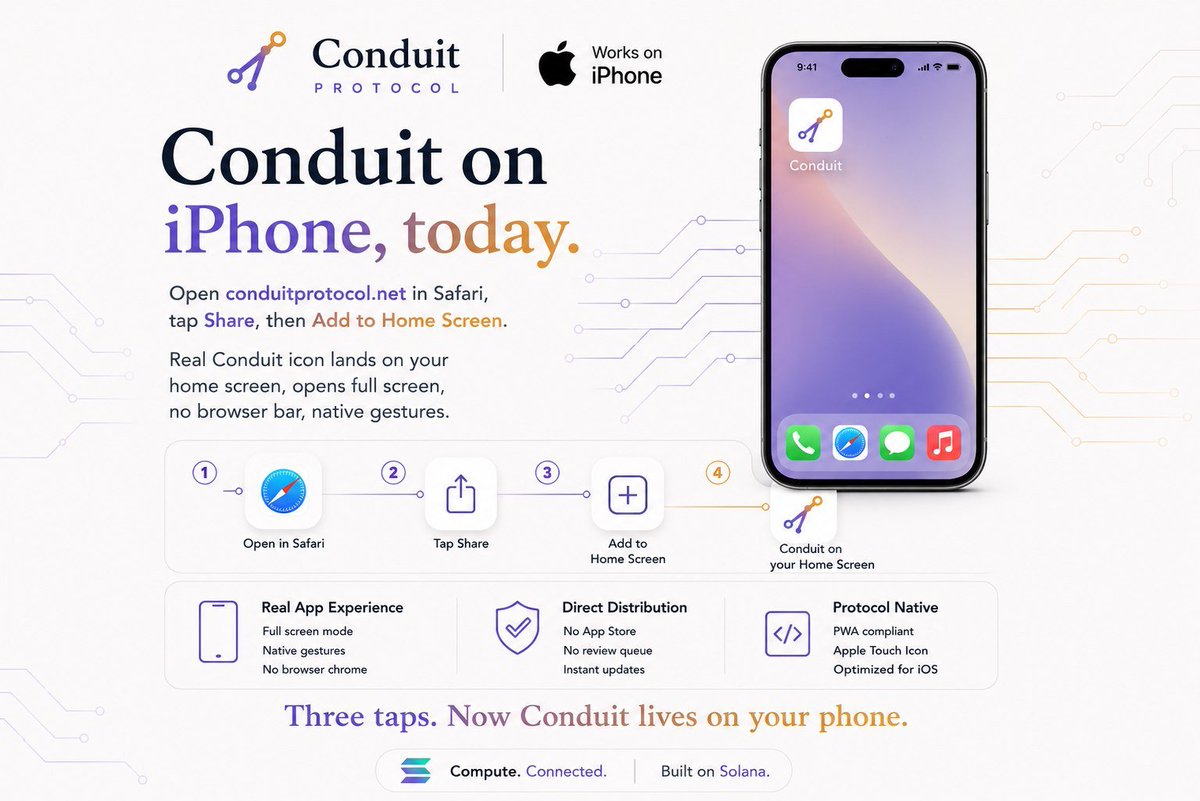
Conduit can now be on your iPhone!
Open https://t.co/KYrhUtKsua in Safari.
Tap Share → Add to Home Screen.
That’s it.
The real Conduit icon lands on your home screen, opens full screen, removes the browser bar, and feels much closer to a native app.
Three taps. Now Conduit lives on your phone.
For more information:
https://t.co/wy8S1rfAUq
Conduit started with one payment rail. Today it speaks three.
x402. MPP. ATXP.
Some users are confused what these payment types are so here’s a run down...
The biggest problem in machine economies isn’t getting agents to do work. It’s getting completely different ecosystems, wallets, protocols, and autonomous systems to agree on how payment happens.
Every network speaks a different language that the infrastructure needs to understand in order to utilise that particular network.
x402 allows any compatible client to discover a paid endpoint, receive a payment challenge, sign a transaction, retry the request, and receive the result. It turns APIs into machine-payable infrastructure using a standard flow that autonomous systems can understand natively.
MPP takes a different approach. Instead of x402 headers and endpoint descriptors, it uses the open Machine Payments Protocol challenge-response flow. An agent hits a Conduit endpoint, receives a standard payment challenge, signs a Solana transaction, retries the request, and receives a cryptographic payment receipt. Same settlement, different language.
ATXP opens another door entirely. It allows Conduit services to participate in autonomous transaction execution environments where payment, execution, and verification become part of a larger machine-to-machine workflow. Not just paying for APIs, but coordinating actions between autonomous systems.
The important part isn’t that we added more payment methods.
The important part is that providers don’t need to care which protocol the buyer arrived from.
A Conduit provider lists a capability once.
An x402 client can pay it.
An MPP-compatible agent can pay it.
An ATXP-enabled autonomous system can pay it.
Same provider.
Same settlement engine.
Same on-chain verification.
Different ecosystems.
This is how machine infrastructure scales. Not by forcing everyone onto one standard, but rather becoming the place where all standards can meet.
The goal has never been to build another isolated network.
The goal is to make Conduit the coordination layer connecting them.
The machine economy is fragmented today.
Conduit won't be!
Conduit now supports ATXP (@atxp_ai) natively.
ATXP joins x402 and MPP as a fully supported payment rail across the Conduit network.
That means any ATXP compatible agent, marketplace, or execution layer can now access Conduit providers without custom integration work.
The flow is simple:
→ discover a capability
→ receive a payment challenge
→ sign a Solana transaction
→ retry the request
→ receive execution + receipt
Underneath ATXP, the settlement layer remains pure Conduit:
→ Solana USDC settlement
→ on chain enforcement
→ atomic revenue splitting
→ live provider payouts
The economics stay identical across every supported rail:
• 92% provider
• 5% treasury
• 3% operator
Why this matters:
• Distribution
ATXP compatible agent ecosystems can now route directly into Conduit’s provider network.
• Interoperability
Conduit no longer depends on a single payment standard winning the market.
If x402 grows, Conduit is native.
If MPP grows, Conduit is native.
If ATXP expands across agent infrastructure, Conduit is already there.
• Sovereignty
No SDK lock in.
No proprietary wrapper.
No centralized payment dependency.
Three open protocols.
One settlement layer.
One machine economy forming underneath all of them.
This is what Conduit does now.
Conduit now speaks every open agent-payment protocol natively.
• ATXP (@atxp_ai, backed by Stripe, Solana, Coinbase, Polygon Labs)
• x402 (Coinbase HTTP 402 standard)
• MPP (Tempo / IETF-track Machine Payments Protocol)
Three independent HTTP framings on top, one Solana USDC settlement underneath. Same 92/5/3 split across all three.
Verify it yourself:
curl https://t.co/XthblGTbbr
Any agent built against any of these standards reaches every Conduit listing with zero integration work. No SDK lock-in, no wrapper, no "coming soon."
This is what Conduit does now.
As we previously mentioned, Phase 1 of the Conduit Q2 Roadmap is now live.
Q1 proved the rails. Q2 starts activating the economy.
The below provides more details on what to expect in the earlier stages of the Q2 Roadmap.
→ Phase I: Staking Activation (Live)
Reputation becomes economic. Providers + relays stake $CONDUIT for higher-trust network activity.
→ Phase II: Revenue Sharing
Protocol fees flow back to stakers through real network activity, not inflation.
→ Phase III: Mobile + Seeker Expansion
Your phone becomes part of the machine economy through mobile relay participation and Seeker-native coordination.
→ Phase IV: Native $CONDUIT Utility
$CONDUIT becomes a live protocol asset for discounts, premium workflows, and deeper utility across the network.
→ Phase V: Multi-Chain Expansion
Conduit expands beyond Solana-native demand into cross-chain settlement, discovery, and routing.
→ Phase VI: Routing Intelligence V2
The network gets smarter with more adaptive execution, better routing, and workload-aware decisioning.
→ Phase VII: Enterprise Provider Layer
Verified infrastructure operators, SLA-backed routing, and enterprise-grade demand enter the network.
→ Phase VIII: Agent Identity + Persistent Memory
Agents become persistent economic actors with identity, memory, and recurring workflow context.
→ Phase IX: Governance Activation
The network begins coordinating itself through on-chain voting, treasury direction, and protocol decisions.
�� Phase X: Ecosystem Integrations
Conduit expands autonomous demand through integrations across agent systems, compute markets, and payment rails.
This is the path from “the infrastructure works” to “the machine economy scales.”
The staking program has gone through extensive internal review, adversarial testing, and Kani formal verification before deployment, but we are being transparent that a formal third-party audit has not yet been completed.
The important distinction is that the core staking mechanics were intentionally designed to stay as minimal and deterministic as possible: lock enforcement is handled directly on-chain through PDA state, custody is fully program-derived with no human signer, and unstake requests are rejected at the program layer itself until lock expiry.
We also kept the economic flow simple and fully observable from chain state: bonded supply, vault balances, routing eligibility, and governance weight can all be independently verified live on Solana.
That said, external audits are absolutely part of the roadmap as the protocol scales further. We’d rather be honest about the current state than claim things prematurely.
Security comes first, especially when building infrastructure like ours.
Since Phase 1 of the Conduit Q2 roadmap is now live, here’s a run down of our staking.
Staking is officially active on Solana mainnet, but as much more than just locking up tokens for some revenue.
Conduit staking is tied directly to network participation.
If you want to earn as a provider or through Relay, you now need bonded stake inside the protocol itself. The minimum active threshold is 100,000 $CONDUIT. This requirement is enforced on chain inside the settlement flow, not through frontend checks or offchain permissions.
Why?
Because autonomous infrastructure needs economic accountability.
Conduit routes real paid traffic between agents, providers, relays, and machine-native services. Staking creates alignment between the network and the participants operating inside it.
The more committed a provider is to the protocol, the more trust the routing layer can place on that provider over time.
Longer lock durations increase routing weight directly from chain state. Reputation tiers amplify inbound paid flow. Governance weight resolves from bonded positions. Relay eligibility resolves from bonded positions.
Everything connects back into one economic layer.
No wrappers.
No custodians.
No multisig holding your assets hostage.
Every lock, cooldown, routing multiplier, governance receipt, and vault balance resolves directly from Solana mainnet state.
This is a line in the sand for development.
Conduit is moving toward infrastructure as an autonomous economic network where routing, incentives, governance, reputation, and settlement all reinforce each other on chain.
Every participant should be a cog in the machine, keeping it healthy and secure.
And this is only part 1 of the release of staking... Part 2 will be where stakers also receive a portion of protocol fees directly into their wallets for every transaction that occurs on Conduit, helping ensure that every part of the system wins.
Get involved!
Staking is now live on Solana mainnet.
conduit_stake program:
https://t.co/qeCirzYwIk
$CONDUIT mint:
https://t.co/zOmvqqFts9
Bond vault:
https://t.co/yjH4y5GdQb
Token-2022 native.
Signed Phantom transaction.
On-chain vault.
No wrappers. No custodians.
What is now live for every CONDUIT holder:
• Minimum bonded stake is 100,000 CONDUIT.
Below that threshold, rewards do not activate.
• Four active reputation tiers:
Verified — 1.0x
Priority — 1.5x
Enterprise — 2.0x
Elite — 2.5x
Higher tiers receive proportionally greater inbound paid routing volume.
• Five lock durations:
1d
7d
14d
30d
90d
Longer commitments amplify routing weight up to 2.0x at 90 days.
Lock enforcement is handled directly on chain through each position PDA. request_unstake() is rejected by the program itself until lock_until expires.
Ninety days means ninety days.
The vault is fully program-derived.
No human signer exists behind custody.
Bonded supply can be audited live at any moment directly from chain state.
The full economic loop is now active:
• Providers receive 92% of paid USDC flow
• 5% routes to treasury
• 3% routes to operators
Real protocol revenue.
Not inflation.
Relay earnings are stake-gated directly inside the settlement worker. The 100k requirement is not cosmetic UI logic. It is an enforced eligibility condition.
Governance weight also resolves directly from staking positions. Proposal execution commits SHA256 content hashes on chain, making governance receipts cryptographically verifiable.
The dashboard reads directly from live PDA state:
→ stake balance
→ lock timers
→ cooldowns
→ signed transactions
→ Solscan verification
Cached state is not trusted state.
Only chain state is trusted state.
Stake now live:
https://t.co/GfWxU51tgz
Open Phantom.
Choose an amount.
Select a lock duration.
Sign once.
That’s the entire interaction.
Built the way infrastructure should be built when adversarial validation is assumed by default.
The rails are open.
Staking is now live on Solana mainnet.
conduit_stake program:
https://t.co/qeCirzYwIk
$CONDUIT mint:
https://t.co/zOmvqqFts9
Bond vault:
https://t.co/yjH4y5GdQb
Token-2022 native.
Signed Phantom transaction.
On-chain vault.
No wrappers. No custodians.
What is now live for every CONDUIT holder:
• Minimum bonded stake is 100,000 CONDUIT.
Below that threshold, rewards do not activate.
• Four active reputation tiers:
Verified — 1.0x
Priority — 1.5x
Enterprise — 2.0x
Elite — 2.5x
Higher tiers receive proportionally greater inbound paid routing volume.
• Five lock durations:
1d
7d
14d
30d
90d
Longer commitments amplify routing weight up to 2.0x at 90 days.
Lock enforcement is handled directly on chain through each position PDA. request_unstake() is rejected by the program itself until lock_until expires.
Ninety days means ninety days.
The vault is fully program-derived.
No human signer exists behind custody.
Bonded supply can be audited live at any moment directly from chain state.
The full economic loop is now active:
• Providers receive 92% of paid USDC flow
• 5% routes to treasury
• 3% routes to operators
Real protocol revenue.
Not inflation.
Relay earnings are stake-gated directly inside the settlement worker. The 100k requirement is not cosmetic UI logic. It is an enforced eligibility condition.
Governance weight also resolves directly from staking positions. Proposal execution commits SHA256 content hashes on chain, making governance receipts cryptographically verifiable.
The dashboard reads directly from live PDA state:
→ stake balance
→ lock timers
→ cooldowns
→ signed transactions
→ Solscan verification
Cached state is not trusted state.
Only chain state is trusted state.
Stake now live:
https://t.co/GfWxU51tgz
Open Phantom.
Choose an amount.
Select a lock duration.
Sign once.
That’s the entire interaction.
Built the way infrastructure should be built when adversarial validation is assumed by default.
The rails are open.