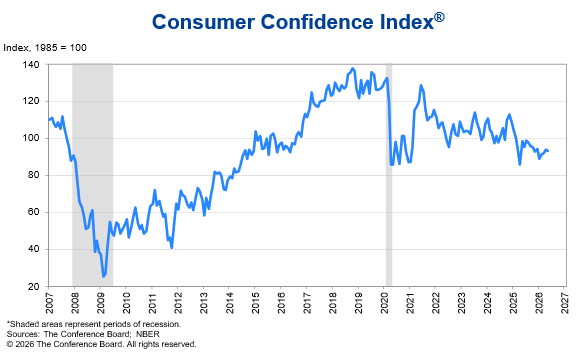
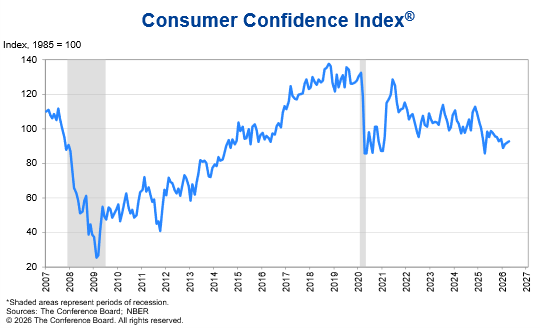
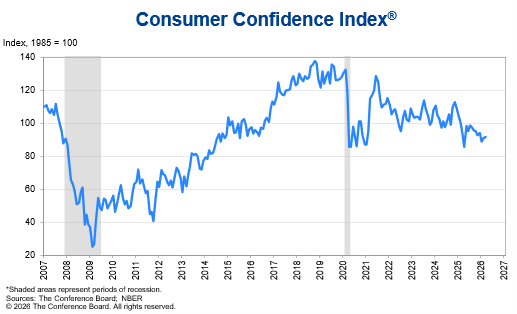
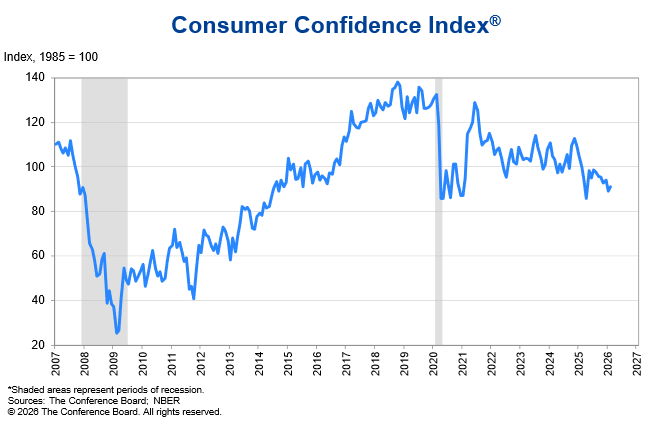
The Conference Board #ConsumerConfidence Index® dipped 0.7 points to 93.1 (1985=100) in May, down from an upwardly revised 93.8 in April.
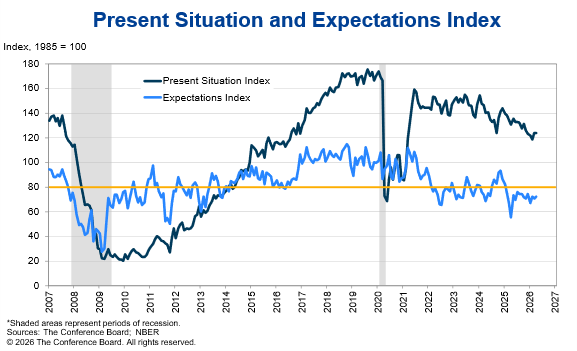
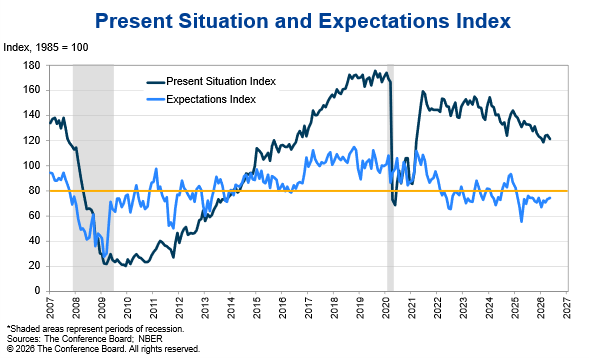
🌡️The #PresentSituation Index—based on #consumers’ view of current business and labor market conditions—retreated by 3.2 points to 121.2.
The Conference Board #ConsumerConfidence Index edged up by 0.6 points to 92.8 (1985=100) in April, from 92.2 in March.
🌡️The #PresentSituation — based on consumers’ assessment of current business and labor market conditions—retreated by 0.3 points to 123.8.
🔮The #ExpectationsIndex—based on consumers’ short-term outlook for income, business, and labor market conditions—rose by 1.2 points to 72.2.
Read the full report: https://t.co/xtzC5r13T6
Special questions in May found:
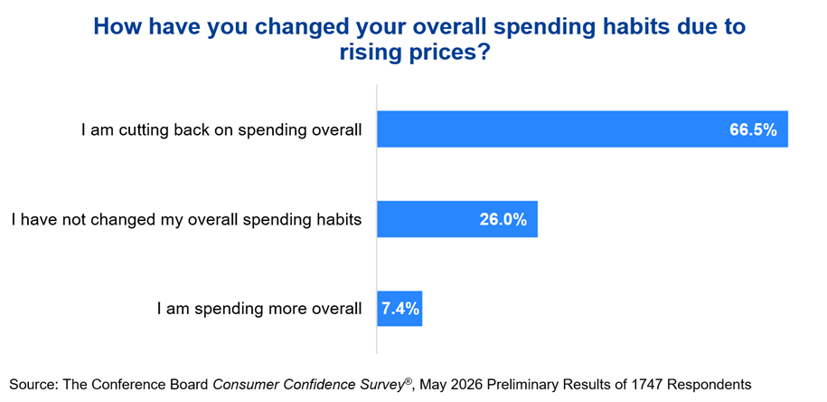
✂️ Two-thirds of consumers cited #cuttingback on spending overall due to rising prices
🛍️ Most who are cutting back bought fewer items and delayed expensive purchases
👟 Areas they're economizing include clothing/footwear, hobby items, games/toys
The Conference Board #ConsumerConfidence Index® dipped 0.7 points to 93.1 (1985=100) in May, down from an upwardly revised 93.8 in April.
🌡️The #PresentSituation Index—based on #consumers’ view of current business and labor market conditions—retreated by 3.2 points to 121.2.
🔮 The #ExpectationsIndex—based on consumers’ short-term outlook for income, business, and labor market conditions—rose by 1.0 points to 74.4.
This month’s survey was conducted May 1–19, encompassing the ongoing Middle East war that is placing upward pressure on prices globally.
The Conference Board #ConsumerConfidence Index® edged up by 0.8 pts in March to 91.8 (1985=100), from 91.0 in February.
The #PresentSituation Index—based on consumers’ assessment of current business and labor market conditions—rose 4.6 points to 123.3.
The #ExpectationsIndex—based on consumers’ short-term outlook for income, business, and labor market conditions—fell 1.7 points to 70.9.
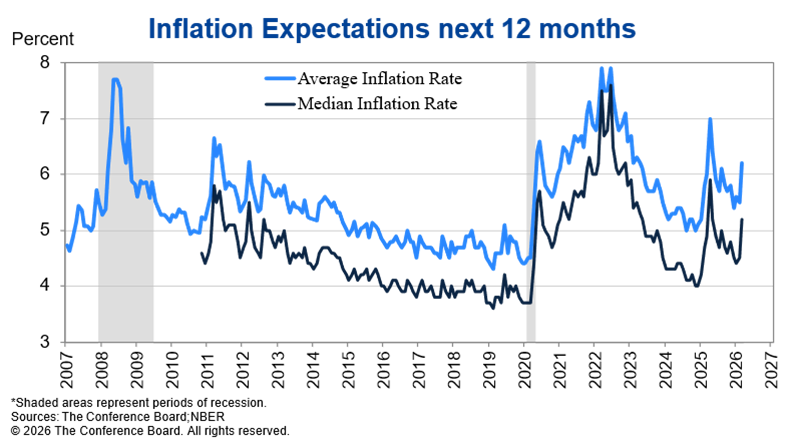
Reflecting the #Iran war oil shock, average inflation expectations surged in March to levels last seen in August 2025.
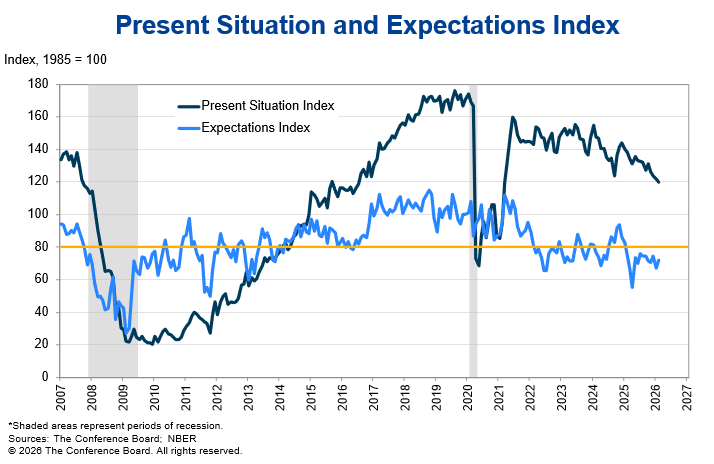
🔮The Expectations Index—based on consumers’ short-term outlook for #income, #business, and #labormarket conditions—rose by 4.8 points to 72.0.
Read the full report: https://t.co/xtzC5r13T6
The Conference Board #ConsumerConfidence Index® increased by 2.2 points in February to 91.2 (1985=100), from an upwardly revised 89.0 in January.
🌡️The #PresentSituation Index fell 1.8 points to 120.0 in February.
Our Senior Economist Erin McLaughlin joined @BBCWorld to discuss the #SupremeCourt's 6-3 decision to strike down the Administration's global #tariffs, and what comes next for the US economy.
Follow our #TariffTracker here: https://t.co/AYpZY6iag5
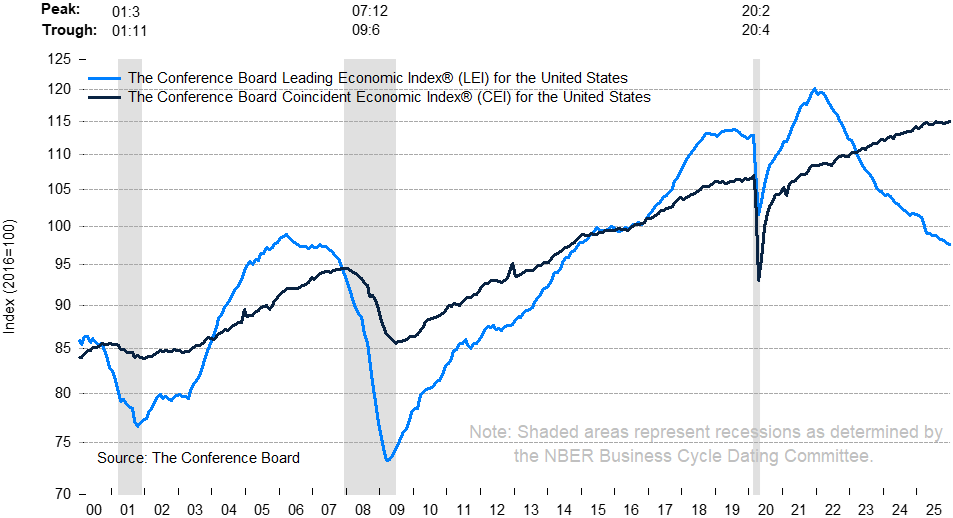
Overall, the LEI fell by 1.2% over the second half of 2025, a substantial improvement from its 2.8% contraction over the first half of 2025.
Read the report: https://t.co/4xHZ7dgeqM
The US Leading Economic Index (#LEI) fell 0.2% in December 2025 to 97.6 (2016=100), following a 0.3% decline in November and a downwardly revised 0.2% decline in October.
From the economy to talent to geopolitics, our Chief Economist Dana M Peterson reveals why pervasive #uncertainty is the dominant force shaping #CEO decision-making in 2026—outweighing even the hype around #AI.
Read Dana's op-ed in @barronsonline: https://t.co/XRSP2oQqZH
Confidence declined in January across demographics, including all age and income groups.
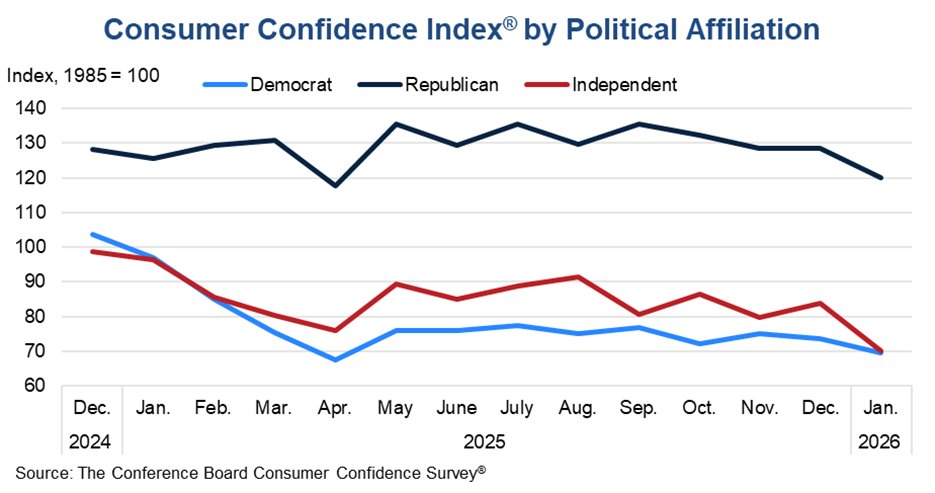
Likewise, confidence faded this month among among consumers of all political affiliations, with the sharpest decline seen in Independents.
Full report: https://t.co/xtzC5r13T6
The Conference Board #ConsumerConfidence Index fell 9.7 points in January, to 84.5 (1985=100), from an upwardly revised 94.2 in December.
Following this month's plunge, #confidence now stands at its lowest point since 2014, surpassing the depths of the COVID-19 pandemic.
All five components of the Index deteriorated, driving down both current and future confidence:
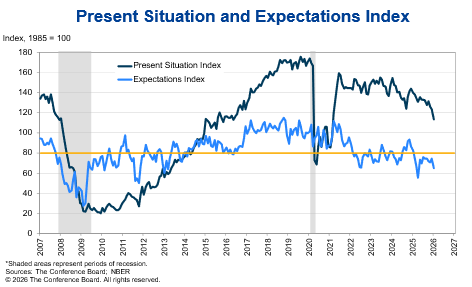
🌡️The #PresentSituation Index fell 9.9 pts to 113.7.
🔮The #ExpectationsIndex fell 9.5 points to 65.1, well below the threshold of 80 that usually signals a recession ahead.
"The big theme of 2026 is #BusinessPlan changes," says Chief Economist Dana M Peterson. "That can mean small tweaks or it can mean ripping up the old plan and starting anew."
Watch her @bsurveillance interview on #uncertainty, which dominated our #CSuiteOutlook survey results.
Our report aggregates the wisdom of CEOs and other #CSuite executives around the globe to uncover how they’re navigating these challenges and what they plan to prioritize to achieve growth and profitability amid the choppy waters ahead.
Read the report: https://t.co/Gr7NFlNWr1
What’s keeping the world’s CEOs up at night in 2026?
Our #CSuiteOutlook survey of over 1,700 top executives found fears of a #recession top the world’s worry list for 2026: 36% of global #CEOs say a downturn/recession is a major economic threat in the year ahead.
CEOs in the US have a bigger headache—43% rank #uncertainty as their top concern.
Indeed, business leaders face a daunting convergence of forces: #geopolitical tensions, rapid #AI advances, shifting #LaborMarkets, and structural changes in #SupplyChains and consumer behaviors.