Hello, everyone! We would like to thank everyone who supports us financially and continues to do so regularly. Please don't stop, we work hard and publish interesting professional analytics for you. We also run YouTube channel. Therefore, we ask you, if possible, to support our project.
➡️In fact, everything that Conflict Capital has is financed by our community. Monthly subscriptions to Patreon are especially valuable, as they allow us to plan (link in bio). Also, You can support us on PayPal.
PayPal: [email protected]
So if you can, please support our project so that we can grow and become bigger. We have the potential...
🇨🇿Coalition chessboard: why the future government of the Czech Republic is important for Ukraine
According to the mandates received, the coalition of ANO, SPD and AUTO is obvious (forming a majority in the lower house, 108 mandates in total). As of now, preparations are underway to conclude a coalition agreement.
Babiš (leader of ANO) said that by the end of this week the "skeleton" of the agreement will be formed, and after the first meeting of the lower house (November 3) there will be a final agreement between the three parties. Against this background, an important process is underway for Ukraine, namely:
Distribution of ministerial portfolios between parties (for us, the priority is the Minister of Defense, the Minister of Finance and the Head of the Foreign Ministry, because these positions are responsible for providing assistance to Ukraine).
The positions of Minister of Defense and Finance are claimed by representatives of ANO (it is interesting that the leader of the SPD party also touched on the topic of the defense sector in his speech). I am inclined to believe that these positions will go to ANO precisely because of their promises to the electorate to improve the country's economic situation.
As for the head of the Foreign Ministry, it is more interesting here, because the Eurosceptic party AUTO has not formally declared its intention to receive this position. MP Filip Turek admitted that the ministries of foreign affairs, culture and the environment could be occupied by the "Motorists", but he did not disclose the details (most likely, negotiations are still ongoing).
🇺🇦For us, this is a conditional plus, because we get relative Euroscepticism (leaving the EU and NATO is not considered), unlike the position of the same SPD.
➡️In addition, among the interesting moments that I noticed for myself: the strengthening of differences between ANO and SPD. This concerns the distribution of the mandate for the Minister of the Interior (the SPD announced that they plan to receive this position, while Babis called it a "non-Semitic thing".
🇺🇦For us, this is also a plus, taking into account the probable weakening of internal ties between parties (as a result of the decrease in support for pro-Russian ideas).
So, let's move on to the preliminary conclusions. Considering the theses voiced in previous posts, in particular the probable decrease in support for Ukraine, I can assume that the situation will stabilize and there will be no suspension of aid to Ukraine, no exit from the EU in the Czech Republic. The presidential factor plays a role here, which I spoke about earlier in the context of institutional restrictions.⤵️
To be more precise, Pavel has already set a conditional "framework" for Babis. Peter Pavel has not yet provided permission to form the ANO government with the condition of permission after the first session of the lower house on November 3 (exactly when the final coalition agreement will be).
By doing this, Pavel actually narrows the possibilities for Babis (we are talking about a quick distribution of positions) so that the president can regulate ministerial portfolios. Against this background, he declares the need to further support the projectile initiative for us in the "framework + condition" format, which makes this initiative voluntarily mandatory.
🇲🇩📥Parliamentary elections in Moldova: Moscow exhausted?
I decided not to give premature predictions and focus your attention on less noticeable factors, such as the extradition of Plahotniuc (Moldovan billionaire, Yanukovych's "alter ego"). The election results are as follows:
🇺🇦Pro-Ukrainian government party "Action and Solidarity" (PAS) - 55 mandates (this is a politically "absolute victory", which gives a monomajority and eliminates the further influence of the pro-Russian opposition);
🇷🇺Pro-Russian parties (fully/partially):
"Patriotic Electoral Bloc" - 26;
Bloc "Alternative" - 8;
"Our Party" - 6;
Party "Democracy at Home" - 6.
For a better understanding, it is worth understanding the nature of these elections. Moldova is a parliamentary-presidential republic. This means that the parliament plays a key role in decision-making processes, including budget approval, personnel appointments and reforms (and therefore it is it that determines the political and economic course of the country). Therefore, it can breathe a little for now, because one of the threats has potentially disappeared.
However, after observing the preparatory process and the election campaign, I came to some interesting conclusions: the Kremlin seems to have slowed down and can no longer open its pockets so widely, while the Chisinau government has done a great job:
First, the full-fledged network of Russian influence in Moldova was dismantled even before this campaign, and its remnants worked under pressure (I will leave a link to the previous post, there is more detail there).
💬The ban on the Shor party by the Constitutional Court in 2023, along with the detention/restriction of the main mouthpieces (for example, the ban on the nomination of the pro-Russian Heart of Moldova party, the Patriots bloc, and sanctions against its leader Irina Vlah) of the Kremlin. This deprived the latter of its main tool for organizing mass street protests and buying up protest (this is actually the basis-core for the disinformation campaign).
Secondly, instead of an expensive "offline" operation, the Russian Federation switched to cheaper and more hybrid methods (the use of crypto-financing and AI content increased).
💬A week before the vote, the anti-corruption agency conducted more than 30 searches in the case of party financing through cryptocurrencies, while streaming platforms massively blocked networks associated with disinformation.
Thirdly, the sanctions "framework", as such, for the Moldovan track worked in full force precisely in 2025.
💬In particular, in July, the EU applied targeted sanctions to individuals and structures involved in voter bribery and destabilization in 2024. The bottom line is that the financial and logistical channels for a mass operation have become more expensive and visible, and the risks are higher.
Fourthly, even the "meager", outside the framework of the usual Russian campaigns, work with the diaspora did not have the effect of mass disruption or mobilization of voters. Everything turned out the opposite, independent narratives recorded the Russian Federation's attempts to promote bribery schemes and lead to the challenge of the results. Moreover, the government party "PAS" also won the internal vote, which critically destroys the "legend of the West's hand in overseas offices".
What does this give us practically?
First of all, it is worth mentioning the joint negotiating cluster with the EU: the European Union Partnership Mission in Moldova and the EP resolutions have already created a legal framework. We, in turn, can attach a “package-2” to it with mutual recognition of procedures in cyberspace, media hygiene and transparency of party financing. Which, in my opinion, will be successful against the backdrop of the past elections.
Secondly, as I have already said, we do not have to keep our finger on the pulse, waiting for Russian problems from the rear. The logic is simple - the more the Russian Federation interferes in Europe, the harder it is for us to promote our own interests and receive decisive decisions from European countries.
Added to this are no less important aspects such as the transfer of equipment, a stable logistics corridor with Europe, another voice of the Minister of Foreign Affairs/Defense at joint consultations and meetings on assistance to Ukraine.
🇷🇺🇪🇺The "new old" hybrid war of the Russian Federation
I will return to my post on September 8 about Russian martyrs in Poland. The key prediction, which unfortunately turned out to be true:
The incident in Poland is not a one-time incident, but only the beginning of Moscow's hybrid operations (a look in retrospect).
What we are monitoring at this stage is the conduct of a full-fledged and full-scale destabilization campaign by the Russian Federation. In just two weeks, our enemy has become more active and carried out at least 7 point operations in 6 EU/NATO countries and the Baltic Sea. ⤵️
However, what is no less important is how quickly Europe "forgets" about such incidents and lets them go. In 2024, the Russian Federation tested reactions: provocations in the Baltic Sea (in particular, cutting of underwater cables, launching drones from sanctioned "shadow fleet" ships, using electronic warfare in the Kaliningrad region).
All this provided the potential and basis for the September sabotage: the systematic use of electronic warfare and the running-in of zones with "dirty GPS" in the Baltic, which forced aviation to switch to backup procedures and increased the load on controllers and military duty.
This is a typical preparatory stage that studies the reactions of civil and military infrastructure to the moment when real objects “similar to drones” appear in the airspace.
The second is the promotion of the “infrastructure” branch of hybrid warfare: a series of arsons, sabotage and damage to submarine cables in Europe, which European intelligence services have been directly linking to Russian structures for the past year and a half. It demonstrates the intention to hit communication nodes and effectively “cheaply” create disruptions without crossing the formal border of an armed attack.
This has increased the tolerance of systems to “small Extraordinary Events”, and therefore their vulnerability to new forms of pressure, including the massive appearance of UAVs.
Therefore, we see the same thing, but in a new wrapper and with new capabilities. For a better understanding, in addition to the usual sabotage (meaning disruption of airport operations, creating logistical disruptions), Moscow began to actively conduct reconnaissance:
use of the Il-20M (in the broad sense, a reconnaissance aircraft stuffed with Soviet reconnaissance devices), which had not happened before.
involvement of the same drones, but for full-fledged reconnaissance of defense-industrial complex facilities, training bases and airfields (the Danish incident).
A similar "new-old" story with the violation of airspace by MiGs, which, based on media information, were in combat readiness, equipped with R-73 missiles (there was no use, but as an element of "intimidation").
Why now?
First of all, I am convinced that the time frame fits into the general "plan" of hybrid warfare (I wrote about this above) and Muscovy is at the stage of reaping the fruits. The Danish incidents (September 22 and 25) showed this: the government did not publicly name the culprit, but was forced to increase the level of mobilization of forces and spending, which in itself is a tactical victory for the Russian Federation.
Secondly, this is a kind of preparation for winter. Moscow traditionally prepares new strikes on Ukrainian energy. Against this background, the creation of "air noise" along the eastern flank de facto connects part of the European air defense and surveillance means, which could potentially go to Ukraine.
Thirdly, the cumulative effect (EW, UAVs, fighter and reconnaissance aircraft, sabotage at sea, cyberattacks) creates a background of "mistrust and permanent threat." This is not news (not a new story) for the Baltics and the North — but now this background is now integrated.
#Russia #UkraineRussiaWar #HybridWar
🇷🇺Political changes among Putin’s close circle
On September 18, Putin signed a decree dismissing Dmitry Kozak from his post as Deputy Head of the Presidential Administration of the Russian Federation.
Unlike the dismissal/appointment of consuls or ministers, the removal of a deputy head of the Presidential Administration is a significant signal of shifting positions within the state’s leadership. It helps to understand the course of the presidential apparatus, and thus of Russia as a whole.
Deputy heads of the Administration are the so-called “curators of directions” and “nodes” of access to the president. Each area has a “curator” with the authority to coordinate personnel, budgets, and special projects.
Here’s what I noticed:
1. The dismissal was reportedly “at his own request,” with no explanations about future plans (a typical Kremlin model to avoid drawing attention to scandals, news triggers, etc.).
2. Why Kozak specifically? Kozak, a “lawyer-crisis manager” who sought agreements and restrictive frameworks for the security bloc, was incompatible with the war logic of 2022–2025. After the invasion, his key levers—oversight of the occupied territories and budget flows—were transferred to First Deputy Head of the Administration Sergey Kiriyenko (keep that in mind).
As a result, today’s resignation is not an event in itself, but a legal formalization of a process ongoing since at least 2022 (when Kozak became inconvenient for the regime): the Kremlin has been consistently “nullifying” his powers.
Looking deeper, the political backdrop escalated last year: in Kozak’s “conditional sphere,” the Republic of Abkhazia (a breakaway territory of Georgia), an attempt to push through an investment deal with Russia ended in mass protests and the resignation of de-facto president Aslan Bzhania in November 2024.
After that, the Kremlin demonstratively handed political management to Kiriyenko, who installed a preferred candidate and simultaneously “tied” the republic with transport-infrastructure projects.
3. This also provides an answer to the question “why now?” The dismissal was the final step after the August reorganization of the Presidential Administration itself.
On August 29, Putin abolished two “external” departments of the Administration and replaced them with a single Directorate for Strategic Partnership and Cooperation; Kiriyenko’s political bloc gained public control over it.
In effect, this centralizes the Administration’s track (occupied territories and the “near abroad” under Kiriyenko) and removes from Kozak even the institutions through which he could still exert influence.
The logical question is: what comes after Kozak, and how will it function? No formal successor has been announced, but Kozak’s “function” has effectively been dissolved into Kiriyenko’s political bloc, which now holds a consolidated vertical of power.
So, who is Kiriyenko himself? He is neither an ideologue nor a public politician. He is a “system manager” who turns politics into production with plans and figures. I recommend looking into him in more detail (link to an interesting article on Kiriyenko).
In short: for him, the main thing is the result—a required percentage in elections, required turnout, required number of passports issued or “social” services launched. To achieve these goals, he assembles entire teams of officials, contractors, media, and security services.
For the Russian elites, the signal is simple: the “group of negotiator-technocrats” has disappeared from the system. In their place came loyal “war project operators,” who quickly turn political tasks into manageable processes and, most importantly, will never say “no” to Putin.
🇷🇺Russian LNG exports are “sinking”
On September 15, the fourth tanker carrying Russian liquefied natural gas (LNG) unloaded in China. According to Reuters, the country has already received over 552,000 cubic meters of LNG from Russia (a fifth carrier is expected by the end of September).
At first glance, these seem like substantial volumes. However, before “beating the drum of panic,” three points should be weighed:
1. Who is the main importer of Russian LNG? Top buyers (as of August 2025): the EU (50%), China (21%), and Japan (18%). With positive trends such as the tightening EU sanctions regime, Europe is starting to phase out. Specifically, the 19th sanctions package bans new contracts until 2026 and limits existing ones to June 2026 (short-term) and the end of 2027 (long-term). Against this backdrop, the Russian war machine will lose half of its revenue (an equivalent of €286 million), and it’s only a matter of time.
2. Next in line is China and supplies from “Arctic LNG 2.” Russia’s so-called “tanker breakthrough” in China is, in my view, more of a media picture than a real financial lifeline for the Kremlin.
For clarity: the first four tankers from Arctic LNG-2 delivered around 0.25 million tons, or about 0.33 bcm of gas after regasification. For scale: in August alone, China imported about 6.0 million tons of LNG (≈8+ bcm), meaning the “Arctic” contribution accounts for only about 4% of one average month.
In other words, Beijing is not dependent on these volumes and can easily replace them when needed (the main flow comes from Australia). Moreover, this is purely a seasonal story of the Northern Sea Route, which works in summer–autumn; in winter, the window closes due to ice, and logistics costs soar.
🇪🇺Meanwhile, the EU is preparing technical barriers for Chinese entities: restricting LNG services for Russian clients at Chinese terminals, with possible sanctions against the latter. + 🇺🇸This story is further complicated by U.S. secondary sanctions risks specifically targeting Arctic LNG-2.
On September 12, Washington directly warned financial institutions and traders about “significant” sanctions risks for any deals with the project. This does not block individual shipments to Beihai, but it raises insurance premiums and complicates settlements. Thus, even the regular tanker calls in September are more about testing the limits of sanctions “red lines” than creating a stable and significant cash flow.
Japan — the third major buyer of Russian LNG — is no “savior” for Moscow either. Tokyo still maintains long-term contracts under Sakhalin-2 (about 9% of Japan’s LNG balance), but the island’s oil and gas reserves are depleting, some agreements expire between 2026–2033, and Japan is simultaneously expanding alternative imports and restarting nuclear power plants.
The final picture for Russian LNG in 2025: exports are “running aground” — deliveries fell by ~6% between January–August, and August was 24.5% lower year-on-year. Even if part of the losses is offset by seasonal Arctic shipments to China, this does not change the systemic trend.
The main market (EU🇪🇺) is shrinking as scheduled, the second (China🇨🇳) takes Arctic cargo episodically without critical dependence, and the third (Japan🇯🇵) is stuck in a narrow corridor with no room for growth. In the end, Russia’s LNG system is entering a prolonged “low tid.
About Kupiansk Threat on the Frontline
Since yesterday, news has spread across the information space about the so-called operation “Truba 3.0” (infiltration of small sabotage groups through the gas pipeline).
Taking into account all prior information (both ours and the enemy’s), the situation with the pipeline is under control, as we intercept and eliminate mini-groups at the pipeline’s exit (map: illustrative marking of the pipeline in pink). Overall, Russian tactics have not changed (build-up — entrenchment — advance).
However, de facto, the critical nature of the situation lies not in the “moles” crawling through the pipes, but in the negative trends that affect our presence in the Kupiansk direction and its control, in particular:
➡️ Enemy units have partially blocked logistical routes (the bridges I mentioned almost a year ago), which primarily complicates defensive operations and thereby allows Russian formations to intensify offensive actions.
➡️ Currently, one of the main arteries remains the H-26 highway, which connects the left and right banks of the city of Kupiansk. Its cutting near Sobolivka essentially hampers the delivery and maneuvering of reserves in the urban agglomeration. Because of this, Russian units were pressing in the Sobolivka—southern outskirts zone at the end of August.
➡️ In addition, the enemy is now trying to maximally burden and pin down our forces (red circles) through airstrikes and UAV strikes against railway connections (Kupiansk hub).
Therefore, our main task is not to let the enemy create a controlled fire pocket and break into the operational space along the Sobolivka–Kovalivka–Palamarivka line. Penetration and entrenchment on this arc, combined with fire pressure on bridges/crossings, would create conditions for restricting our maneuver within the city and for potential enemy advance further inland through favorable terrain folds.
For now, however, attempts to expand capabilities for transferring heavy equipment across the Oskil (pontoon crossings near Dvorichna) are being systematically disrupted by our side, which restrains the development of success from sabotage infiltrations.
🇪🇺🇺🇸 Thoughts on the EU+US Sanctions-Tariff Mess
Since August, the European Commission (Kadri Simson, Kaja Kallas) has been publicly signaling that the 19th sanctions package is being prepared for adoption in September, with a focus on draining Russia’s oil revenues and dismantling the “shadow fleet.”
On August 27, the US imposed 50% tariffs on a list of Indian goods, justified by India’s purchases of Russian oil — something we already discussed (and the results are there: shipments decreased, Moscow is losing profits).
Overall, the situation looked quite promising, considering the EU’s regular sanctions and Washington’s more active measures. However:
On September 12, 2025, a new track of restrictions emerged: the US presented to G7 finance ministers, and in its talks with the EU, a proposal for high tariffs (up to 100%) against China and India “for buying Russian oil,” with the claim that tariffs would be lifted “the day the war ends.”
The essence: shifting the pressure lever from Russia to its key oil buyers, which the EU would be expected to initiate, with the US following suit. Theoretically plausible — BUT only in isolated, ideal conditions that ignore the actual state of EU economies and the Union’s trade with China and India.
🇪🇺That is why I believe Brussels’ reaction is obvious. The EU is “unlikely” to impose high tariffs against China/India at Washington’s request. Instead, work continues on the 19th sanctions package (adding restrictions on Central Asian banks and Chinese refineries aiding circumvention). The point is that the EU is sticking to the sanctions trajectory, not tariffs — and in my view, rightly so.
Economic picture: in 2024 China was the EU’s largest supplier of goods (≈21.3% of imports); 96.7% were industrial products (machinery/cars making up more than half). A tariff surge or “country sanctions” against China would directly hit supply chains and consumer prices in the EU at a time when the economy is already slowing. This would clearly not bring the expected effect.
So, what we actually have is a fundamental lack of alignment between the West (EU + US) on restrictive measures meant to pressure Russia. Against this backdrop, Russia’s energy “oxygen tube” remains uncut: last month China received the first three LNG cargoes from the sanctioned Russian “Arctic LNG-2” project, with two more tankers on the way. And to me, the US economic stance currently works by Trump’s “great economist” principle:
-contradicting logic, since it doesn’t impose tariffs on Russia itself (I agree with Shrayk’s phrasing: a scheme to punish everyone but Russia);
-shifting the burden onto the EU to soften the blow on the US economy, while potentially increasing American energy and goods exports to Europe if EU tariffs hit China and India;
-meanwhile, Slovakia and Hungary continue importing Russian gas, which, according to Trump’s tariff plan, is also of no concern to him.
To conclude my point, I recently revisited Zbigniew Brzezinski’s The Choice (2000). One of his core theses is more relevant than ever: “Transatlantic unity is not a decorative option, but a strategic instrument.”
➡️When the US and Europe act as a single political will, their power becomes the rules of the game for everyone else (Russia, China, and other parts of the Axis of Evil included).
➡️ When coordination is absent, any “hard” measures (sanctions or tariffs) break down into fragments and noise, which our opponent exploits by slipping through the cracks between allies. That is why today the key question is not “how many” restrictions we impose, but “how well” they are coordinated across both sides of the Atlantic.
If there is no response, Russia will gradually accustom Poland and neighboring countries to disruptions in aviation operations. Adding my own point: this will not only affect Poland but all countries bordering Ukraine.
The main objectives are: to project power over neighboring countries and influence a critical logistics element without using high-impact weaponry — instead employing simple dummy missiles, sometimes even without warheads;
- to actively integrate Russian electronic warfare (EW) tactics already tested in Ukraine — using EW to simulate aerial threats, recalling how Kaliningrad previously jammed aviation communications and could now generate fake attack signals, as well as recent exercises in Belarus;
- to create indirect pressure on Ukraine by threatening surrounding countries, portraying them as “at risk” because of their support for Kyiv;
- to complicate and potentially reroute supply chains into Ukraine, causing temporary disruptions and delays, which would open a narrow operational window for a future Russian offensive on the front;
- to drive up the cost of transit with each additional logistical blockage; to normalize chaos for Europe and systematically erase its own “red lines”;
- to push NATO’s infrastructure and forces further from its borders — a goal that is strategically logical for Moscow;
- and to collect intelligence on NATO’s defensive procedures. Each airspace intrusion tests response times for scrambling fighter jets, maps interception corridors and strike zones, and identifies “seams” between Polish, Lithuanian, Slovak, and Romanian air-defense and control chains.
The key strategy is managing “red lines.” Moscow constantly “plays on the edge”: using inert dummies, “unknown-origin” UAVs, and low-altitude flights to reduce radar visibility and blur the legal definition of an “armed attack.” This builds precedents where NATO increasingly responds under Article 4 (consultations) rather than invoking Article 5 (collective defense).
Carefully look at what was targeted — the airport serving as a logistics hub for Ukraine. In other words, Poland suffered “because of its support for Ukraine.” If this narrative emerges, do not be surprised.
The goal of the strike is quite clear: to aggressively undermine support for Ukraine, and paradoxically, this might work in the media with Nawrocki (the President of Poland). Yes, the government supports us, but Nawrocki could start stirring up controversy; and to cross all red lines. Poland is an active member of the coalition of the willing. If Poland ignores this, everyone else will ignore it too.
This is not the start of World War III, nor NATO being dragged into a war. It is a textbook scenario of testing the alliance’s cohesion (U.S. disengagement, lack of unified response, Article 5 becoming more of a legend). From a dictator’s perspective, Putin’s actions are entirely rational — the 1939 playbook is in use.
China’s interest is also hard to overlook. This strike was 99% discussed with Xi during the summit, and I believe Xi also expressed interest in testing NATO — but softly. There were no casualties, no major impacts, and Russia even has plausible justifications: they struck a Ukrainian presence in another country; the strike was still limited, though on a larger scale; and Western countries still have limited tools to respond. They won’t dare retaliate directly. Sending us more weapons lacks the same media effect as striking a NATO country. Deploying their own troops and guaranteeing involvement in repelling further Russian missile attacks is possible — but far from certain.
The main takeaway: if the West swallows this, open your history books to 1939 and see what follows. Right now, Putin is engaged in a duel of wills, like boxers staring each other down before the fight. And don’t forget the shadow actor — China.
@PeterOcasek Because we have no money. I mean the mechanism is different. European government purchasing European based producers for Ukraine. That how it works
🇪🇺European Political Theso-box
➡️ 1. The PURL initiative continues. As of today, eight countries are participating, with Luxembourg joining most recently. In practical terms, we currently have a total of $2.32 billion committed, excluding Luxembourg’s package, which hasn’t been officially released yet.
📊 The essence of the initiative is to fast-track access to U.S. weaponry — from air-defense missiles to artillery shells — under a simple scheme: Europe pays → the U.S. produces or draws from stockpiles → Ukraine receives. This mechanism effectively bypasses Washington’s bureaucracy, including lengthy congressional approvals and lobbying battles, and partially neutralizes the unpredictability of Trump’s influence.
The “added value” lies in Europe simultaneously covering Ukraine’s immediate defense needs. As I’ve discussed before regarding the SAFE mechanism and the acceleration of Europe’s defense-industrial base, the outcome is politically similar to the Biden era: we still get both U.S. and European arms.
➡️ 2. Positive momentum against Orbán. There’s progress in diluting Hungary’s veto power, the key lever Viktor Orbán has used to block EU decisions. A notable turning point came when Orbán was excluded from the recent SCO summit (more on that in a separate post).
The EU continues exploring ways to reduce dependency on a “one key for 27 locks” model in foreign policy. Ahead of the informal Copenhagen meeting of EU foreign ministers on August 30, member states received a technical briefing outlining where majority voting is already possible under existing treaties and where this flexibility could be quickly expanded.
Chances of implementation vary. The fastest track involves “small but numerous” decisions — those already allowed by EU law or those that can leverage alternative legal frameworks outside traditional foreign policy. These changes could realistically materialize in the coming months.
For Ukraine, the benefits are tangible:
First, faster sanctions cycles. More sanctions = less money for Russia’s war.
Second, unblocking or restructuring payments for already-delivered weapons — the same €6.6 billion package. Faster reimbursements mean quicker rotation of air-defense systems and ammunition to the front.
Beyond that, these shifts create maneuvering room for Ukraine’s EU accession track. Recently, Lithuania spearheaded a proposal to accelerate Ukraine’s “real and irreversible” membership process.
Today, EU Commissioner for Enlargement Marta Kos stated that at the Copenhagen meeting, membership talks were discussed despite bilateral objections from some member states, particularly Hungary’s recurring complaints about minority rights.
In my view, this is a direct indicator that partially neutralizes the risk of decoupling Ukraine’s accession track from Moldova’s, something I flagged earlier. Lithuania’s proposal also suggests beginning technical-level accession talks with Ukraine and Moldova without Hungary’s participation, provided 26 member states agree. Formal approval could follow later if Budapest softens its stance.
However, this leaves us with Slovakia as another sensitive case, with a key meeting with Prime Minister Robert Fico coming up soon — a potentially critical turning point.
➡️ 3. The “Danish gas ban.” Denmark, as the current EU Council Presidency, circulated a compromise draft on an upcoming ban on Russian gas imports.
Under the proposal, importers would need to prove the gas is not of Russian origin. The draft introduces a “presumption of Russian origin” for all gas entering via Russia/Belarus or the Strandzha-2/Malkoclar point.
This is a direct attempt to close a major loophole — the practice of mixing Russian gas at Turkey’s hub and relabeling it as “non-Russian.”
#UkraineWar #UkraineRussianWar #EuropeanUnion #EuropeNews
🇫🇷🇺🇦 French vote of confidence: implications for Ukraine’s support
On Monday, French Prime Minister François Bayrou announced he would submit a vote of confidence for his government.
On July 15, Bayrou presented a €43.8 billion spending cut plan, including reducing social benefits, pensions, and public holidays and merging state agencies to lower France’s 5.8% budget deficit.
Opposition parties, including National Rally (Marine Le Pen’s far-right) and La France Insoumise (Jean-Luc Mélenchon’s far-left), sharply criticized the plan and vowed to “push Bayrou out” of parliament.
The Socialists, also in opposition, lean toward voting “against”. Their leader Olivier Faure stated: “It’s unimaginable for the Socialists to support François Bayrou.”
As a result, the Macron-Bayrou government risks a political crisis and potential parliament dissolution. To pass the vote, the government needs 289 out of 577 votes in the National Assembly, as abstentions are not counted.
The current numbers indicate a likely defeat:
Pro-government votes: 161 (Ensemble, MoDem, Horizons) + potential 49 from centrist Democrats (DR).
Declared opposition: 194 votes from the left and far-right + 139 more from minor opposition and Socialists — totaling ~330 votes “against”.
Even with DR support and 11 independents, the pro-government side reaches only 221 votes, falling far short.
🔄 Three potential scenarios are being considered:
Most likely: Build a centrist-right bridge by removing controversial reforms, especially cutting public holidays, to buy abstentions from left-wing MPs.
Less likely: Offer the Socialists concessions (protecting pension indexation, education/health investments) to secure neutrality, but this risks political backlash after Faure’s “unimaginable” statement. Least likely: Bayrou skips the vote entirely, turning his speech into a political declaration to buy time for a reshuffle and revised government plan.
🇺🇦 For Ukraine: A failed confidence vote could trigger internal instability in France, potentially slowing its international efforts — including negotiations and sanctions. However, French military aid remains unaffected: Paris increased assistance to Ukraine by 54.6% in H1 2025 and continues participating in the SAFE defense mechanism.
#France #MacronLaHonte #StandWithUkraine #RussiaUkraineWar
🏭🇷🇺 Russia’s Defense Industry is unprofitable:
- PAO Yakovlev (formerly Irkut, part of UAC — United Aircraft Corporation) — net loss of about ₽4.06 billion.
- AO Russian Helicopters — ₽2.5 billion in net losses after showing profits last year.
- PAO KAMAZ — ₽20.8 billion in net losses and a shift to a four-day workweek for some divisions starting August 1 due to a collapse in the heavy truck market.
- Beriev TANTK (UAC) — net loss of around ₽1.78 billion, with revenues plummeting severalfold.
The trend is clear: despite gray imports bypassing sanctions and increased funding for the defense sector, Russia’s military-industrial complex is struggling to sustain wartime production capacity.
First, prices under Russia’s state defense procurement program (GOZ) are fixed by the government, which caps profitability. Even now, Moscow is only “adjusting” pricing rules to bring contract prices closer to reality — a process formalized in Decree No. 1465 (updated June 23, 2025) and confirmed by UAC’s statements about price renegotiations with the Ministry of Defense.
Second, financing is expensive. Despite two cuts in June and July, the Russian Central Bank’s key interest rate remains at 18% annually. For long-cycle aviation and heavy machinery projects, these borrowing costs are crushing.
Third, operational risks and workforce shortages cause production delays. The August 15 explosion at the Elastik plant near Ryazan — dozens killed and over a hundred injured — is a stark example. This isn’t just halted production; retraining and hiring specialists can take six months to several years.
Over the next 6–12 months, the baseline scenario looks like this: “expensive and unstable.”
The worst case? If the Defense Ministry accelerates price adjustments under GOZ and expands subsidized lending and upfront financing, some plants might break even by H2 2025. Without such measures, persistent losses will continue, and “reduced workweeks” (like at KAMAZ) will become standard practice.
Another critical dimension: Ukraine’s strikes on Russia’s defense-industrial base. The war is increasingly being carried into the Russian rear, targeting production hubs and supply chains.
Yelabuga cluster, Tatarstan (Geran/Shahed drone production): multiple strikes in 2024–2025 (June 15 and August 9), forcing Russia to disperse manufacturing, complicate logistics, and increase indirect spending on security and air defenses.
Deep strikes on defense enterprises and supporting facilities: on August 11, a strike hit a plant in Nizhny Novgorod producing cruise missile components; earlier hits targeted an instrument-making plant in Murom and facilities in Bryansk and Kaluga regions.
Parallel strikes on fuel infrastructure and logistics (oil facilities, refineries, transport routes) are further raising costs and forcing supply chain rerouting.
These attacks rarely “shut down” plants permanently, but they systematically undermine production rhythms and cooperation: repairs, relocation, security measures, duplicating assembly lines. They force Russia to pull air defense assets away from the frontlines and drain its budget to cover mounting expenses. Combined with price caps and high financing costs, this explains the paradox of “losses during wartime”: volumes are high, but margins are thin and fragile, and risks are costly.
Russia’s defense industry isn’t collapsing, but it’s becoming more expensive, slower, and more fragile.
For Ukraine, this means: increasingly uneven Russian supplies, rising unit costs for each additional vehicle or shell, and growing vulnerability to combined pressure — strikes on production chains coupled with financial strain through GOZ pricing and credit tightening.
#Russianarmy #RussiaIsCollapsing #UkraineRussiaWar #UkraineWar
Possible scenarios of Putin&Zelensky meeting
- It’s likely there will be a high-level meeting, though not at the presidential level. Ushakov’s comments about an “elevated format” were widely discussed, but he gave no specifics. A plausible scenario would be a meeting between Ushakov and Yermak, or perhaps Sybiha and Peskov — essentially the same Istanbul-style framework, but at a higher tier and in a one-on-one setting, ideally mediated by someone like Rubio.
UPD: While drafting this, we got an important sign: Rubio will head the working group of U.S. national security advisors and NATO representatives tasked with developing security guarantees for Ukraine.
- Another possible scenario involves the “separate rooms” format. I consider this unlikely, but worth mentioning. Both Russian and Ukrainian delegations — along with their presidents — could meet in Istanbul or Qatar, staying in adjacent rooms and communicating through Trump as mediator. Interesting, but improbable.
- Behind the scenes, a potential Putin–Zelensky meeting was rumored to happen in two weeks (per Merz’s statements). But in two weeks, Putin is scheduled to be in China (September 3), and there’s still speculation that Trump might also visit Beijing at that time.
Honestly, I don’t believe Trump would go. There’s no reason for him to — he’s already spoken with Putin, and appearing on Xi’s turf would signal weakness. But if it did happen, Putin could use the opportunity to “pass the ball” back to Ukraine by shaping the narrative directly with Trump, which would hardly work in our favor, given that the setting itself would play into Putin’s hands.
For now, it’s also worth watching the Kremlin’s reaction. Throughout the talks, Russian officials and state media have remained unusually quiet — apart from quoting Trump, Zelensky, and European leaders. Meanwhile, today’s strike on Ukraine’s gas infrastructure coincided with the meeting. No comments needed — it follows the usual pattern of “noise-cover operations.”
🇺🇸🇺🇦 Key Takeaways from the Washington Meeting
➡️ Following Trump’s meeting with Putin, the “ball” was passed to our side. Putin set the tone by agreeing to meet Zelensky in person — fully playing into Trump’s expectations. More than that, we saw Trump openly float the idea of giving Russia five regions, while stressing that “everything depends on Kyiv.”
Then it was our turn to “return the ball.” The meeting went smoothly, without incidents. Credit here goes to the preparation — especially the Europeans (Stubb in particular), who provided guidance on how best to handle Trump. Thanks also to Rubio and the influence groups who helped keep Trump relatively balanced. On the media side, Zelensky gifting Trump a golf club from a Ukrainian soldier, along with passing on a letter to Melania from the First Lady, was a smart move to capture his attention.
On the positive side, Trump adjusted his rhetoric — now saying that he himself is ready to encourage negotiations. That means it’s no longer framed as purely Kyiv’s responsibility; the U.S. is also prepared to provide security guarantees. This shift, I think, is the direct result of the personal Zelensky–Trump meeting (judging by the press conference comments).
Of course, we can only speculate what was said behind closed doors, but I suspect Zelensky signaled a “certain readiness” for “some” territorial compromises in exchange for “specific” U.S. security guarantees.
Important note: I’m not saying Zelensky sold Ukraine out in secret. Rather, I think he skillfully played into Trump’s wishes without giving away concrete details. Because if he had, the “Redhead” (pardon me) would’ve immediately tried to push a draft agreement across the table.
So at this stage, Trump is euphoric again — since both Putin and Zelensky appear open to talks, the illusion of an imminent peace deal is back on the table.
This is both a positive and a negative signal. Here’s why:
Putin has no interest in meeting Ukraine or in a ceasefire. His goal is simply to buy time, reduce U.S. influence on Russia’s ability to wage war, and ease the economic pressure — one flows from the other. Trump, on the contrary, is eager for talks. If Putin stalls again, it will frustrate Trump and bring him another step closer to “reality check” mode. That, in turn, could translate into measures against Russia.
But there’s another angle: Moscow has likely realized that disappointing Trump has to be done carefully. Putin may try to “return the ball” to us by proposing terms that are unacceptable to Ukraine, yet still align with Trump’s expectations (a reprise of the Minsk scenario).
And don’t think Russia has nothing to put forward. One option could be along the lines of what Bolton once suggested — a “Palestinian model”: legally, the territories remain Ukrainian, but de facto they’re controlled by Russia, which rebuilds infrastructure, handles humanitarian issues, and controls crossings. On paper, people’s rights are protected, Ukraine hasn’t “lost” its land, and Russia still gets its leverage. Easy to imagine Trump liking this.
#Trump #TrumpPutinSummit #Zelensky
🇺🇸🇪🇺🇺🇦 A quick outline of the key points of the meeting between the European Response Group, the Ukrainian delegation, and the U.S. representatives.
➡️ First of all, there’s no need to fall into a defeatist mood. Yes, the context of this meeting (coming right after the Trump–Putin “summit”) is far from ideal. Donald may have left with a smile, but we didn’t see any drastic steps from the U.S. administration: sanctions remain in place, contracted weapons continue to be delivered.
➡️ That said, there are several positives worth highlighting from our side. Preparation, in my view, has been handled quite well, both technically and in terms of image-building.
On the technical side, a number of meetings with European partners took place (the coalition of the willing and the joint statement by leaders), which is crucial for scenario planning and shaping a communication strategy at the negotiations. Another notable aspect is the involvement of Navrocki and Stubb in the preparatory consultations (the Polish president — stronger interaction and political backing from the new head of state; the Finnish president — closer personal ties with Trump; add here Meloni and Rutte as well). As for Stubb and the golf story, I’ll skip it — everyone’s already mentioned it.
On the image front, our team also managed to deliver: the “thanks to Trump and America,” the acknowledgment of Meloni’s letter to Trump, and even Zelensky wearing a suit — all worked to our advantage. We’ll cover these details more thoroughly tomorrow.
#TrumpPutinSummit #Zelensky #Ukraine #TrumpZelenskymeet
⚔️🇺🇦Ukrainian Frontline: August Trends
Russian forces failed to achieve a strategic breakthrough. However, a number of threats remain that must be understood.
➡️In the northern sector (Kharkiv region), the front remains stable: Russian attempts to advance have been unsuccessful. The enemy is clearly focused on holding captured bridgeheads and wearing down our forces through regular shelling and assaults.
➡️The Siversk to Pokrovsk line remains key. Here, Russia continues to rely on mass: increasing artillery density and deploying small assault groups.
Pokrovsk–Myrnohrad — the battle for the settlement of Rodynske, the “key” to two major cities. The enemy is trying to implement a “pincer” tactic, gradually advancing on the flanks instead of storming Pokrovsk head-on (the distance to “closing the fire pocket” is about 18 km). The main effort is creating multi-node pressure on rear logistics hubs (Hryshyne, Shevchenko — still additional arteries) to force the UAF to withdraw without large-scale fighting inside the cities themselves.
Kostiantynivka — the enemy seeks to create a “scissors effect” on Toretsk’s logistics by attacking from two directions simultaneously. A distinctive feature is the focus on controlling high ground for FPV drone deployment, making even small villages critically important to both sides. At the same time, this sector is saturated with small groups (1–3 people) supported by drones and mortars.
Importantly, the Kostiantynivka “hub” is one of the three main supply routes to the Toretsk agglomeration. Its breach or blockade immediately raises the risk of losing the entire agglomeration in the long term, as only two logistic arteries would remain — both of which could quickly come under Russian fire control from new positions.
Another notable trend is in the Serebrianske forestry area. Enemy units are changing tactics, betting on infiltration by small groups into weak points in the defense (in practice, two or three Russians attempting either a sprint or crawling under camouflage for hours or days). This yields local gains, especially in rear areas, and poses a threat around Torske and Zarichne.
➡️Southern theater — the greatest concentration of risks and opportunities. In the Zaporizhzhia sector, the enemy holds the defense, but increased redeployment of reserves is noted near Berdyansk and Mariupol. In Kherson region, fighting continues on the islands and coastal areas, where both sides seek to control logistically advantageous crossing points.
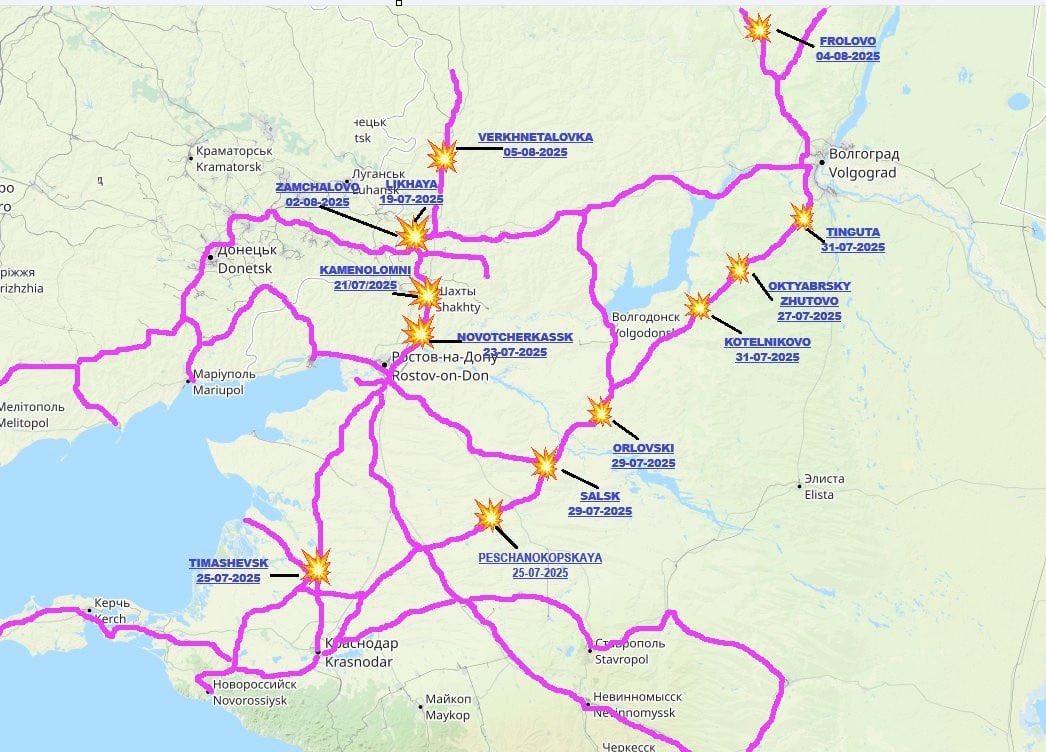
Now to the positive news: a key development of recent weeks is the intensification of strikes on Russian railway infrastructure, especially in the south. From July 19 to August 5, over ten targeted hits were recorded (Timashevsk, Salsk, Novocherkassk, Frolovo, etc.) affecting key junctions and intersections used for the main flow of military cargo to Crimea, Donbas, and the North Caucasus.
For clarity: single, isolated strikes do not have much effect (tracks can be repaired within days, making such attacks inefficient). However, the current wave of mass strikes not only delays trains but creates a “traffic jam effect” where alternate routes become overloaded, reducing throughput across the network.
Thus, Russia enters August with a front held mostly by the inertia of accumulated reserves and stable logistics from its central regions. If the pace of deep strikes in the rear is maintained, by autumn Russian forces could face systemic supply disruptions in the southern grouping — opening space for localized Ukrainian offensive actions.
#UkraineRussiaWar #UkraineWar #UkraineWillWin #Ukraine
@Lepp06519086 Will u pay attention to our work? It is very interesting to talk with china citizen. Do u support Ukraine or know enough about our situation? It is not a manipulation, just a friendly question to understand the borders)
Hello, everyone! We would like to thank everyone who supports us financially and continues to do so regularly. Please don't stop, we work hard and publish interesting professional analytics for you. We also run YouTube channel. Therefore, we ask you, if possible, to support our project.
➡️In fact, everything that Conflict Capital has is financed by our community. Monthly subscriptions to Patreon are especially valuable, as they allow us to plan (link in bio). Also, You can support us on PayPal.
PayPal: [email protected]
So if you can, please support our project so that we can grow and become bigger. We have the potential...