If we are trying to change a system, how do we know if the system is actually changing?
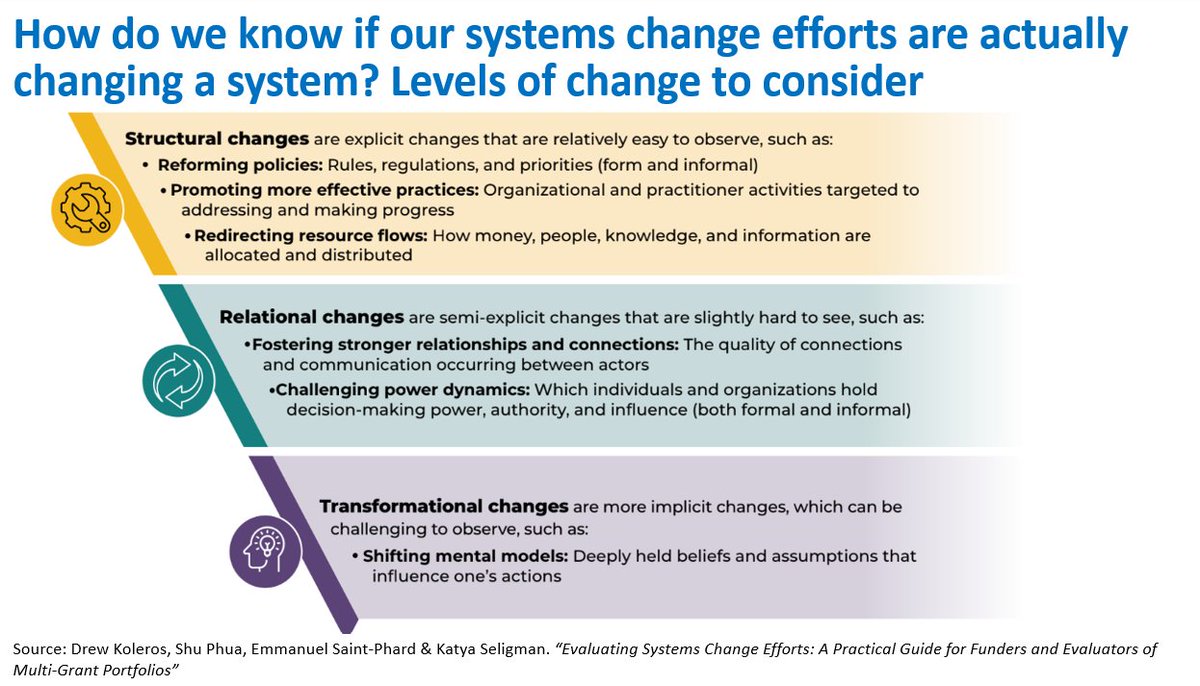
A framework I use often in my change practice is the “Water of Systems Change” from @johnvkania & colleagues. It says that to understand the problems in a system, we should explore six interdependent “conditions” that typically hold the problem in place. These relate to structural conditions (policies, practices & resource flows), relational conditions (relationships/connections; power dynamics) & transformational conditions (mental models - the deeply held beliefs & assumptions that influence our actions).
Now Drew Koleros & colleagues have produced a “Practical Guide to Evaluating Systems Change Efforts”, based on this framework. They translate the six conditions into levels of change. They conclude that efforts to measure whether a change intervention is actually making a difference will more often focus on surface level “structural changes”, because these explicit changes have established indicators & data sources. If we really want to know if a system is changing, we also need signs of change related to relational & transformational changes. These require deliberately developed indicators, multiple methods & validation with the people involved in the change, rather than being treated as secondary or invisible.
Six actions for leaders of change who want to show their efforts are actually changing the system, based on the practical guide:
1) Map the system with the people in it. Agree its boundaries & check whose perspectives are missing, especially people with the least power.
2) Name where your change enters the system. Translate each entry point into the structural, relational & transformational changes you expect. Relationships & mental models" take longer to shift, so set timescales to match.
3) Co-design the signs of change. For each system change, ask those involved: what would it look like if this was changing? What would we expect to see? How would we know? People trust measures they helped to shape.
4) Pair leading & lagging signs. A leading sign of shifting power might be people reporting greater trust or influence. A lagging sign might be people with less formal power shaping decisions, visible in who speaks & who decides in key meetings.
5) Bring numbers & stories together. Performance data & staff surveys show the scale of change. Interviews & focus groups show what it means to the people living it. Make sense of the evidence together, continuously.
6) Review progress with a diverse group.Rrefine the signs as you learn, use a simple measure of progress (emerging, advancing, embedded) & share findings at regular points to adapt the work as it unfolds.
It’s highly unlikely that one change initiative (or one team) will shift all six conditions alone. We will make the strongest case for impact if we describe our efforts, show what changed as a result, across multiple levels & draw plausible links to where the system is heading.
Links and useful resources:
The recent article from Medium that inspired my post titled “How Do You Know When a System Is Changing? : Measuring the signs of systems change” by Drew Koleros, Emmanuel Saint-Phard & Shu Phua: https://t.co/FgaTwlWsaw.
Their “Practical Guide to Evaluating Systems Change Efforts”: https://t.co/q1L9iD5eVs.
About the Water of System Change framework created by John Kania, Mark Kramer & Peter Senge: https://t.co/99RVEAFPn5
The Water of System Change Action Learning Exercise: https://t.co/5FHEgi0iRi (I use this exercise often with groups).
An in depth video that explains the Water of System Change framework very effectively from @CIForumTweets : https://t.co/99RVEAFPn5.
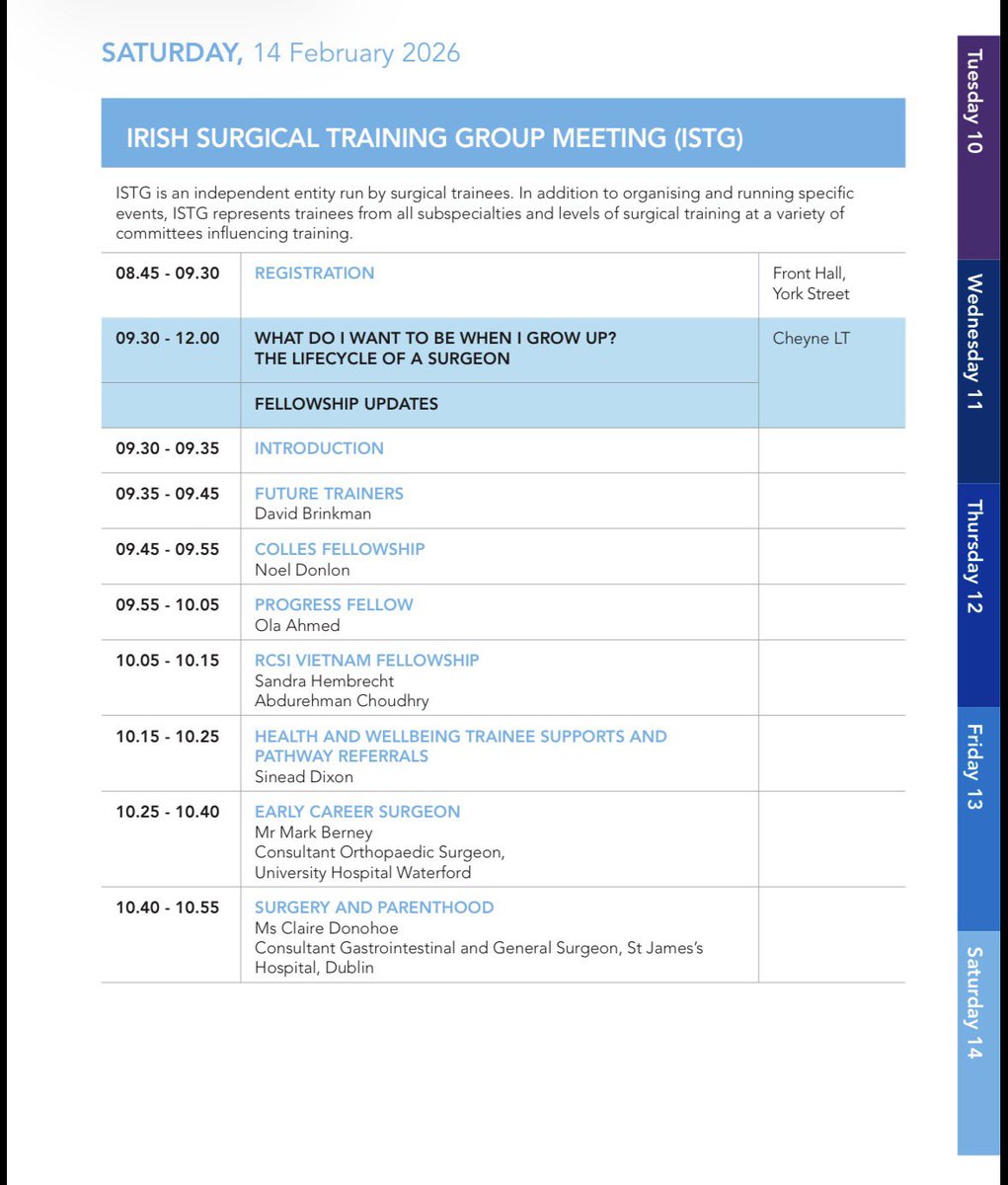
What’s better than spending your Valentine’s day with the @ISTGofficial? A lot of interesting talks and an intriguing debate as part of our Charter’s week session! It’s all going down next Saturday the 14th of Feb! @RCSI_Irl
Roscommon University Hospital is proud to launch the new Universal Patient Communications Passport “Getting to Know What Matters to Me.”💙
This passport helps patients share what’s important to them, breaking down communication barriers and supporting truly person centered care.
Often, when we are a person in the middle of a big organisational transition, we may feel powerless, with no ability to influence things. Yet systems knowledge tells us that the opposite may be true.
At critical points during a transition process, the overall structures that supported the system previously disintegrate & new ones have to emerge. Transitions make systems less predictable & less controllable. This creates the conditions for, small, positive, local changes that lead to big, system-wide improvements.
1) Small changes can spread: In chaotic situations, small initiatives that reflect the new paradigm—pockets of the future—can gain traction: They become amplified through positive feedback loops to grow rapidly.
2) Systems can organise themselves: Complex systems often don’t need a boss telling every part what to do. Instead, by following "simple rules" & reacting to what is happening nearby, local groups with order can influence the bigger system.
3) Shifting the emotional & cultural narrative may enable systemic change more effectively than top-down policies.
See: https://t.co/nRkvfSuXqL. Via Joss Colchester @Sys_innovation.
What is AI & why is it narrow?
AI, or Artificial Intelligence, mimics human intelligence in machines. It involves reasoning, learning, perception, and self-correction.
AI ranges from simple rule-based systems to advanced neural networks for tasks like image recognition or language translation, aiming for autonomous or assistive decision-making.
There are three types of AI - Artificial Narrow Intelligence (ANI), Artificial General Intelligence (AGI) & Artificial Super Intelligence (ASI).
- ANI is task-specific and exists today (e.g. Siri)
- AGI would be capable of general learning and reasoning like a human but doesn't exist yet.
- ASI would exceed human intelligence comprehensively, and remains a hypothetical future scenario.
As AI technology matures it will have a profound impact in all aspects of society including healthcare.
https://t.co/X3XOyOQYSZ
What is the difference between cooperation, coordination & collaboration?
1) Cooperation - making sure our respective activities don't conflict; doesn't require high levels of trust, we just need to respect each other's space & activity.
2) Coordination - moving together towards a known shared outcome; requires greater trust as we rely on one another to do the work to achieve the common goal.
3) Collaboration - uniting people to create something new together that we couldn't accomplish alone; needs strong interpersonal trust.
We need all three in different contexts. When it comes to leading across systems, we get the best outcomes when we invest in the strong trusting relationships that enable us to collaborate: https://t.co/P8IGk3PiP3. By Ed Morrison @Strategic_Doing.
Deeper dive: https://t.co/i2Mv1w4hC0
Caroline gave an excellent talk on Monday, getting right into the details of how a functional clinical trial programme should operate.
The high level of competence of the people I am lucky to work with in the @HSE_West_NWest group is what makes me believe the challenges we face can be overcome.
Caroline Kelly is a good example of this.
Thank you Caroline!
Mary Bedding, Project Lead for the National Deteriorating Patient Improvement Programme (DPIP) is the final presenter for the NOCA Quality Improvement Champion Award 2025.
The IRESTORE Early Warning System pilot reduced unplanned transfers in older persons’ care by 25%, enhancing early detection of deterioration and timely treatment within residential facilities.
✅ 76% of deterioration episodes first identified by nurses
✅ 69% flagged by soft signs
✅ Increased staff confidence in escalation decisions
#NOCA2025
NOCA Poster Competition 2025
The winner of the NOCA Poster Competition, from over 40 posters presented today, was 'Paediatric Medication Plans for Life Limiting Conditions' from @PortiunculaHosp. The poster was presented to Aoife Mc Inerney. Congratulations to the team.
Comprehensive medication plans at PUH have transformed care for paediatric patients with life-limiting conditions:
✅ Seamless communication across care teams
✅ Faster decisions during emergencies
✅ Families feel empowered to manage care at home #NOCA2025
Dr Nessa Keane, Registrar in Palliative Medicine at Galway University Hospital is the first presenter shortlisted for the NOCA Quality Improvement Champion Award 2025.
She presents the project 'Improving Prescribing Accuracy of PRN Medications for Haematology/Oncology Patients to Improve Safety and Efficacy'.
✅ Errors reduced from 30% to 8% in 12 weeks
✅ NCHDs gained confidence with new resources & training
✅ Sustainable improvements through system integration
Multidisciplinary collaboration led to measurable improvements in PRN prescribing, enhancing safety and care quality. #NOCA2025
Join us for the NOCA Annual Conference 2025 on the 4th February, in association with @RCSI_Irl Charter Meeting 2025.
This year’s theme—“Data-Driven Healthcare: Planning, Delivering, Improving”—highlights how national clinical audit data can shape a more effective, patient-centred healthcare system.
Get involved by submitting:
➡️ NOCA Quality Improvement Champion Award: The award recognises an individual or team who has made best use of national or local clinical audit data to improve patient care in their healthcare organisation. Top 3 invited to present at the Conference.
➡️ Abstract Submissions: Present your innovative clinical audit or quality improvement projects.
⏰ Closing Date: Monday 6th January at 5pm
Visit https://t.co/wlWRujyNRp for further information and guidelines.
#NOCA2025 #ClinicalAudit #QualityImprovement
Having effective facilitation can make a massive difference to outcomes. By enabling clear communication, structured problem-solving, and inclusive decision-making, facilitation drives performance & innovation. Bringing in highly skilled external facilitators who help us to see the big picture can be a powerful intervention but it isn't enough. Every leader should be a facilitator. Leaders who prioritize & cultivate facilitation skills often see immediate improvements in team dynamics & productivity. Facilitative leadership can create a strong foundation for sustained success.
https://t.co/OO3W4fwcqs. By Voltage Control.
Graphic by Adrian Robke.
We are excited to be participating in the isupport audit this week @PaedsLUH, Paeds ED, and Paeds opd. Auditing how we use rights based guidance to ensure children feel safe and included in all of their healthcare experiences. @HSE_West_NWest@siobhanmh@MaireadL2
I am taking on the editorship of the Interantional Journal of Healthcare Quality Assurance @EmeraldGlobal . So if you have an article that you would like to have considered for publication (or if you would like to be considered as a reviewer for IJHCQA) send me a dm.