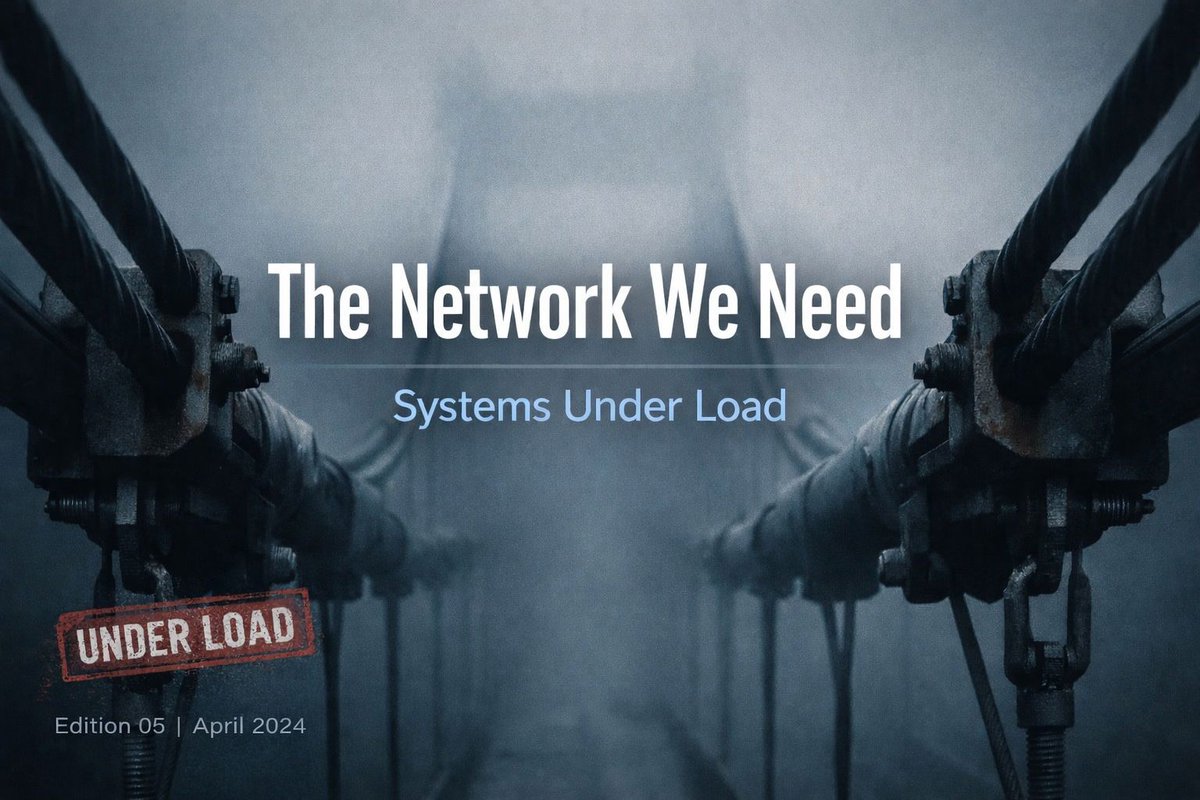
Edition 05 of The Network We Need is live.
Systems aren’t failing all at once.
They’re still working — but with less capacity to absorb pressure.
5 signals + field notes on what we’re seeing.
https://t.co/iUD52nVSuE
Once the world moved in great living rhythms.
Bison herds that took days to pass.
Rivers running silver with fish.
Forests blooming white with chestnut.
What those migrations teach us about collective power and fragmentation of human systems.
Read: https://t.co/sOh9fwpfbG
Systems rarely collapse all at once.
More often the structure remains while the motion disappears.
This issue of The Network We Need explores what ecological migration systems can teach us about institutional momentum.
🔗 https://t.co/MBNkaOIxFn
We talk a lot about alignment, coordination, and systems change.
This month’s newsletter looks at something quieter and more consequential: the language, roles, and connective work that actually let systems function under load.
https://t.co/YwBt6dCzBl
We talk a lot about alignment, coordination, and systems change.
This month’s newsletter looks at something quieter and more consequential: the language, roles, and connective work that actually let systems function under load.
https://t.co/YwBt6dCzBl
Once a system can feel, it can learn. Once it can learn, it can adapt. Once it can adapt, the pulse returns. Connective Tissue closes on: resilience is a system remembering its own circulation.
Read the essay here: https://t.co/6cnzdrUsCe
Connection isn’t a value. It’s a system function. When architecture forces reciprocity, systems begin to move with coherence again. These six design principles show how water, public health, and democracy can rebuild their connective tissue.
Essay: https://t.co/6cnzdrUsCe
We talk about “communication gaps” and “coordination challenges,”
but the real issue is architectural:
our systems behave like funnels when they should behave like circuits.
This is what disconnection looks like — and why it keeps repeating.
🔗 Essay: https://t.co/6cnzdrUsCe
The places where systems actually work, from tribal salmon co-management to WASH systems to civic assemblies, share architecture: information moves without distortion, and authority returns without losing grounding.
🔗 Read the Connective Tissue essay: https://t.co/6cnzdrUsCe
Systems fail not due to apathy, but because the architecture between ground truth and global decisions loses meaning. The culvert in Maine is a diagnostic, not a metaphor.
🔗 Read the full essay: https://t.co/6cnzdrUsCe
If your work involves climate, water, governance, or systems, this will resonate re the gap between ground truth and global decision-making. "Connective Tissue" examines how coherence is restored when signals circulate through systems.
🔗 Read more: https://t.co/6cnzdrUsCe
Today, we’re launching The Networks We Need, a monthly newsletter from Connecting for Change about the hidden architecture of collaboration, partnerships, systems, and collective action, I think you’ll find value in it.
Subscribe to The Network We Need
https://t.co/s0ylyZu5OU
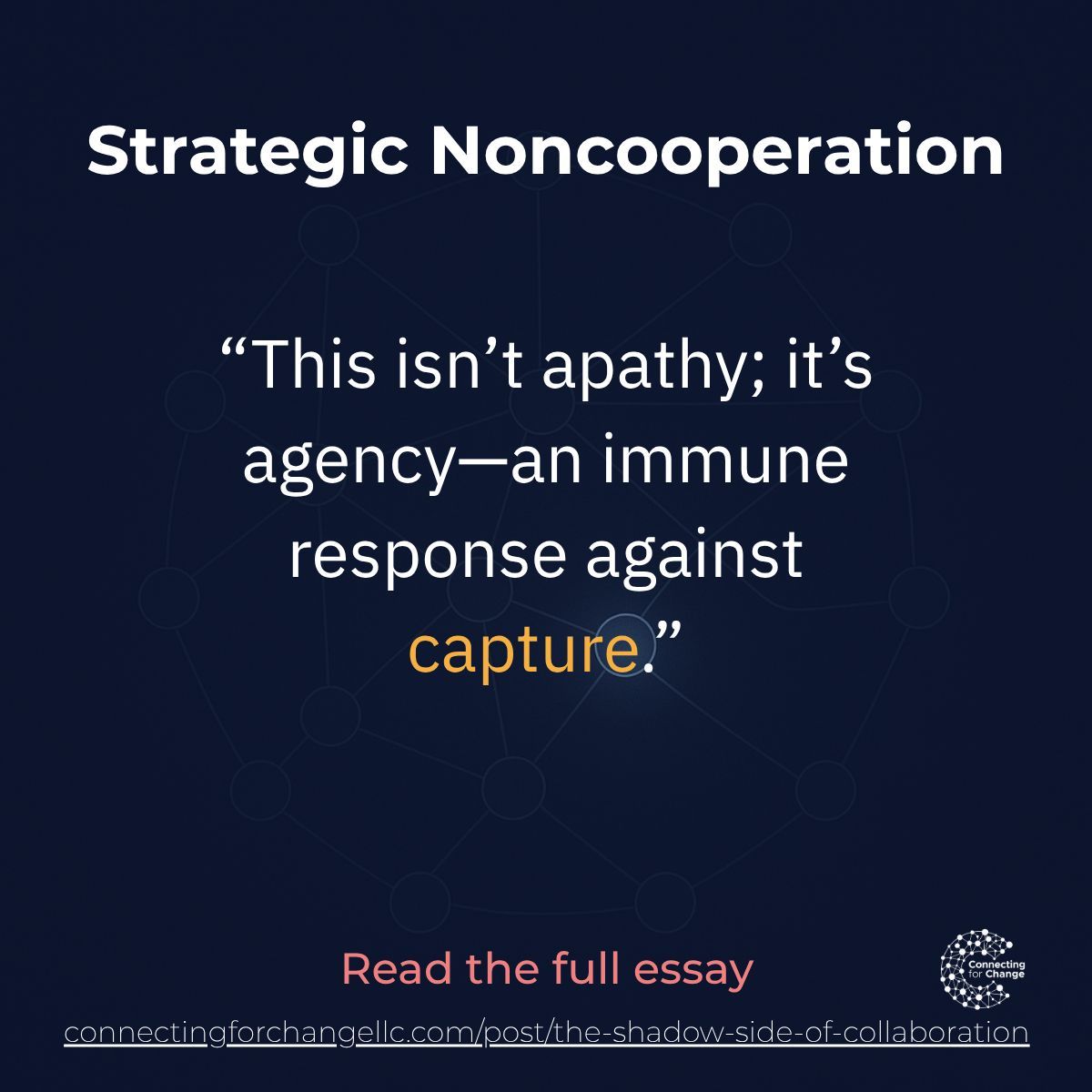
Every network carries its own medicine — the capacity to notice, pause, and refuse. Healthy systems protect their integrity through discernment and design.
Full essay → https://t.co/jiAXF6fbTn
#Leadership#Strategy#Resilience#SystemsThinking#collaboration
From Connecting for Change: a new field note on power, trust, and the fragile architecture of collaboration.
The Shadow Side of Collaboration explores the strengths that make networks thrive and make them vulnerable to capture.
Read the full essay → https://t.co/jiAXF6fbTn
Every network carries its own medicine, the capacity to notice, pause, and refuse. The Healthy systems protect their integrity through discernment & design.
Read the full essay → https://t.co/jiAXF6fbTn
#Collaboration#Integrity#SystemsThinking#CollectiveImpact
The Shadow Side of Collaboration explores how networks are vulnerable to drift. This is meant to invite conversation, not consensus. Curious how others navigate these dynamics.
Full essay → https://t.co/jiAXF6fbTn
#Collaboration#SystemsThinking#SocialImpact#Leadership
The Shadow Side of Collaboration explores how networks are vulnerable to drift. This is meant to invite conversation, not consensus. Curious how others navigate these dynamics.
Full essay → https://t.co/jiAXF6fbTn
#Collaboration#SystemsThinking#SocialImpact#Leadership