One thing the map made obvious:
A task can have a perfectly clear output and still be expensive to verify.
Clear instructions make delegation easier.
They do not automatically make supervision cheap.
An AI agent can make a task look finished before it is.
The spreadsheet opens, the dashboard loads, the memo sounds right.
Then someone has to verify it.
UC Berkeley researchers built a benchmark from more than 1,000 professional tasks, from reconstructing balance sheets to running ERP workflows and auditing M&A filings.
It is called Agents’ Last Exam.
We mapped six of its public task cards using two questions:
How clearly can “done” be defined?
How hard is the result to verify?
Because the practical question is not:
“Can AI do my job?”
It is:
“Can I delegate this without having to redo it just to know it is right?”
Sources and related reading:
Agents’ Last Exam paper and public task materials:
https://t.co/JKZIQiH7t8
https://t.co/O2FaTPzlNe
https://t.co/QbtQ5XzGGC on verification becoming the bottleneck as AI generation gets cheaper:
https://t.co/lZmE66jmiT
Emergence AI on verifiability, reversibility, and task contracts:
https://t.co/pFC4f8JAyu
The task placements in our map are Connectstep editorial interpretations of the public ALE task cards.
One thing I learned from processing around 100 company reports with an AI agent:
“Unresolved” is a valid output.
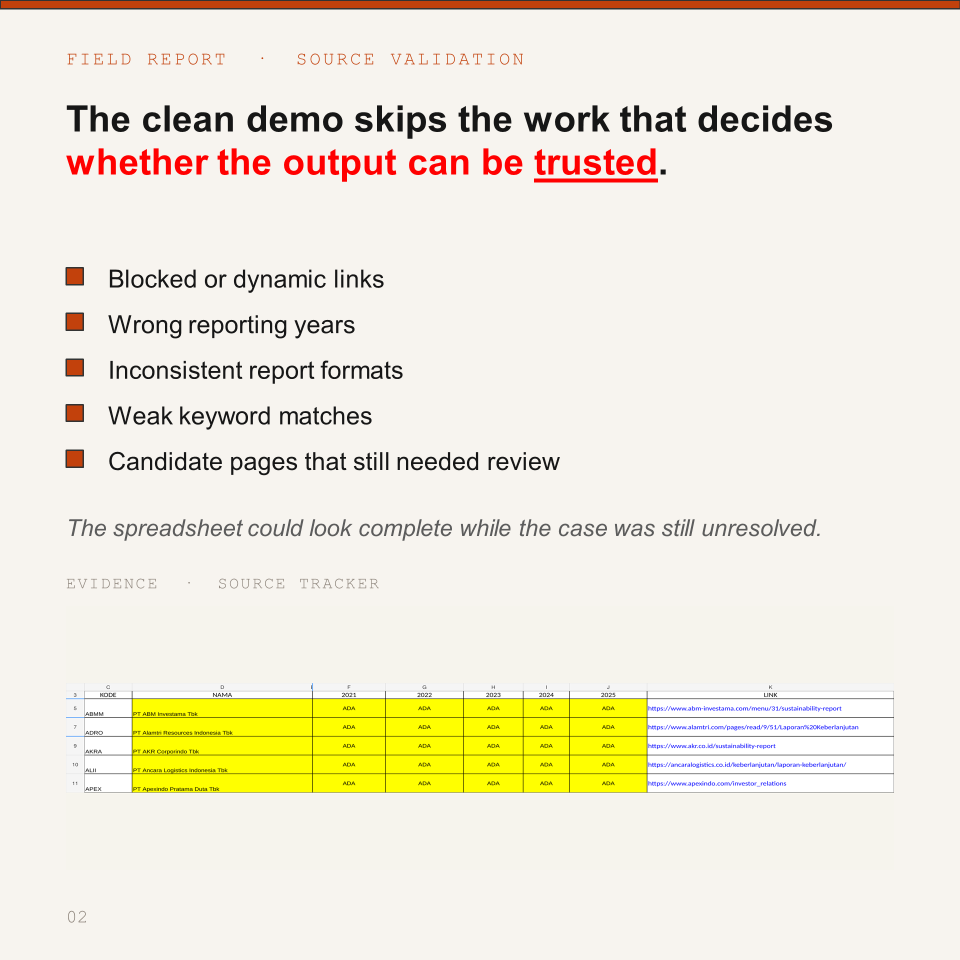
in one case, the source was missing, the upload failed, and the local path could not be accessed. we kept the company out of scoring until the report was recovered and revalidated.
The spreadsheet only moved forward after the evidence was usable and the write was explicitly approved.
A complete-looking file is not the same as a review-ready file.
Where do unresolved cases live in your workflow today?
One AI agent helped me turn about 100 company reports into one spreadsheet in one day.
I expected the job to take 1-2 weeks. But speed wasn’t the hardest part. Deciding what deserved to enter the file was...
The project covered 20 companies, five reporting years, and 18 disclosure indicators: 1,800 scoring decisions in total.
The execution ran through a Hermes agent using GPT-5.5. It handled much of the document search, candidate-evidence collection, progress tracking, and workbook writing.
I used ChatGPT as a separate review layer, then decided what needed validation, another attempt, or human judgment.
A spreadsheet can look complete while the underlying case is still unresolved.
The practical checklist and three real examples from operators who hit similar failure modes are in the replies 👇
Across all four cases, the lesson wasn’t “don’t use AI.”
Use it to reduce search and structuring work. Keep source validation, exception handling, and final judgment explicit.
That’s what Connectstep will document: AI workflows that still hold up when the files are messy and the output has to survive review.
What part of document-heavy AI work breaks first for you?
Another operator saw the same shift.
A 100+ page PDF tallying task initially took longer than doing it manually because the models hallucinated and failed to correct themselves.
The workflow improved later when he moved beyond chat-style prompting and gave Claude Code his process, edge cases, and file structure.
The useful version wasn’t autonomous. It worked because the operator could shape the workflow and handle exceptions. https://t.co/DqxKHUYLcQ
One task involves parsing a 100+ page PDF file and tallying specific item totals with a set of rules. In August, both LLMs struggled much more than I expected. They had hallucinations and wouldn't fix when corrected. Ultimately took more time than manual and I gave up.
the actual move is neither.
don’t start with formatting.
don’t ask AI for the final deck either.
ask it to plan the presentation first:
what’s the point?
who’s watching?
what should each slide prove?
what visual would make it clearer?
what do i need to verify?
then make the deck.
the internal struggle is so real ���
do i spend 4 hours making the slides look decent
or do i let AI generate the whole deck and pretend i’m not scared to open it