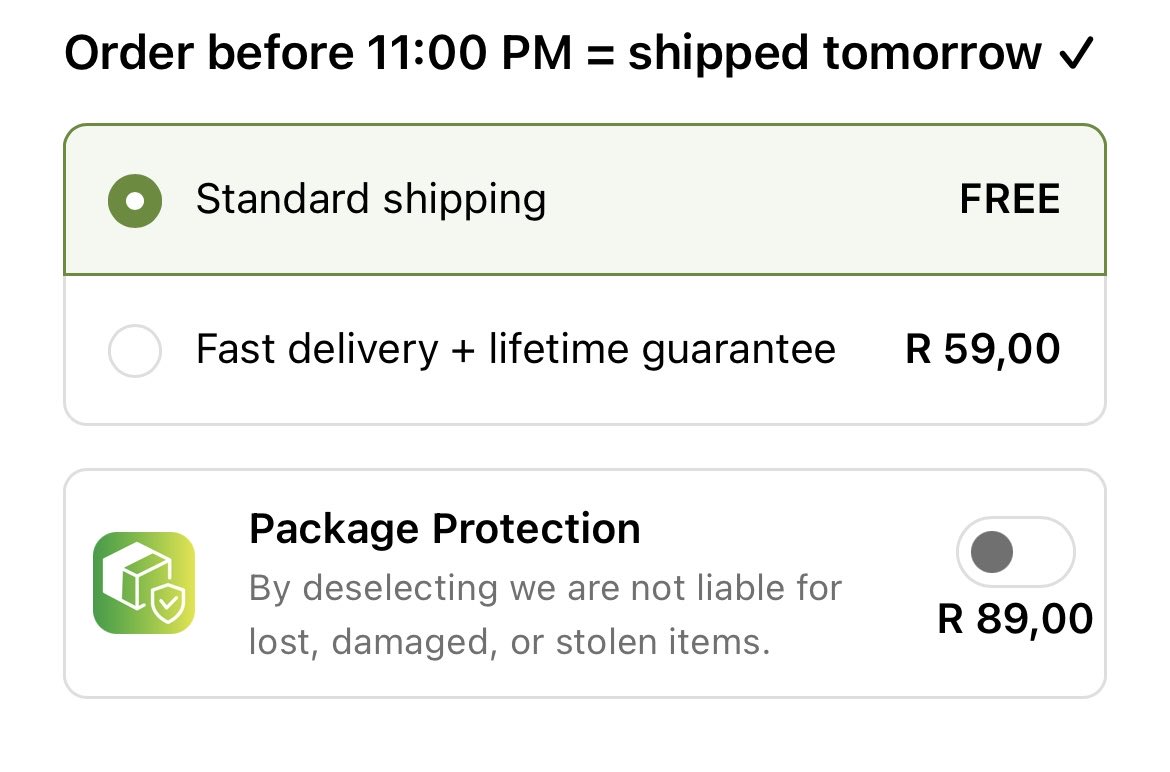
With this online order, the customer is expected to pay extra for “package protection”,otherwise they take on all pre-delivery risk.
That’s legally invalid.😡
CPA Section19(c): “Goods to be delivered remain at the supplier’s risk until the consumer has
accepted delivery of them.”
In 1987, the South African government replaced the power producer ESCOM with a new version called Eskom. However, this wasn’t just a name change—it was a significant shift in how the country handled electricity.
Along with the name change, the government passed a new law, the Eskom Act, which changed Eskom’s primary goal from serving the public to focusing on cost and efficiency, more like a business.
For over 60 years up to that point, ESCOM had followed a simple rule written into its Act: supply electricity “neither at a profit nor at a loss”. That meant the focus was on providing energy as a public service, not on making a profit.
But in 1987, that statute was thrown out. The new Eskom was expected to run like a company, and for the first time, private businesses—like the Chamber of Mines—got seats at the decision-making table.
Before this change, ESCOM had helped build South Africa’s economy. It provided cheap power, kept key sectors like electricity and rail in public hands, and helped the country grow from a rural colony into a regional power.
In the 1970s and 1980s, when sanctions made borrowing money from abroad difficult, ESCOM turned to local lenders and became South Africa’s biggest borrower. ESCOM didn’t just keep the lights on but also played a strategic role in the domestic economy.
ESCOM’s large local borrowings allowed the state to continue expanding electricity generation, maintain infrastructure, and support heavy industry—all of which were essential to keeping the economy functional under pressure.
By becoming South Africa’s biggest borrower, ESCOM provided a reliable demand for domestic savings. It issued bonds and other debt instruments that helped deepen local capital markets and gave institutional investors (like pension funds and banks) a stable, state-backed outlet for their money. This kept the financial system active despite isolation from global markets.
The electricity ESCOM provided through this locally financed expansion was also crucial for the mining sector, manufacturing, and other energy-intensive industries. These sectors—dominated by White capital—relied on cheap, stable electricity to remain globally competitive.
So, by sustaining the electricity supply without foreign loans, ESCOM helped preserve and strengthen the country’s economic base.
However, as Apartheid began to fall apart, the government started selling off state-owned assets. This was a strategic move. They knew a Black-led government was coming, so they wanted to ensure that new leaders wouldn’t have full control over key parts of the economy. Privatising these sectors made that possible.
Still, when the ANC took power, many expected things would change. But in 1996, the ANC adopted the GEAR plan—short for Growth, Employment, and Redistribution—which continued the same market-friendly approach. It focused more on investor confidence than public welfare, surprising even some White South Africans who thought the ANC would take a different path.
President Thabo Mbeki, in his 1999 State of the Nation address, stated, “To improve our competitiveness, we must lower input costs throughout the economy. Accordingly, we have decided to go over to a managed liberalisation of the energy, transport and telecommunications sectors”.
So, in 2001, Mbeki signed the Eskom Conversion Act. This turned Eskom into a tax-paying, profit-making company that could be listed on the stock exchange. It was no longer just a public utility—it was now a commercial business.
Control over Eskom was also moved from the Minister of Minerals and Energy to the Minister of Public Enterprises, whose job was to push privatisation. This change came alongside other economic reforms, like loosening controls on the Reserve Bank and selling off more state companies.
By forcing Eskom to behave like a for-profit company, the 1987 reforms planted the seeds for many of the problems we see today. The Apartheid government may have seen these issues coming—but keeping the economy in private hands was more important to them than making sure it worked for everyone.
When Eskom began operating like a business, it shifted its focus to areas where it could earn the most revenue—mostly urban centres and large industries. Poorer communities, especially in rural areas, were often left out because they weren’t seen as profitable markets.
This is similar to what we see with telecom companies like Vodacom and MTN, which are slow to build enough cell towers in rural areas because the people there don’t have the buying power to make those investments worthwhile.
As a result, these communities are left with weak signals, poor internet access, and unreliable communication—cutting them off from job opportunities, digital services, and participation in the broader economy. In the same way, the poor majority were sidelined from reliable energy access because their needs didn’t fit the profit model.
Electricity is essential for modern life—much like water or healthcare. When Eskom was run as a public utility, the goal was to provide power broadly and affordably. But when it became a commercial company, electricity turned into a product—something to be sold for profit.
This shift meant that the ability to pay began to shape access. For millions of poor households, it made electricity less of a right and more of a luxury.
Under ESCOM’s old model, wealthier users and industries effectively subsidised poorer ones through uniform pricing and cross-subsidies. After commercialisation, the logic changed: each user had to “pay their way”.
But in a country with deep income inequality, this meant poor households either paid a disproportionate share of their income for electricity—or got cut off. Cost recovery had replaced redistribution.
Moreover, commercial Eskom became more accountable to banks, credit agencies, and bondholders than to ordinary South Africans. Poor communities had little say in how electricity was priced or where it was delivered.
To fund massive projects, Eskom borrowed heavily from private markets. As the debt grew, so did electricity prices. Poor households paid more and more for power they often couldn’t afford, while the benefits of these megaprojects mostly went to industries.
Commercialisation was part of a bigger plan to lock in White economic power before Black majority rule. By putting key sectors under market control, the Apartheid state made it difficult—if not impossible—for a democratic government to use them for redistribution or development.
The irony is that while Eskom was turned into a profit-driven company, the social consequences—like disconnection, unrest, and service delivery protests—still fall on the State. In the end, commercialisation didn’t reduce the burden on the government—it just made it harder to serve the people who need it most.
The commercialisation of Eskom marked a critical turning point in South Africa’s energy and economic history. What was once a state utility built on the principle of delivering affordable power to all—“neither at a profit nor a loss”—was transformed into a semi-corporate entity chasing cost efficiency and commercial viability.
This shift had deep consequences for the poor majority, who were increasingly seen not as citizens with rights to basic infrastructure but as customers whose needs only mattered if they could pay.
The restructuring laid the groundwork for a broader neoliberal orientation: one that made essential services conditional on profitability rather than universal provision.
In this model, access is uneven, and exclusion is systemic—not because the technology doesn’t exist, but because commercial logic deems some lives unworthy of infrastructure.
Interestingly, by 2023, President Mbeki had flipped his stance on commercialising and privatising public utilities when he told the South African Association of Public Administration and Management‘s annual conference in Ekurhuleni that, “Relegating government functions to the private sector is dangerous... As the state becomes less and less capable, it is being increasingly bypassed by private actors.”
The lesson should be clear—without a strong, capable public sector grounded in the public interest, essential services like electricity will remain a luxury for some rather than a right for all.
service delivery could look VERY different if politicians were forced to use public services (healthcare, education, transport)
inconvenience is an excellent incentive for improvement
- Serena Williams was accused of being a man when outperforming a white female
-Caster Semennya was accused of being a man when outperforming a white female
-Imane Khalifa was accused of being a man when outperforming a white female
Take what you want from this.
Algerian female Boxer, Imane Khelif defeated her opponent, Angela Carini who quit after just 46 seconds at the 2024 Paris Olympics.
She is facing criticism and harassment from people accusing her of being a man. She reportedly has XY chromosomes.
She was disqualified from the 2023 World Championships, after failing an unspecified gender eligibility test.
She has high levels of testosterone.