We educate the next generation of #digital leaders.
Join us behind the scenes as we chat with professors, alumni, and Ph.D. aspirants about what makes our institute exceptional.
Watch the full video below- https://t.co/D339m3ChcZ
Despite their importance in quantum theory, joint quantum measurements remain poorly understood.
Remarkably, by using shared entanglement, this can be achieved perfectly when disregarding the post-measurement state.
Read the full paper here - https://t.co/QmHLHjpkNp
New paper alert!
Dynamic analysis of software systems produces behavioural models that are useful for analysis, verification and testing.
Read the full paper here - https://t.co/0UZ8Qgixzf
More than 50 distinguished leading figures from business, politics, and academia came together on 18 June at the Constructor Institute of Technology (CIT) for a high-level innovation event hosted by the Economic Promotion of the Canton of Schaffhausen.
The Constructor Institute of Technology successfully hosted another session of the Schaffhausen Wednesdays in Technology (SWIT) series.
The event featured Catalin Toma, a master’s student, who delivered an insightful talk titled “Quantum Computing – Latest Trends.”
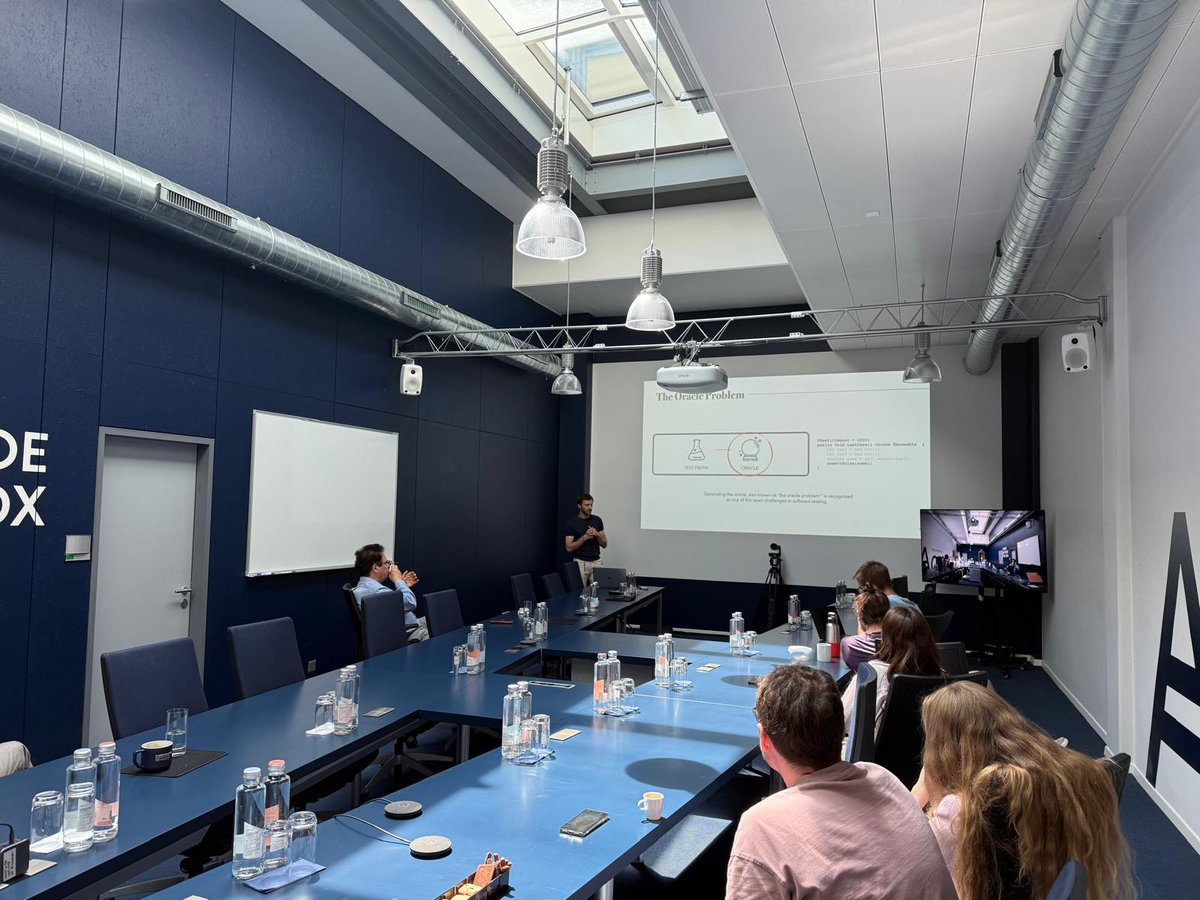
We were delighted to host Davide Molinelli, PhD student, for a compelling presentation on:
“TraTTO: A Neuro-Symbolic Approach to Deriving Axiomatic Test Oracles”
Join Prof. Manuel Oriol, President of Constructor Institute of Technology, for a free live webinar exploring the evolving roles in software development and engineering
➡️ Register now - https://t.co/92bxoBD6Oa
Traditional software testing doesn't work in dynamic, human-centric systems like smart cities. That’s why our latest research proposes a shift—from seeking perfection to ensuring system health.
🔗 Read the full research on our website: https://t.co/5IviK9NDaA
🚀 Are you an outstanding student in Computer Science, Software Engineering, or Quantum Technologies?
Constructor Institute of Technology is offering exclusive scholarships for top academic talent.
Apply now for Fall 2025 - https://t.co/mhM8nwB38e
Did You Know? The Waterfall Model Was Born in June 1956 Long before agile, there was waterfall.
Back in June 1956, the foundational ideas that would later shape the Waterfall Model began emerging in software engineering.
This research introduces a unified verification strategy that transforms proof failures into development assets—bridging the gap between static verification and dynamic testing.
Read more here - https://t.co/mS7wb8OxAY
Can computers correct our coding mistakes?
Around 14% of bugs in real-world software—like those in major systems—are small, localized errors that could be easily fixed with the right tools.
Read more here - https://t.co/dQmLbLdZQ2
May 1981 — The Birth of Quantum Computing!
In a groundbreaking talk at MIT, physicist Richard Feynman proposed a radical idea: to simulate quantum systems, we’d need a computer based on quantum mechanics itself.
Our students recently presented their Capstone group projects — the result of months of collaboration, critical thinking, and hands-on learning.
These presentations showcase not just technical knowledge, but also teamwork, creativity, and real-world problem solving.
New #Research Alert Manual test generation? Tedious. Dynamic methods? Often slow.
Discover a fully static and efficient alternative in the latest paper by Professor Bertrand Meyer: “Seeding Contradiction”.
Read the full article: https://t.co/4hQwsmHdvM
Did you know? #Python, one of the most powerful and beginner-friendly programming languages, was first released in May 1991 by Guido van Rossum. Over three decades later, it continues to power everything from simple scripts to complex AI systems.
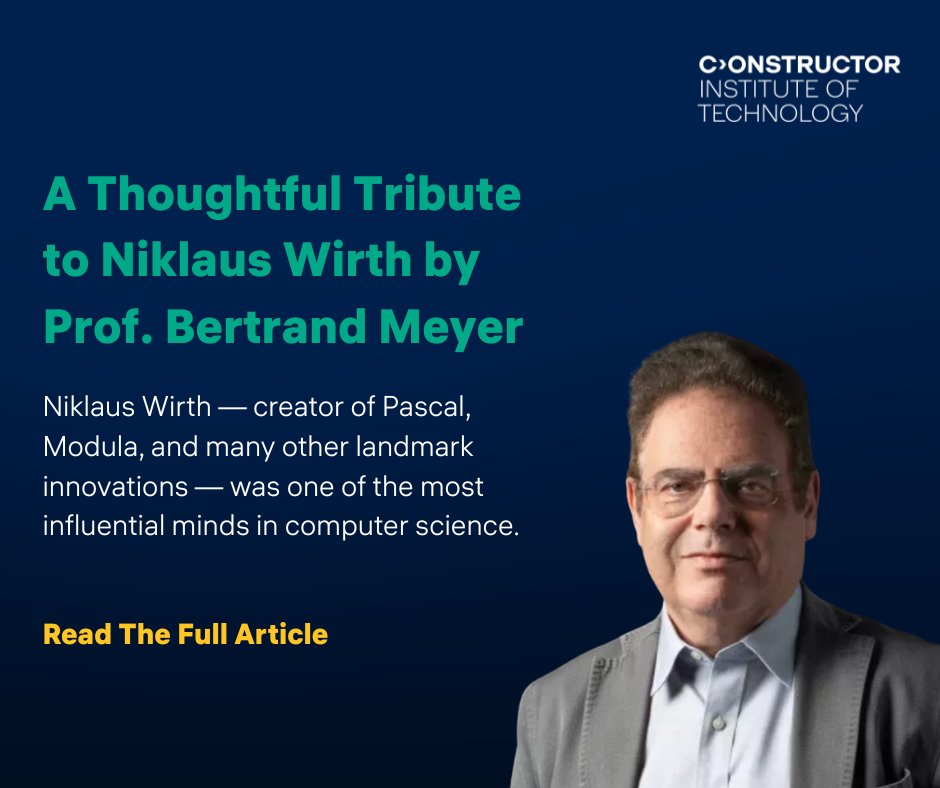
A Thoughtful Tribute to Niklaus Wirth by Professor Bertrand Meyer.
Niklaus Wirth — creator of Pascal, Modula, and many other landmark innovations — was one of the most influential minds in computer science.
🔗 Read here: https://t.co/ML1h1VzXOP