@Mystery_Trades 😂
Mine is down too. Only one stock was doing heavy lifting for all stocks in the morning so it was up but later it gave up too and now it is down.
Peole are cheering his reinstatement. But between his resignation and his reinstatement, there must be several deals went between him and govt. So far I have understood, without political backing, it is not possible to get the success in corporate world.
This guy truly is the superstar of the tech world
I think Trump was right: the whole incident actually only helped him consolidate his vital role in the field.
Writer: Oliver
Thanks everyone who has voted. Yes, majority missed the rally. But usually reversals happen like that only. If sustain above 26600, all will get a chance to participate in future rallies.
they are increasing the chances of leakage of bank customers data. I wonder why these banks can't have dedicated SMS employees and desks!? So far 2 PSU banks has confirmed that they outsource SMS services.
PSU banks stop sending debit and transaction messages, citing it is not in their hand to send SMSes but it is outsourced to other companies. So at least Rule 4 may save PSU bank customers. @RBI and PSU banks don't understand that by outsourcing SMS service to outside companies
🚨 BREAKING: RBI Proposes New Rules to Stop Digital Fraud
1. STOP SWITCH:
You can instantly block all customer-initiated debits from your account. One switch, full stop.
2. TRUSTED PERSON:
You can nominate any adult (18+) as your trusted person. For any transaction above YOUR set limit, they will have 1 hour to approve. No approval = Transaction Cancelled.
3. CUSTOM LIMITS:
You can set your own per-transaction limit, per-beneficiary daily limit, and time windows when payments stay disabled.
4. BANKS WILL BE LIABLE:
If bank fails to give MFA, alerts, or has staff collusion, bank will pay for your loss.
This will be mandatory from 1 July 2027. Bank negligence rule from 1 Jan 2027.
Do you think this will stop fraud or just make payments slow?
#RBI #Banking
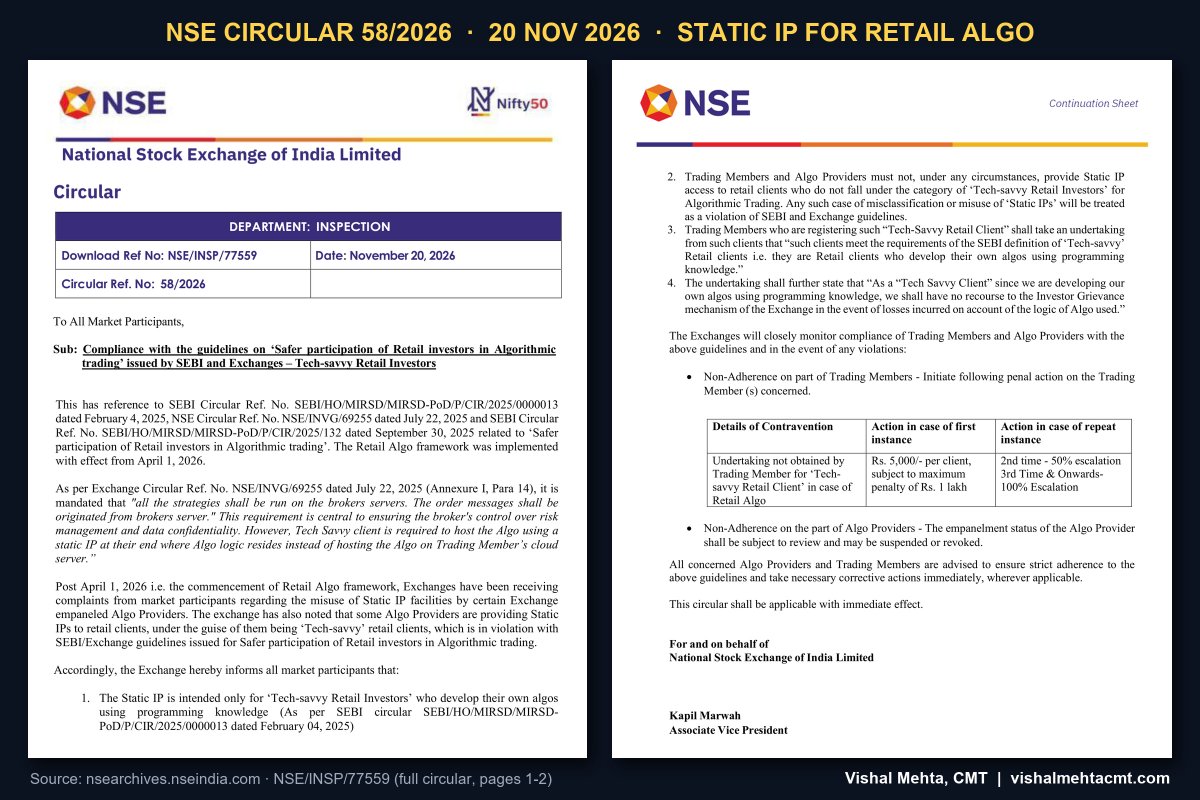
Can't code? Your algo strategy is no longer yours. 🚨
NSE just gave retail traders 2 choices: learn Python and own every loss, or wait in the broker's approval queue.
NSE circular 58/2026 (20 Nov, immediate effect):
Static IP is ONLY for retail traders who write their own algo code.
Think about a normal retail trader:
• You have a strategy that works for you
• You get a coder to build it, or buy a ready setup
• Till now, some algo providers handed such traders a static IP as "tech-savvy"
That door is now shut.
Your only route: run it through your broker or an empanelled algo provider, on their platform, through the exchange-approval process.
What that means for you:
❌ Your own strategy now lives on someone else's platform
❌ Approval steps, platform fees, less control over your own logic
❌ For a small account, the cost and hassle can be bigger than the edge
And if you do code it yourself and take a static IP?
You sign that you have no recourse to NSE's Investor Grievance mechanism for losses from your algo's logic.
So the retail trader's choice now is:
learn to code and own every loss,
or walk an approval route that may not be worth the effort.
Retail safety is the right goal.
But is compliance now costing more than the strategy itself?
Retail algo traders, what will you do? 👇
Source: NSE/INSP/77559
Education only. Not a buy/sell call.
Vishal Mehta, CMT | https://t.co/PggBPvVKPe
#AlgoTrading #NSE #SEBI #RetailTraders #StockMarketIndia
In the 1990s - India had three immensely popular electronic brands
BPL, Onida & Videocon
They had flourishing factories and large workforces and made good profits
Their problem
NO PROPRIETARY TECHNOLOGY & NO SUPPLY CHAIN
They relied heavily on Japanese components imported to India and stuck to CRT technology rather than invest into newer technology
Videocon sank all their profits into Oil & Gas ventures in a get rich quick scheme and lost it all
Once LG and Samsung entered India, they had the two things - Proprietary Technology and Supply Chain
They wiped the floor with the Indian companies
Their market share went from 62% in 1997 to 11% by 2007
Same when Godrej & Kelvinator had a combined 67% refrigerator share in 1995 and by 2005 Kelvinator was history and Godrejs share crawled to 13%
It's why Indian Brands like Karbonn, Lava, Micromax and Intex were wiped out by Chinese Brands like Oppo, Vivo, Redmi, Oneplus and Realme
We are making the exact same mistake again
No Proprietary Technology and No Supply Chains
Meanwhile where we focused on supply chains, our brands maintained leads
Two wheelers - Bajaj, TVS, Hero kept the market share intact through the decades
@ashutoshshah "Tel dekho, tel ki dhaar dekho ", that may be the reason we didn't jump in to AI boom. Now it is coming down and in next leg up, India might be present there. Just assuming.
I met a 55 year old man in Coorg who completely changed my perspective on earning money.
A few weekends ago, I travelled from Bengaluru to Coorg.
I got off the bus around 4 AM. It was raining heavily, pitch dark everywhere, and there were barely any people around except a few taxi drivers waiting for passengers.
One middle-aged driver approached us:
"Sir, come with me. I'll take you to one of the best hotels with an amazing view."
With no other option in that weather, we went along with him.
And guess what? He took us to HIS OWN HOMESTAY!
He showed us a room, initially quoted ₹3,000 for the night, and after some bargaining, agreed to ₹2,500.
The room was average, but considering the weather and timing, we decided to stay.
Later, he also offered to take us sightseeing for ₹4,000.
Now look at the business model:
• 2 rooms in his homestay • ₹2,500–₹3,000 per room per night • ₹4,000 for sightseeing trips • Potential daily revenue of ₹10,000+ on busy days
That's potentially ₹2–3 lakh in monthly revenue during good tourist months, before expenses.
And here's the most interesting part,
He told us both his daughters work in IT, and he is now constructing a massive hotel in Coorg with more than 30 rooms.
Just imagine!
A 55 year old man living in his hometown, running a hospitality business, earning potentially ₹2 lakh+ a month and expanding into a full fledged hotel.
Meanwhile, many people in big cities are spending 10–12 hours a day in corporate offices, paying huge rents and waiting for their next appraisal.
Sometimes, you don't need a fancy degree, a corporate job or a big-city lifestyle to build wealth.
You just need to identify an opportunity, understand what people need and build a business around it.
This man didn't move to Bengaluru to chase opportunities.
He built one right in his own backyard. ❤️
He has a point. My mom always says current kids are the ones who are being raised in best comfortable environment. What will happen to them 2mrw when life will be difficult. They usually are 1 or 2 kids only. So no or negligible support system they have.
Big Pharma wanted ₹9 crore a year for a drug. A Hyderabad doctor just bypassed them and got it for ₹2.5 lakh. 🤯
She didn't wait for the company to drop the price. She used a legal workaround in the Netherlands.
For kids with a rare genetic disorder called AHDS, a year's supply of the medicine (tiratricol) costs up to ₹9 crore in the US.
One Indian mother was paying ₹12–13 lakh every month just to import it from Germany.
When attempts to get the drug through the manufacturer failed, paediatrician Dr. Sivaranjani Santosh put out a public appeal on social media in September.
A Dutch non-profit (Pharmaceutical Accountability Foundation) saw it, teamed up with Transvaal Pharmacy in The Hague, and legally custom-compounded the exact same medicine using the raw active ingredient.
• The annual cost crashed from ₹9 crore to ~₹2.5 lakh per child.
• Donors in India and the Netherlands pooled ~₹15 lakh to cover the entire bill.
• With Access to Medicines India and ORDI clearing the import permits, 7 kids will get a full year’s supply completely free on November 30.
The commercial price hasn't changed globally, and Dr. Sivaranjani says importing batches from Europe isn't a permanent fix. She’s now pushing the Indian government to allow local compounding under the National Policy for Rare Diseases so families aren't left at the mercy of ₹9 crore price tags.
We get your concern. Kindly copy our team link and access the link using the web browser through laptop/desktop/any other browser from your mobile.
If you are unable to access the link, kindly drop in your details here: https://t.co/M4mjNya77g, our team will review it and provide an update within 6-12 hours.
-Shabreen
Money cut but status shows payment failed in #Amazon.in. 4 products ordered, 1 delivered too, but for rest 3 products getting status as payment failed. In customer service page, it shows it is ordered & those 3 products will be delivered by Nov 23.
We get your concern. Kindly copy our team link and access the link using the web browser through laptop/desktop/any other browser from your mobile.
If you are unable to access the link, kindly drop in your details here: https://t.co/M4mjNya77g, our team will review it and provide an update within 6-12 hours.
-Shabreen
@neeluprod Quite possible. But if remaons above 26600 or so, don't remain short. Rest, time will tell. I am waiting for confirmation on monthly TF, which may be by Jan start.
I am just wondering what people will have to say if #Nifty has bottomed out at 22180 and may go to 35k in 2 years? Will they hold govt responsible for this or it will just be a cyclical nature of the markets?
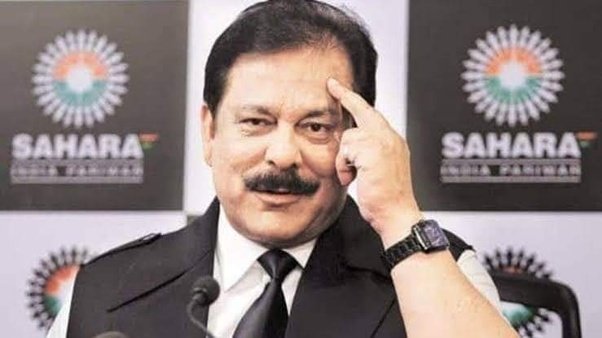
Not even two decades have passed since Subrata Roy Sahara’s son got married in Lucknow—a spectacle where Amitabh Bachchan and his entire family danced in the wedding procession, and the prime minister climbed onto the stage despite knee trouble to bless the couple.
It seemed as though almost every heavyweight in the country was there: dozens of chief ministers, the union cabinet, the state government, and lawmakers from Lok Sabha, Rajya Sabha, and state assemblies gathered together in numbers rarely seen elsewhere.
Once a man who went around on a bicycle selling savoury snacks and biscuits, Roy looked bigger in influence at that moment than Ambani, Adani, or Tata do today. Yet a single misstep in expanding his empire and clout pulled him into a spiral that left him stripped of support and powerless, ending in his passing in that same state of helplessness.
He probably never imagined that someone named Roshan Lal from Indore would dim that glittering world.
The story began around 2009, when Sahara issued bonds through its real estate arms. Around three crore people subscribed to them, raising roughly ₹24,000 crore while allegedly sidestepping rules set by the market regulator, SEBI.
Roshan Lal sent a complaint to the National Housing Bank. When the bank issued a notice based on that letter, Sahara brushed it aside, saying the matter had nothing to do with the bank, only SEBI had authority to ask questions, and it should stay out of it. Offended by the reply, bank officials forwarded Roshan Lal’s letter along with Sahara’s response to SEBI with their own remarks and a request for a probe.
That triggered SEBI’s investigation. Accustomed to feeling that top power circles were in his corner, Roy treated the inquiry lightly. When SEBI sought records on the bonds, Sahara dispatched 127 trucks carrying 31,669 cartons of paperwork to the regulator’s office, daring them to go through it all.
Lining up 127 trucks outside SEBI’s office in Mumbai created traffic gridlock and put the entire standoff squarely under the media spotlight. Pranab Mukherjee, then finance minister, backed a thorough probe. SEBI ordered Sahara to refund the money raised irregularly from investors with 15% interest, a sum Sahara could not pay back. The dispute reached the Supreme Court, Roy went to jail, and from there his fortunes steadily unravelled until the outcome everyone witnessed.
That is why, even if hard work, luck, or clever manoeuvring takes you to the top, two lessons stay relevant: do not let arrogance take over, and remember that while you can reach the summit, you cannot build a permanent home there—how you behave once at the top decides how long you stay.
Late Subrata Roy Sahara’s life had a cinematic arc from the 1970s onward, marked by immense wealth and reach. After the era of Nawabs in Lucknow, his own court-like presence stood out, complete with lavish gatherings and security resembling a private force.
Around 1994–95, the gleaming Aliganj–Kapurthala complex in Lucknow, Saturday dress codes, the Sahara anthem, and long corporate addresses felt unfamiliar and striking in the city. Many viewed him as an early superstar of Indian business during a stretch when his prominence seemed unshakeable, and people he backed often rose fast in wealth, visibility, and clout.
Alongside politics and public image, his newspaper Rashtriya Sahara carried strong weight in the print era, and his influence was widely felt across circles of power. Stories about his personal life took on near-mythic proportions, with figures from films, cricket, politics, and public life frequently showing deference, and even retiring senior bureaucrats sometimes seeking roles with the group.