Poor control is often due to system faults, not tuning. Bad I/O, noisy sensors, valve stiction or comms delays can upset even tuned loops. System Health Monitoring finds these issues automatically so tuning isn't wasted. https://t.co/Bh3PfnIY7i #ProcessControl
Register now! https://t.co/ApykbwpzQs ]
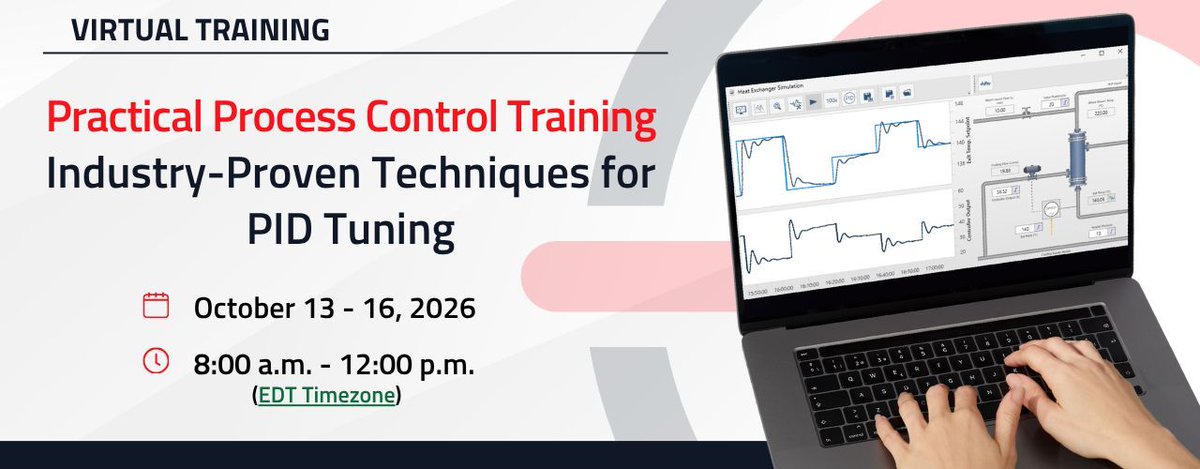
Improving PID performance requires more than tuning rules.
Applied techniques include model identification, disturbance analysis, and structured tuning objectives.
This training shows how these methods are used in real plants.
Feed-forward control is powerful — but only when the disturbance can be measured.
This short explains how feed-forward works and why feedback control is still required for stability.
Watch:
https://t.co/9f8sqZ8zyg
🔗 Register now to save your spot: https://t.co/JxtmWds5q3
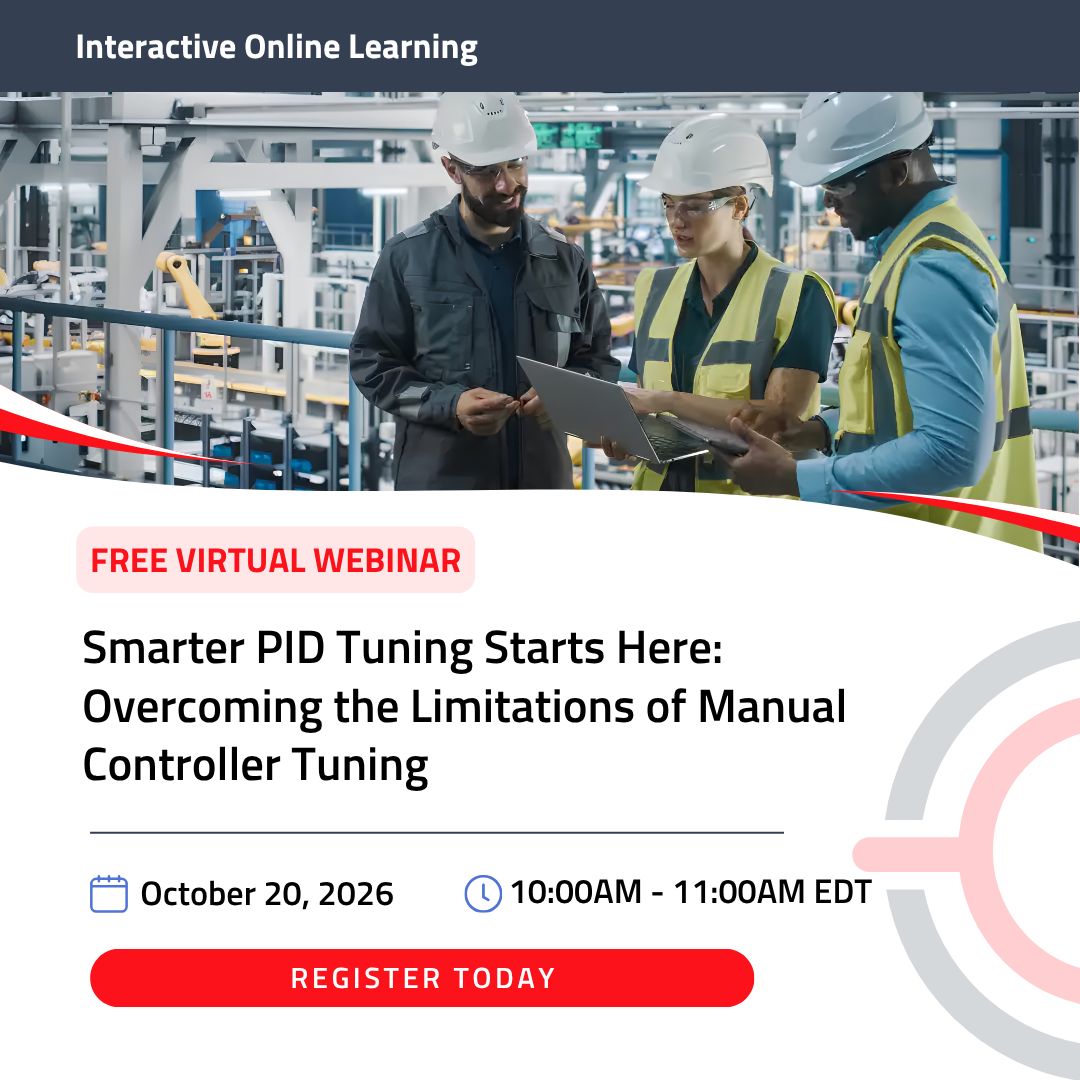
⏰ Still relying on manual PID tuning? Your next improvement could start tomorrow!
Attendee Perk: Receive an exclusive resource guide after the event, available only to attendees!
Loop interactions frequently trigger oscillations in multivariable processes. Digital Lifecycle Solutions analyze plant-wide data to reveal interaction patterns and recommend coordinated tuning https://t.co/yymUi58Ukm
Plants degrade from hundreds of mis‑tuned loops, not one loop. PlantESP monitors controllers for oscillation, saturation, dead time and interaction, so engineers prioritize loops impacting production. Demo: https://t.co/ZQfe6QVpLU #processcontrol
🔗 Register today: https://t.co/JxtmWds5q3
You’ll also learn how modeling can help reduce the trial-and-error involved in manual tuning and support more consistent plant-wide control.
Attendee Perk: All attendees will receive an exclusive resource guide following the webinar!
Feed-forward control can eliminate disturbances before they affect the loop — but only if the model is accurate.
This short explains when feed-forward works, when it fails, and why combining it with feedback gives better results.
Watch:
https://t.co/hCfzNWNSEW
Apparent loop stability can hurt performance. High valve travel, erratic output or slow recovery indicate poor models or wrong tuning. LOOP‑PRO Tuner identifies models from data for tuning—faster rejection, fewer oscillations, less intervention. https://t.co/lC3of4EPya #PID
🔗 Register today: https://t.co/JxtmWds5q3
Learn how real operating data can be used to build reliable models, test PID performance before implementation, and find tuning parameters with fewer iterations.
#PIDTuning#PIDControl#ProcessControl#ProcessEngineering
Register here: https://t.co/B0T5FA2Lbm
Many control problems are not caused by poor tuning — they come from incorrect process understanding.
Applied process control requires accurate models, disturbance analysis, and structured tuning methods.
Controller performance often degrades after operating conditions change.
State-based analytics allows performance to be evaluated separately for each operating condition, making it possible to maintain good control.
Digital Lifecycle Solutions support continuous tuning.
Good control engineers drive processes the same way experienced drivers handle hills — anticipating disturbances instead of reacting late.
This short explains why accelerating before the load change improves stability, and how the same principle applies to PID control.
Request a Demo! https://t.co/idnbHBbUis
Many plants know they have poorly performing loops but cannot quantify the impact.
Without performance metrics, tuning work becomes reactive and inconsistent.
Request a demo to see how performance monitoring supports optimization.
#OCE is a performance metric that measures how well a controller is operating relative to its theoretical limit.
This short explains how OCE helps engineers distinguish between acceptable control and optimal control.
Watch the Short https://t.co/wSAGlxddHh
Oscillation is often treated as a tuning problem, but many oscillations are caused by loop interaction.
PlantESP interaction analysis identifies correlated oscillations and helps engineers determine whether retuning, decoupling, or constraint changes are required.
At the ISA Automation event, Control Station will demonstrate how Digital Lifecycle Solutions combine monitoring, tuning, and analytics to sustain performance across the entire plant.
Visit our booth to learn how engineers are maintaining performance long after commissioning.
👉 Save your spot: https://t.co/XSx1ZxQlJb
🚨 Happening Tomorrow! Is your plant’s control performance telling the whole story?
Learn how to turn the data you already have into actionable insights for more stable, reliable, and efficient process control.
Optimization does not start with AI.
It starts with stable control loops.
This short explains why process stability is the foundation for analytics, optimization, and digital transformation.
Watch the Short.
https://t.co/gYijrEk2K9




![Control_Station's tweet photo. Register now! https://t.co/ApykbwpzQs ]
Improving PID performance requires more than tuning rules.
Applied techniques include model identification, disturbance analysis, and structured tuning objectives.
This training shows how these methods are used in real plants. https://t.co/NdkVR6yLd6](https://pbs.twimg.com/media/HVKREUMW4AA6z31.jpg)