Welcoming Schemerr to the Convert partner network.
Imagery-first CRO for Shopify brands.
Schemerr is a founder-led CRO agency built for Shopify brands. Dayo Samuel runs point on every account, with a hand-picked senior squad behind him: strategist, designer, engineer, director.
The approach is called Imagery-First CRO.
It starts with category-correct AI product images, shipped in 48 hours through their visual intelligence engine (AdaptiveIQ).
Once the imagery lift is measured, the CRO engine takes over: hypothesis, design, test, implement, repeat.
Ten categories, ten different conversion playbooks. The squad embeds in your stack so testing runs at in-house speed, without the headcount.
Recent work includes Source, Step One Foods, Tradewind Group, and eManuals.
They also run a free PDP teardown: drop your product page URL, get a one-page score with your three biggest conversion issues. No call required.
Welcome to the certified partner network, Schemerr!
AI is in every CRO workflow now.
5 experts told us how it changed theirs.
We asked five experimentation pros the same question:
How is AI influencing your experimentation workflows?
Their answers came from different angles but landed in the same place.
Pieter Boonstra sees AI handling everything around the work: experiment setup, analyses, coding, statistics. The point is to free people up for what only humans can do, which is coming up with solutions for other people.
Matthew Bass uses it to compress days of analysis into hours. AI synthesises qualitative and quantitative data, pressure-tests ideas, and surfaces untapped hypotheses. "It increases the leverage of leaders who already know how to ask the right questions."
Dzifa Mensah calls it a "reliable thinking partner in the pre-test phase." She also uses it for stakeholder management: drafting test announcements, writing readable reports, and communicating results to non-technical audiences.
Katie Faulkner treats AI like a team member. "While the agent is doing that, we'll be doing it too. We meet halfway." Her sharpest line: "AI should be on that list of minds. But that's the important word: one of those minds, not the mind."
Bruno Borges uses AI most for research, especially organising large customer survey datasets and generating hypotheses. He's tested identical prompts across multiple AI tools and Claude consistently gives him the most accurate, structured insights.
The same pattern shows up in every interview:
AI handles the synthesis, humans handle the thinking.
Whoever knows the right question to ask still leads.
You can win on the landing page and lose by day 7.
The first week decides if they stay.
Daphne Tideman wrote an article making the case that the first 7 days after a customer signs up or buys is the most underrated CRO opportunity.
The argument: most teams optimise the landing page, the checkout, the form. The biggest drop-offs happen after the conversion.
Her framework for fixing it:
1. Define what "activated" means for your product. Pull two groups from your data: customers who churned within two weeks, and customers still active after 60 days. Look at what they did differently in week one.
2. Audit your post-purchase experience as if you were a new customer. Buy the product, sign up, go through every email and prompt. For each moment, ask: is this building trust, creating clarity, increasing motivation, or just noise?
3. Experiment on the moments that matter most. For most businesses, day 0 (the moment of purchase) and days 1-3 (first use) are where the biggest drops happen.
4. Don't forget pre-purchase messaging. What you communicate before someone buys shapes how they behave afterward.
What to measure: day 1 and day 7 retention, time to first key action, and second session rate. Conversion rate alone misses the point.
The compounding effect Daphne flags is the bit worth saving.
A 10% lift in landing page conversion gives you 10% more customers.
The same lift in 7-day retention means those customers stay longer, spend more, and refer others.
One adds. The other multiplies.
https://t.co/Kbya6sTYqu
21 lessons that walk you from Ikigai to your first published post.
Posting isn't step one.
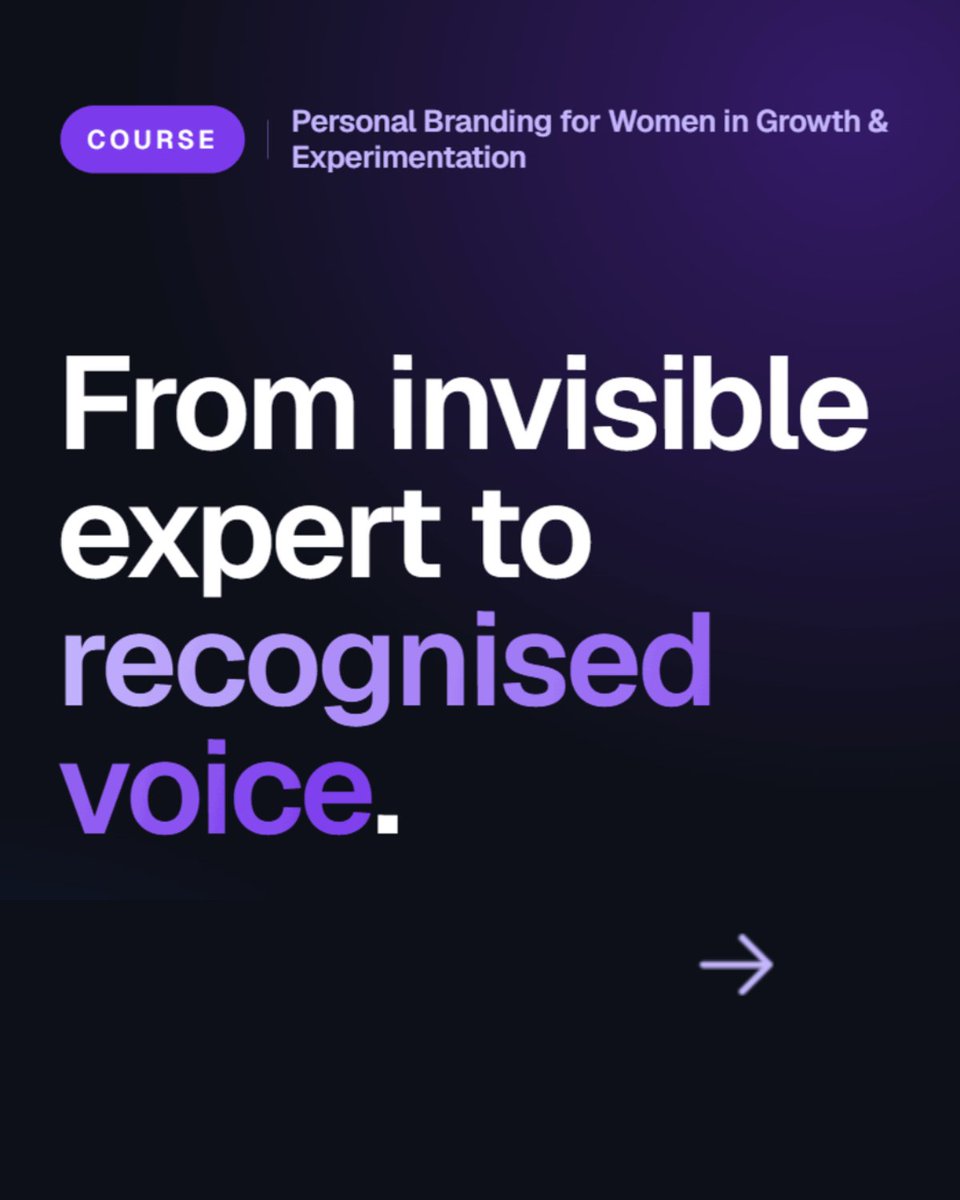
Personal Branding for Women in Growth & Experimentation is the cohort Lucia van den Brink and Daphne Tideman are running starting July 10.
The course unfolds over three weeks:
- Positioning (Week 1).
You work through the Ikigai framework, identify three content pillars, choose your channel, and map out a monetisation roadmap.
- Profile (Week 2).
You rewrite your headline (220 characters, three questions), redesign your banner, restructure your About section, and build an engagement routine that creates relationships instead of just impressions.
- Content system (Week 3).
You learn what good posts do, write hooks, find your tone of voice, edit drafts, and develop the habit of posting through writer's block.
By the end, you walk out with a positioning statement, a profile rewrite, a content system, and a published post.
Lucia runs The Initial, a CRO consultancy working with British Airways, Semrush, and Independer, and has 17K LinkedIn followers.
Daphne built a fractional growth practice entirely on inbound and has 26K LinkedIn followers. They built both alongside the work, not instead of it.
One more detail worth flagging: for every paid ticket, a free spot opens for someone in the community who's out of work or in financial difficulty.
Buying a place gives one too.
Cohort runs July 10-24, 2026.
Course outline and how to enroll: https://t.co/LwsY3nUnb5
"The silent killers of good A/B tests."
That's the first section of Deborah O'Malley's new course.
The five hours is worth it.
Deborah is the founder of GuessTheTest and a guest speaker at the Nielsen Norman Group.
Her new course is called A/B Testing: A Complete Guide.
The structure: six sections, 36 videos, five hours of content, plus practice activities.
What it covers:
- Silent killers of good A/B tests (nine lessons on what quietly breaks test reliability)
- How to choose impactful design ideas to test
- Determining sample size and testing duration
- Choosing the right testing platform
- Analyzing and presenting results stakeholders trust
The framework is built on years of analysing tests across hundreds of brands for GuessTheTest.
It covers the rigorous side: how to identify wins, losses, and inconclusive results, and how to communicate each one without overstating what the data actually shows.
Geared at intermediate-to-advanced practitioners.
Worth it if you're running A/B tests at scale or want to learn how to spot suspicious results in tests other teams ran.
https://t.co/7S54EKZNdj
Save this if you've ever used "slider" and "carousel" interchangeably.
The difference matters more than CROs realise.
Sliders rotate through one slide at a time.
Carousels show multiple slides in one frame and rotate the group.
People use both words for both things. They're not the same.
Sliders are the full-frame rotating banners most ecommerce sites have above the fold.
Carousels are the rows of logos, testimonials, or bestsellers that sit further down the page. Both rotate.
Only one of them belongs on most homepages.
Carousels earn their place when:
- Shoppers expect the format (reviews, testimonials, bestsellers)
- The carousel saves time or clicks
- Two products are worth comparing side by side
When they fail:
- They sit in the hero, where one clear message wins
- The content benefits the brand more than the visitor
- It's a "dump everything here" zone with no clear purpose
If you do use one, four things matter:
1. Make it manual. Auto-rotation almost always loses
2. Add visible arrows or dot navigation
3. Keep text inside each slide short and clear
4. Mobile swipe should work the same way as desktop
Sliders steal hero attention.
Carousels reward it when used right.
Save this for the next homepage redesign.
The fastest way to grow Shopify revenue
is also the fastest way to lose repeat customers.
Shopify price testing is the practice of exposing different visitors or cohorts to different prices, pricing structures, or price-related rules to see how those changes affect behaviour.
It usually shows up in four forms:
- Testing two or more price points for the same product.
- Testing different subscription prices or billing cadences.
- Testing tiered pricing structures or bundles.
- Testing discounts, offers, or price framing while keeping the list price fixed.
Each comes with different rules around comparability, customer fairness, and what you can actually learn from the data.
Design is the difference between revenue and resentment.
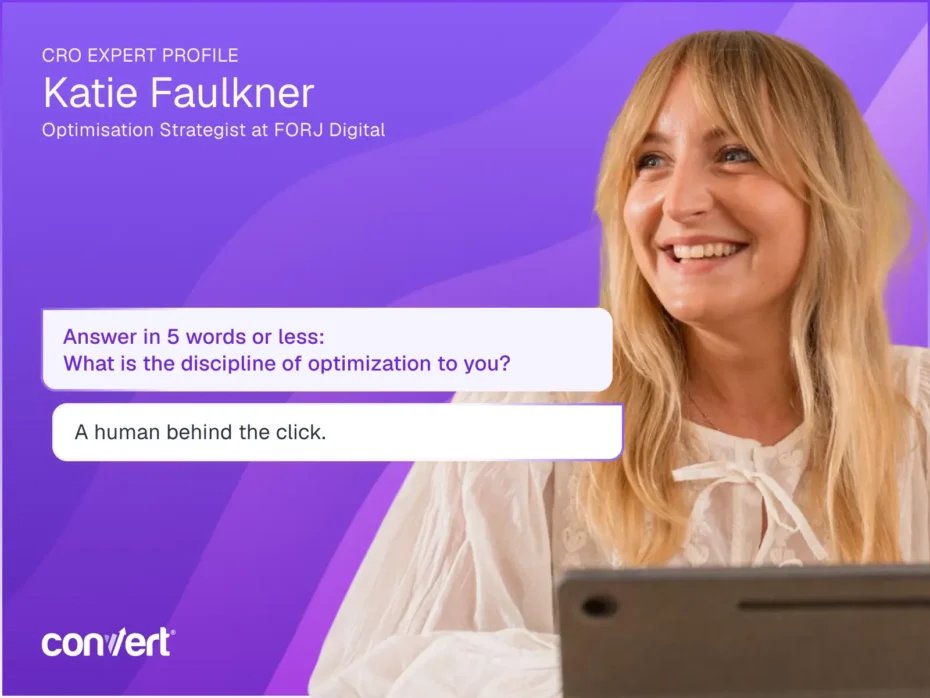
"If you want to build credibility in 2026, the best thing you can do is be human."
Katie Faulkner's correction to the AI hype in CRO.
She's the Optimisation Strategist at FORJ Digital Ltd and this year's winner of SpeakUp to Uplevel, our annual competition with Women in Experimentation.
A few lines worth pulling out:
Her 5-word definition of optimisation: "A human behind the click."
How she uses AI: "In real life, we treat AI like a member of our team. We'll give an agent a job to do, like making a report, analysing raw qualitative data, or turning research insights into a wireframe. While the agent is doing that, we'll be doing it too. We meet halfway."
Where AI fits, in her view: "I really believe that diverse minds do the best work. The best ideas come from groups of people with different backgrounds, points of view, and ways of looking at a problem. I think AI should be on that list of minds. But that's the important word: one of those minds, not the mind."
Her view of where CRO is heading: "We are all in learning mode right now, so we don't know for sure. The technology is moving faster than the rules we have for using it, and I think the best way to deal with this is to be curious instead of confident."
How work has shifted: "Work is less about the process and more about the effect now. AI has made execution easier, so instead of saying 'here's what we're doing,' we now focus more on 'here's what it means for your business.'"
Her advice for building credibility in 2026: "If you want to build credibility in 2026, the best thing you can do is be human. You don't have to show off your confidence or skills. Talk about what really interests you, what motivates you, and what makes you happy."
https://t.co/0YRdXMILso
DEPT® just joined the Convert partner network.
A 4,000-strong agency working with Google, Meta, eBay, and OpenAI.
DEPT calls itself a Growth Invention company.
The work crosses Brand & Media, Customer Experience, Commerce, CRM, and Technology & Data.
DEPT® Studios, their flagship, was built with Adobe to handle enterprise content production at scale.
Their Growth Invention Framework is the lens they use to find where growth is going next.
The 4,000+ team is split evenly between marketing and technology, working at the intersection of both for clients like Google, Lufthansa, Meta, eBay, and OpenAI.
Two details we appreciate: DEPT has been a Certified B Corp and Climate Neutral since 2021.
Values alignment matters to us when we partner up.
Welcome to the certified partner network, DEPT®.
Critical thinking is the last competitive advantage in CRO.
Dzifa Mensah on why AI hasn't changed that.
She's a Conversion Optimization Specialist with over a decade of experience across SaaS, e-commerce, and charities.
Her take on where the discipline is heading:
"Critical thinking and rigorous analysis will be the last competitive advantage. What AI can't replicate is genuine human understanding."
She means it literally: things like sitting with a user during research, noticing the hesitation in their voice, or catching the detail that doesn't show up in any dashboard. Those stay with the humans.
One story from her work makes the point cleanly.
Dzifa ran the same A/B test on French, English, and German websites. The setup was identical: same proposition, same structure, three language versions of essentially the same site. Only the English version reached statistical significance, while the other two told different stories entirely.
"It was a humbling reminder," she told us, "that localisation goes far beyond translation. Cultural context shapes how people interpret, trust, and act on information in ways that generic copy simply can't account for."
She also runs CRO for a charity, where "conversion" stops meaning what it does in ecommerce. Optimising for donations sits at the intersection of emotion, empathy, and trust, with metrics that don't sit neatly in a dashboard. A reminder that the work isn't a metric chase, even when the dashboards say it is.
Even on AI, the framing stays the same. She uses it as a thinking partner in the pre-test phase, surfacing patterns, drafting reports, and communicating results.
The mechanical work gets handled, which means the human judgement layer gets more attention, not less.
Her five-word answer on what optimisation is: "Making every interaction meaningfully better."
Full interview: https://t.co/I7UhPkD327
Unlike carousels on websites, PDP image carousels actually get used.
Despite that, plenty of brands still underuse the space.
Heatmaps and session recordings show people clicking through them, especially images 2-5, which is where they slow down to sanity-check details and decide whether to buy.
Daphne Tideman wrote about the seven things to get right.
1. Hero image: make it clear what someone's buying, especially with bundles. If there's a free gift, show it upfront.
2. Mobile-first: about half the real estate above the fold on mobile is the carousel, so one message per image and text big enough to read.
3. Images 2-5 should answer decision questions: context of use, outcomes, proof, and detail. Each slide should earn its spot.
4. Don't copy-paste the same shot five times. The 17% lift Daphne saw came from rebuilding a near-identical-shot carousel into a structured one.
5. Adjust depth to the product. Wearables need angles, close-ups, and fit shots. Consumables need clear packaging, labels, and usage demonstration.
6. Trust builders work well, as long as you keep them simple. Studies, expert endorsements, and certifications all qualify, but stick to one clear point per image.
7. Short videos can help, if done right. Keep them 5-30 seconds, understandable without sound, and closer to a loop than a brand film.
The carousel is one of the rare places on a website where shoppers will actually swipe through. It's worth giving them something useful when they do.
Daphne's full article, with all the examples:
https://t.co/pIqhg4YXpl
Funnels show you the neat paths you've designed.
Process mining shows you the paths your buyers actually take.
Nothing you find through process mining is business as usual. If you do it right, expect unexpected routes, points of fricton, and head-scratching drop-off patterns.
Process mining is humbling. After all, it is about how "off" your carefully-crafted experiences are. But the good news is, process mining with A/B testing can reconcile this difference.
Calling on the team of Alexandros Kakakis of Online Dialogue and Florien Cramwinckel, PhD for this Process Mining 101 session.
They'll cover:
1. What process mining is
2. The signs that your company is ready to embrace process mining and the data you'll need access to.
3. Live walkthrough of an actual process mining project -- complete with the "we weren't expecting this" findings.
4. How to get started with process mining - even if you've never heard of it before!
**Replay available.
Join live to get the chance to win 5x Claude usage.
PS: This session is part of our Growth Foundations series where we visit the fundamentals of good experimentation and decision-making that we can't afford to forget.
https://t.co/MLpLWxfgCf
1 in 4 people in the EU needs accessibility support.
Far fewer digital products are built with them in mind.
That's 189 million people across the EU.
Shirley van Haalem opens her talk at Women in Experimentation 2025 with the breakdown: 13 million with visual impairments, 34 million with dyslexia, and the 80% of disabilities that are invisible.
She speaks from inside that group, running CRO experiments at significant zoom on her own screen because of her own low vision.
A LinkedIn post with five emojis per line gets read out loud as "clapping hands, clapping hands, clapping hands, clapping hands, clapping hands" by a screen reader, then again on the next line.
It's the detail you only notice if you've watched someone live with it.
Accessibility is wildly underrated as a conversion lever.
Shirley uses Online Dialogue's BOOM model and notes that "ability" (making behaviour easier) is the highest-uplift strategy across their experiments.
Accessibility is just that, applied universally.
The state of the web doesn't help. 95% of the top one million homepages have detected accessibility errors, averaging 51 per page.
Today, on Global Accessibility Awareness Day, that number is worth sitting with.
Common issues include low contrast, missing alt text, and empty links, all of which are especially problematic for screen reader users.
The starting move is small.
You can run a free Wave Chrome scan on your site, test navigation using your laptop's built-in voiceover, or ask someone who isn't you to try the site cold.
Shirley's framing on the difference: good accessibility is for compliance. Great accessibility is for empathy.
The example we'll be quoting for a while: large click targets help people with limited dexterity, and people with long nails.
Good accessibility is good design for everyone.
Watch the full talk here: https://t.co/cl0B1G86Uf
Heatmaps come to Convert.
The why behind any variation is now one click away.
Three types of heatmaps are available: clicks, taps, and scrolls.
Each can be filtered by device (desktop, tablet, mobile) and by variation (original or any you're testing against).
Overlays render in real time on the actual page UI, not on a screenshot, so you're looking at the live experience users had.
In practice, the workflow is: you run a test, you see which variation won, you open the heatmap, and you see the behaviour that explains the result.
Maybe the winning variation pulled more clicks on a CTA that was buried below the fold on the original. Or the losing variation had users scrolling past the new section entirely.
That kind of detail feeds straight back into the hypothesis for the next test.
A side benefit: no more bouncing between Convert and a separate heatmap tool to figure out why a result landed the way it did.
The behavioural data and the experiment data share a view.
We took our time getting here, and it was worth it. Heatmaps now actually fit into the experimentation workflow instead of sitting next to it.
It's available now to all customers.
54.8% of 18-24s now use TikTok over Google for search.
Chantel Jordan's take on the latest SearchPulse data.
Chantel pulled out the data points that actually matter for CRO, and reframed them through three sharp lenses:
Principle of Least Effort: users go to AI because it removes friction. 61.2% value ease of use, 56.9% prioritise quick results.
The goal is faster answers, not deeper thinking.
Authority Bias: Perplexity users trust the platform 60% of the time.
ChatGPT trust sits at 43%.
Specialist AI is winning on authority, not scale.
Trust Paradox: 35% don't fully trust AI answers, and 41.5% would trust a brand LESS for advertising inside an AI conversation.
Paid attention inside AI breaks the relationship.
The takeaway for CRO teams: the new job is to become the source AI models cite, not to sit at the top of a paid placement.
Move from selling to proving.
https://t.co/2DlFfMdcdd
Best In Test 2026 happens June 10.
Free seat on Zoom, plus an hour of the year's most rigorous A/B tests.
It's run by GuessTheTest, with https://t.co/WQWQf9trqB co-hosting and EchoLogyx Ltd as technical sponsor.
Five awards go out across two tracks.
On the A/B testing side:
- Gold for the most statistically rigorous experiment
- Silver for high-impact methodology excellence
- Bronze for innovation that moves needles
For the educational content track:
- Education Impact Award for framework-focused content creators
- Community Contribution Award for high-impact methodology excellence
The prize stack for the A/B testing track:
First Place: iPhone 17 (256GB)
Second Place: iPad 11th Gen
Third Place: AirPods 4 with noise cancellation
Every winner also gets a GuessTheTest Annual Pro Membership ($497 value).
Educational content winners pick up extras: a custom eco-friendly plaque, 60 days of Convert ($800), and $250 in Claude tokens.
The whole pool tops $5,000 in value, plus spotlight features across GuessTheTest and Convert for the winners.
Wednesday, June 10 at 11 AM Eastern.
Register free: https://t.co/2sl3gk1rrm
London 2026 wrapped: three events, two weeks on the ground.
Here's what stood out.
1. Women in Experimentation meetup
This one was a proper sit-down dinner rather than a stand-up networking thing. You actually finished sentences with the person next to you.
A couple of the threads from the table are still running in our heads.
2. Convert Quests at the Experimentation Elite
We ran a treasure hunt during the Ex Elite conference. The format was simple: five teams of five took on five quests, and the fastest team to clear all of them took the win.
Each quest pushed people to think on their feet, work fast, and divide up tasks without a manual. By the second, the room was getting louder, the fun was real, and teams that hadn't met an hour earlier were strategising like they'd worked together for years.
3. Speero Circus
This was Speero's first AI and experimentation conference in London. What made it work was less the topic and more how the day was built. Every session was designed to keep the room active, not just listening.
You ended up talking through ideas with the person next to you, then comparing notes when the room came back together. The format made the AI conversation feel less abstract and more like something you could actually take home and try.
Each format worked for a different reason. The thread we kept noticing: experimentation events are getting more participatory, and the rooms that pulled that off were the ones we'll remember.
Big thanks to the Convert crew on the ground: Tiffany Fortune, Victoria Harrison, Carmen Apostu, Poonam Nagekar, Marcella Sullivan, and Vladimir Popov. 🌮
A/B testing vendors advertise snippets of 2.8KB, 13KB, 17KB.
We measured what actually loads in production.
The advertised snippet is usually just the loader.
What follows arrives after the page renders, distributed across runtime requests. Sometimes hundreds of KB.
We analysed the full execution footprint across 8 platforms: initial script, runtime-loaded resources, experiment configurations, total network requests, and timing of execution.
What we found: the smaller the reported snippet, the more likely the rest is deferred.
The total cost exists either way. Only the timing changes.
Snippet size alone is a weak metric.
Better questions to ask would be:
What is the total payload?
When is it applied?
What does the user actually experience?
Read the full breakdown here:
https://t.co/U0ZNRDm17d
Experimentation awards are open on both sides of the pond.
The first deadline closes tonight.
Three programs are taking submissions right now, each with a different angle:
- Best In Test Awards 2026 (US)
This one is co-hosted by GuessTheTest, https://t.co/WQWQf9trqB, and EchoLogyx Ltd, and it recognises the most statistically rigorous A/B tests of the year.
Three tiers on the A/B test track: Gold for statistical rigour, Silver for methodology excellence, and Bronze for innovation that moves needles. A second track recognises educational content.
Prizes include an iPhone 17 (256GB), iPad 11th Gen, AirPods 4, plus Pro memberships, Convert subscriptions, and Claude tokens. The total pool tops $5,000.
Submissions close May 15 at 11:59 PM Eastern, with the live ceremony on June 10.
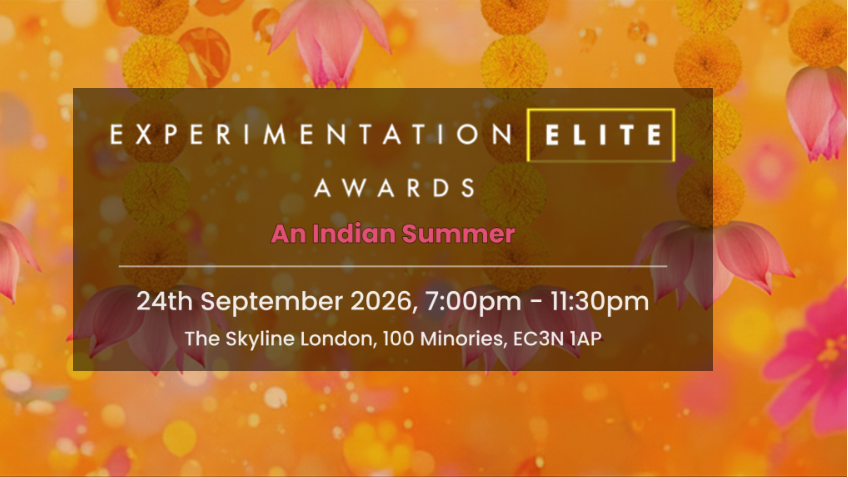
- Experimentation Elite Awards
This one is European-judged, with Campaign and Practitioner categories. The panel brings combined CRO experience approaching a century, spanning optimization, UX, statistics, and analytics.
Entries close May 26.
- Experimentation Culture Awards 2026
Hosted out of Conversion Hotel, this one recognises the teams, programmes, and cultures driving experimentation maturity. Four categories cover individuals through to organisations: Rising Star, Team, Organisation-wide, and Community Award.
The window closes May 31, with the live broadcast on July 16.
All three awards have different bars, different focuses, and different windows. Whatever you ran or built this year, one of them is the right home for it. The first window closes tonight. The others give you a bit more time to decide which entry shows your best work.
Best In Test Awards: https://t.co/2sl3gk1rrm
Experimentation Elite Awards: https://t.co/AqufcRbSeW
Experimentation Culture Awards: https://t.co/PAUsGOJ3hl