most cleaning leads dont come in at 2pm.
they come in at 10pm when someone finally sits down.
if the only option is "call us" that job goes to whoever lets them book right there.
He bought a $500,000-revenue cleaning company for just $5,000. 🤯
The owner was so burned out, she was ready to shut down the very next day. No lengthy negotiations. No months-long transition. Just a $5,000 check, a document full of passwords, and a 10-minute handover.
It was one of Derek Christian’s most remarkable acquisitions… and a powerful reminder that sometimes, the right deal comes down to solving the right problem for the right person.
But as Derek shares, the transition was far from easy.
🎙️ Watch the full conversation with Derek Christian on ConvertLabs Conversations, now live on YouTube: https://t.co/SrUbqbxaUy
What if preparing your cleaning business for sale made you realize you don’t want to sell it anymore?
Derek Christian has bought and sold 20 cleaning companies since 2008.
In Part 2 of ConvertLabs Conversations, he shares what makes a cleaning business attractive to buyers—and what can derail a deal.
We get into:
➡️ Why some owners decide not to sell after all
➡️ How competitor relationships lead to acquisitions
➡️ How messy financials can kill a deal
➡️ What buyers look for during due diligence
➡️ Why scaling sometimes means doing less
Derek also explains why you shouldn’t wait until burnout to prepare for an exit.
His biggest takeaway?
Build a business that gives you options—whether you decide to sell or keep it.
Strong systems, clean financials, and a capable team make your business more valuable and easier to run.
🎙️ Watch Part 2 of ConvertLabs Conversations with Derek Christian, now live on YouTube:
https://t.co/PExI1rKvQ0
What actually makes a cleaning business worth buying?
Derek Christian has bought and sold 20 cleaning companies since 2008.
And he's seen firsthand what makes a business attractive to buyers — and what can hurt its value.
In this episode of ConvertLabs Conversations, Derek shares how he evaluates cleaning companies, structures acquisitions, and helps owners prepare for an eventual sale.
We get into:
➡️ Why Derek bought a $500,000-revenue cleaning business for just $5,000
➡️ How buyers determine what a cleaning company is worth
➡️ Why clean financials and strong profit margins matter
➡️ How documented systems and a capable team can increase business value
➡️ Why customer retention is essential to long-term profitability
Derek also shares advice for owners who want to sell their businesses in the next year or two.
His biggest takeaway?
Build a business that doesn't depend on you to keep everything running.
Because buyers aren't just looking at what your company earns today. They're looking at whether it can continue earning money after you leave.
🎙️ Watch the full conversation with Derek Christian on ConvertLabs Conversations, now live on YouTube: https://t.co/SrUbqbxaUy
What's one of Sam Lusty's biggest sources of commercial cleaning opportunities?
His local Chamber of Commerce.
After quitting his full-time job to focus on the business, Sam joined the Erie Chamber of Commerce.
It opened his eyes to the number of local businesses and business owners he could meet simply by being in the room.
And because commercial cleaning is such a specific niche, Sam saw an opportunity to stand out.
Instead of just joining the Chamber, he's actively meeting local businesses, getting to know business owners, and building relationships.
Now, it's become one of the channels he's focusing most of his efforts on.
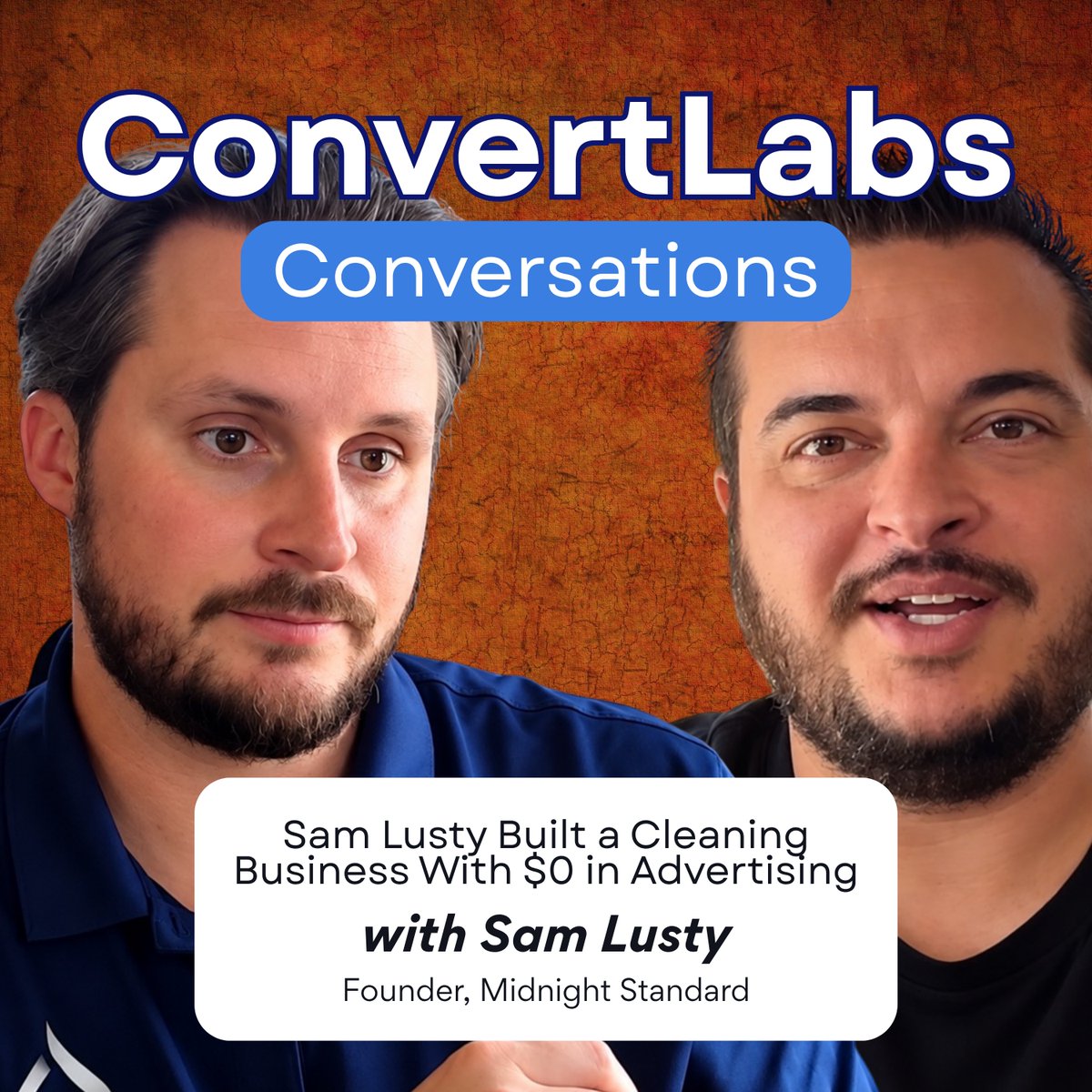
🎙️ Watch the full conversation with Sam Lusty on the latest episode of ConvertLabs Conversations, now live on YouTube:
https://t.co/araVeEAgYi
What if you could grow a cleaning business without spending money on advertising?
Sam Lusty says his companies currently spend $0 on advertising. NADA!
When he first started Clean Cruise, he experimented with a third-party lead service.
It got him his first few clients… but he quickly realized prospects were being contacted by multiple cleaning companies at once.
So he changed his approach.
He started meeting customers in person, building relationships, and focusing on word-of-mouth referrals.
Then he built up his online presence through a website, Google Business Profile, and Google reviews.
And those organic channels have continued to pay dividends.
🎙️ Watch the full conversation with Sam Lusty on the latest episode of ConvertLabs Conversations, now live on YouTube:
https://t.co/araVeEAgYi
What if your cleaning company stopped trying to be everything to everyone?
Sam Lusty started Clean Cruise about two years ago on the residential side.
Today, commercial cleaning makes up more than 70% of his client base and about 80% of his revenue.
His approach?
Specialize.
Build local relationships.
And become the company people actually want to refer.
In this episode of ConvertLabs Conversations, Sam shares how he built the commercial side of his business through relationships, word of mouth, Google reviews, local networking, and a strong focus on the businesses he can serve best.
We get into:
➡️ Why Midnight Standard focuses specifically on commercial cleaning
➡️ How Google Business Profile and reviews generate organic leads
➡️ Why some customers are finding Sam through AI
➡️ How joining the local Chamber of Commerce opened new opportunities
Sam also talks about something every aspiring entrepreneur can relate to: analysis paralysis.
His advice?
Don't wait until you have everything figured out.
Try something.
Get comfortable being uncomfortable.
Learn from what happens.
Then keep going.
🎙️ Watch the full conversation with Sam Lusty on ConvertLabs Conversations, now live on YouTube: https://t.co/araVeEAgYi
Here's a customer-service tactic Wyatt uses that most cleaning companies aren't doing.
Instead of waiting until the cleaning is finished (or waiting for the customer to complain), his sales team calls while the cleaner is still working.
They simply ask:
“How's the cleaning going right now?”
It's proactive.
The customer gets a chance to speak up immediately, while the cleaner is still there.
And according to Wyatt, most customers simply say everything is going great.
Sometimes the best way to prevent a bad review is to catch the problem before the job is even finished.
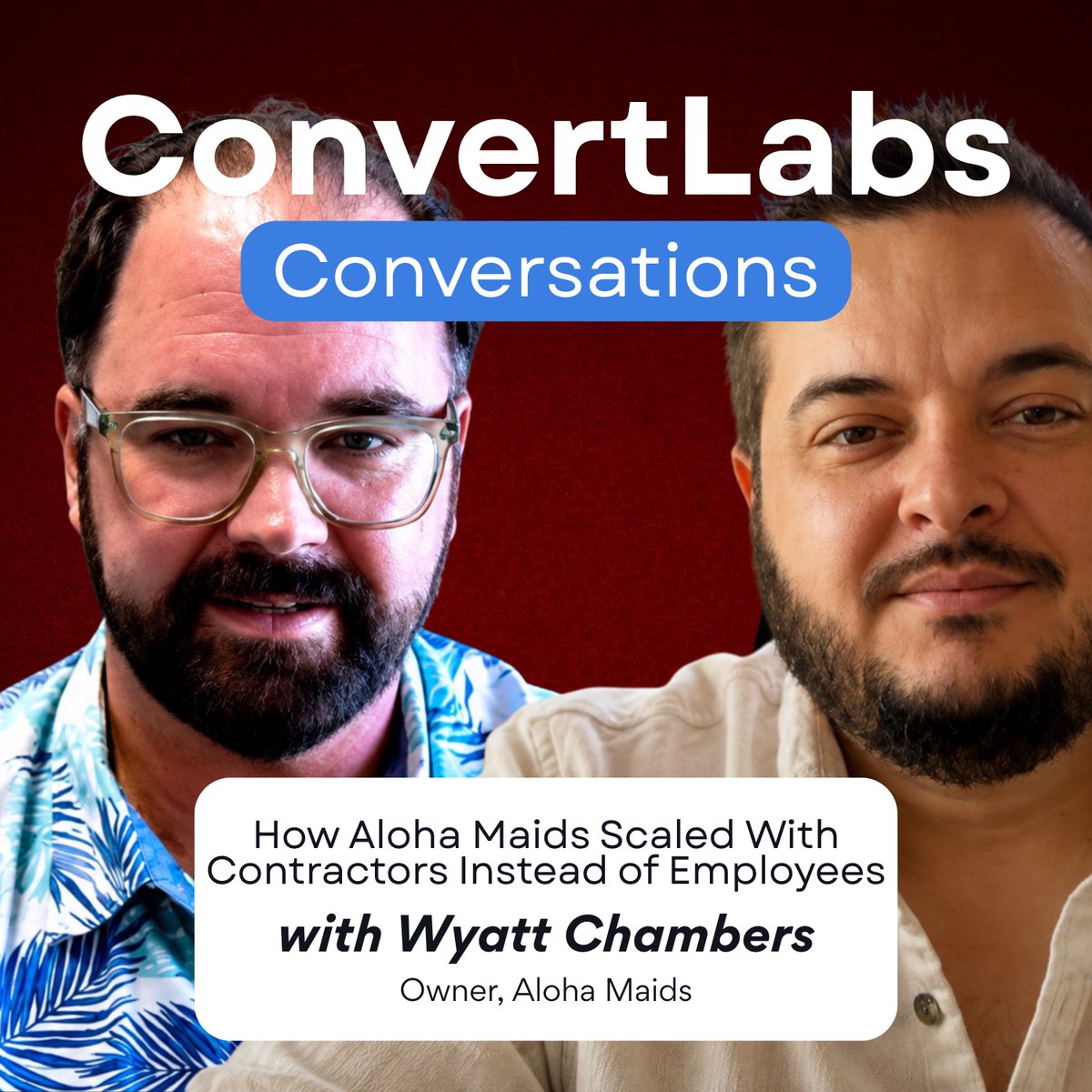
🎙️ Watch the full conversation with Wyatt Chambers on the latest episode of ConvertLabs Conversations, now live on YouTube:
https://t.co/agkb50Ay2H
Before & after photos aren't just for showing off your work.
They can protect the cleaner, too.
Wyatt Chambers explains why his team encourages contractors to document jobs—and then Kevin reveals how ConvertLabs built before-and-after photos directly into the app.
With thousands of cleaners using the app every day, that creates an incredible amount of documentation.
And Wyatt’s verdict?
“If I were starting new right now… I would start with Kevin Pereira’s ConvertLabs.”
🎙️ Hear why on the full episode. https://t.co/agkb50Ay2H
When you're sending cleaning professionals into customers' homes, safety can't be an afterthought.
Jamie explains some of the protocols her cleaning business uses to protect both customers and cleaning professionals.
Customers don't get the cleaner's last name.
Cleaning professionals don't get the customer's phone number.
Communication stays between the customer and the office.
And if a home is being cleaned while it's empty, other vendors aren't allowed to be inside at the same time.
These may seem like small details, but they're important boundaries when your employees are regularly entering private homes.
The goal is to create clear separation between the customer and the cleaning professional while making sure the business remains the point of contact.
For cleaning business owners, having these protocols in place can help create a safer and more professional experience for everyone involved.
🎙️ Watch the full conversation with Jamie Reader on the latest episode of ConvertLabs Conversations, now live on YouTube:
https://t.co/oqZ7WI5o8M
I asked Wyatt exactly what happens after an applicant comes in (from the application to actually sending that cleaner out on a job).
Wyatt says Aloha Maids uses a detailed online form with conditional logic to screen applicants before moving them forward.
They look at things like:
➡️ Cleaning experience
➡️ Whether they have their own equipment
➡️ Whether they have reliable transportation
➡️ Their answers to cleaning-specific questions
But he adds that there’s another quality that matters just as much as cleaning ability:
Can they deal with customers?
Because some people can clean.
Some people are great with customers.
When you find someone who can do both?
“You’ve found gold.”
For cleaning business owners, recruiting isn’t only about generating applicants.
The real system is what happens after the application comes in.
🎙️ Watch the full conversation with Wyatt Chambers on the latest episode of ConvertLabs Conversations, now live on YouTube:
https://t.co/agkb50Ay2H
Aloha Maids’ cleaner walked into a home during COVID and found a dead body.
The team tried to protect cleaners by asking the usual questions before a job—Is the water on?
Is the electricity working?—but there’s no way to ask about something you never expect to encounter.
After that experience, the cleaner wouldn’t take another job.
What’s the craziest thing you’ve ever encountered on a cleaning job?
🎙️ Watch the full conversation with Wyatt Chambers on the latest episode of ConvertLabs Conversations, now live on YouTube:
https://t.co/tHrtH4iror
Most Cleaning Businesses Don’t Have a Hiring Problem
They have a customer acquisition problem.
Sam says getting good leads, closing them, and figuring out where to invest your limited marketing budget is one of the biggest challenges when starting a cleaning business.
And he sees the same pattern over and over:
The people who succeed figure out how to consistently acquire customers.
The people who don't?
They never crack that part of the business.
You can have great cleaners.
You can have a great website.
You can have the perfect systems.
But if you can't consistently generate customers, none of it matters.
Customer acquisition is the real bottleneck.
🎙️ Watch the full conversation with Sam on the latest episode of ConvertLabs Conversations, now live on YouTube:
https://t.co/dpvzlprhTz
The cleaning business gets CRAZY behind the scenes…
In Part 2 with Wyatt Chambers of Aloha Maids, we get into some stories you honestly couldn’t make up.
👜 A customer accused a cleaner of stealing a purse…
🏠 An employee allegedly pretended to be a customer to get new floors…
😳 A cleaner walked into a home and found a BODY.
✈️ And somehow, Wyatt built a business that lets him travel while dozens of jobs are happening without him sitting in the office.
But one of the biggest takeaways?
Wyatt says if he were starting a cleaning business from scratch TODAY, he’d choose ConvertLabs.
We talk about the wild side of the industry, building with contractors, virtual assistants, surviving downturns, and how the right technology can completely change the way you run a cleaning company.
If you’re in the cleaning business or thinking about starting one, you’ll want to listen to this.
🎙️ Watch the full conversation with Wyatt Chambers on ConvertLabs Conversations, now live on YouTube: https://t.co/agkb50Ay2H
Getting applicants isn't the hard part.
The hard part is figuring out which ones are actually worth hiring.
Sam explains how his cleaning business filters roughly 100 applicants down to about 20, then down to fewer than five people for interviews.
And they're specifically looking for what Sam calls a "whale" cleaner… someone who can take on a meaningful number of jobs, consistently do great work, and grow with the company.
He also explains why having years of commercial cleaning experience doesn't necessarily make someone a great residential cleaner.
Because residential cleaning requires a completely different skill set.
And once someone makes it through the interview?
They still have to prove themselves through a test clean.
🎙️ Watch the full conversation with Sam on the latest episode of ConvertLabs Conversations, now live on YouTube:
https://t.co/dpvzlprhTz
How does a 17-year-old cleaning company actually get new customers?
Kevin asks Molly what Green Sweep's marketing looks like.
Her answer includes:
Google Ads.
Yelp.
Nextdoor.
Meta Ads.
But there's one strategy that's worked especially well for them:
Molly herself.
Because when you're sending cleaners into someone's home, trust matters.
So instead of hiding behind polished corporate advertising, Molly gets in front of the camera and talks directly to potential customers.
She's the owner.
She's been running Green Sweep for 17 years.
🎙️ Watch the full conversation with Molly Moran on the latest episode of ConvertLabs Conversations, now live on YouTube:
https://t.co/EShomsZWFX
Wyatt started Aloha Maids after losing many of his clients during the recession.
But as he learned the business, he realized something important:
His cleaners didn't want to work the way he envisioned.
Hawaiian shirts? No.
Equipment he provided? They preferred their own.
So Wyatt changed his approach.
Instead of trying to control every detail, he shifted to a contractor-based model.
That allowed him to focus on customer service and marketing while his cleaners focused on cleaning.
That shift became a major part of how Aloha Maids scaled.
Today, Wyatt's company operates across Southern California and has expanded into markets like Las Vegas, Dallas, and Jacksonville.
But scaling isn't just about finding more cleaners.
It's about building systems around them:
➡️ Online applicant screening
➡️ Conditional logic to filter candidates
➡️ A dedicated recruiter
➡️ Craigslist recruitment
➡️ Technology to track performance
➡️ Customer feedback to evaluate cleaners
➡️ Separate teams for sales, dispatch, marketing, SEO, and web design
Wyatt's philosophy is simple:
You don't have to be the best cleaner. You need to find the right people, trust them, and put them in the right roles.
That's the mindset shift from running a cleaning business to building a cleaning company.
🎙️ Watch the full conversation with Wyatt Chambers on ConvertLabs Conversations, now live on YouTube.
https://t.co/tHrtH4iror
A full schedule doesn't always mean you should stop marketing.
Jamie explains why cleaning business owners can get themselves into trouble when they turn off their ads simply because they're temporarily short on cleaners.
It feels logical:
"We don't have enough people to take more jobs, so let's stop bringing in customers."
But that can create a cycle where the business loses momentum as soon as capacity opens back up.
Instead, Jamie explains how owners can think about capacity and demand together, continuing to build their pipeline while using available capacity strategically.
Because staffing problems and marketing problems don't happen independently.
If you wait until you desperately need customers to start marketing again, you're already behind.
🎙️ Watch the full conversation with Jamie Reader on the latest episode of ConvertLabs Conversations, now live on YouTube:
https://t.co/oqZ7WI5o8M
According to Jamie Reader, being overstaffed isn't actually a problem; it's a growth strategy.
A lot of cleaning business owners make the same mistake:
They get understaffed → panic → turn off their ads → stop hiring.
And then a cleaner quits.
Suddenly, they don't have enough people to service the customers they're generating.
Jamie takes the opposite approach.
She'd rather be slightly overstaffed than constantly scrambling to catch up.
Because when you're understaffed, the consequences can show up months later.
You don't have enough trainers.
You can't onboard new people fast enough.
You have to rely on cleaners you might not want to rely on.
And eventually, customer experience suffers.
Instead, Jamie keeps hiring and uses excess capacity as an opportunity to generate more bookings.
She talks about using last-minute specials, giving sales teams incentives to fill new cleaners' schedules, and eventually using scorecards to identify and remove underperformers.
But staffing isn't the only system Jamie has built.
Reviews are another major part of the business.
Her Raleigh location has approximately 1,100 Google reviews, and she explains how directly asking customers for reviews helped accelerate their growth.
She also believes businesses need to respond to every review, including negative ones.
And sometimes the right answer isn't giving the customer whatever they want.
Sometimes, you have to fire the customer.
Jamie explains why not every customer is a fit, how her sales team looks for red flags, and why protecting cleaning professionals is a non-negotiable part of running the business.
The conversation also dives into Google Ads, customer acquisition, sales training, call grading, team coaching, and AI.
GoJambee has built an AI chatbot that can:
➡️ Answer customers after hours
➡️ Provide pricing
➡️ Send booking links
➡️ Create follow-up tasks for sales reps
➡️ Route leads to the appropriate team member
➡️ Help businesses follow up the next business day
The bigger lesson?
Scaling a cleaning business isn't just about getting more customers.
It's about building the people, processes, training, technology, and standards that allow you to handle those customers consistently.
🎙️ Watch the full conversation with Jamie Reader on ConvertLabs Conversations, now live on YouTube: https://t.co/L65E6f1Khk
How do you build three cleaning businesses that generate $140K/month — without being physically present in any of them?
@SamCleaningCEO started his first cleaning business in 2022 while living in New York City. About a year later, it had reached roughly $60K/month.
Then he opened a second location in Canada.
That business has grown to around $40K/month and is mostly recurring revenue.
Then came a third location.
Today, the three businesses generate approximately $140K/month collectively, using a fully remote model and subcontracted cleaners.
And Sam's story is especially interesting because cleaning wasn't where he started. Before becoming a cleaning business owner, he worked in private equity in New York, regularly putting in 50–80 hour weeks.’
He wanted something different.
Something asset-light.
Something he could build without buying trucks, equipment, or a massive physical infrastructure.
So he started a cleaning company.
And the results came quickly.
His first month generated around $4K.
By month four, he was around $20K/month.
He quit his corporate job and never looked back.
In this episode of ConvertLabs Conversations, Kevin and Sam break down:
➡️ How he built a remote cleaning company from scratch
➡️ How he scaled the first location to $60K/month
➡️ How he expanded into multiple markets
➡️ Why positioning matters
➡️ High-ticket vs. recurring cleaning
➡️ Google Ads and customer acquisition
➡️ Why SEO can compound over time
➡️ How to hire great cleaners
➡️ The hiring funnel he uses with Indeed
➡️ His Facebook Group strategy for finding professional cleaners
➡️ Why you shouldn't hand your entire business to one VA
➡️ How to build systems before outsourcing
➡️ Why the remote cleaning model has changed in 2026
➡️ How to think about market selection
➡️ Building a cleaning business as a lifestyle business
➡️ The future of AI and automation in cleaning
One of the biggest takeaways?
Customer acquisition is where most cleaning businesses get stuck.
Sam says hiring is something most owners eventually figure out, but finding a consistent source of good customers is where businesses can experience major bottlenecks.
And his advice isn't to blindly pick one marketing channel.
Test.
Track.
Find what works in your market.
Then double down.
If you're thinking about starting a cleaning business, or you're already running one and trying to figure out how to scale it, this conversation is packed with practical strategies.
🎙️ Watch the full conversation with Sam on ConvertLabs Conversations, now live on YouTube: https://t.co/dpvzlprhTz