🚨 BREAKING: A federal appeals court just ruled the Democrat-controlled House UNCONSTITUTIONALLY passed the $1.7 TRILLION spending bill in 2022!
The issue? Pelosi-era PROXY VOTING.
Lawmakers counted as present weren’t physically there, violating constitutional quorum requirements.
MASSIVE ruling!
In December 1941, Japanese troops captured an American surgical nurse in the Philippines.
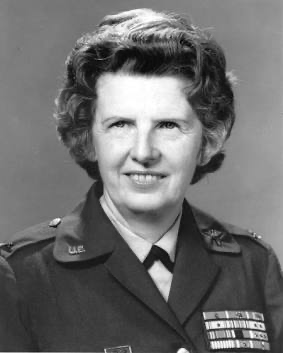
Colonel Ruby Bradley, United States Army Nurse Corps.
For the next 37 months, she ran an operating room inside a prison camp while starving alongside her patients.
Her name was Ruby Bradley.
Born in West Virginia in 1907, she taught school before joining the United States Army Nurse Corps in 1934.
In 1943, the Japanese Army locked her inside the Santo Tomas Internment Camp in Manila with thousands of prisoners.
Food was scarce and people were dying in the barracks every week.
Ruby refused to leave the hospital ward.
As starvation stripped the weight from her bones, her uniform hung loose on her frame.
She used the empty space under her clothes to smuggle surgical tools, soap, and medicine past armed guards into the clinic.
Whenever she saw starving children crying in the dirt, she gave them her own small food ration and went to sleep hungry.
Over three years in captivity, she assisted in 230 major surgeries and helped deliver 13 babies behind barbed wire.
The prisoners called her one of the Angels in Fatigues.
On February 3, 1945, American tanks smashed through the camp gates and set them free.
Ruby walked out weighing just 86 pounds.
Everyone expected her to go home and leave the military forever.
She refused to quit.
Then war broke out in Korea in 1950.
At age 42, Ruby volunteered for the front lines as Chief Nurse of the 171st Evacuation Hospital.
In one afternoon in November 1950, her team treated 780 wounded soldiers in the bitter cold.
Days later, 100,000 Chinese troops surrounded her hospital in Pyongyang.
With enemy artillery shelling the city, commanders told Ruby to take an early flight to safety.
She refused to board a plane while wounded men were still lying in the snow.
With shells exploding nearby, she stayed on the freezing runway and loaded every injured soldier onto transport planes first.
She was the last one out.
Seconds after she stepped onto the final plane, an enemy shell blew up the ambulance she had just left behind.
She later led 500 combat nurses across Korea and became the third woman in United States Army history to reach the rank of Colonel.
She retired in 1963 with 34 medals for bravery, died in 2002 at age 94, and was buried at Arlington National Cemetery.
Across two wars, three years in a prison camp, and an enemy siege, she never once left a patient behind.
In 1944, thousands of Japanese on Saipan hid in caves, sure the Americans would torture them if they came out. Many families chose the cliffs instead.
An 18-year-old American Marine from East Los Angeles walked up to those caves at night, alone, and called to them in Japanese.
His name was Guy Gabaldon. He was a Mexican American kid who had grown up partly in the home of a Japanese American family, the Nakanos. That is where he picked up his Japanese. When the war came, the Nakanos were sent to internment camps. Their twin sons, Lane and Lyle, joined the U.S. Army anyway and served in the 442nd.
Fifty years later, he still said it plainly: "These were Americans."
On Saipan, Gabaldon was a scout with the 2nd Marine Regiment. Right after landing, he slipped off on his own and came back with prisoners. His commanding officer, Capt. John Schwabe, threatened him with a court-martial for leaving his post.
The next night, he came back with about fifty.
After that, they let him go out alone.
He crawled to the cave mouths in the dark and promised the people inside water, medical care, and that nobody would hurt them. Night after night, ten or twenty at a time, they followed him out.
On July 8, by his own account, about 800 came out in a single day. Schwabe remembered that day too. It was the day they tagged him the Pied Piper of Saipan.
Not everyone listened. At the cliffs, he begged a mother not to kill her child. He watched her throw the baby and jump. He was still talking about it fifty years later.
His Navy Cross citation says that on Saipan and Tinian he brought in "well over one thousand enemy civilians and troops."
Schwabe recommended him for the Medal of Honor. He received the Silver Star. Sixteen years later, after Hollywood made a movie about him, the Navy upgraded it to the Navy Cross.
He died in 2006 and is buried at Arlington National Cemetery.
I am Japanese. Those caves were full of my people, frightened, starving, and certain that the Americans were monsters.
An American teenager walked toward them in the dark and offered them water.
On this Veterans Day, Japan should know his name.
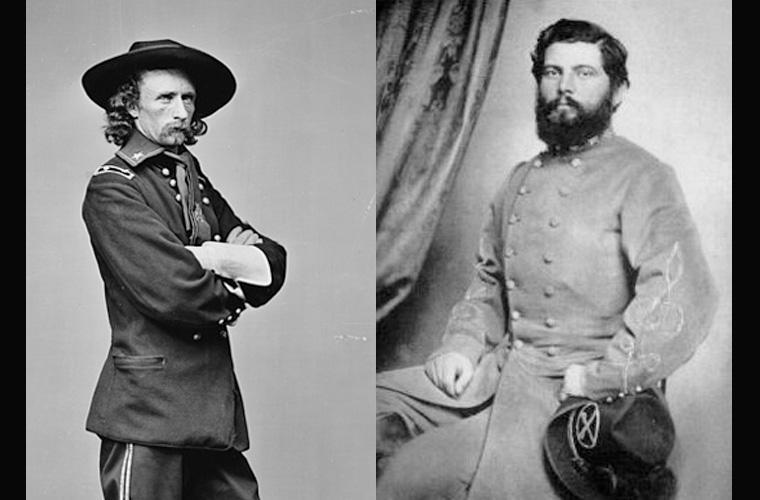
At West Point, George Custer and Thomas Rosser were close friends. Custer was the class clown from Ohio who racked up demerits. Rosser was a big, tough Texan everyone liked. They pulled pranks together and spent their free time together.
In May 1861, just weeks before graduation, Rosser resigned and went south to join the Confederacy. Custer graduated last in his class and went straight into the Union army.
Over the next three years both men rose fast. By 1864, at just 24 and 28, both were cavalry generals.
And in October 1864, they found themselves facing each other in the Shenandoah Valley.
Rosser had been sent to stop Union cavalry from burning the valley. He'd been calling himself the "Savior of the Valley" and was hounding Custer's rear guard every day.
On October 9th at Tom's Brook, the two old friends lined up across from each other.
Before the fight started, Custer spotted Rosser through his field glasses. He rode out alone in front of his men, swept off his hat, and bowed to his old classmate.
Then he charged.
Rosser's line collapsed. His men fled so fast and so far that Union troops nicknamed it the "Woodstock Races." The chase went on for roughly 20 miles.
Custer's men captured Rosser's headquarters wagon, including his personal baggage and his dress uniform.
So Custer put it on.
He wore Rosser's Confederate coat around camp, then sent his friend a note across the lines. He thanked him for the gift and asked if Rosser could have his tailor make the coattails a little shorter next time.
The war ended six months later, and the friendship survived it.
In 1873, Rosser was chief engineer for the Northern Pacific Railroad, surveying a route through the Yellowstone country. The cavalry escort assigned to protect his crews was the 7th Cavalry, led by Custer. The two old friends spent that summer together on the plains, swapping stories around the campfire.
Three years later, Custer was killed at the Little Bighorn.
As the newspapers started picking apart his decisions, one of the loudest voices defending him was the former Confederate general he'd once humiliated at Tom's Brook.
Thomas Rosser stood up for his friend until the end.
I'm Iranian. I've lived under the Islamic Republic for decades. I've seen how they ruined my country and took away our freedoms and every single right we had.
They control what you can wear, what music you can listen to, how you behave in public, and even how men and women are allowed to interact. Women are forced to follow a dress code. Women can't even sing solo in public. Dancing can get you in trouble. Drinking alcohol is illegal. Having a private party with men and women together can get your home raided and everyone arrested. Relationships outside marriage are criminalized. Even what you can watch, listen to, say, and post online is subject to censorship. Social media platforms are blocked. You can be punished, imprisoned, or even executed for speaking out against the regime.
Your own home isn't necessarily safe from their interference. Your private life isn't yours. Your freedom isn't yours. They want to dictate how you live, from the moment you wake up to the moment you go to sleep.
This is the country I grew up in. This is what I experienced. They took so much from me that I was eventually forced to flee my own country.
America, I'm terrified for you. I know exactly where this road leads. I've watched it. I lived it.
🚨 IT'S OFFICIAL: Florida APPROVES Amendment 3 — phase out homeowner property taxes with 62% PERCENT of the vote
DESANTIS: "Had Amendment 3 not been on the ballot, I don't know that we'd turn out the voters that we turned out...many of them voted Republican."
This is HISTORY! ☀️
This coming year, the value of a home 100% EXEMPT from property taxes goes to $150,000, then $250,000, then the legislature is directed to have a plan in place to phase it out entirely
MANY people with homes $250K and under will no longer pay ANY primary property tax rent to the government, and residents in the $300K-500K range see MAJOR tax cuts
The year is 180. You are a gladiator in Ephesus, and the films will give you a body like a bronze statue. You are fed barley porridge and beans, and the crowd calls you a barley man to your face. The porridge puts a layer of fat over your muscle so the cuts bleed instead of killing, which is good for the show. The man who owns you dines on dormice rolled in honey and poppy seed. When your bones are dug up eighteen centuries later they are full of barley and almost nothing else, and a man at a university will call your diet plant-forward.
The year is 1300. You are a villein on a Hampshire manor, living, as the brochure will one day put it, in harmony with the land. The land gives you pottage: peas, beans and oats in the one pot, every day, until you die of it at forty. The hall above you smells of venison from the lord's own park, roast pork, eel, swan, butter from cows you milked before dawn. Take one deer from his wood and you lose a hand. The court that decides it sits in his hall, after dinner.
The year is 1755. You are a Highland tenant eating oatmeal three times a day, and in London Dr Johnson has just printed his dictionary. Oats: a grain which in England is generally given to horses, but in Scotland supports the people. The laird at the head of your glen finds this very funny over his beef. The beef was driven to market past your door.
The year is 1795. You are a Berkshire farm labourer and a clergyman is at your table with a notebook, writing down what your children eat. Bread. Tea. A little cheese. Bacon on Sunday if the pig did well. He prints it as a national disgrace. The squire you work for has a joint every day of the year and is told from the pulpit that your trouble is thrift.
The year is 1847. You are in County Clare and the potatoes have gone black in the ground for the second year running. Your family lived on them, ten pounds a day for a working man, and you are sitting in a cabin with nothing. At the harbour the ships are loading cattle, pigs, butter and bacon for England, under armed guard. The agent on the quay looks well. So does the bullock walking up the gangplank past the people who raised it.
The year is 1933. You are in a village outside Kharkiv. The grain quota has been collected, then collected again, then the brigades have come with iron rods to probe the floors for anything buried. Your children are eating boiled bark, and the dog next door has stopped barking. In the district town there is a shop for Party members with a curtain over the window. Behind the curtain there is sausage.
The year is 1997. You are in North Pyongan and the rations stopped months ago. You are stripping the inner bark from pines and boiling grass, and the famine will take hundreds of thousands before it ends. The Dear Leader's personal chef is flying to Japan for tuna, to Denmark for pork and to Iran for caviar, and will write a book about it.
The year is 2026. You are in a supermarket in England. The posters say eat less meat for the planet. The spread is plant-based, the cereal has a heart on the box, and the beef carries a warning about its footprint. You take the lentils, because you are a responsible person, and you pay more for them than the villein's pottage ever cost anyone.
The people who put the posters up flew to the climate conference, and the menu had beef on it. They eat what the lord ate, what the laird ate, what the agent on the quay ate, what the man behind the curtain ate.
Two thousand years, and the diet of grain and beans was always what the powerful handed down to the people beneath them. Everyone at both ends of the table knew what it meant.
Now it has a name, a logo and a moral, and for the first time in history the peasant is paying extra for it.
🚨HOLY CRAP!!!
A White man in Illinois GOES BALLISTIC on a Black family who took 40 JUICE BOXES off his porch during Halloween.
White Homeowner: "YOU STOLE FORTY JUICE BOXES!!!! You took EVERYTHING! YOU ARE THIEVES!!
Black Mother: "Well then you shouldn't put it outside..."