Domestic Policy @MLInstitute, Canada's leading independent, nationally focused think tank. Pursuer of ordered liberty, and the True, Good and Beautiful.
Ben Woodfinden made this argument, which the Globe editorial board is making today, over a week ago in the Post.
The timeframe from our pages to the Globe editorial page is condensing.
https://t.co/sj01P6t5t8
https://t.co/JJvSx9BxQl
How should Canada better manage the distribution of asylum seekers across provinces?
MLI Senior Fellow Michael Barutciski testified before the Standing Committee on Citizenship and Immigration on the provincial distribution of asylum seekers in Canada, offering insights into the challenges, policy considerations, and impacts on provinces, communities, and Canada’s immigration system.
Peter Copeland and Jamie Tronnes: The legislation is sorely needed, but it must not be allowed to weaken privacy protections and cybersecurity
https://t.co/HXsHnpkrIh
This is one of a slew of surprisingly sane articles from the Globe in recent weeks. The court didn't get SO or homelessness right, but I may have to stop calling it the Grope and Flail. It may yet regain its reputation and reclaim 'newspaper of record' status.
The narrative that MAiD provides a peaceful, beautiful death every time is false.
One patient cried "help me" and showed signs of distress during MAiD. Bradley Stewart resumed breathing after being declared dead, leaving his family traumatized. In one study, one-third of family members described the MAiD death as traumatic.
Informed consent requires disclosure of complications and adverse outcomes, not just promises of a beautiful death.
My comments in Sharon Kirkey's National Post article 👇
https://t.co/iOlAnSExYt
It’s important Canada obtains the lawful access framework that Stephen Harper’s government tried to implement over a decade ago. We cannot credibly ask to be treated as a trusted partner while lagging behind all G7 and Five Eyes counterparts, and most European countries with lawful access frameworks. Nor will violent crime be blunted solely by bail reform and mandatory minimums—measures which target the foot soldiers of increasingly foreign-state influenced transnational organized crime, which must be combatted with better digital tools.
The bill leaves much to be defined in regulation, and given the cybersecurity vulnerabilities present based on recent experience in the US, and the threats to privacy from governments around the world, the encryption and metadata requirements need to be spelled out clearly in legislation. So too, do the ministerial powers need to be constrained, so we don’t repeat what happened in the UK with Apple’s product line that had to be removed.
But the need is clear. Intelligence and police primarily need location and transmission-based tracking information - non-content-based information - and not every possible linkage to and between a users' metadata.
Some industry and privacy concerns have been overstated in this regard. For example, where encrypted content is truly necessary, police can already seek judicial authorization for targeted on-device investigative tools that access data at the endpoint, where it may be readable, without requiring provider-level backdoors that weaken encryption for everyone. But for these tools to be more effective, they need access to the location and transmission metadata that other countries already require retention of.
The irony is that Stephen Harper recognized this, and tried to bring forward lawful access multiple times, decades ago, before the Spencer privacy ruling that blocked an overly broad version of lawful access. That’s where we are with today's version that has ‘confirmation of service order’ capabilities that meet the Spencer threshold, as the entry point for the lawful access regime.
Glad to work with my colleague Jamie Tronnes of @CNAPS_ to make the case for this important tool with the appropriate amendments in place. @MLInstitute
“Canadian lawmakers must understand that any measures that pose a security risk or threaten the competitive advantage of digital giants will land on the White House’s radar, and draw attention from legislators on both sides of the congressional aisle…To address these concerns, Parliament must build safeguards directly into the legislation, not leave them to regulation or ministerial discretion. The law should clearly state that no regulation, compliance order or penalty may require a provider to weaken, or prevent, the use of end-to-end encryption — a term that should be defined as exhaustively as necessary to eliminate any loopholes,” write Peter Copeland (@CopelanPeter) and Jamie Tronnes in the @nationalpost.
Read here⬇️
https://t.co/irEB9ssgtJ
“Canadian lawmakers must understand that any measures that pose a security risk or threaten the competitive advantage of digital giants will land on the White House’s radar, and draw attention from legislators on both sides of the congressional aisle…To address these concerns, Parliament must build safeguards directly into the legislation, not leave them to regulation or ministerial discretion. The law should clearly state that no regulation, compliance order or penalty may require a provider to weaken, or prevent, the use of end-to-end encryption — a term that should be defined as exhaustively as necessary to eliminate any loopholes,” write Peter Copeland (@CopelanPeter) and Jamie Tronnes in the @nationalpost.
Read here⬇️
https://t.co/irEB9ssgtJ
I'm prepared to go to jail over this.
My grandmother Rita Pete went to St. Mary's Indian Residential School. She experienced terrible abuse. As a consequence, she struggled with alcohol use most of her life.
My mother was born with FASD as a consequence of her using alcohol to cope with her trauma.
I am Chief of my community Chawathil First Nation. I am working to address the longstanding impacts of these past policies through renovating homes, building new homes, creating childcare, and growing businesses through economic development.
I have interviewed people who went to Indian Residential Schools. I have interviewed people who believe Indian Residential Schools were awful, horrible schools, meant to remove the Indian from the child.
I've also interviewed people who believe they were well intended, generous investments by Canadian taxpayers meant to assimilate a society and had shortcomings.
Like with many things, the history is dark, complicated, and with any policy that existed for a long time, across a whole country - there were different experiences.
No one story tells us everything. No report shares the full experience of the individuals who went. No commentator today can disprove someone's lived experience with statistics.
The path forward is not to criminalize speech, questions, or debate.
The path forward is empathy for past attendees.
The path forward is truth based on facts.
The path forward is real conversations.
The path forward is to lean into complexity.
If the government criminalizes this, then I will be a criminal for having these conversations.
If I am a criminal by the laws definition, then I am committed to going to jail over this.
"Why are you so concerned about MAiD?"
Because a lack of access to care, failure to provide treatment and support, and discrimination based on age, disability, poverty, or other vulnerabilities can influence a person's request for MAiD and also unconsciously affect the MAiD provider's decision to approve them. Choices are not made in a vacuum.
Because I've been notified of cases that troubled me enough to report.
Because families have described traumatic deaths.
Because MAiD protocols have not always been followed.
Because a man in his 40s was approved for MAiD after a single assessment at a Tim Hortons despite untreated addiction and mental illness.
They're real people who matter.
My conversation with Andrew Brown on London Morning:
https://t.co/Nk1sYKbhAi
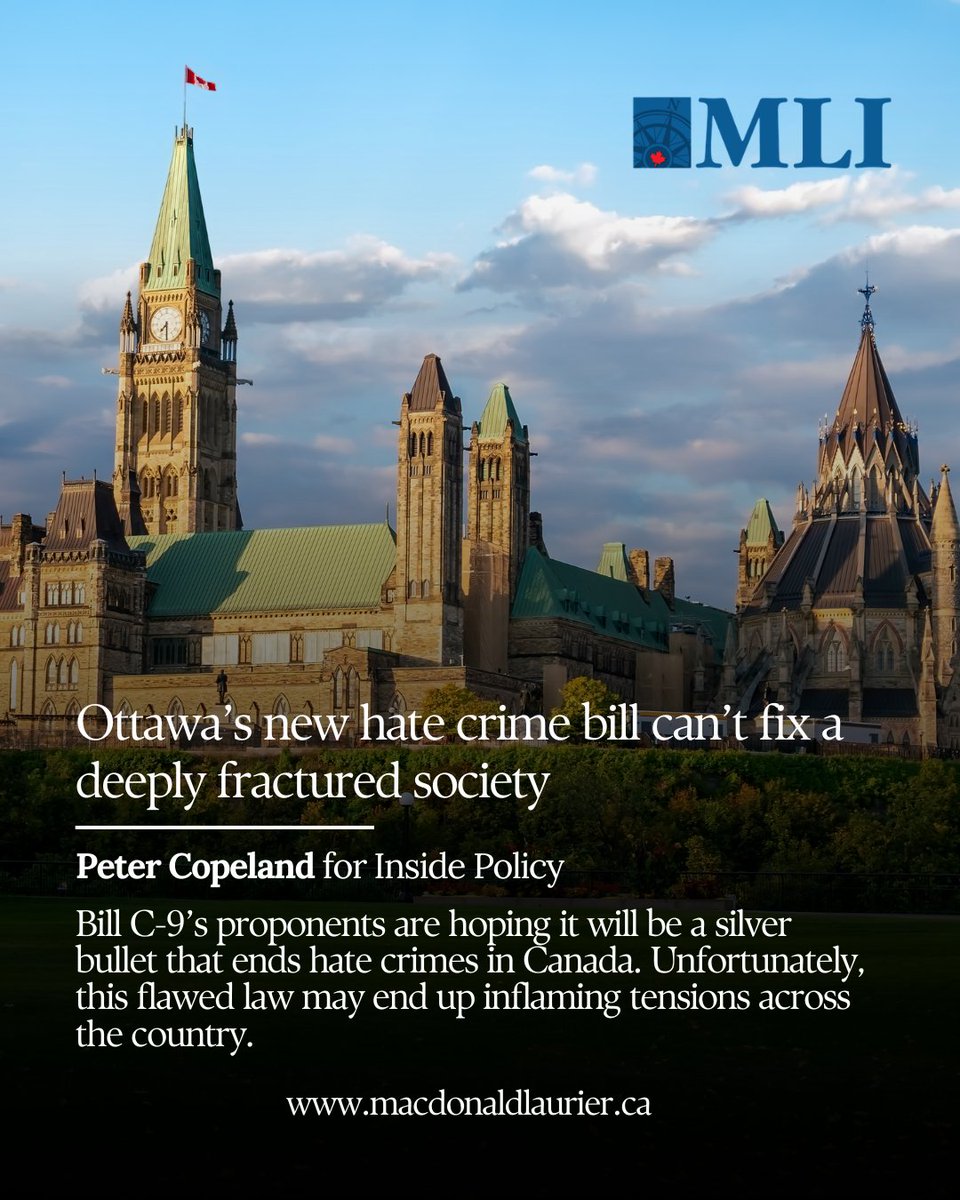
“Bill C-9’s proponents are hoping it will be a silver bullet that ends hate crimes in Canada. Unfortunately, this flawed law may end up inflaming tensions across the country. The problems run much deeper, exacerbated by a ‘cultural mosaic’ mantra that derides and dismisses Canada’s history, culture, and traditions. Until we get a handle on that, and realize that unity is our strength, not diversity for its own sake, we will have an increasingly balkanized country,” writes Peter Copeland (@CopelanPeter), deputy director of domestic policy at MLI.
Read here⬇️
https://t.co/s2n7ZaACNO
What actually changed my life was learning to do things I hated every single day.
Some people read the early chapters of Troubled and say, “I can’t recognize this person. How does the teenage kid I’m reading about become the person I’m speaking to now?”
The answer is simple: if you spend eight years in the military, you’re going to change.
And it took all eight of those years for me to reshape my personality, my outlook, and my priorities to the point where I could function as a self-sufficient adult.
I initially enlisted for four years. One of the most important lessons I learned during that time was that motivation is overrated. It took me a long time to understand this, but motivation is just a feeling. Do I want to do this? Do I not want to do this? Do I feel inspired today?
Self-discipline matters more than motivation. Self-discipline means doing what needs to be done regardless of how you feel. It means sticking to healthy routines and making good decisions even when you don’t feel motivated. If you can string together enough productive days over a long enough period of time, your life will begin to improve.
What’s happening internally, in terms of motivation or lack of motivation, matters less than people think. The real question is: can you do it anyway?
At first, that discipline was imposed from the outside. In basic training, the instructors enforce structure and routine. But over time, that external discipline gradually becomes internal self-discipline.
Even after my first four years in the Air Force, from ages seventeen to twenty-one, I knew I still wasn’t ready to leave that rigid structure behind. I understood that I needed more time inside an environment that demanded responsibility and consistency from me. So I reenlisted for another four years.
By the time I was twenty-four or twenty-five, I was finally prepared.
Favouring drug legalization is a luxury belief.
It’s one of several examples of elite hypocrisy that author Rob Henderson discussed with MLI Managing Director @brianleecrowley at our recent Voices That Inspire event in Vancouver.
@robkhenderson, who famously coined the term “luxury beliefs,” said the higher you go up the socioeconomic ladder, the more likely people are to support relaxing drug laws, while those with lower socioeconomic status tend to be more adverse to this.
Watch the full conversation: https://t.co/svXZ2W50Rv
The federal government’s newly proposed Bill C-9 is a response to the issue of rising hate crimes – particularly against Jewish communities and other vulnerable groups – and its tabling signals a welcome seriousness in confronting these challenges.
However, the bill contains several troubling provisions and is largely unnecessary. Legally, our existing laws are largely sufficient; the problem lies in their enforcement and prosecution.
The Bill has symbolic value and includes a few important measures, but these are outweighed by its risks. It requires further amendment to be salvageable and would still offer only limited value, as it addresses the wrong problem – a lack of political capital and sufficiently broad public support for police to enforce the law.
Police and prosecutors increasingly operate in politically polarized environments where enforcement decisions involving identity, protest movements, religion, and minority communities carry significant reputational and professional risk. In practice, this can lead to hesitation in proactive enforcement in contentious situations, particularly where authorities fear accusations of bias, discrimination, or political partiality.
This reflects a society that has lost a strong common identity, where handling diversity has become the top priority.
"Bill C-9 risks treating what are ultimately cultural and enforcement problems as legislative ones. Canada already possesses extensive legal tools to prosecute hate-motivated intimidation, threats, obstruction, and violence..."
Ottawa’s new hate crime bill can’t fix a deeply fractured society
@CopelanPeter, @MLInstitute
https://t.co/wNoAN6IETl
"Bill C-9 risks treating what are ultimately cultural and enforcement problems as legislative ones. Canada already possesses extensive legal tools to prosecute hate-motivated intimidation, threats, obstruction, and violence..."
Ottawa’s new hate crime bill can’t fix a deeply fractured society
@CopelanPeter, @MLInstitute
https://t.co/wNoAN6IETl
Really good and important paper here from Dave Snow and @MLInstitute on what's happened to Section 7 of the Charter and how it's been transformed into a tool for radical progressive judicially imposed policy making, especially in light of the decision last week on the Kitchener encampment.
Snow built an original dataset of every Supreme Court Charter decision from 1984-2025 and the findings on Section 7. 21 different "principles of fundamental justice" invented across 151 cases. The Oakes test? Effectively dead for Sec 7 as the government has successfully justified a breach exactly once in forty years. Meanwhile, lower courts are using this framework to constitutionalise bike lanes, block encampment removals, and prevent bans on public drug use.
Section 7 has become an open-ended invitation for judges to make policy, which it was never intended to be. The framers explicitly chose "principles of fundamental justice" over "due process" to prevent American-style judicial adventurism. The Supreme Court discarded that intent almost immediately