Warmest holiday wishes from the Copium DAO NFT community! This Christmas, our NFT enthusiasts come together to celebrate creativity, innovation, and the boundless possibilities that blockchain art offers.
Creators are growing tired of failed promises, while projects are fed up with mediocrity. This dissatisfaction drives drives the big shift to @RallyOnChain
Protocols promise but fail to deliver, but Rally listens to its community and delivers real value for creators and projects
I stopped thinking of leverage as “extra exposure” the day I realized I had been managing the position more than the idea.
Most times I opened a BTC long, the conviction and direction were right, but I kept adjusting margin, watching funding, calculating risk, instead of just holding. The trades didn’t fail, but the structure made it exhausting.
That’s when it clicked that leverage shouldn't be just about sizing up, but about how the exposure is built.
Curiosity led me to research and I discovered BTC-Jr.
BTC-Jr targets 1.33× BTC exposure through structure, not debt, so there’s no borrowing loop, no liquidation mechanics to constantly manage. Now, you're closer to your position and you can sit with it, instead of babysitting.
Finally, leverage doesn't feel like a “loan” anymore but is structured into the system itself. With no external lenders and no funding ticking in the background.
And for a long-term thinker like me, that difference matters more than the multiplier.
This is all I've been yearning for, and I didn't waste any time joining the waitlist
To experience how @FragmentsOrg executes this in practice join the waitlist and get control of BTC leverages
https://t.co/A1DKKpoEbj
Also, there is a small bonus to 10 random April waitlist signups to earn $200 each ($2,000 total), nobody should be missing out on free money
Fragments feels like one you shouldn't waste your time waiting on and is worth watching early.
Trading BTC has always felt like the usual 9-5 with many questions arising about leverage. I'm one of the traders always curious to know why leverages are not engineered better than the usual until this discovery
I've been digging into BTC-Jr from @FragmentsOrg and I’ll be honest, this is one of the few leverage ideas that actually makes sense to me.
Most leverage is just about borrowing, paying fees, pray you don’t get liquidated.
BTC-Jr is different.
It gives ~1.33× BTC exposure, but it’s structured, not borrowed. No debt layer, no liquidation engine hanging over your head. Feels more like engineered exposure than trading leverage.
Which is why I joined the waitlist. If this works as intended, it fits long-term BTC conviction way better than typical leverage products.
If you’re curious, here’s the link:
https://t.co/A1DKKpoEbj
Lest I forget, there's a small bonus; they’re running an April giveaway with $2000 in total prize, where 10 random people from the waitlist get $200 each. It's not a life-changing prize, but I mean I’ll take it.
Definitely keeping an eye on this. Might be early, might be nothing, but it’s one of the more interesting experiments around BTC exposure I’ve seen.
If I were you, I'd follow @FragmentsOrg and stay active too, because it feels like the kind of project that rewards early attention.
When they say information is key, I see no lie there cos while most people are out here grinding points, hoping for a future airdrop that may or may not come some of us are already getting paid in stablecoins for being a creator
Not theory. Not promises. @RallyOnChain is literally paying creators right now.
All you do is pick a campaign, write a post, submit it and their system scores it based on actual substance. Accuracy, alignment, originality, and real engagement. Then payouts happen on-chain.
No guessing. No waiting for months to “maybe” get rewarded, that’s the most interesting part to me
We’ve normalized doing work upfront with no guarantee. Threads, content, and engagement are all points that might end up worthless.
Meanwhile, Rally is quietly flipping that model. You create, you get evaluated, and you get paid in stables immediately.
The gap between people farming points and people earning real money is widening. If you’re still only chasing speculative rewards, you might want to rethink that, because people are getting paid today
Bradbury is live and this might be one of the most important testnet launches we’ve seen in a while.
@GenLayer isn’t just shipping another chain. It’s introducing a different idea of what blockchains should actually do.
For years, we’ve built on systems that are great at computation but terrible at interpretation. Smart contracts execute rules, but they can’t understand context, evaluate nuance, or interact meaningfully with real-world information.
That worked when blockchains were mostly financial rails but breaks in the agentic era.
AI agents don’t operate in clean, deterministic environments. They deal with messy inputs, ambiguous data, and decisions that require reasoning. They read, interpret, compare, and act.
Traditional chains were never designed for that and this is where the Bradbury testnet becomes interesting.
It’s the first real environment where developers can start building with GenLayer’s intelligent contracts. Contracts that don’t just execute logic, but evaluate information through validator consensus.
Not “is 1+1 equal 2?” but “does this output make sense given the context?”
That shift matters, because if AI agents are going to interact with decentralized systems, those systems need to meet them halfway. They need to handle uncertainty, not reject it.
Bradbury is where that idea starts to be pressure-tested and marks a shift from blockchains as execution engines to blockchains as systems of verifiable reasoning.
And that is exactly what the agentic era has been missing.
Every time I use the @grvt_io app the part that clicked for me was how everything sits in one balance.
I'm able to deposit, open a position, then check my portfolio and I don’t have to switch contexts or track separate wallets.
It sounds small, but not having to think about where funds are parked makes trading feel a lot more straightforward and keeps me glued to the app
One thing from the @grvt_io AMA that stood out to me is the +6% additional community allocation while existing points remain protected.
For someone like me who has been tracking my points this season, it matters a lot. Normally when allocation changes, early effort gets diluted. But it's different with Grvt cos your position stays intact while the total pool increases which sound amusing.
From a farmer’s perspective, it's also important because the value per point doesn’t compress as much, and time already spent on the platform still counts rather than being quietly reset.
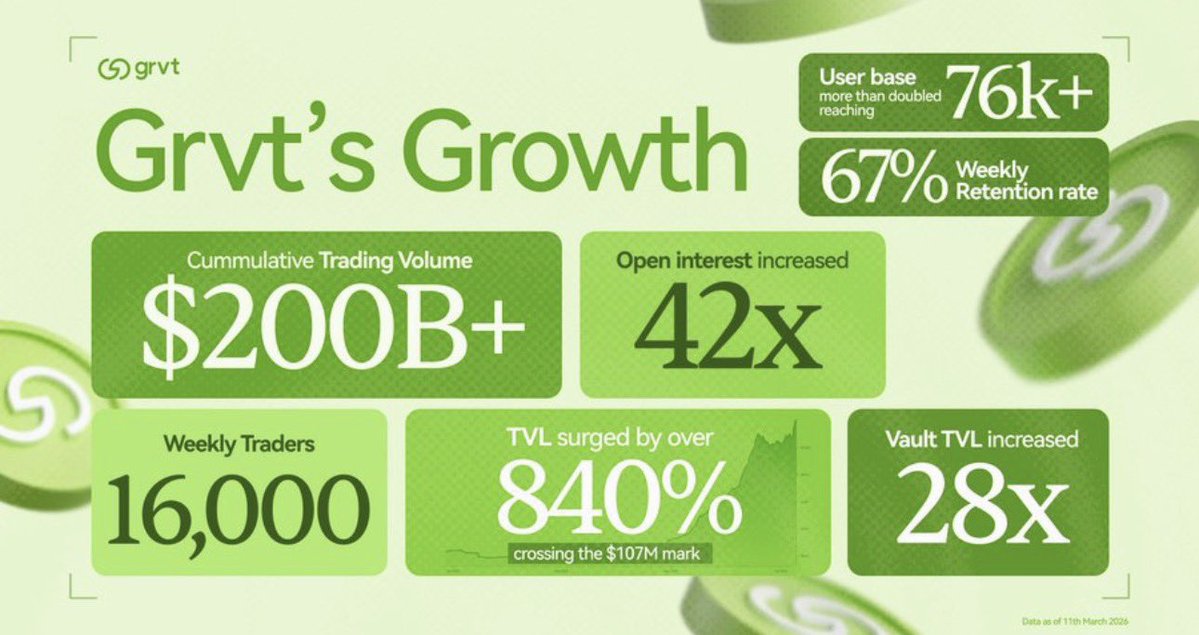
In the current market, while a lot of other platforms haven’t really moved, @grvt_io stands out with their TVL pushing past $ 100M
These numbers aren't just a one-off spike cos I’ve been watching the numbers over time, everything is organic and more of a steady build.
Usually, when TVL grows like that, it means users aren't just trading and rotating out; they’re actually keeping capital on Grvt, likely because their capital earns for them while still usable.
That kind of behavior is harder to fake than volume and says more about real traction.
Everyone’s racing to build AI. But almost no one is asking the big question if we can trust the data behind it
That’s where things start to break.
Behind most AI systems today is a messy reality:
- Anonymous labelers
- Opaque workflows
- Zero auditability
Yet this same data feeds models making real-world decisions.
That disconnect is dangerous.
Generally, we’ve optimized AI pipelines for Speed = Cost not Trust = Transparency
So companies scale fast but build on data they can’t verify.
Ask a typical AI team:
- Who labeled this dataset?
- What qualifies them?
- How was accuracy measured?
Most don’t have clear answers. Not because they don’t care but because the system wasn’t built for it.
Now zoom out:
Right now AI is moving into healthcare, finance, and autonomous systems. In these environments, “probably correct” isn’t good enough. You need provable trust.
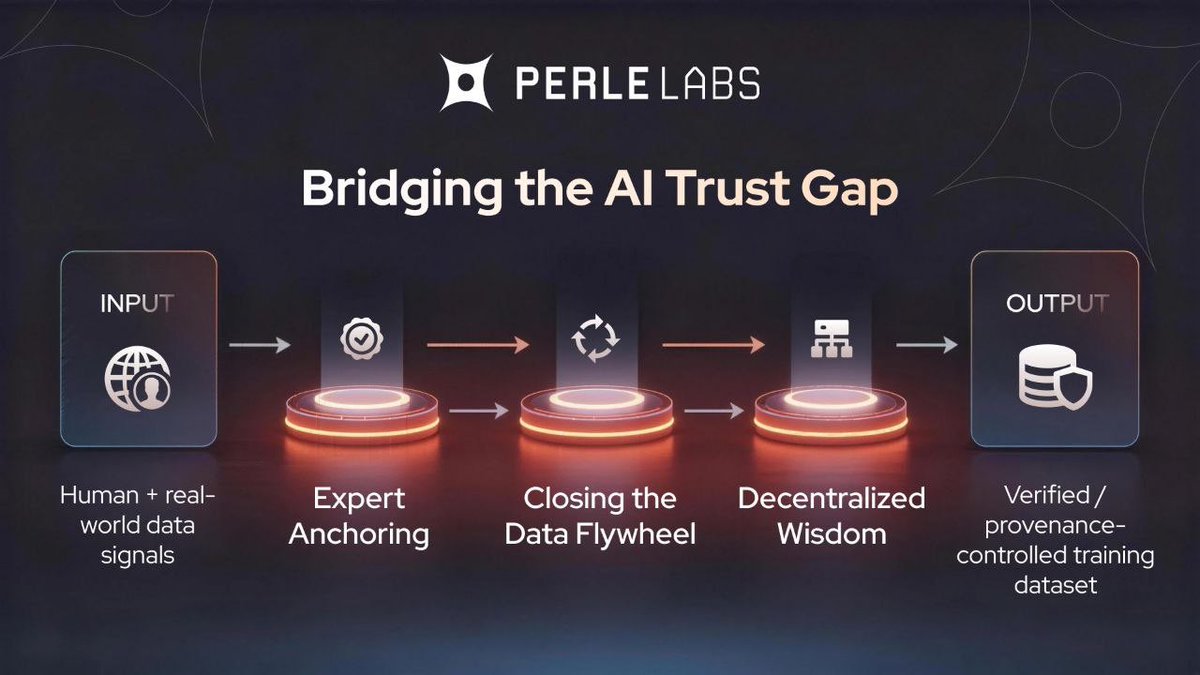
This is where @PerleLabs flips the model. Instead of black-box pipelines, it introduces:
→ Verified contributors
→ On-chain data provenance
→ Performance-based reputation
Meaning every data point has a trail and is verifiable
You can see:
- who contributed it
- how they performed
- whether it passed validation
That’s a completely different standard.
Perle turns data work from cheap, anonymous tasks into verifiable, reputation-backed contributions and that shift matters more than people think.
Because in the next phase of AI models, it won’t be the only differentiator. Data quality and auditability will be the moat.
Perle isn’t just improving data pipelines. It’s redefining them as auditable systems of record for human intelligence. This is a big unlock for serious AI teams.
Bottom line:
If your AI isn’t built on auditable data, it’s built on assumptions. And assumptions don’t scale in high-stakes systems.
#PerleAI #ToPerle
participating in @PerleLabs community campaign
Most leverage products for Bitcoin are designed for active traders rather than long-term holders.
They rely on borrowed capital, recurring fees, and liquidation thresholds mechanisms that suit short-term speculation but are inefficient for sustained BTC exposure.
Over the weekend, I delved into BTC-Jr, and I found its design quite intriguing.
Instead of relying on debt-based leverage, BTC-Jr offers 1.33× BTC exposure through a clever structure; no borrowing, no liquidation risks. It’s leveraged Bitcoin that you can actually hold, not just manage actively.
I'm eager to see how @FragmentsOrg will bring this idea to life when they launch.
If you’re also curious, you can join the waitlist via the link: https://t.co/A1DKKpoEbj
Watching Clawbot onboard millions of AI agents makes one thing clear;
Agent-to-agent coordination needs more than simple smart contracts.
Traditional blockchains only handle deterministic logic, but agents make subjective calls, parse language, and act on uncertain data.
That is where @GenLayer fits as a trust and decision layer, enabling agents to validate outcomes through decentralized consensus rather than blind execution.
Without that layer, large-scale agent economies turn into fragile automation instead of reliable systems.
Rally stands out because it tackles a challenge most blockchains can't; understanding meaning, not just performing calculations.
At @RallyOnChain, campaign submissions are judged based on relevance, originality, and intent; powerful signals drawn from natural language and external context. Unlike traditional smart contracts, which can only verify fixed inputs like hashes or timestamps, Rally's approach assesses qualitative aspects that can't be reduced to simple data.
This is where @GenLayer comes into play as vital infrastructure. GenLayer enables intelligent contracts to process unstructured data, reason over off-chain information, and deliver judgments to a consensus-reaching validator set, making subjective outcomes verifiable on-chain.
Instead of relying on rigid rules, Rally utilizes distributed AI evaluation combined with cryptographic finality.
Without GenLayer, Rally would have to rely on centralized moderation or reduce its campaigns to basic pass/fail checks. Thanks to GenLayer, subjective marketing results become transparent and verifiable within the blockchain.
In essence, Rally’s core logic exemplifies how GenLayer’s decision layer transforms human judgment into decentralized consensus, pushing the boundaries of what blockchain technology can achieve.
As AI agents start forging contracts with humans and each other, disputes become real and urgent. Missing an SLA, delivering the wrong dataset, or failing a task no longer means passing the buck, they can’t just send these cases to human courts without risking the loss of automation altogether.
This is the gap https://t.co/HTOQY7rpBo is designed to fill. It provides a trustless dispute resolution layer for the Agent Economy. When a conflict occurs, both sides submit digital evidence such as logs, hashes, or performance records. An on-chain AI jury made up of independent validators evaluates the evidence and returns a verdict in minutes, not months.
Imagine a data agent paid to deliver a verified dataset by a deadline. The buyer claims the data is incomplete, the agent claims it met the contract. Instead of arbitration by humans, the evidence is sent to Internet Court, where AI validators check compliance and issue a ruling on-chain.
For autonomous systems to coordinate at scale, they need neutral and fast enforcement. A protocol-level court with an AI jury and cryptographic evidence is not a novelty, it is infrastructure. Internet Court is an early model of how machine-native disputes can be resolved without lawyers or centralized control.
I’ve been testing Rally, and it's made me realize that ownership is more important than attention, and it feels like a fairer way for creators and projects to work together.
@RallyOnChain uses AI to judge posts by quality instead of follower count, so small accounts actually have a shot. The upcoming Beta adding tokens to campaigns could make this more than just points and turn good content into real alignment with projects.