Gulf of Maine Archaic Tradition (ca. 8000-4000 B.C.E.)
An early series of hunting-gathering-fishing groups participating in a shared marine hunting tradition. One of North America's lesser known cultures.
I'm likely going to remake this one with new icons. Need to design those first, though.
lol, a pseudoarchaeologist is accusing me of "not being a scientist"
I have peer reviewed publications in The Journal of Archaeological SCIENCE & Quaternary SCIENCE Reviews. And a paper coming out soon in Archaeological and Anthropological SCIENCES
These guys are clowns
Fixed chart, the Cardial Chart included some Nuragic and Chasseen (Middle Neolithic) samples that were labeled as Cardial erroneously due to their PCA proximity.
I2a dominates interestingly in this new version, with a cutoff point at ~4500bc for Cardial samples
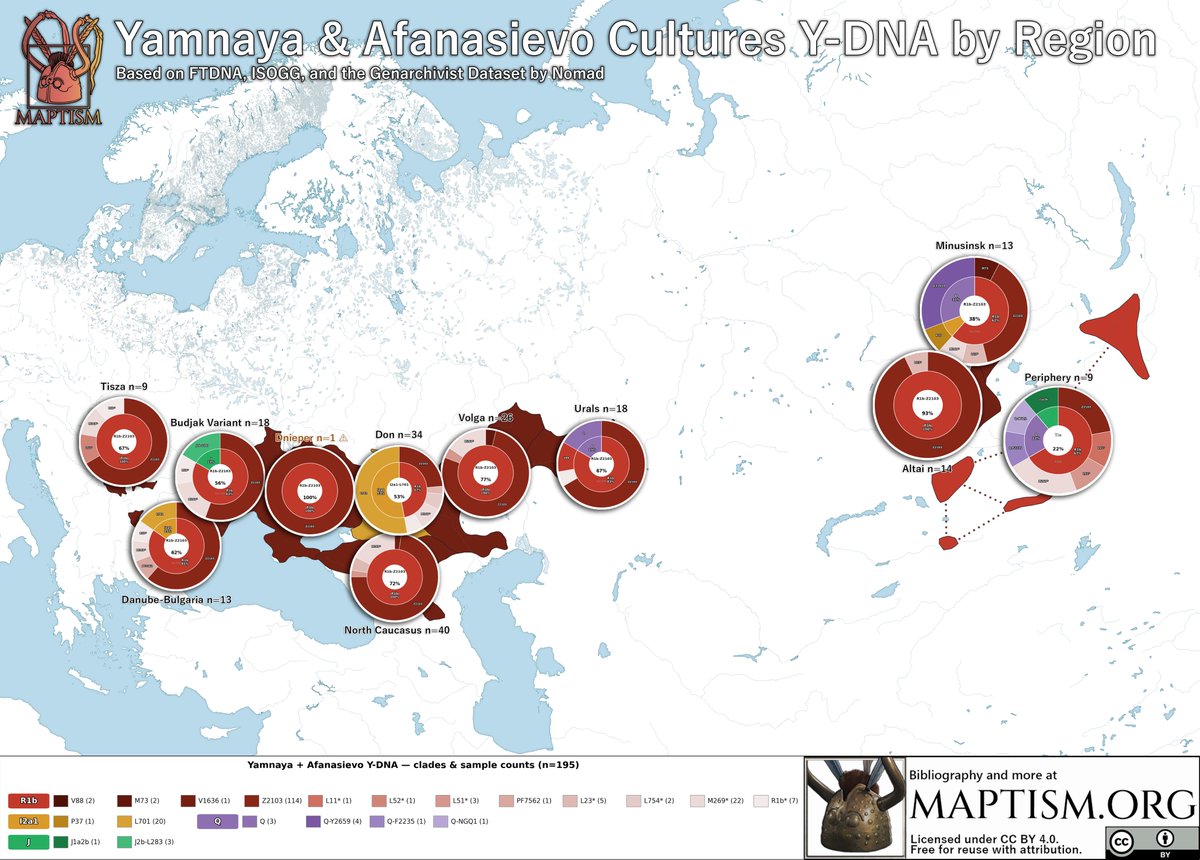
Y-DNA of European Neolithic populations, primarily the Cardial Culture in the Mediterranean, Linearbandkeramik in Central Europe, Starcevo Culture in Serbia and Pannonia, Greek Early Neolithic and the Cucuteni-Trypillia Culture in Romania and Ukraine.
If the French had continued to worship the chief Frankish god Wodan, then in modern French he would be called Guodan, and Mecredi would be called something like Guodi
It's good seeing Oleksandr Zavalii's work getting more global attention. His paper's are worth reading. He's even published a book proposing the baked clay "disc" from Nebelivka and elsewhere are early solar calendars and/or astrolabes.
You can see more of the lovely megalithic monuments and learn a lot more about where they came from and why they were built in my documentary film about their origins. It was filmed in Brittany, Portugal and Britain and many of the images from this thread are taken from the film. Thank you! /thread
https://t.co/JxZKkviyvS
Preserved Cucurbita (Pepo Squash) from the Middle Archaic Sharrow site in Central Maine, dated ca. 6320-5695 B.P. (roughly 4320-3695 B.C.E.). It's the oldest known squash in the Northeast.
So the earliest Neolithic boats we know already featured additional parts added to their dugout base, even if both their exact function and how they were joined to the boats remain unclear.
Early Neolithic carpentry: Well A (late 6th millennium BC, LBK site of Altscherbitz, Germany) features mortise and tenon joints. Could Neolithic boats have featured them too? La Marmotta canoes (contemporary to this well) 1 & 2 had additional wooden boards added to the dugout.
It's likely this plant was introduced by people, since its native range is along the lower Mississippi River valley and Gulf coast. This strongly suggests people were cultivating squash across the Midwest and New England thousands of years earlier than currently thought, since organic remains often decompose.
Preserved Cucurbita (Pepo Squash) from the Middle Archaic Sharrow site in Central Maine, dated ca. 6320-5695 B.P. (roughly 4320-3695 B.C.E.). It's the oldest known squash in the Northeast.