IFRS for SMEs - Third Edition: What’s Changing?
Section 7: Statement of Cash Flows
The Third Edition requires a reconciliation of financing liabilities and adds disclosures on supplier finance arrangements.
A clearer picture of financing changes.
#IFRSforSMEs
IFRS for SMEs - Third Edition: What’s Changing?
Section 6: Statement of Changes in Equity
Not all dividends are recognised in the financial statements.
The Third Edition adds disclosures on unrecognised dividends and dividends per share.
#IFRSforSMEs#Clearerpicture
IFRS for SMEs - Third Edition: What’s Changing?
Section 4: Statement of Financial Position
Sometimes, one line item doesn't tell the whole story.
Breaking down line items can provide a clearer picture of an entity’s financial position when more detail matters.
#IFRSforSMEs
IFRS for SMEs - Third Edition: What’s Changing?
Section 3: Materiality and Aggregation
How information is aggregated affects how well it is understood.
Material information shouldn’t be hidden among immaterial information or mixed with unrelated items.
#IFRSforSMEs
IFRS for SMEs - Third Edition: What’s Changing?
Section 2: Recognition
Second criterion: Faithful representation
An item is recognised when it gives users a true picture of what is happening.
Recognition should give users a complete and reliable picture.
#IFRSforSMEs
IFRS for SMEs - Third Edition: What’s Changing?
Section 2: Recognition
First criterion: Relevance
An item is recognised when doing so provides useful information to users of the financial statements.
Does recognising it make a difference to the users’ decisions.
#IFRSforSMEs
IFRS for SMEs - Third Edition: What’s Changing?
130 paragraphs, up from just 52.
Section 2 has been completely rewritten and aligned with the 2018 Conceptual Framework.
52 paragraphs → 130 paragraphs.
A major rewrite, and definitely a section worth rereading.
#IFRSforSMEs
IFRS for SMEs - Third Edition: What’s Changing?
Section 1: The starting point
First change: a clearer definition.
The SME definition is largely unchanged, but “public accountability” is clarified.
Small change, important distinction.
#IFRSforSMEs
An account being unchanged from last year doesn't make it low risk.
The underlying transactions, estimates, assumptions, and business circumstances may have changed significantly even when the closing balance looks familiar.
Familiar isn't the same as reliable.
#Audit
Professional scepticism isn't assuming management is wrong.
It's about being willing to ask:
“Does this make sense?”
Even when the explanation sounds reasonable, auditors still need to assess the evidence.
Scepticism is a mindset, not a checklist.
#Audit#ISA
One of the biggest time wasters in audit?
Finishing a working paper… only to realise you didn't actually answer the audit objective.
The work may look complete, but the conclusion doesn't make sense.
Before ticking it off, ask:
“What am I actually trying to prove?”
#Audit
Audit deadlines make everything feel urgent.
The challenge isn't just finishing the work, it's finishing efficiently without cutting corners.
Work faster where you can, but don't let faster become less thorough.
The deadline changes. The quality shouldn't.
#Audit
In reference to ISA 320 - materiality during audit:
Materiality isn't just a number, it's a judgment.
• Overall materiality guides the audit.
• Performance materiality reduces audit risk.
• Qualitative factors can make even small errors material.
#Audit#ISA320#Materiality
Not all audit AI is built the same.
AI capabilities may look similar on the surface. The differences emerge when context, governance and audit quality are required.
Read more: https://t.co/YgrTE4901T
#AIinAudit#AccountingTechnology#audit#accounting#assurance#AI#agentic #innovation
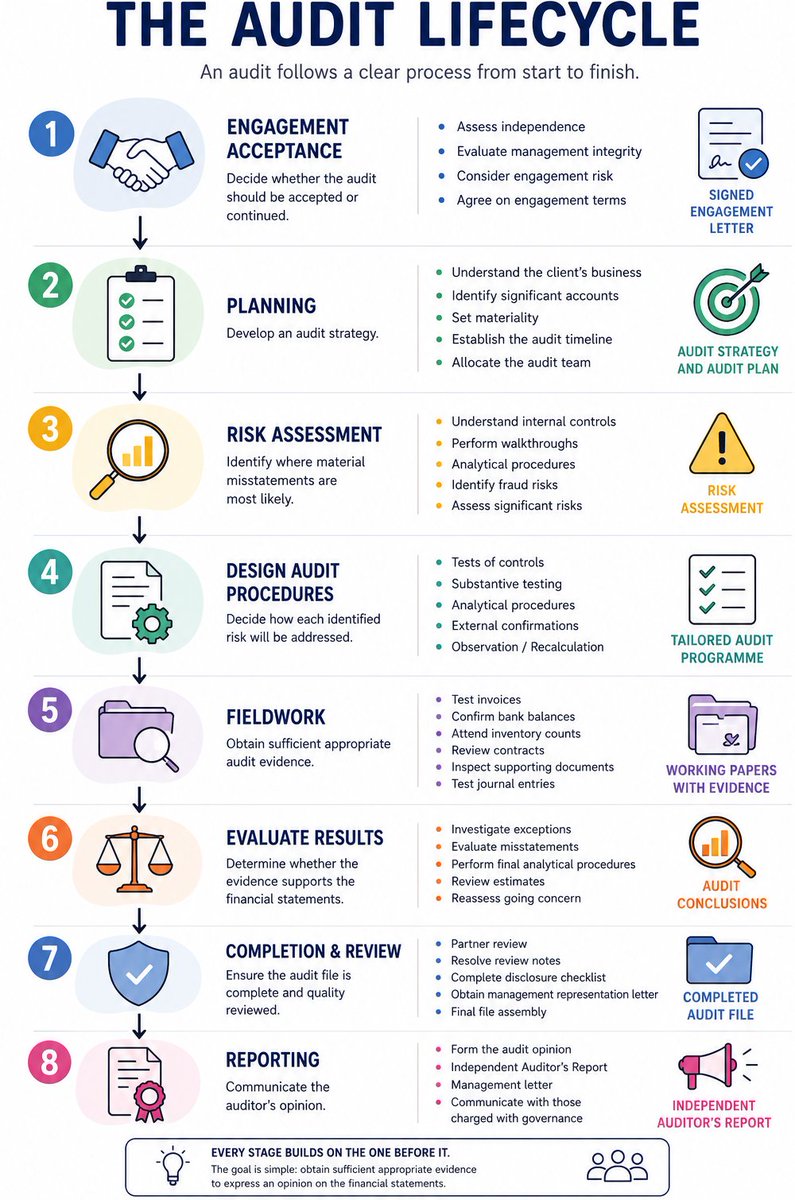
Understanding the audit lifecycle makes every audit procedure easier to understand.
From engagement acceptance to the audit report, each step has a purpose.
#Audit#ISA#SAICA
One of the simplest ways to improve as an auditor?
Before every procedure, ask: "Which assertion am I testing?"
It changes how you approach the entire audit.
#Audit#Assertions
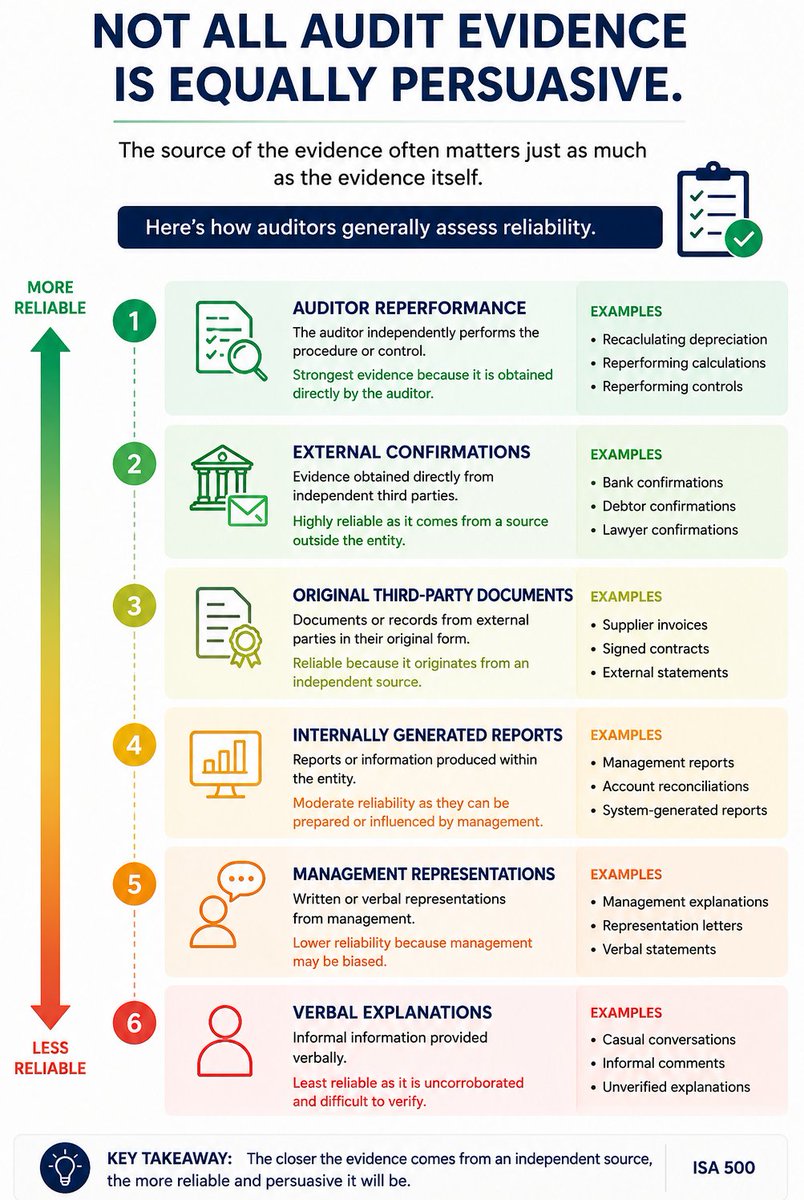
More evidence doesn't always mean better evidence.
A single external confirmation can be more persuasive than pages of internally generated reports.
Quality matters just as much as quantity.
#Audit#ISA500
One of the first things you learn in audit?
Understanding the client isn't a box to tick.
If you don't know what "normal" looks like for a business, you won't recognise what's unusual.
That's why understanding the business is the foundation of every audit.
#Audit#SAICA